


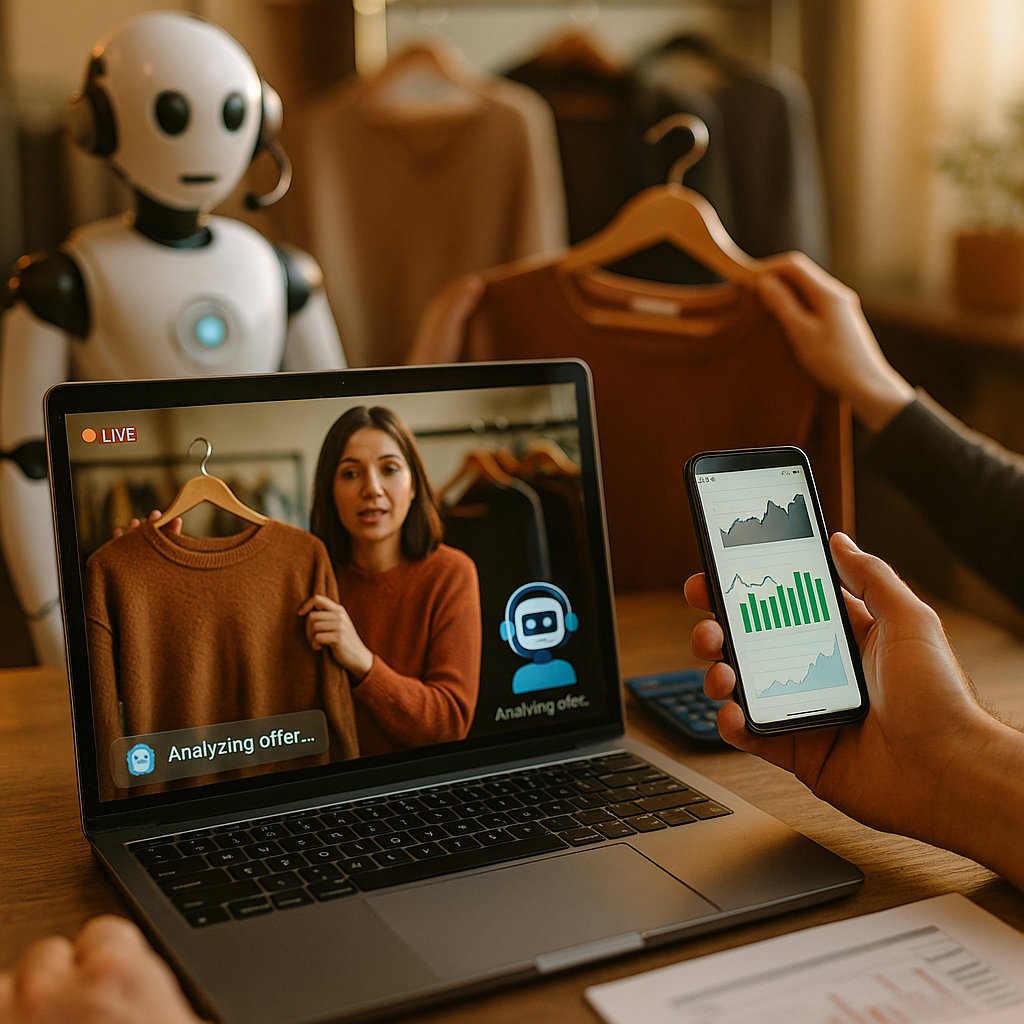
Forty percent of live shopping hosts now say they’ve lost a sale because they froze, mispriced an offer, or forgot a promo code mid-stream. That’s the gap a live commerce AI co-pilot is supposed to close: a real-time assistant feeding scripts, objection handlers, and dynamic offers to hosts while the cart count ticks up on screen. The pitch sounds airtight. The operational reality, as usual, is messier.
What Is a Live Commerce AI Co-Pilot, Exactly?
Strip away the marketing language and a live commerce AI co-pilot is three systems duct-taped together: a speech-to-text layer that listens to the host, a language model that generates suggested lines or offers, and a display (usually a teleprompter overlay or a phone screen just off-camera) that surfaces those suggestions in near real time. Vendors like Bambuser, Whatnot’s internal tooling, and a growing list of white-label startups have built versions of this for TikTok Shop, YouTube Shopping, and Instagram Live.
The promise is simple: reduce host error, shorten the gap between viewer question and answer, and nudge conversion with dynamically priced offers when engagement dips. In practice, latency and hallucination risk are the two variables that separate a genuinely useful tool from an expensive teleprompter with delusions of grandeur.
A script assistant that lags three seconds behind live chat isn’t assisting. It’s a liability wearing a helpful UI.
The Pitch vs the Reality on the Sales Floor
Vendors demo these tools in controlled environments: quiet studio, scripted questions, no bandwidth issues. Real streams are chaotic. Chat scrolls at hundreds of messages per minute during a flash sale. Hosts get interrupted, product SKUs get confused, and inventory counts change mid-sentence because someone in fulfillment forgot to sync the feed.
Ask any vendor for their median latency under peak chat volume, not their best-case number. That’s the figure that determines whether the co-pilot actually functions when it matters most, during a spike, not during a lull.
Brands running live commerce through TikTok Shop attribution setups have already learned this lesson the hard way with tracking tools. The same skepticism applies here: a co-pilot’s demo environment rarely resembles a Saturday night flash sale with 40,000 concurrent viewers.
Where the Money Actually Gets Made
The real ROI case isn’t glamour. It’s error reduction. A host who doesn’t misquote a discount code, doesn’t forget a bundle upsell, and doesn’t stumble on a product spec saves the brand from refund requests, chargebacks, and awkward on-camera corrections. That’s measurable. eMarketer has tracked rising live shopping adoption in the US market, and the operational failure points, not the flashy AI narrative, are usually what determine whether a program scales profitably (eMarketer research).
Script Assistants: Where They Earn Their Keep (and Where They Don’t)
Script co-pilots generally fall into two camps. The first generates talking points ahead of time, essentially a smart teleprompter that adapts based on which products are trending in the cart. The second listens live and generates responses to viewer questions in real time, which is the harder engineering problem and the one most likely to misfire.
- Pre-generated scripts: Low risk, high reliability. Good for structured segments like product reveals or countdown offers.
- Live response generation: Higher risk. Useful for FAQ deflection (sizing, shipping times) but dangerous for anything involving pricing, medical claims, or comparative statements about competitors.
- Sentiment-triggered prompts: The assistant nudges the host to change tone or pace based on chat sentiment. Interesting in theory, unproven at scale, and easy to overfit to noisy signals.
Here’s the uncomfortable truth: most brands don’t need live response generation. They need reliable pre-generated scripting with fast manual override. The fancier live-listening features look great in a sales deck and create the most operational risk on air.
Offer Engines and the Risk of Runaway Discounting
This is where evaluation gets serious. Offer assistants are designed to suggest dynamic discounts, bundle deals, or urgency prompts (“only 12 left”) based on real-time viewer behavior. Done well, this lifts average order value. Done poorly, it trains your most loyal customers to wait for the AI to panic-discount inventory, which quietly erodes margin over every subsequent stream.
Ask vendors these questions before signing anything:
- Does the offer engine have a hard floor on discount depth, or can it stack promotions without a human approval step?
- How does it reconcile with your existing pricing rules in your commerce platform, not just the streaming interface?
- Can finance or merchandising pull a real-time log of every offer surfaced during a stream, for audit purposes?
Teams that have already gone through this exercise on the analytics side, evaluating platforms like the ones compared in live budget attribution tools, know the drill: procurement scrutiny only gets harder once real dollars are flowing through an automated decision layer. The same discipline applies to offer engines. If a vendor can’t produce a clean audit trail, that’s disqualifying, not a minor gap to work around later.
An offer engine without a discount ceiling isn’t optimizing sales. It’s optimizing for the fastest possible margin erosion.
A Vetting Framework Before You Sign
Treat this like any other martech evaluation, not a novelty add-on. The checklist that’s worked for us covers five areas:
- Latency under load: Request performance data from actual high-traffic streams, not staged demos.
- Override control: Hosts and producers need a one-tap way to silence or override any AI suggestion instantly.
- Data residency and consent: If the tool is transcribing live audio and chat, confirm how that data is stored and whether it touches any personally identifiable viewer information.
- Integration depth: Does it talk to your inventory system, your CDP, and your attribution stack, or does it operate in an isolated silo that produces yet another dashboard nobody trusts?
- Escalation logging: Every AI-generated claim or offer should be timestamped and retrievable for compliance review.
If a vendor can’t answer all five cleanly, that’s a signal to keep evaluating, not a reason to walk away entirely. Some of these tools are genuinely early-stage and worth a pilot with tight guardrails rather than a full commitment. This mirrors the same caution brands apply when reviewing commerce OS platforms making bold attribution claims: scale and polish in a sales pitch rarely match operational reality on day one.
Compliance Is Not Optional
Live commerce sits at an uncomfortable intersection of advertising claims, endorsement disclosure, and real-time speech, none of which the FTC treats casually. If an AI co-pilot generates a health claim, a price comparison, or an urgency statement (“selling out now”) that isn’t accurate, the brand is on the hook, not the vendor. Review the FTC’s endorsement guidance closely before letting any generative tool touch on-air claims (FTC guidance on endorsements and advertising).
The same logic applies internationally. UK-based programs should cross-check obligations with the ICO’s guidance on data processing, particularly around live audio transcription and any viewer data the co-pilot might capture during chat analysis.
This isn’t fearmongering. It’s the same due diligence teams already apply to creator deal terms tied to commerce platforms, where contract language now routinely addresses who’s liable when an automated system makes a claim on a brand’s behalf.
Measuring What Actually Matters
Don’t let vendors sell you on “engagement lift” alone. Tie evaluation to the metrics your finance team already trusts: conversion rate per minute of stream, average order value before and after co-pilot adoption, refund rate tied to misstated offers, and host retention (good hosts quit fast if a tool undermines their credibility on camera). Pair this with the kind of real-time optimization dashboards your team already uses for response signal tracking, so live commerce data doesn’t live in a separate silo from the rest of your performance stack.
HubSpot’s research on AI adoption in customer-facing roles reinforces a pattern worth repeating here: tools that assist human judgment outperform tools that try to replace it, especially in high-stakes, real-time contexts (HubSpot marketing research). A live commerce co-pilot should make a good host better, not attempt to run the show itself.
Run a two-week pilot on your lowest-risk product category, log every AI-suggested offer against actual conversion, and only expand to flagship SKUs once your compliance team has signed off on the audit trail. That’s the difference between adopting a tool and inheriting a liability.
FAQs
What is a live commerce AI co-pilot?
It’s a real-time software layer that listens to a live shopping stream and suggests scripts, offers, or responses to the host, typically displayed on a teleprompter or secondary screen off-camera.
Do these tools actually increase conversion during live streams?
They can, mainly by reducing host errors and speeding up response time to viewer questions. The clearest ROI comes from fewer mispriced offers and fewer stalled moments, not from flashy AI-generated dialogue.
What’s the biggest risk with AI-generated offers during a live stream?
Runaway discounting. Without a hard floor on discount depth and a human approval step, an offer engine can stack promotions that erode margin far faster than any manual process would allow.
How do we stay compliant when using AI-generated scripts on air?
Every AI-generated claim or offer needs to be timestamped, logged, and reviewable, and hosts need instant override capability. Review FTC endorsement guidance before letting any generative tool touch pricing or health-related claims.
Should small or mid-size brands adopt these tools yet?
A limited pilot on a low-risk product category makes sense. Full rollout across flagship SKUs should wait until latency, audit logging, and compliance review have all been tested under real, high-traffic conditions.
Top Influencer Marketing Agencies
The leading agencies shaping influencer marketing in 2026
Agencies ranked by campaign performance, client diversity, platform expertise, proven ROI, industry recognition, and client satisfaction. Assessed through verified case studies, reviews, and industry consultations.
Moburst

-
2

The Shelf
Boutique Beauty & Lifestyle Influencer AgencyA data-driven boutique agency specializing exclusively in beauty, wellness, and lifestyle influencer campaigns on Instagram and TikTok. Best for brands already focused on the beauty/personal care space that need curated, aesthetic-driven content.Clients: Pepsi, The Honest Company, Hims, Elf Cosmetics, Pure LeafVisit The Shelf → -
3

Audiencly
Niche Gaming & Esports Influencer AgencyA specialized agency focused exclusively on gaming and esports creators on YouTube, Twitch, and TikTok. Ideal if your campaign is 100% gaming-focused — from game launches to hardware and esports events.Clients: Epic Games, NordVPN, Ubisoft, Wargaming, Tencent GamesVisit Audiencly → -
4

Viral Nation
Global Influencer Marketing & Talent AgencyA dual talent management and marketing agency with proprietary brand safety tools and a global creator network spanning nano-influencers to celebrities across all major platforms.Clients: Meta, Activision Blizzard, Energizer, Aston Martin, WalmartVisit Viral Nation → -
5

The Influencer Marketing Factory
TikTok, Instagram & YouTube CampaignsA full-service agency with strong TikTok expertise, offering end-to-end campaign management from influencer discovery through performance reporting with a focus on platform-native content.Clients: Google, Snapchat, Universal Music, Bumble, YelpVisit TIMF → -
6

NeoReach
Enterprise Analytics & Influencer CampaignsAn enterprise-focused agency combining managed campaigns with a powerful self-service data platform for influencer search, audience analytics, and attribution modeling.Clients: Amazon, Airbnb, Netflix, Honda, The New York TimesVisit NeoReach → -
7

Ubiquitous
Creator-First Marketing PlatformA tech-driven platform combining self-service tools with managed campaign options, emphasizing speed and scalability for brands managing multiple influencer relationships.Clients: Lyft, Disney, Target, American Eagle, NetflixVisit Ubiquitous → -
8

Obviously
Scalable Enterprise Influencer CampaignsA tech-enabled agency built for high-volume campaigns, coordinating hundreds of creators simultaneously with end-to-end logistics, content rights management, and product seeding.Clients: Google, Ulta Beauty, Converse, AmazonVisit Obviously →