


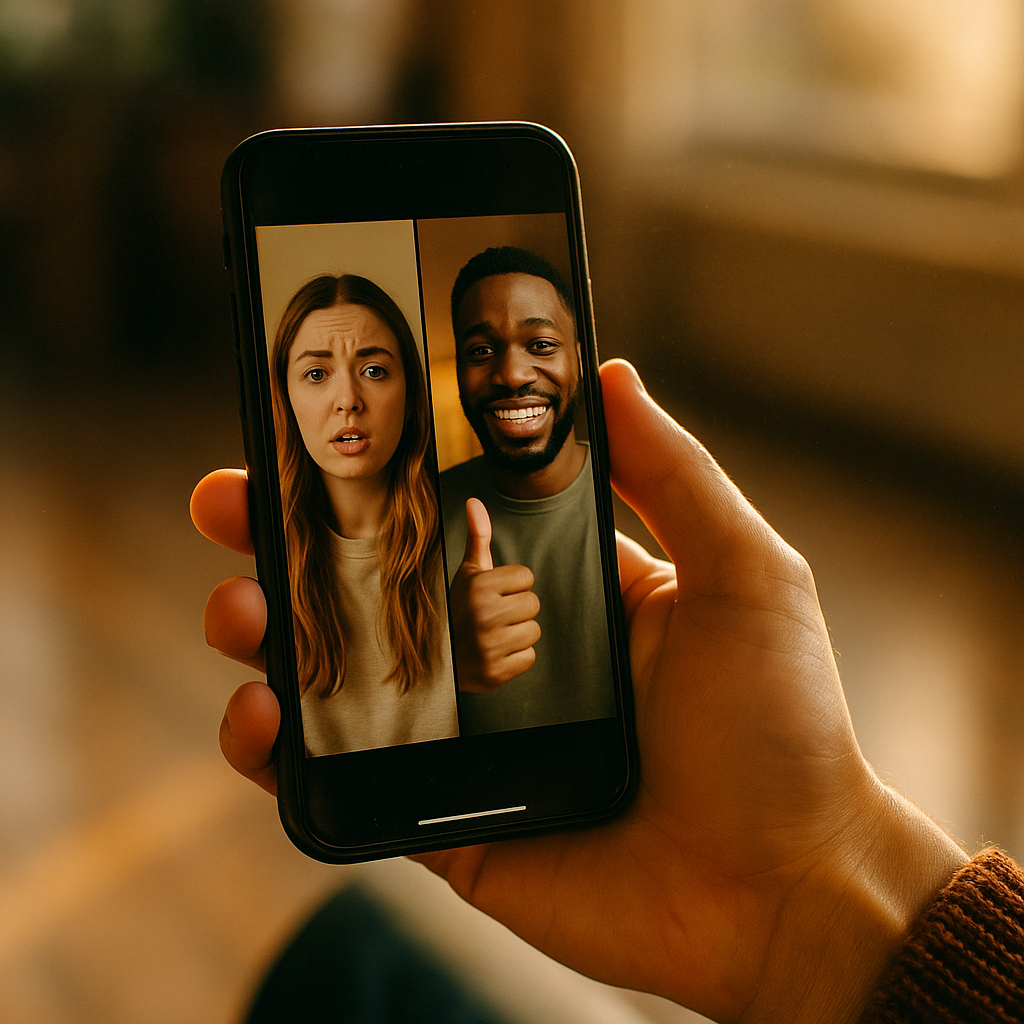
TikTok’s own creative benchmarks have shown duet and stitch formats posting engagement rates well above standard single-frame video, and yet most brand briefs still ignore the format entirely. That’s a costly oversight. The split-screen reaction format puts your product or content on one side of the frame and a real human response on the other, and it works because it mimics the exact social proof loop that makes word-of-mouth marketing so persuasive. If you’re not briefing for it yet, you’re leaving conversion on the table.
What Makes Split-Screen Reactions Different From Standard UGC
Most user-generated content asks a creator to talk about a product. Split-screen reaction content asks them to respond to something, a video, a stat, a competitor claim, another creator’s take, in real time, on camera, side by side with the source material. The viewer sees both the stimulus and the human reaction simultaneously. That juxtaposition does something a single talking-head video can’t: it lets the audience judge authenticity for themselves.
This isn’t new behavior. Reaction content has driven watch time on YouTube for over a decade. What’s changed is the tooling. TikTok’s duet feature, Instagram’s collab and remix tools, and CapCut’s split-screen templates have made the format trivially easy to produce at scale. For brands, that means lower production cost and faster turnaround than traditional UGC shoots.
Split-screen reactions convert because they answer the one question every buyer silently asks: “would a real person actually feel this way, or is this scripted?” The visible reaction is the proof.
If you’ve already experimented with reaction style UGC, split-screen is the logical next step. It adds a visual layer of context that pure reaction clips lack, which matters when you’re trying to pass legal or brand safety review.
The Anatomy of a High-Converting Duet
Not every split-screen video performs. The winners share a structure, and it’s worth breaking down before you write a single brief.
- The stimulus clip runs 6 to 10 seconds. Long enough to establish context, short enough that the reaction doesn’t feel delayed.
- The reaction is unscripted in tone, scripted in beats. Creators need a hook to hit (surprise, skepticism, validation) but the delivery has to feel spontaneous.
- The payoff lands inside the first three seconds of the reaction side. Attention spans on TikTok and Reels don’t forgive slow builds.
- There’s a clear call to action baked into the final frame, not bolted on as a text overlay afterthought.
Brands that treat the reaction half like a performance, not an improvisation, get more consistent results. That’s the same principle behind hook first UGC briefs: give creators a beat sheet, not a script, and let them fill in the emotional texture themselves.
Briefing Creators Without Killing the Authenticity
Here’s the tension every brand manager runs into: you need enough structure to protect the brand message, but too much structure kills the very authenticity that made the format work in the first place. So how do you thread that needle?
Start with a stimulus library instead of a single asset. Give creators three or four options for what they’re reacting to, whether it’s a competitor ad, a customer complaint turned into a teaching moment, or a product demo. Letting them choose which one resonates produces better performance than forcing a single asset on every creator in a campaign.
Second, separate your non-negotiables from your suggestions. Non-negotiables are things like disclosure language, claims accuracy, and CTA placement. Suggestions are tone, pacing, and specific phrasing. Creators who feel micromanaged on tone tend to produce flat content, and flat content doesn’t get duetted or shared further.
Third, borrow structure from the multi hook shoot model. Book creators for a single session and have them react to three or four stimulus variants back to back. You’ll walk away with a testing set instead of a single bet, which matters enormously when you’re trying to find the hook that actually moves your target CPM down.
Rights, Compliance, and the Question Nobody Wants to Ask
Who owns the split-screen composite when it includes someone else’s original clip? This is the question that trips up more legal teams than any other part of the format.
If the stimulus clip is your own branded content, you’re fine, you own both halves and can license the composite for paid media the way you would any other creator asset. If the stimulus clip belongs to a third party, a competitor, a news outlet, another creator, you need explicit permission before running the composite as a paid ad, even if TikTok’s platform-native duet function allows the organic post to exist without one. Organic and paid are governed by different rules, and the FTC’s endorsement guidance still applies to the reaction creator regardless of who owns the stimulus footage.
A split-screen video that’s perfectly compliant as an organic post can become a legal liability the moment you toggle on paid amplification. Check rights before you check budget.
Build this into your workflow the same way you would for any UGC asset headed to paid. The checklist used in paid amplification rights reviews applies directly here: confirm usage windows, confirm platform scope, and confirm whether the license covers derivative or composite formats specifically. Split-screen composites are technically derivative works, and a lot of standard UGC contracts don’t address that explicitly. If you’re running these at any real volume, a rights registry saves you from scrambling when legal asks for proof of clearance six months later.
Where This Format Fits in Your Content Calendar
Split-screen reactions aren’t a replacement for your always-on UGC library, they’re a rapid-response layer that sits on top of it. When a competitor launches a claim you can debunk, when a trending audio creates an opening, or when a customer review goes semi-viral, this format lets you respond inside a day or two instead of waiting for a full production cycle.
That speed advantage pairs naturally with trend-jacking workflows. If your team already runs a trend jacking template process, split-screen reaction should be one of the format options in that rotation, alongside straight replication and stitch-based responses like the ones covered in trend stitch duets. The three formats solve overlapping but distinct problems: stitch protects brand voice inside someone else’s trend, split-screen adds a visual proof layer, and straight trend jacking maximizes speed.
Consider platform fit too. TikTok’s duet infrastructure makes split-screen native and frictionless. Instagram’s Reels remix works similarly but has lower discoverability outside a creator’s existing follower base. YouTube Shorts supports the format through third-party editing but lacks a native duet button, so you’re relying on creators to build it manually in CapCut or Premiere Rush before upload. Budget your production timeline accordingly, YouTube reaction composites simply take longer to produce than TikTok duets.
Measuring Performance Beyond View Count
View count tells you almost nothing about whether the format is working commercially. The metrics that actually matter for split-screen reaction content:
- Duet and remix rate: how many viewers created their own reaction to your creator’s reaction. This is the compounding effect that makes the format worth the investment.
- Completion rate on the reaction half specifically, not the composite as a whole, since platform analytics sometimes blend the two.
- Click-through on the CTA frame, tracked against a control group of standard talking-head UGC from the same creator cohort.
- Sentiment in the comment section. Split-screen formats tend to generate more debate-style comments than standard UGC, which is a feature, not a bug, provided the sentiment trends positive.
Platforms like Sprout Social and native analytics dashboards from TikTok Ads Manager now break out duet-specific engagement metrics, so there’s no excuse for reporting on aggregate view count alone. If your team reports to leadership on vanity metrics, this is the format to push back with a more rigorous measurement framework.
Industry benchmarks from eMarketer continue to show creator-led formats outperforming brand-produced video on cost per engagement, and split-screen reactions sit at the more efficient end of that spectrum precisely because production cost is low relative to the social proof they generate.
Frequently Asked Questions
What is the split-screen reaction format in influencer marketing?
It’s a video format that places a stimulus clip (an ad, a claim, another creator’s content) on one side of the frame and a creator’s live reaction on the other, giving viewers visual proof of an authentic response rather than a scripted endorsement.
Do I need special rights clearance for split-screen duets?
Yes, if the stimulus footage belongs to a third party and you plan to run the composite as paid media. Organic posting under a platform’s native duet feature is generally covered by that platform’s terms, but paid amplification requires explicit licensing of the composite as a derivative asset.
Which platform works best for this format?
TikTok has the most native support through its built-in duet function, making production fastest. Instagram Reels supports remix with lower organic reach outside existing followers, and YouTube Shorts requires manual editing since there’s no native duet button.
How is split-screen reaction different from standard reaction UGC?
Standard reaction UGC shows only the creator’s response, often referencing an unseen stimulus. Split-screen shows both the source material and the reaction simultaneously, which increases perceived authenticity and gives brands more control over context.
What KPIs should I track for split-screen campaigns?
Prioritize duet or remix rate, completion rate on the reaction segment, CTA click-through compared against standard UGC benchmarks, and comment sentiment, rather than relying on raw view count alone.
Start small: pick one recent trend or competitor claim, brief three creators using a beat sheet instead of a script, and measure duet rate against your standard UGC baseline before scaling the format across your calendar.
Frequently Asked Questions
What is the split-screen reaction format in influencer marketing?
It’s a video format that places a stimulus clip (an ad, a claim, another creator’s content) on one side of the frame and a creator’s live reaction on the other, giving viewers visual proof of an authentic response rather than a scripted endorsement.
Do I need special rights clearance for split-screen duets?
Yes, if the stimulus footage belongs to a third party and you plan to run the composite as paid media. Organic posting under a platform’s native duet feature is generally covered by that platform’s terms, but paid amplification requires explicit licensing of the composite as a derivative asset.
Which platform works best for this format?
TikTok has the most native support through its built-in duet function, making production fastest. Instagram Reels supports remix with lower organic reach outside existing followers, and YouTube Shorts requires manual editing since there’s no native duet button.
How is split-screen reaction different from standard reaction UGC?
Standard reaction UGC shows only the creator’s response, often referencing an unseen stimulus. Split-screen shows both the source material and the reaction simultaneously, which increases perceived authenticity and gives brands more control over context.
What KPIs should I track for split-screen campaigns?
Prioritize duet or remix rate, completion rate on the reaction segment, CTA click-through compared against standard UGC benchmarks, and comment sentiment, rather than relying on raw view count alone.
Top Influencer Marketing Agencies
The leading agencies shaping influencer marketing in 2026
Agencies ranked by campaign performance, client diversity, platform expertise, proven ROI, industry recognition, and client satisfaction. Assessed through verified case studies, reviews, and industry consultations.
Moburst

-
2

The Shelf
Boutique Beauty & Lifestyle Influencer AgencyA data-driven boutique agency specializing exclusively in beauty, wellness, and lifestyle influencer campaigns on Instagram and TikTok. Best for brands already focused on the beauty/personal care space that need curated, aesthetic-driven content.Clients: Pepsi, The Honest Company, Hims, Elf Cosmetics, Pure LeafVisit The Shelf → -
3

Audiencly
Niche Gaming & Esports Influencer AgencyA specialized agency focused exclusively on gaming and esports creators on YouTube, Twitch, and TikTok. Ideal if your campaign is 100% gaming-focused — from game launches to hardware and esports events.Clients: Epic Games, NordVPN, Ubisoft, Wargaming, Tencent GamesVisit Audiencly → -
4

Viral Nation
Global Influencer Marketing & Talent AgencyA dual talent management and marketing agency with proprietary brand safety tools and a global creator network spanning nano-influencers to celebrities across all major platforms.Clients: Meta, Activision Blizzard, Energizer, Aston Martin, WalmartVisit Viral Nation → -
5

The Influencer Marketing Factory
TikTok, Instagram & YouTube CampaignsA full-service agency with strong TikTok expertise, offering end-to-end campaign management from influencer discovery through performance reporting with a focus on platform-native content.Clients: Google, Snapchat, Universal Music, Bumble, YelpVisit TIMF → -
6

NeoReach
Enterprise Analytics & Influencer CampaignsAn enterprise-focused agency combining managed campaigns with a powerful self-service data platform for influencer search, audience analytics, and attribution modeling.Clients: Amazon, Airbnb, Netflix, Honda, The New York TimesVisit NeoReach → -
7

Ubiquitous
Creator-First Marketing PlatformA tech-driven platform combining self-service tools with managed campaign options, emphasizing speed and scalability for brands managing multiple influencer relationships.Clients: Lyft, Disney, Target, American Eagle, NetflixVisit Ubiquitous → -
8

Obviously
Scalable Enterprise Influencer CampaignsA tech-enabled agency built for high-volume campaigns, coordinating hundreds of creators simultaneously with end-to-end logistics, content rights management, and product seeding.Clients: Google, Ulta Beauty, Converse, AmazonVisit Obviously →