


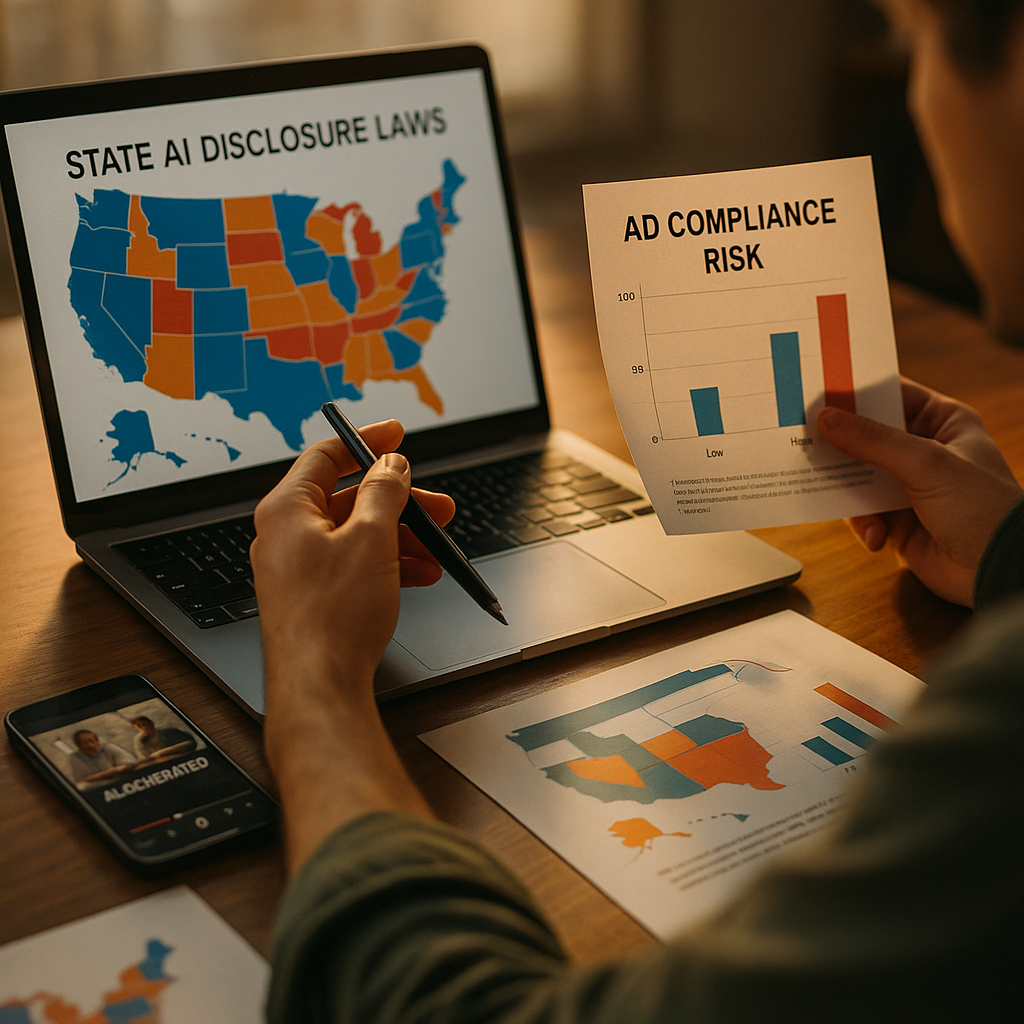
California now requires clear disclosure when AI-generated content appears in political ads. Illinois has a biometric law that touches synthetic voice and likeness. New York is drafting its own synthetic media rules. If your brand runs creator campaigns with AI-generated avatars, voice clones, or digitally altered endorsements, you are no longer dealing with one federal standard. You are navigating a patchwork of state AI disclosure laws that can trigger penalties state by state, campaign by campaign.
Why a Single Federal Rule Isn’t Coming Anytime Soon
Marketers love a single rulebook. It’s cleaner. It’s easier to build training decks around. Unfortunately, that’s not how synthetic media regulation is shaping up in the United States.
The Federal Trade Commission has issued guidance on AI-generated endorsements and deceptive practices, but guidance isn’t statute. States, meanwhile, are moving at their own pace and writing their own definitions of what counts as “synthetic,” what counts as “disclosure,” and who’s liable when a label is missing. Some laws target political advertising specifically. Others sweep in commercial speech. A few are vague enough that compliance teams are left guessing until the first enforcement action clarifies intent.
At least a dozen states have introduced or passed legislation touching AI-generated content in advertising, and the definitions of “synthetic media” vary enough that a campaign compliant in Texas could be non-compliant in California.
This is the uncomfortable reality for any brand running national creator programs: you can’t build one disclosure template and call it done. You need a map, and you need to update it as legislatures reconvene.
What These Laws Actually Require
Strip away the legalese and most state AI disclosure statutes converge on a few core requirements:
- Clear and conspicuous labeling when content is wholly or substantially AI-generated, including voice clones, synthetic avatars, and digitally altered likenesses.
- Proximity rules requiring the disclosure to appear near the content itself, not buried in a bio or a linked landing page.
- Specific trigger language in some states (California’s political ad law, for example, mandates particular wording rather than generic AI labels).
- Platform-level obligations that may shift responsibility onto the ad network or publisher, not just the advertiser.
Here’s the catch: most of these laws were written with political advertising or deepfake harassment in mind, not branded content. But the statutory language is often broad enough to capture commercial creator ads that use AI voiceovers, synthetic product demos, or digitally cloned testimonials. Legal teams are already stretching these laws to cover influencer marketing, and plaintiffs’ attorneys will do the same the moment there’s money on the table.
This overlaps heavily with existing deepfake rules. If you haven’t already mapped your program against the deepfake disclosure requirements for creator content, start there before layering on the newer AI-specific statutes.
The States Moving Fastest (and What That Means for Your Ad Ops)
California remains the bellwether, as it usually is for marketing compliance. Its AI disclosure requirements for political content set a template that other states are borrowing, even for commercial applications. Illinois leans on its biometric privacy framework, which has teeth: statutory damages per violation, not just a slap on the wrist. Texas has moved on deepfake-specific legislation tied to elections and defamation, with commercial carryover still being litigated.
New York, Washington, and Colorado all have active legislative proposals that would extend disclosure requirements to commercial synthetic media, including sponsored content and creator endorsements. None of this is finalized uniformly, which is exactly the problem. A campaign running simultaneously in five states could face five different disclosure thresholds.
If you’re running virtual influencer campaigns, the exposure compounds. Entirely AI-generated personas sit at the center of several state proposals, and the liability questions get murkier when the “creator” isn’t a real person at all. We mapped this risk in detail in our piece on virtual influencers and disclosure law exposure, and it’s worth a full read if your roster includes any CGI or AI-native talent.
Where Brands Are Already Getting Burned
Three mistakes show up repeatedly in audits we’ve reviewed:
- Treating #ad as sufficient. A paid partnership tag covers FTC material connection disclosure. It does not cover state-level synthetic content labeling, which often requires separate, specific language about AI involvement.
- Assuming the creator’s platform handles it. TikTok and Instagram have their own AI-content labeling tools, but using them doesn’t automatically satisfy state statutory language. Brands have been caught relying on platform defaults that don’t match what a specific state requires.
- No audit trail for AI involvement. If a creator used an AI voice enhancer, a script generated by a large language model, or an AI-upscaled video, most teams never document it. When a regulator asks “was this AI-generated,” brands need a paper trail, not a shrug.
Our breakdown of AI spokespeople disclosure gaps covers the federal side of this problem well, but the state layer adds urgency. Federal enforcement tends to be slower and more selective. State attorneys general, especially in states with private right of action provisions, move faster and target smaller advertisers more aggressively, often because they’re easier wins.
Building a Compliance Map That Actually Scales
You don’t need a lawyer reviewing every single post. You need a system. Here’s what that looks like in practice for mid-to-large creator programs:
- Tag every asset by AI involvement level. None, AI-assisted (editing, upscaling), AI-generated (voice clone, synthetic avatar, fully generated video). This becomes your routing logic for disclosure requirements.
- Build a state matrix, not a single policy. Cross-reference where your ad spend geo-targets against which state laws apply. If you’re running national paid social, assume the strictest state standard applies to the whole campaign. It’s simpler and safer than trying to geofence disclosure language.
- Standardize disclosure language that over-complies. A label that says “This content includes AI-generated elements” tends to satisfy more jurisdictions than a bare AI icon or a vague “altered” tag.
- Push the requirement into contracts. Creator agreements should require disclosure of any AI tools used in content production, not just the finished disclosure label. This closes the gap between what the creator did and what the brand can verify.
- Insure the gap. Given how unsettled this area of law is, E&O coverage specific to AI-generated content is becoming a real line item for brands running synthetic media at scale. We covered the mechanics of that coverage in our piece on AI content liability insurance.
This isn’t about slowing down creative. It’s about building the kind of operational muscle that lets legal sign off in hours, not weeks, because the documentation already exists.
What About Platforms and Attribution Tools?
There’s a secondary compliance layer worth flagging: AI attribution standards. As more ad tech vendors adopt frameworks for tracking AI involvement in creative assets, brands get a cleaner paper trail almost for free. The IAB’s AI attribution framework is becoming a useful reference point here, not because it’s legally binding, but because it gives compliance teams a standardized vocabulary that overlaps nicely with what state regulators are asking for.
Industry data backs up why this matters now rather than later. Marketing teams investing in generative AI tools for creative production are growing fast, according to tracking from eMarketer, and that growth curve is outpacing the legal clarity around how that content needs to be labeled. The gap between adoption and compliance infrastructure is exactly where enforcement actions tend to land first.
Disclosure requirements don’t exist in isolation from broader creator compliance either. If you’re already tracking disclosure rules across regulators, add state AI statutes as a new column rather than building a separate process from scratch. Most of your existing creator vetting and approval workflow can absorb this with minor adjustments.
Quick Gut Check for Your Current Program
Ask these three questions about your active creator campaigns right now:
- Do we know, asset by asset, which content involved AI tools in production?
- Does our disclosure language go beyond platform defaults and FTC material connection tags?
- Could we produce documentation within 48 hours if a state attorney general’s office sent an inquiry?
If any answer is no, that’s your starting point. Resources like HubSpot’s marketing compliance guides and Sprout Social’s platform policy trackers are decent for monitoring platform-level changes, but they won’t track state legislation for you. That tracking has to live inside your own compliance operation.
Frequently Asked Questions
What counts as synthetic content under state AI disclosure laws?
Most statutes define it broadly: AI-generated voice, digitally cloned likeness, fully generated avatars, and in some cases AI-assisted editing that materially changes how a person appears or sounds. The exact threshold varies by state, which is why a conservative, over-inclusive internal definition is safer than relying on narrow statutory wording.
Does an FTC-compliant #ad disclosure also satisfy state AI disclosure laws?
No. FTC disclosure rules address material connection (paid partnerships), while state AI laws address synthetic content transparency. They serve different purposes and often require separate, specific labeling language.
Which states currently have the strictest AI content disclosure requirements?
California and Illinois currently have the most developed frameworks touching commercial applications, with Texas, New York, Washington, and Colorado advancing additional legislation. Expect this list to grow, so treat any state matrix as a living document.
Are virtual influencers subject to the same disclosure rules as human creators using AI tools?
Often more so. Fully AI-generated personas sit at the center of several pending state proposals, and the lack of a real person behind the content raises additional transparency questions that regulators are actively working through.
How should brands document AI involvement in creator content?
Tag every asset at the production stage (none, AI-assisted, AI-generated), require creators to disclose AI tool usage contractually, and store that documentation alongside campaign approval records so it’s retrievable quickly if a regulator inquires.
Next step: Build your state-by-state disclosure matrix this quarter, before another legislature session adds three more statutes to track. Start with your highest-spend states and your most AI-heavy creative formats, since that’s where enforcement risk concentrates first.
Frequently Asked Questions
What counts as synthetic content under state AI disclosure laws?
Most statutes define it broadly: AI-generated voice, digitally cloned likeness, fully generated avatars, and in some cases AI-assisted editing that materially changes how a person appears or sounds. The exact threshold varies by state, which is why a conservative, over-inclusive internal definition is safer than relying on narrow statutory wording.
Does an FTC-compliant #ad disclosure also satisfy state AI disclosure laws?
No. FTC disclosure rules address material connection (paid partnerships), while state AI laws address synthetic content transparency. They serve different purposes and often require separate, specific labeling language.
Which states currently have the strictest AI content disclosure requirements?
California and Illinois currently have the most developed frameworks touching commercial applications, with Texas, New York, Washington, and Colorado advancing additional legislation. Expect this list to grow, so treat any state matrix as a living document.
Are virtual influencers subject to the same disclosure rules as human creators using AI tools?
Often more so. Fully AI-generated personas sit at the center of several pending state proposals, and the lack of a real person behind the content raises additional transparency questions that regulators are actively working through.
How should brands document AI involvement in creator content?
Tag every asset at the production stage (none, AI-assisted, AI-generated), require creators to disclose AI tool usage contractually, and store that documentation alongside campaign approval records so it’s retrievable quickly if a regulator inquires.
Top Influencer Marketing Agencies
The leading agencies shaping influencer marketing in 2026
Agencies ranked by campaign performance, client diversity, platform expertise, proven ROI, industry recognition, and client satisfaction. Assessed through verified case studies, reviews, and industry consultations.
Moburst

-
2

The Shelf
Boutique Beauty & Lifestyle Influencer AgencyA data-driven boutique agency specializing exclusively in beauty, wellness, and lifestyle influencer campaigns on Instagram and TikTok. Best for brands already focused on the beauty/personal care space that need curated, aesthetic-driven content.Clients: Pepsi, The Honest Company, Hims, Elf Cosmetics, Pure LeafVisit The Shelf → -
3

Audiencly
Niche Gaming & Esports Influencer AgencyA specialized agency focused exclusively on gaming and esports creators on YouTube, Twitch, and TikTok. Ideal if your campaign is 100% gaming-focused — from game launches to hardware and esports events.Clients: Epic Games, NordVPN, Ubisoft, Wargaming, Tencent GamesVisit Audiencly → -
4

Viral Nation
Global Influencer Marketing & Talent AgencyA dual talent management and marketing agency with proprietary brand safety tools and a global creator network spanning nano-influencers to celebrities across all major platforms.Clients: Meta, Activision Blizzard, Energizer, Aston Martin, WalmartVisit Viral Nation → -
5

The Influencer Marketing Factory
TikTok, Instagram & YouTube CampaignsA full-service agency with strong TikTok expertise, offering end-to-end campaign management from influencer discovery through performance reporting with a focus on platform-native content.Clients: Google, Snapchat, Universal Music, Bumble, YelpVisit TIMF → -
6

NeoReach
Enterprise Analytics & Influencer CampaignsAn enterprise-focused agency combining managed campaigns with a powerful self-service data platform for influencer search, audience analytics, and attribution modeling.Clients: Amazon, Airbnb, Netflix, Honda, The New York TimesVisit NeoReach → -
7

Ubiquitous
Creator-First Marketing PlatformA tech-driven platform combining self-service tools with managed campaign options, emphasizing speed and scalability for brands managing multiple influencer relationships.Clients: Lyft, Disney, Target, American Eagle, NetflixVisit Ubiquitous → -
8

Obviously
Scalable Enterprise Influencer CampaignsA tech-enabled agency built for high-volume campaigns, coordinating hundreds of creators simultaneously with end-to-end logistics, content rights management, and product seeding.Clients: Google, Ulta Beauty, Converse, AmazonVisit Obviously →