


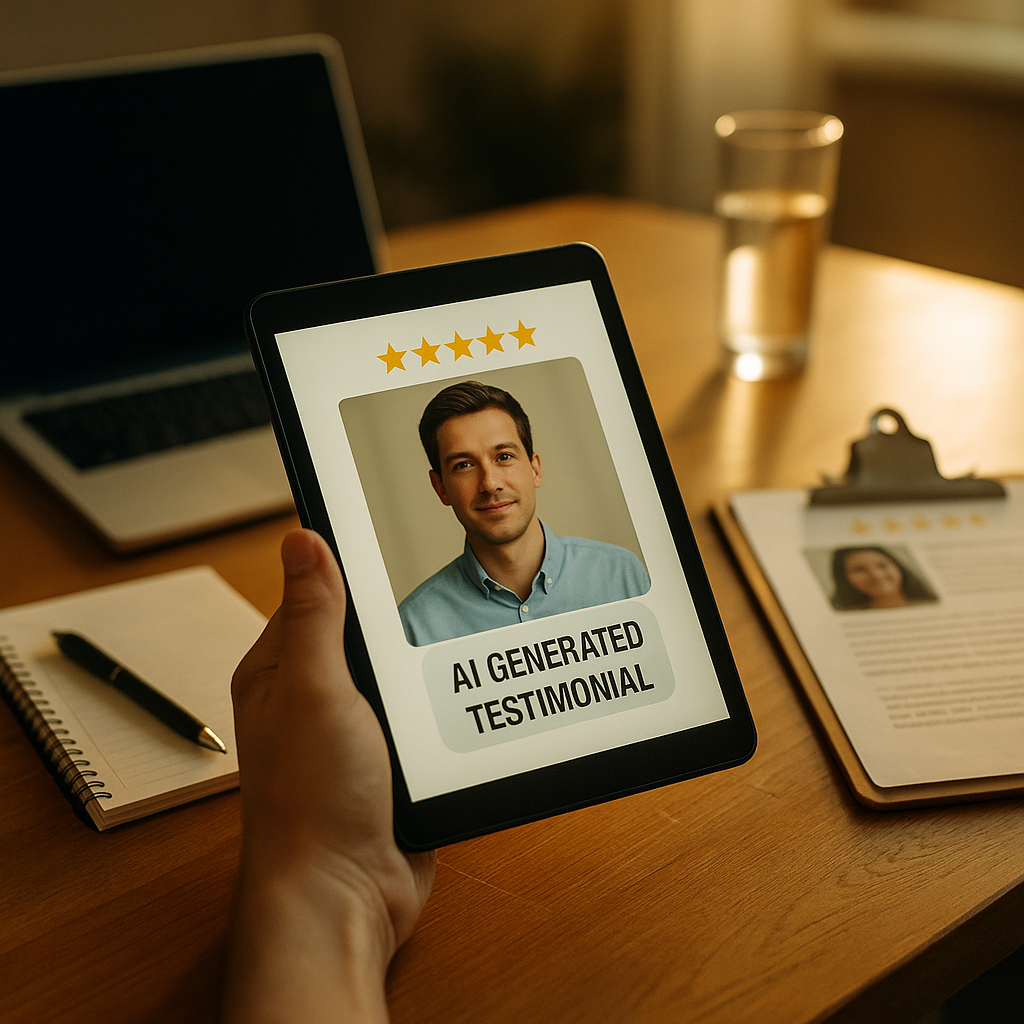
Seventy two percent of marketers now use AI tools somewhere in their creator content pipeline, yet fewer than a third have updated their disclosure language to match. That gap is exactly where the FTC’s updated Endorsement Guide expectations for AI generated testimonials come in. If your brand is running synthetic reviews, AI avatars, or chatbot generated “customer” quotes without a clear compliance process, you are sitting on legal exposure that did not exist two product cycles ago.
Why the FTC Is Zeroing In on AI Testimonials Now
The Federal Trade Commission has spent years refining its Endorsement Guides for human influencers: paid posts, free products, affiliate links, all of it needs clear and conspicuous disclosure. AI generated testimonials break that model in a new way. A testimonial implies a real person had a real experience with a product. When that “person” is a synthetic voice, an AI composite review, or a chatbot trained to sound like a satisfied customer, the implied experience claim becomes the problem, not the disclosure font size.
Regulators have already signaled this shift through enforcement actions around fake reviews and synthetic endorsements. The agency’s position is straightforward: if a reasonable consumer would believe a testimonial reflects an actual human’s genuine opinion, and it does not, that is deceptive regardless of how the content was produced. Add an AI layer, and you have compounded the risk with an authenticity problem on top of a disclosure problem.
A disclosure label does not fix a false premise. If the testimonial never happened, no amount of “sponsored” or “ad” tagging makes it compliant.
What Counts as an AI Generated Testimonial?
This is broader than most marketing teams assume. It covers:
- AI generated customer avatars delivering scripted “reviews” in video ads
- Chatbot or LLM generated text framed as a customer quote
- Composite testimonials built by aggregating and rewriting real reviews into a single “voice”
- Synthetic voiceovers reading real customer text without disclosing the voice is not the customer’s own
- Virtual influencer endorsements that imply product usage without disclosure of the non human nature of the “creator”
Each of these carries a different disclosure obligation, and brands that treat them as one category tend to under disclose the riskiest formats. For a deeper breakdown of how AI avatars and spokespeople specifically intersect with endorsement law, see our coverage of AI spokespeople in ads.
The Updated Disclosure Standard: Clear, Conspicuous, Unavoidable
The FTC’s core language has not changed dramatically, but its application to AI content has gotten more specific. Disclosures need to be:
- Unavoidable: viewers should not need to click “more” or pause a video to find the AI disclosure.
- Proximate: the disclosure sits next to the claim, not buried in a footer or a bio link.
- Plain language: “AI generated” or “synthetic testimonial” beats vague terms like “digitally enhanced” or “stylized.”
- Platform native: a disclosure that works on a static image but disappears in a 15 second TikTok cut does not meet the standard on that platform.
This is where a lot of brands trip. Agencies often build one disclosure asset and drop it across formats without checking whether it survives platform specific compression, cropping, or auto captioning. A disclosure that gets cut off by TikTok’s UI overlay is not a disclosure, it is a liability waiting for a complaint.
How This Differs From Standard Influencer Disclosure Rules
Traditional influencer compliance focuses on the relationship: is this paid, gifted, or affiliate driven? AI testimonial compliance adds a second axis: is this content real? You now need two disclosure layers working together, one for the material connection and one for the synthetic nature of the endorsement itself. Brands running paid partnership campaigns alongside AI generated content should review how paid partnership labels interact with state level unfair and deceptive practices statutes, since state regulators are moving faster than federal guidance in some cases. Our state by state breakdown of AI disclosure laws is worth bookmarking if you run campaigns across multiple jurisdictions.
Where Brands Are Getting This Wrong
Three patterns show up repeatedly in campaign audits:
- Treating AI voiceover as a production choice, not a disclosure trigger. If an AI voice reads a testimonial, even a real one, failing to disclose the synthetic voice element can mislead consumers about authenticity.
- Using virtual influencers without labeling them as non human. Audiences increasingly cannot tell the difference between a real creator and a CGI or AI generated one, which is exactly why regulators care. We mapped the specific risk exposure in virtual influencer disclosure requirements.
- Letting agencies self-certify compliance without an audit trail. If your agency says “we handled disclosure” but cannot produce the actual asset, caption file, or platform screenshot showing it rendered correctly, you have no defense if a complaint lands.
None of these are hypothetical. Fake review enforcement and synthetic endorsement complaints have already resulted in settlements, and the FTC’s rulemaking posture suggests AI testimonials are next in line for scrutiny, not years down the road.
Building a Compliance Workflow That Actually Scales
Legal review on every piece of AI generated content is not realistic for brands running hundreds of SKUs or creator partnerships monthly. What scales instead is a tiered workflow:
- Tag content at the brief stage. Any brief that calls for AI voice, AI avatar, or synthetic testimonial elements gets flagged before production starts, not after the asset is live.
- Standardize disclosure templates per platform. Build one for TikTok, one for Instagram Reels, one for YouTube Shorts, each tested against that platform’s UI overlays and auto crop behavior.
- Require proof of rendering. Agencies submit a screen recording or screenshot showing the disclosure as it actually appears live, not just the source file.
- Centralize the audit trail. Store disclosure proof alongside the content asset so legal can retrieve it in minutes if a regulator or platform trust and safety team asks.
The brands getting burned are not the ones making bold creative bets. They are the ones with no record of what disclosure actually shipped.
This workflow mirrors what we recommended in our pre-launch compliance checklist for IAB’s AI attribution standard, and it is worth running both frameworks side by side if your team touches both performance attribution and testimonial content.
Insurance and Contract Language Need an Update Too
Disclosure compliance is only half the risk picture. If an AI generated testimonial triggers a complaint or a platform strike, who absorbs the cost of pulling the campaign, re-cutting assets, or defending a claim? Brands increasingly need errors and omissions coverage that explicitly contemplates AI generated content, since standard media liability policies were not written with synthetic testimonials in mind. We covered the gap in detail in AI generated content E&O insurance. Contracts with creators and agencies should also specify who owns the disclosure obligation when AI tools are layered onto a creator’s original content, a gray area we broke down in our piece on creator contract gaps tied to AI attribution.
What Platforms Are Doing in Parallel
Platform policy is moving alongside regulatory guidance, not waiting for it. Meta has rolled out labeling requirements for AI generated and digitally altered content, and TikTok has expanded its synthetic media policy to cover AI generated endorsements specifically. Brands should treat platform labels (like Meta’s “AI info” tag) as a floor, not a ceiling. Meeting a platform’s labeling requirement does not automatically satisfy FTC disclosure standards, and vice versa. Check current requirements directly through Meta’s business guidelines and TikTok’s advertising policies before assuming your existing creative meets both bars.
For brands running campaigns that touch EU or UK audiences, the ICO’s guidance on AI and data protection adds another compliance layer worth checking, particularly where AI testimonials involve any processing of real customer data to generate the synthetic content.
A Practical Checklist Before You Launch
- Confirm whether the testimonial reflects a real customer experience or a synthetic composite.
- Draft disclosure language that names the AI element plainly, not vaguely.
- Test the disclosure on the actual platform and format, not just the source asset.
- Capture proof of how the disclosure rendered live.
- Confirm contract language assigns disclosure responsibility clearly between brand, agency, and creator.
- Check your E&O policy covers AI generated endorsement claims.
Running influencer campaigns alongside AI testimonial content? Review how disclosure rules intersect across regulators in our comparison of FTC, ASA, and local regulator rules, since multi market campaigns often need to satisfy the strictest applicable standard rather than the most lenient one.
According to recent data from eMarketer, AI generated content in paid social campaigns continues to climb year over year, which means the disclosure stakes are only growing. Brands that build the audit infrastructure now will not be scrambling when enforcement catches up to adoption.
Frequently Asked Questions
Does the FTC require disclosure for AI generated testimonials specifically?
Yes. The FTC’s Endorsement Guides apply to any testimonial that could mislead a reasonable consumer, and an AI generated testimonial presented as a genuine customer experience falls squarely within that standard. The disclosure needs to make clear the testimonial is synthetic, not just that the post is sponsored.
Is a small disclosure icon enough to satisfy the rule?
No. The FTC’s “clear and conspicuous” standard requires disclosures that a typical viewer would actually notice without extra effort, such as pausing a video or zooming into text. A tiny icon buried in a corner generally will not meet that bar, especially on mobile first platforms.
What is the difference between an AI generated testimonial and an AI enhanced one?
An AI enhanced testimonial usually involves a real customer’s genuine feedback edited, translated, or voiced with AI tools. An AI generated testimonial is fabricated content presented as if it came from a real customer. The second category carries much higher regulatory risk because it implies an experience that never happened.
Do virtual influencers count as AI generated testimonials?
When a virtual influencer makes a product claim or shares a “personal” experience with a product, that content functions like a testimonial and needs disclosure that the influencer is not a real human, in addition to any paid partnership disclosure.
Who is liable if an agency fails to disclose AI generated content correctly?
Liability often falls on the brand even when an agency or creator produced the content, since the FTC generally holds advertisers responsible for endorsements made on their behalf. Clear contract language assigning disclosure responsibility helps, but it does not eliminate brand side exposure.
Next step: audit your last three campaigns that used any AI voice, avatar, or synthetic testimonial element, and confirm you have rendered proof of disclosure on file. If you cannot produce that proof today, fix the workflow before your next launch, not after a complaint forces the issue.
FAQs
Does the FTC require disclosure for AI generated testimonials specifically?
Yes. The FTC’s Endorsement Guides apply to any testimonial that could mislead a reasonable consumer, and an AI generated testimonial presented as a genuine customer experience falls squarely within that standard. The disclosure needs to make clear the testimonial is synthetic, not just that the post is sponsored.
Is a small disclosure icon enough to satisfy the rule?
No. The FTC’s “clear and conspicuous” standard requires disclosures that a typical viewer would actually notice without extra effort, such as pausing a video or zooming into text. A tiny icon buried in a corner generally will not meet that bar, especially on mobile first platforms.
What is the difference between an AI generated testimonial and an AI enhanced one?
An AI enhanced testimonial usually involves a real customer’s genuine feedback edited, translated, or voiced with AI tools. An AI generated testimonial is fabricated content presented as if it came from a real customer. The second category carries much higher regulatory risk because it implies an experience that never happened.
Do virtual influencers count as AI generated testimonials?
When a virtual influencer makes a product claim or shares a “personal” experience with a product, that content functions like a testimonial and needs disclosure that the influencer is not a real human, in addition to any paid partnership disclosure.
Who is liable if an agency fails to disclose AI generated content correctly?
Liability often falls on the brand even when an agency or creator produced the content, since the FTC generally holds advertisers responsible for endorsements made on their behalf. Clear contract language assigning disclosure responsibility helps, but it does not eliminate brand side exposure.
Top Influencer Marketing Agencies
The leading agencies shaping influencer marketing in 2026
Agencies ranked by campaign performance, client diversity, platform expertise, proven ROI, industry recognition, and client satisfaction. Assessed through verified case studies, reviews, and industry consultations.
Moburst

-
2

The Shelf
Boutique Beauty & Lifestyle Influencer AgencyA data-driven boutique agency specializing exclusively in beauty, wellness, and lifestyle influencer campaigns on Instagram and TikTok. Best for brands already focused on the beauty/personal care space that need curated, aesthetic-driven content.Clients: Pepsi, The Honest Company, Hims, Elf Cosmetics, Pure LeafVisit The Shelf → -
3

Audiencly
Niche Gaming & Esports Influencer AgencyA specialized agency focused exclusively on gaming and esports creators on YouTube, Twitch, and TikTok. Ideal if your campaign is 100% gaming-focused — from game launches to hardware and esports events.Clients: Epic Games, NordVPN, Ubisoft, Wargaming, Tencent GamesVisit Audiencly → -
4

Viral Nation
Global Influencer Marketing & Talent AgencyA dual talent management and marketing agency with proprietary brand safety tools and a global creator network spanning nano-influencers to celebrities across all major platforms.Clients: Meta, Activision Blizzard, Energizer, Aston Martin, WalmartVisit Viral Nation → -
5

The Influencer Marketing Factory
TikTok, Instagram & YouTube CampaignsA full-service agency with strong TikTok expertise, offering end-to-end campaign management from influencer discovery through performance reporting with a focus on platform-native content.Clients: Google, Snapchat, Universal Music, Bumble, YelpVisit TIMF → -
6

NeoReach
Enterprise Analytics & Influencer CampaignsAn enterprise-focused agency combining managed campaigns with a powerful self-service data platform for influencer search, audience analytics, and attribution modeling.Clients: Amazon, Airbnb, Netflix, Honda, The New York TimesVisit NeoReach → -
7

Ubiquitous
Creator-First Marketing PlatformA tech-driven platform combining self-service tools with managed campaign options, emphasizing speed and scalability for brands managing multiple influencer relationships.Clients: Lyft, Disney, Target, American Eagle, NetflixVisit Ubiquitous → -
8

Obviously
Scalable Enterprise Influencer CampaignsA tech-enabled agency built for high-volume campaigns, coordinating hundreds of creators simultaneously with end-to-end logistics, content rights management, and product seeding.Clients: Google, Ulta Beauty, Converse, AmazonVisit Obviously →