


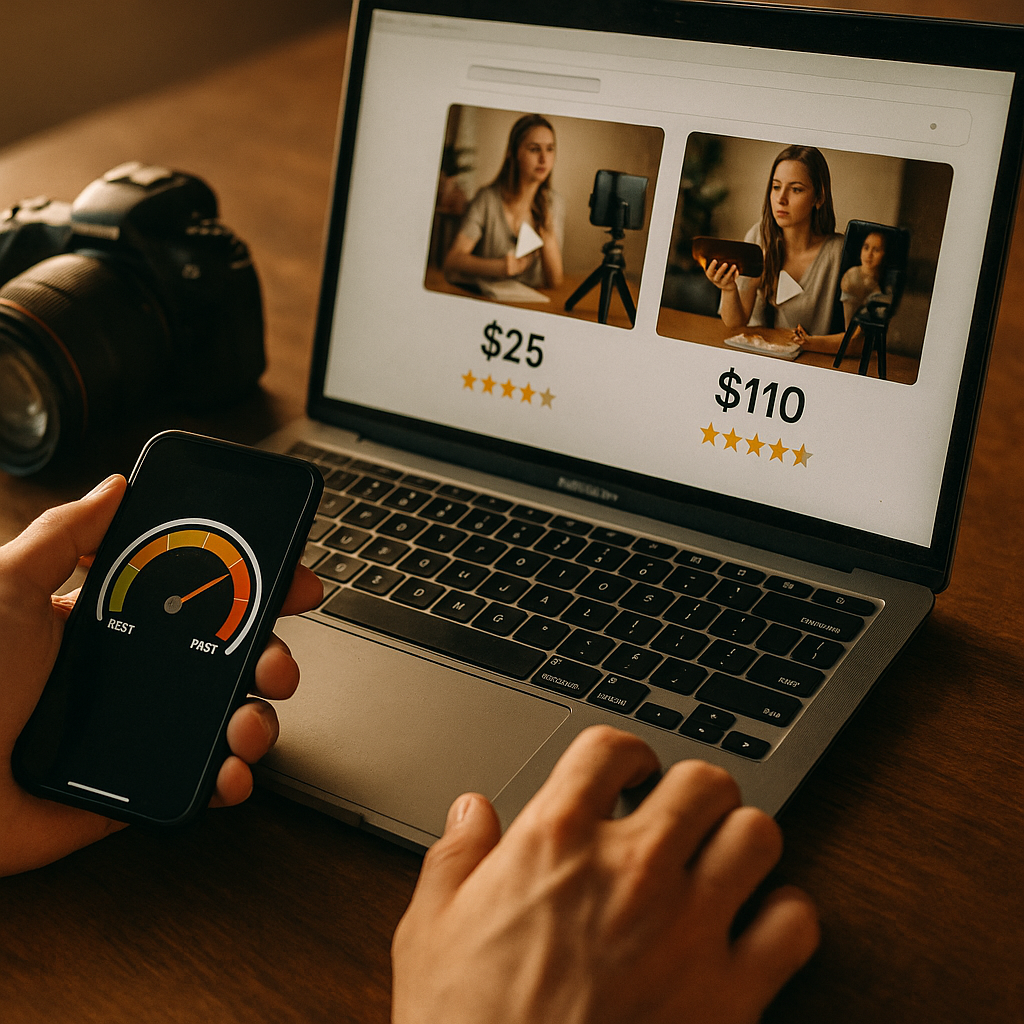
Brands now spend an average of 11 days waiting on a single piece of branded UGC, yet some marketplaces deliver usable assets in under 48 hours. That gap is the whole ballgame. A UGC production marketplace comparison isn’t an academic exercise anymore: it’s a budget decision that determines whether your paid social team has fresh creative every week or is stuck recutting the same three hooks from last quarter.
This piece benchmarks the major players on the three variables that actually matter to a media buyer: turnaround time, output quality, and true cost per usable asset. Not list price. Usable asset cost, after you factor in revisions, rejections, and the creators who ghost mid-brief.
Why “Cost Per Video” Is the Wrong Metric
Every marketplace will quote you a per-video rate. Fiverr freelancers might advertise $50 UGC clips. Insense and Billo sit closer to $150 to $300 per asset depending on usage rights and whiteglove service. But the sticker price tells you almost nothing about what it costs to get a deployable ad.
The real formula looks like this: total spend divided by assets that actually passed creative review and ran in a live campaign. Run that math across a few hundred briefs and the rankings shuffle. A $90 asset with a 40% rejection rate costs more per usable unit than a $180 asset with a 92% approval rate.
Teams that track cost per usable asset, not cost per order, consistently reallocate 15 to 25% of their UGC budget away from the cheapest vendor within two quarters.
We’ve written before about this exact tension between price and risk in the context of specific vendors. If you haven’t already, it’s worth reading our breakdown on matching UGC cost to risk, which goes deeper on how marketplace structure (managed vs. self-serve) changes your exposure to bad creative.
Speed Benchmarks: Who Actually Delivers Fast
Speed claims are the most gamed metric in this category. “48-hour turnaround” usually means 48 hours from creator acceptance, not from brief submission. Here’s roughly what we’re seeing across managed marketplaces heading into this year’s benchmarking cycle:
- Billo: Average 5 to 7 business days from brief to first draft, with rush options at a premium. Creator matching is automated, which speeds sourcing but can slow quality alignment.
- Insense: 7 to 10 days typical, longer for niche verticals (finance, healthcare) where compliant creators are scarcer. Insense leans into creator-brand chemistry over raw speed.
- Fiverr (UGC category): Wildly variable, from 2 days to 3 weeks, because you’re sourcing individual freelancers rather than a vetted pool. Fastest option if you already have a trusted seller relationship, riskiest if you’re starting cold.
- Boutique UGC studios: Slower onboarding (often 2 weeks for the first batch) but faster repeat cycles once a brief template and creator roster are locked in.
Speed isn’t a fixed property of the platform. It’s a function of how specific your brief is and how many revision rounds you’ve built into your workflow. Vague briefs kill turnaround time faster than any platform limitation does.
The Hidden Speed Tax: Revisions
Nobody benchmarks revision cycles, but they should. A platform that delivers a first draft in 3 days but needs two rounds of revisions (each adding 2 to 4 days) is slower in practice than one that delivers a near-final cut in 6 days. When you’re evaluating vendors, ask for their average revision count per asset, not just their stated turnaround window.
Quality: What “Good UGC” Actually Means for Paid Media
Quality in this category isn’t about production polish. It’s about conversion performance. The best-performing UGC on Meta and TikTok Shop in recent cycles has deliberately rough edges: handheld camera work, unscripted-sounding delivery, authentic settings. Studio-polished content often underperforms because audiences pattern-match it to traditional advertising and scroll past.
That said, “authentic-looking” is not the same as “actually good.” The marketplaces that consistently produce high-converting assets share a few traits:
- Structured hook libraries creators pull from, rather than improvised openings
- Built-in compliance review before delivery (critical for regulated categories)
- Creator-brand fit scoring based on past performance data, not just follower count or niche tags
We recently ran a detailed comparison of how boutique studios stack up against algorithmic hook-generation tools in our piece on benchmarking conversion rates across UGC formats. The short version: hook quality predicts conversion far better than video production value does.
Cost Tiers: What You Should Actually Budget
Here’s a rough 2026 budgeting framework based on current marketplace pricing, adjusted for the usable-asset math above:
- Entry tier ($50 to $120 per asset): Fiverr freelancers, self-serve creator marketplaces. Expect 30 to 45% rejection rates without tight briefs and pre-vetted creators.
- Mid tier ($150 to $300 per asset): Insense, Billo, and similar managed platforms. Rejection rates typically drop to 10 to 20% with clear briefs and platform-side quality checks.
- Premium tier ($350+ per asset): Boutique studios and white-glove agencies offering strategy, creator vetting, and usage rights bundling. Rejection rates under 10%, but volume throughput is lower.
For a 10-video monthly program, that translates to roughly $800 to $1,500 at entry tier (after rejections), $1,800 to $3,500 at mid tier, and $4,000+ at premium tier. The mid tier is where most brands with established paid social programs land, because it balances volume with acceptable risk.
If your organization is also weighing broader martech spend alongside creative production, our comparison of cost tiers for lean teams covers a similar framework applied to CRM and automation tooling, useful context if you’re building a full-funnel budget model rather than evaluating UGC in isolation.
Compliance and Rights: The Line Item Nobody Budgets For
Usage rights are the most common source of budget surprises. A lot of entry-tier marketplace pricing covers organic usage only. The moment you want to boost a UGC clip as a paid ad, run it across multiple markets, or extend the license beyond 6 or 12 months, you’re paying again.
Before you lock in a vendor, get explicit answers on three things: paid usage scope, geographic licensing, and renewal terms. This matters even more if you’re running international campaigns, where licensing complexity multiplies fast. Our checklist on multi market creator rights is a useful reference if you’re scaling a UGC program across more than two or three countries.
Platforms are also under more scrutiny around disclosure compliance. The FTC’s endorsement guidelines apply to UGC used in paid ads just as they do to traditional influencer posts, and enforcement has tightened. Make sure whichever marketplace you choose builds disclosure language into creator contracts by default, not as an afterthought you have to request.
So Which Marketplace Should You Actually Pick?
There’s no universal winner here, and anyone telling you there is hasn’t run enough briefs across enough platforms. The decision really comes down to three questions:
- How much creative volume do you need monthly, and how fast does it need to turn around?
- What’s your tolerance for rejected assets, and do you have an internal reviewer to catch issues before spend?
- Are you running in a regulated category (finance, health, alcohol) where compliance review adds non-negotiable friction?
High-volume, fast-moving DTC brands generally do better on mid-tier managed marketplaces like Insense or Billo, where the platform absorbs some of the vetting burden. Brands running smaller, higher-stakes campaigns (new product launches, rebrand moments) tend to get better ROI from boutique studios despite the higher per-asset cost, because the rejection rate savings offset the premium.
One more thing worth checking before you sign an annual contract: ask every vendor for their trailing 90-day average turnaround and rejection rate, not their marketing page numbers. Platforms that won’t share that data are telling you something.
For broader context on how creator data and performance reporting should feed back into your martech stack once assets are live, see our analysis on where creator partnership data should live, which is directly relevant once you’re running UGC at scale across multiple vendors.
Visible FAQs
What is a UGC production marketplace?
A UGC production marketplace is a platform that connects brands with creators who produce authentic-style video and photo content for paid and organic marketing, typically managing briefing, creator matching, revisions, and usage rights in one workflow.
How much does UGC cost per video in 2026?
Pricing generally ranges from $50 to $120 per asset on entry-tier self-serve platforms, $150 to $300 on managed mid-tier marketplaces like Insense or Billo, and $350 or more for premium boutique studio production, though actual usable-asset cost depends heavily on rejection rates.
Which UGC marketplace has the fastest turnaround?
Turnaround varies by platform and category, but managed marketplaces like Billo typically deliver first drafts in 5 to 7 business days, while freelancer marketplaces like Fiverr can range from 2 days to 3 weeks depending on the individual creator’s availability.
Do UGC creators retain usage rights to their content?
Yes, unless the contract explicitly transfers or licenses those rights to the brand. Most marketplace agreements grant limited usage licenses (organic only, or organic plus paid for a set period), so brands should confirm paid usage scope and license duration before signing.
Is cheaper UGC actually worse quality?
Not necessarily in production value, but cheaper, self-serve marketplaces tend to have higher rejection rates due to less structured briefing and creator vetting, which can make the effective cost per usable asset higher than it first appears.
How do brands measure UGC quality beyond production value?
The most reliable measure is conversion performance in live paid campaigns, not visual polish. Brands increasingly score creators on hook effectiveness, past campaign performance, and brand fit rather than follower count or video production quality alone.
Next step: Before renewing or signing any UGC vendor contract, pull your last 90 days of briefs and calculate cost per usable asset, not cost per order. That single number will tell you more about which marketplace deserves your budget than any sales deck will.
FAQs
What is a UGC production marketplace?
A UGC production marketplace is a platform that connects brands with creators who produce authentic-style video and photo content for paid and organic marketing, typically managing briefing, creator matching, revisions, and usage rights in one workflow.
How much does UGC cost per video in 2026?
Pricing generally ranges from $50 to $120 per asset on entry-tier self-serve platforms, $150 to $300 on managed mid-tier marketplaces like Insense or Billo, and $350 or more for premium boutique studio production, though actual usable-asset cost depends heavily on rejection rates.
Which UGC marketplace has the fastest turnaround?
Turnaround varies by platform and category, but managed marketplaces like Billo typically deliver first drafts in 5 to 7 business days, while freelancer marketplaces like Fiverr can range from 2 days to 3 weeks depending on the individual creator’s availability.
Do UGC creators retain usage rights to their content?
Yes, unless the contract explicitly transfers or licenses those rights to the brand. Most marketplace agreements grant limited usage licenses (organic only, or organic plus paid for a set period), so brands should confirm paid usage scope and license duration before signing.
Is cheaper UGC actually worse quality?
Not necessarily in production value, but cheaper, self-serve marketplaces tend to have higher rejection rates due to less structured briefing and creator vetting, which can make the effective cost per usable asset higher than it first appears.
How do brands measure UGC quality beyond production value?
The most reliable measure is conversion performance in live paid campaigns, not visual polish. Brands increasingly score creators on hook effectiveness, past campaign performance, and brand fit rather than follower count or video production quality alone.
Top Influencer Marketing Agencies
The leading agencies shaping influencer marketing in 2026
Agencies ranked by campaign performance, client diversity, platform expertise, proven ROI, industry recognition, and client satisfaction. Assessed through verified case studies, reviews, and industry consultations.
Moburst

-
2

The Shelf
Boutique Beauty & Lifestyle Influencer AgencyA data-driven boutique agency specializing exclusively in beauty, wellness, and lifestyle influencer campaigns on Instagram and TikTok. Best for brands already focused on the beauty/personal care space that need curated, aesthetic-driven content.Clients: Pepsi, The Honest Company, Hims, Elf Cosmetics, Pure LeafVisit The Shelf → -
3

Audiencly
Niche Gaming & Esports Influencer AgencyA specialized agency focused exclusively on gaming and esports creators on YouTube, Twitch, and TikTok. Ideal if your campaign is 100% gaming-focused — from game launches to hardware and esports events.Clients: Epic Games, NordVPN, Ubisoft, Wargaming, Tencent GamesVisit Audiencly → -
4

Viral Nation
Global Influencer Marketing & Talent AgencyA dual talent management and marketing agency with proprietary brand safety tools and a global creator network spanning nano-influencers to celebrities across all major platforms.Clients: Meta, Activision Blizzard, Energizer, Aston Martin, WalmartVisit Viral Nation → -
5

The Influencer Marketing Factory
TikTok, Instagram & YouTube CampaignsA full-service agency with strong TikTok expertise, offering end-to-end campaign management from influencer discovery through performance reporting with a focus on platform-native content.Clients: Google, Snapchat, Universal Music, Bumble, YelpVisit TIMF → -
6

NeoReach
Enterprise Analytics & Influencer CampaignsAn enterprise-focused agency combining managed campaigns with a powerful self-service data platform for influencer search, audience analytics, and attribution modeling.Clients: Amazon, Airbnb, Netflix, Honda, The New York TimesVisit NeoReach → -
7

Ubiquitous
Creator-First Marketing PlatformA tech-driven platform combining self-service tools with managed campaign options, emphasizing speed and scalability for brands managing multiple influencer relationships.Clients: Lyft, Disney, Target, American Eagle, NetflixVisit Ubiquitous → -
8

Obviously
Scalable Enterprise Influencer CampaignsA tech-enabled agency built for high-volume campaigns, coordinating hundreds of creators simultaneously with end-to-end logistics, content rights management, and product seeding.Clients: Google, Ulta Beauty, Converse, AmazonVisit Obviously →