


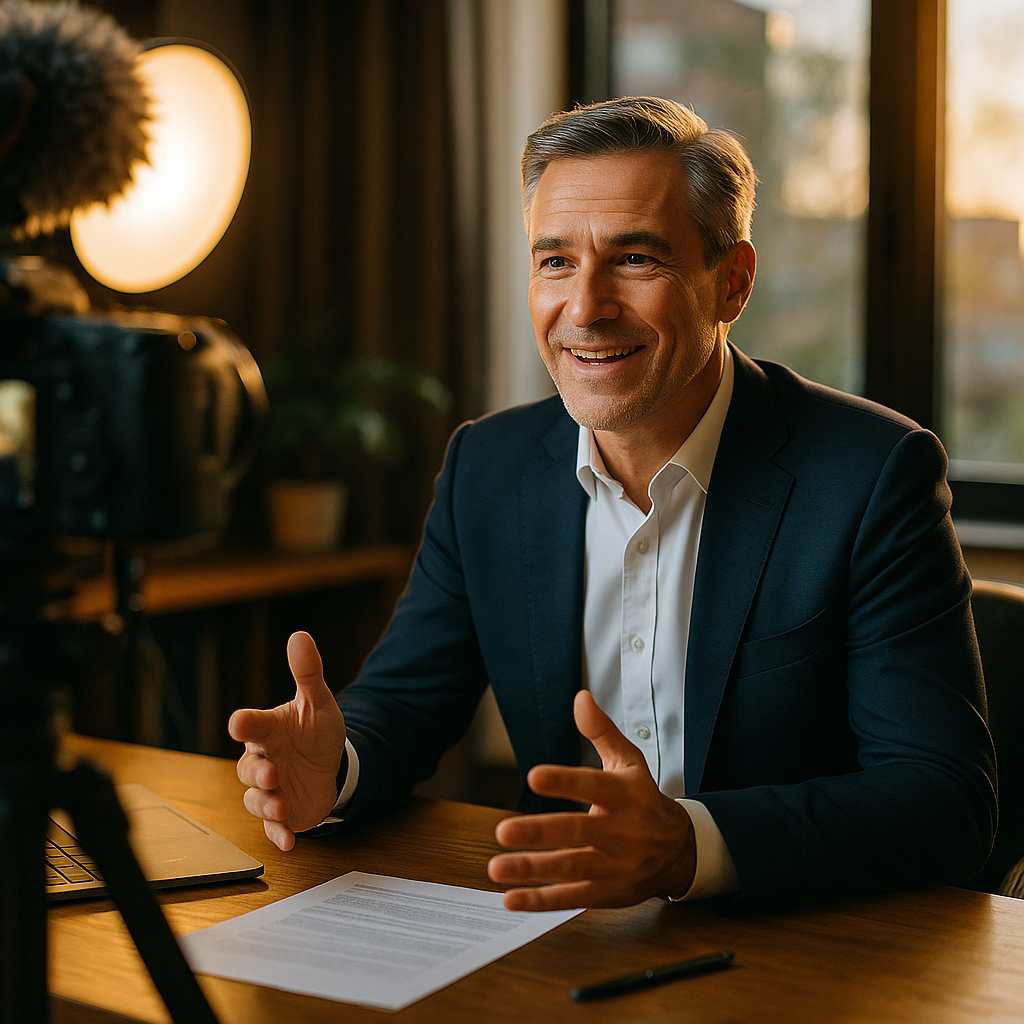
Viewers are 2.4 times more likely to finish a video when the person on screen is identifiable as the company’s founder rather than a hired actor, according to internal creator platform benchmarks cited across the industry this year. That single stat explains why brand teams are quietly shelving six-figure studio ad shoots in favor of a CEO holding a phone in a stockroom. Founder-led video has stopped being a scrappy founder-era tactic and become a line item in serious media plans. The question for marketing leaders is no longer whether it works. It’s how to scale it without losing the thing that makes it work.
Why a Face Beats a Logo
Polished studio ads were built for a broadcast era, where interruption worked because there was nowhere else to look. Social feeds don’t operate on interruption. They operate on judgment, made in under two seconds, about whether the thing on screen is a person or a pitch. A founder talking directly to camera reads as a person, even when the content is clearly promotional. A studio ad, no matter how well lit, reads as a pitch.
That perception gap shows up in the numbers. Sprout Social’s own research on consumer trust has repeatedly found that audiences rate brand communication as more trustworthy when it comes from identifiable humans rather than corporate accounts, a pattern that extends directly to who fronts the video. Founder-led content borrows the credibility of a real person and applies it to a commercial message, which is exactly the arbitrage polished ads can’t replicate.
A founder on a shaky handheld clip outperforms a studio ad not despite the production quality, but because of it. Rough edges are now a trust signal, not a budget constraint.
The Trust Math: What the Data Actually Shows
eMarketer has tracked the steady decline in trust toward traditional brand advertising for several years running, alongside a parallel rise in trust toward individual creators and executives who post directly. HubSpot’s own content marketing surveys show a similar trend: audiences consistently rank “someone who works at the company” above both celebrities and anonymous brand voices when asked who they’d believe about a product claim.
This isn’t just a vanity metric problem. It shows up in hard conversion data too. Campaigns using founder cameo formats have reported meaningfully lower cost-per-acquisition than matched studio ad variants, largely because the founder appearance front-loads credibility that would otherwise need to be built through longer funnels or heavier retargeting. Put simply: a founder’s face does some of the persuasion work that a studio ad has to pay media dollars to achieve through frequency.
Polished Is Now a Red Flag
Here’s the uncomfortable part for creative directors who’ve spent careers perfecting lighting setups. Excessive polish now triggers skepticism. Viewers have been trained by a decade of influencer marketing to associate high production value with low authenticity. A studio ad with a script, a teleprompter, and color grading signals “this was optimized to persuade me,” which is precisely the signal that makes modern audiences disengage.
That doesn’t mean production quality is irrelevant. Audio still matters enormously, arguably more than visual polish, a point covered in depth in sound-led demo formats. The distinction is between quality that serves clarity and quality that signals artifice. A founder video shot on a phone with clean audio and a steady hand beats both the over-produced studio spot and the genuinely sloppy amateur clip.
What Founder-Led Video Actually Looks Like in Practice
The best-performing examples share a few structural traits that brand teams can plan for rather than hope for:
- Unscripted cadence. Founders who speak in their own rhythm, including pauses and verbal tics, outperform those reading from a teleprompter.
- Specific, not generic, claims. “We rebuilt this feature because 40 percent of support tickets were about X” lands harder than “we’re excited to announce.”
- Low-friction settings. Offices, warehouses, and cars read as more credible backdrops than branded studio sets.
- Direct address to camera. First-person framing, the same principle behind POV-style performance ads, creates a one-to-one feel even at scale.
Founders who’ve made this a habit, rather than a one-off stunt, tend to extend it into adjacent formats too, including podcast guesting appearances where the same unscripted, credibility-first approach carries over from video to audio.
Where It Breaks: Risk, Scale, and the Governance Problem
Founder-led video has a ceiling problem that studio ads don’t. A studio shoot can produce fifty variants in a week with a swap of copy and a reshuffled edit. A founder has one calendar, one voice, and a finite tolerance for being on camera constantly. Brand teams that lean too hard on this format risk burning out their most credible asset, or worse, diluting it until audiences start reacting to the founder the way they already react to studio ads: with suspicion.
There’s a compliance dimension too. When a founder makes a product claim on camera, that claim carries the same regulatory weight as any other advertising statement. The FTC’s guidance on endorsements and testimonials applies whether the speaker is an external creator or the person whose name is on the building, and legal teams should treat founder scripts with the same review rigor as paid creator content. Getting this wrong doesn’t just risk a platform takedown, it risks a regulatory inquiry with the founder’s own name attached.
The biggest risk in founder-led video isn’t a bad take. It’s treating the founder as an infinite content resource until the format’s authenticity premium quietly disappears.
Building the System: From One-Off Video to Repeatable Program
The brands getting durable value out of this format treat founder video as raw material, not a finished asset. One ten-minute recording session can be cut into a dozen formats: a long-form upload, several short vertical clips, a quote-card carousel pulled from frame grab stills, and paid variants pushed through spark ads amplification once the organic version proves it resonates.
This is also where it makes sense to bring in outside production support, not to polish the founder’s delivery into something artificial, but to handle the editing, captioning, and multi-platform formatting that turns one recording into weeks of usable content. Moburst, a global full-service digital marketing agency that has worked with over 900 clients including Samsung, Reddit, and Calm, approaches this through its video production agency work, which focuses on exactly this kind of repurposing rather than one-off shoots. The goal for any brand team should be the same: protect the founder’s time and voice while multiplying the output around it.
Operationally, this means building a lightweight content calendar around the founder’s actual availability, pre-clearing topics with legal in batches rather than per-video, and training an internal editor or agency partner to recognize which raw clips have the “it” factor worth cutting down. Statista’s advertising trend data has consistently shown short-form video consumption climbing year over year, which means the repurposing math keeps favoring whoever can turn one recording into the most platform-native formats fastest.
FAQs
Is founder-led video a replacement for all paid studio advertising?
No. It’s a complement that typically performs best at the top and middle of the funnel, where trust-building matters most. Studio production still has a role in brand campaigns, product launches, and anywhere visual consistency across markets matters more than individual voice.
What if the founder isn’t a natural on camera?
Comfort matters more than polish. A founder who’s visibly nervous but genuine still outperforms a slick actor reading brand copy, because audiences are responding to authenticity signals, not performance skill. Short, frequent practice reps usually fix stiffness faster than scripting does.
How do you keep founder video compliant with advertising regulations?
Treat every product claim the founder makes on camera the same way you’d treat a paid creator’s script: run it through legal review, disclose any material connections, and keep records of approved talking points. The FTC’s endorsement guidelines apply regardless of who’s speaking.
How often should a founder appear on camera to sustain the format?
There’s no universal cadence, but most brands find a monthly or biweekly rhythm sustainable without burning out the founder or diluting the novelty. Quality and specificity of content matter more than frequency.
Can this format scale across multiple markets or languages?
Yes, though it usually requires either a founder comfortable recording in multiple languages or a careful dubbing and subtitling approach that preserves the unscripted delivery style rather than flattening it into a corporate voiceover.
FAQs
Is founder-led video a replacement for all paid studio advertising?
No. It’s a complement that typically performs best at the top and middle of the funnel, where trust-building matters most. Studio production still has a role in brand campaigns, product launches, and anywhere visual consistency across markets matters more than individual voice.
What if the founder isn’t a natural on camera?
Comfort matters more than polish. A founder who’s visibly nervous but genuine still outperforms a slick actor reading brand copy, because audiences are responding to authenticity signals, not performance skill. Short, frequent practice reps usually fix stiffness faster than scripting does.
How do you keep founder video compliant with advertising regulations?
Treat every product claim the founder makes on camera the same way you’d treat a paid creator’s script: run it through legal review, disclose any material connections, and keep records of approved talking points. The FTC’s endorsement guidelines apply regardless of who’s speaking.
How often should a founder appear on camera to sustain the format?
There’s no universal cadence, but most brands find a monthly or biweekly rhythm sustainable without burning out the founder or diluting the novelty. Quality and specificity of content matter more than frequency.
Can this format scale across multiple markets or languages?
Yes, though it usually requires either a founder comfortable recording in multiple languages or a careful dubbing and subtitling approach that preserves the unscripted delivery style rather than flattening it into a corporate voiceover.
Start with one unscripted founder clip this quarter, measure it against your best studio ad on completion rate and CPA, and let that single comparison decide how much production budget moves next quarter.
Top Influencer Marketing Agencies
The leading agencies shaping influencer marketing in 2026
Agencies ranked by campaign performance, client diversity, platform expertise, proven ROI, industry recognition, and client satisfaction. Assessed through verified case studies, reviews, and industry consultations.
Moburst

-
2

The Shelf
Boutique Beauty & Lifestyle Influencer AgencyA data-driven boutique agency specializing exclusively in beauty, wellness, and lifestyle influencer campaigns on Instagram and TikTok. Best for brands already focused on the beauty/personal care space that need curated, aesthetic-driven content.Clients: Pepsi, The Honest Company, Hims, Elf Cosmetics, Pure LeafVisit The Shelf → -
3

Audiencly
Niche Gaming & Esports Influencer AgencyA specialized agency focused exclusively on gaming and esports creators on YouTube, Twitch, and TikTok. Ideal if your campaign is 100% gaming-focused — from game launches to hardware and esports events.Clients: Epic Games, NordVPN, Ubisoft, Wargaming, Tencent GamesVisit Audiencly → -
4

Viral Nation
Global Influencer Marketing & Talent AgencyA dual talent management and marketing agency with proprietary brand safety tools and a global creator network spanning nano-influencers to celebrities across all major platforms.Clients: Meta, Activision Blizzard, Energizer, Aston Martin, WalmartVisit Viral Nation → -
5

The Influencer Marketing Factory
TikTok, Instagram & YouTube CampaignsA full-service agency with strong TikTok expertise, offering end-to-end campaign management from influencer discovery through performance reporting with a focus on platform-native content.Clients: Google, Snapchat, Universal Music, Bumble, YelpVisit TIMF → -
6

NeoReach
Enterprise Analytics & Influencer CampaignsAn enterprise-focused agency combining managed campaigns with a powerful self-service data platform for influencer search, audience analytics, and attribution modeling.Clients: Amazon, Airbnb, Netflix, Honda, The New York TimesVisit NeoReach → -
7

Ubiquitous
Creator-First Marketing PlatformA tech-driven platform combining self-service tools with managed campaign options, emphasizing speed and scalability for brands managing multiple influencer relationships.Clients: Lyft, Disney, Target, American Eagle, NetflixVisit Ubiquitous → -
8

Obviously
Scalable Enterprise Influencer CampaignsA tech-enabled agency built for high-volume campaigns, coordinating hundreds of creators simultaneously with end-to-end logistics, content rights management, and product seeding.Clients: Google, Ulta Beauty, Converse, AmazonVisit Obviously →