


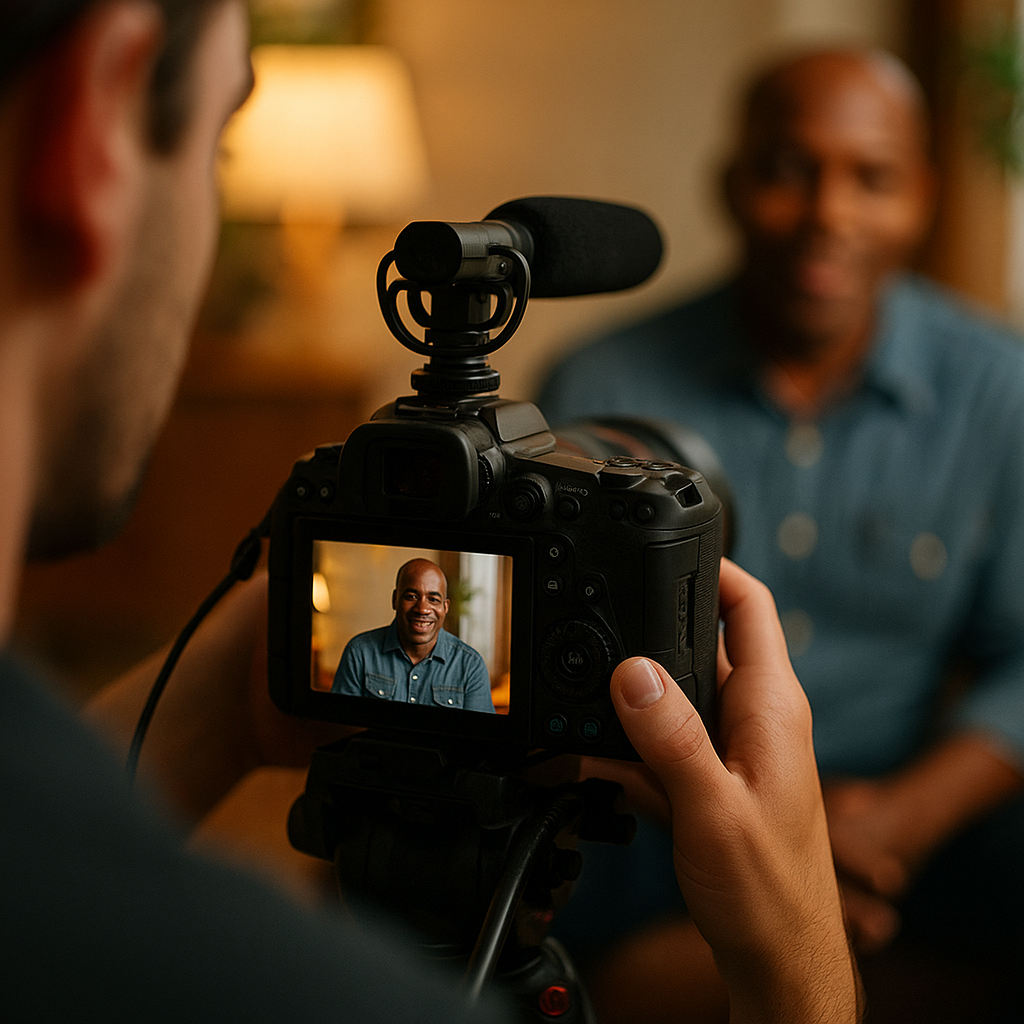
Ninety seconds. That is roughly how long it takes for a well-cut mini-documentary to do what a thirty-second ad spot cannot: make a stranger care. Launch films built in documentary style, part founder origin story, part behind-the-scenes grind, part product reveal, are quietly outperforming polished commercial drops on watch time and brand lift. The format works because it refuses to sell in the first frame. It earns the sell. For brands planning a mini-documentary launch film strategy, that patience is the entire point.
Why Documentary Framing Beats the Hype Reel
Traditional launch content front-loads the product. Documentary-style launch films front-load the problem, the people, and the process, then let the product arrive as the natural conclusion. That structural choice matters more than it sounds. Viewers have been trained by a decade of skippable pre-roll to distrust anything that opens with a hard pitch. A mini-doc opens with tension instead: a founder’s frustration, a manufacturing failure, a customer complaint that sparked the whole project.
This isn’t just creative preference. Audience retention data across platforms consistently shows narrative-first content holding viewers longer than product-first content, which directly affects algorithmic distribution on platforms like YouTube and Meta. Longer watch time signals relevance, and relevance gets rewarded with reach.
A launch film that spends its first forty seconds on story, not spec sheet, tends to outperform a straight product ad on completion rate by a wide margin because it gives the algorithm a reason to keep pushing it.
What Actually Makes a Launch Film a “Mini-Documentary”
Not every behind-the-scenes clip qualifies. The format has a few recognizable ingredients that separate it from a glorified product video:
- A real narrative arc, usually problem, struggle, breakthrough, resolution, rather than a feature list.
- Unscripted or semi-scripted interview segments with founders, engineers, or early customers, not actors reading copy.
- Observational b-roll of the actual building process: prototyping, testing, failing, iterating.
- A runtime between ninety seconds and six minutes, long enough to build emotional investment, short enough to respect attention spans.
- A product reveal that feels earned, placed at the two-thirds mark rather than the opening shot.
Brands that skip the interview component and just stitch together slow-motion factory footage with a moody voiceover are making a product video with documentary aesthetics. That’s fine, but it’s not the same engine. The emotional pull of this format comes from real people saying real things on camera, flaws included.
The ROI Case Nobody Wants to Make Out Loud
Here’s the uncomfortable truth for budget owners: mini-documentary launch films cost more upfront and take longer to produce than a standard fifteen-second UGC ad. A single film can run anywhere from a few thousand dollars for a lean in-house crew to six figures for agency-produced content with original scoring and multi-location shoots. That scares a lot of performance marketers who are used to testing creative in days, not weeks.
But the comparison isn’t apples to apples. A launch film isn’t meant to compete with a micro video ad variant on cost-per-acquisition. It’s meant to compete with a Super Bowl spot on brand equity, at a fraction of the media spend, because it’s engineered for organic distribution and long-tail reuse. One well-made film gets cut into dozens of shorter assets: a founder-led clip for LinkedIn, a product-reveal moment for TikTok, a customer testimonial snippet for paid retargeting. The film is the asset library, not a single ad.
Marketers tracking total content ROI should measure the launch film against its full downstream yield, not just its standalone view count. According to eMarketer, brand-led video content increasingly drives measurable lift in search interest and direct traffic in the weeks following release, a signal that’s easy to miss if you’re only watching platform-native engagement metrics.
Where This Format Fits in the Funnel
Mini-documentary launch films are not top-of-funnel awareness plays by default, and they’re not bottom-of-funnel conversion tools either. They sit in the messy middle: the consideration stage where a buyer already knows the category exists but hasn’t decided who to trust. That’s exactly the zone where funnel stage content mapping becomes essential, because deploying a six-minute origin story to a cold audience scrolling for entertainment is a mismatch that wastes both budget and goodwill.
The smarter play is a sequencing strategy. Run short, punchy variants to build initial awareness. Once a user has engaged once or twice, retarget with the fuller documentary cut. This mirrors the logic behind serialized UGC series, where depth is reserved for audiences who’ve already shown interest, not blasted to everyone on the first touch.
Casting the Right Voices Matters More Than the Camera
A mini-doc lives or dies on who’s talking, not how pretty the lighting is. Brands that cast their actual founder, in a format similar to founder led video, tend to generate more authentic engagement than those relying on a hired narrator. Audiences can tell the difference between someone who built the thing and someone who’s reading a script about it.
That said, founders aren’t always compelling on camera, and that’s fine. A growing number of brands are pairing founder appearances with creator talent in a structure similar to the founder cameo format, where a known creator hosts the narrative and the founder shows up for the credibility beat. This hybrid approach softens the stiffness that sometimes comes with executive-led content while keeping the authenticity intact.
Early customers matter too. A documentary that includes genuine, unscripted reactions from people who used an early prototype carries more weight than five minutes of internal team talk. If the brand has already built a customer base willing to go on camera, that’s a resource worth tapping before hiring outside talent.
Production Reality: What a Lean Version Looks Like
Not every brand has a six-figure video budget, and that’s where this format gets unfairly dismissed as “only for enterprise.” It doesn’t have to be. A scrappy two-person crew with a decent camera, a lavalier mic, and three days on location can produce a credible mini-doc if the story is strong enough. The narrative does the heavy lifting, not the production value.
Modern editing tools have also compressed the post-production timeline significantly. Teams using AI-assisted editing stacks, similar to the workflow described in CapCut AI editing coverage, can turn raw interview and b-roll footage into a polished cut in a fraction of the time a traditional editor would need. That shift matters for mid-market brands trying to compete with enterprise production budgets without enterprise production teams.
Sound design deserves more attention than it usually gets. A documentary-style film with flat, unmixed audio feels amateur no matter how good the footage looks. Pay attention to pacing and ambient sound the way outlined in vertical video sound design guidance, since mismatched audio cadence is one of the fastest ways to lose a viewer in the first fifteen seconds.
Compliance and Disclosure: The Part Legal Teams Will Ask About
Documentary framing can blur the line between editorial content and advertising, which is exactly the kind of ambiguity regulators watch closely. If a launch film features paid creators, influencers, or compensated customer testimonials, disclosure requirements under FTC endorsement guidelines still apply, regardless of how cinematic the production feels. Brands operating in the UK or EU should also review guidance from the ICO on data handling if the film includes any customer footage tied to identifiable personal information.
The safest approach is to build disclosure into the narrative itself rather than bolting on a disclaimer card at the end. A quick on-screen note identifying paid appearances, placed early, protects the brand without undercutting the storytelling. Marketers who’ve navigated similar tension in other formats, like the compliance considerations in before and after transformation reels, know that transparency rarely hurts performance when it’s handled with a light touch.
Measuring Success Without Fooling Yourself
View count is the laziest metric available for this format, and relying on it alone will mislead the whole team. Better indicators include average watch time as a percentage of total runtime, branded search lift in the two to four weeks post-launch, and downstream click-through on the shorter cutdowns pulled from the main film. Tools like Sprout Social and native platform analytics can help track engagement depth rather than surface-level reach.
Brands should also track asset reuse rate: how many secondary clips were pulled from the original film, and how each performed independently. A launch film that only gets used once has underperformed its potential regardless of its initial view count.
Common Mistakes That Sink an Otherwise Strong Film
- Treating the documentary as a one-off hero asset instead of a content library to be mined for months.
- Over-scripting interview subjects until they sound like they’re reciting brand messaging.
- Burying the product reveal so deep that casual viewers drop off before ever seeing it.
- Ignoring platform-specific cutdowns and uploading the full six-minute version natively to TikTok or Reels, where it will get buried.
- Skipping captions and text overlays, which matters enormously for sound-off viewing environments, a challenge well documented in silent captioned storytime strategies.
Brands ready to test this format should start small: pick one upcoming launch, commit to a three-day shoot, and build the narrative around a genuine problem the product solves, not a feature list. Measure watch-through and branded search lift before scaling the budget for the next one.
FAQs
How long should a mini-documentary launch film be?
Most effective launch films run between ninety seconds and six minutes. Shorter cuts work for top-of-funnel distribution, while the full-length version performs best with retargeted or already-engaged audiences.
Is this format only viable for brands with large production budgets?
No. A lean crew with strong storytelling can outperform a high-budget production that lacks a real narrative. The story carries the format more than the equipment does.
Where should a mini-documentary launch film be distributed first?
Owned channels and organic social typically come first, since the format thrives on patient viewing. Paid distribution works best once the film is cut into shorter, platform-native segments.
Do mini-documentary launch films need influencer disclosure?
Yes, if any featured creator, customer, or voice was compensated, FTC disclosure rules apply regardless of the documentary framing.
How do brands measure ROI on a format that isn’t built for direct response?
Track branded search lift, watch-through percentage, and the performance of secondary clips pulled from the original film rather than relying on view count alone.
Top Influencer Marketing Agencies
The leading agencies shaping influencer marketing in 2026
Agencies ranked by campaign performance, client diversity, platform expertise, proven ROI, industry recognition, and client satisfaction. Assessed through verified case studies, reviews, and industry consultations.
Moburst

-
2

The Shelf
Boutique Beauty & Lifestyle Influencer AgencyA data-driven boutique agency specializing exclusively in beauty, wellness, and lifestyle influencer campaigns on Instagram and TikTok. Best for brands already focused on the beauty/personal care space that need curated, aesthetic-driven content.Clients: Pepsi, The Honest Company, Hims, Elf Cosmetics, Pure LeafVisit The Shelf → -
3

Audiencly
Niche Gaming & Esports Influencer AgencyA specialized agency focused exclusively on gaming and esports creators on YouTube, Twitch, and TikTok. Ideal if your campaign is 100% gaming-focused — from game launches to hardware and esports events.Clients: Epic Games, NordVPN, Ubisoft, Wargaming, Tencent GamesVisit Audiencly → -
4

Viral Nation
Global Influencer Marketing & Talent AgencyA dual talent management and marketing agency with proprietary brand safety tools and a global creator network spanning nano-influencers to celebrities across all major platforms.Clients: Meta, Activision Blizzard, Energizer, Aston Martin, WalmartVisit Viral Nation → -
5

The Influencer Marketing Factory
TikTok, Instagram & YouTube CampaignsA full-service agency with strong TikTok expertise, offering end-to-end campaign management from influencer discovery through performance reporting with a focus on platform-native content.Clients: Google, Snapchat, Universal Music, Bumble, YelpVisit TIMF → -
6

NeoReach
Enterprise Analytics & Influencer CampaignsAn enterprise-focused agency combining managed campaigns with a powerful self-service data platform for influencer search, audience analytics, and attribution modeling.Clients: Amazon, Airbnb, Netflix, Honda, The New York TimesVisit NeoReach → -
7

Ubiquitous
Creator-First Marketing PlatformA tech-driven platform combining self-service tools with managed campaign options, emphasizing speed and scalability for brands managing multiple influencer relationships.Clients: Lyft, Disney, Target, American Eagle, NetflixVisit Ubiquitous → -
8

Obviously
Scalable Enterprise Influencer CampaignsA tech-enabled agency built for high-volume campaigns, coordinating hundreds of creators simultaneously with end-to-end logistics, content rights management, and product seeding.Clients: Google, Ulta Beauty, Converse, AmazonVisit Obviously →