


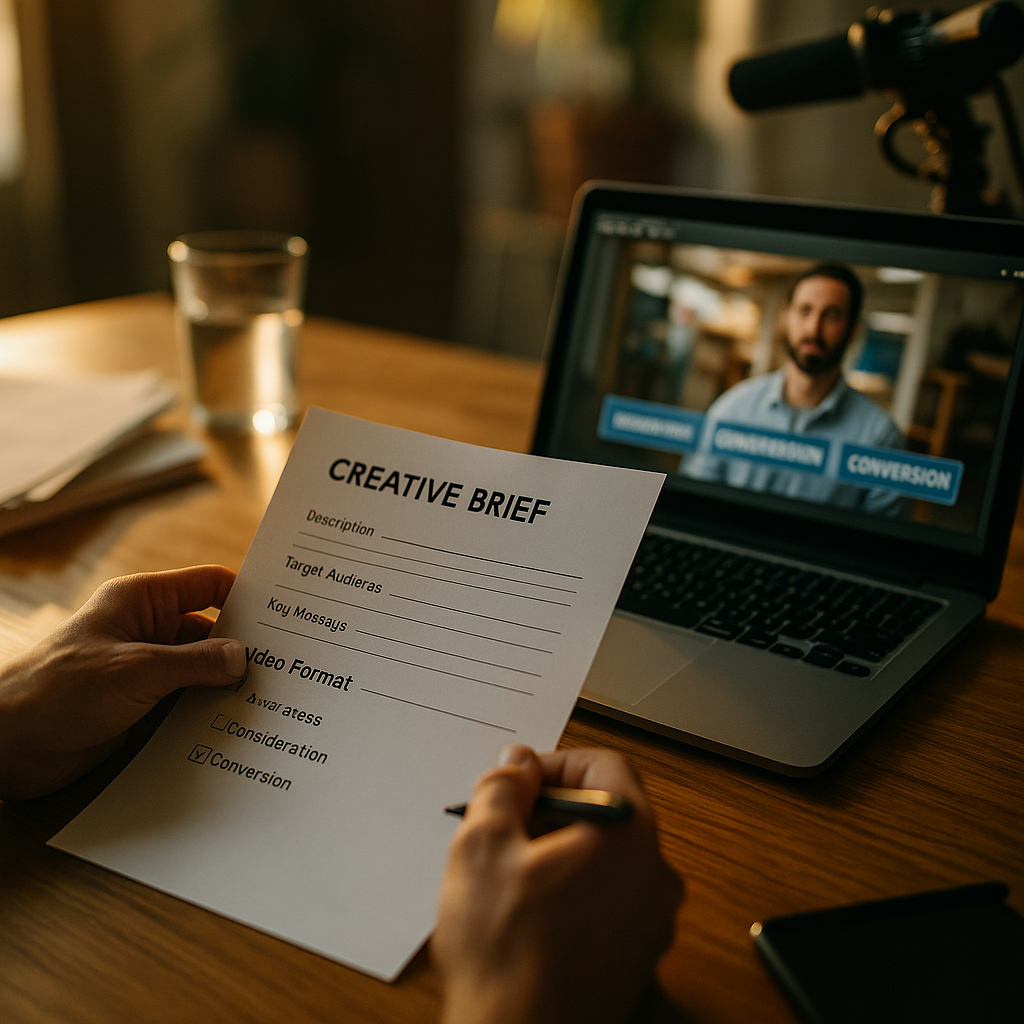
Only 22% of brands say their influencer briefs are tailored to funnel stage, according to recent agency surveys, yet most marketers still send creators the same generic brief regardless of whether the goal is awareness or conversion. That gap is why so much creator content looks great and performs nowhere. Job-specific creative briefs fix this by assigning each video format a single, measurable job: demo videos prove function, story videos build trust, product videos close the sale.
The One Brief Fits All Problem
Here’s the uncomfortable truth: most briefs are written to describe a product, not to do a job. Marketers hand creators a bullet list of features, a brand voice guide, and a vague ask to “show it in action.” The creator interprets that however they want. Sometimes it works. Often it produces a video that’s pretty, on brand, and completely useless for the stage of the funnel it was meant to serve.
A demo video shot like a story video wastes the viewer’s patience. A product video that tries to build emotional narrative instead of showing price and proof loses the bottom-funnel shopper who just wants to know it works. The fix isn’t more creative control. It’s more specificity about the job.
A brief without a stated funnel job is just a content request. A brief with one is a performance asset.
Three Formats, Three Jobs
Strip away the trend chasing and most influencer video content falls into three functional buckets. Each has a distinct job, a distinct viewer mindset, and a distinct success metric.
- Demo video: Job is proof of function. Viewer mindset is skeptical, comparing. Success metric is watch-through and saves.
- Story video: Job is emotional relevance. Viewer mindset is curious, relating. Success metric is comments and shares.
- Product video: Job is purchase decision. Viewer mindset is ready, price checking. Success metric is click-through and add to cart.
Confusing these jobs is the single biggest reason briefs underperform. A demo that tries to also be a story ends up long, unfocused, and skipped. A product video that opens with ten seconds of lifestyle b-roll loses the bottom-funnel viewer before the price ever shows up on screen. This is the same logic behind funnel stage content mapping, which treats format selection as a buyer intent problem, not a creative preference.
Matching Format to Funnel Stage
Think of the funnel in three zones: top (awareness), middle (consideration), bottom (conversion). Each zone has a dominant question the viewer is silently asking. Your job as the brief writer is to answer that exact question and nothing else.
Top of funnel, the question is “why should I care?” Story format wins here. This is where founder narrative, origin story, or a relatable problem-solution arc earns attention before the product is even named. Formats like founder-led video and mini documentary launch films do this job well because they sell the “why” before the “what.”
Middle of funnel, the question is “does this actually work?” Demo format wins here. The viewer has moved past curiosity into evaluation mode. They want to see the product used, hear it work (sound matters more than most brands assume, as sound-only demo data shows), and compare it mentally against alternatives they’ve already seen.
Bottom of funnel, the question is “should I buy this right now?” Product video wins here. Price, offer, shipping terms, and a clear call to action belong in the first five seconds. This is not the place for brand storytelling. It’s the place for friction removal. POV storytelling scripts can still be used here, but the emotional arc gets compressed into a tight, purchase-oriented script rather than a slow build.
If your bottom-funnel video and your top-funnel video could swap scripts without anyone noticing, your briefs aren’t job-specific yet.
What Actually Changes in the Brief Document
Most creative briefs change the “what” (product, offer, hashtag) but not the “how.” Job-specific briefs change five structural elements based on funnel stage, and this is where the real operational discipline lives.
- Hook timing. Story videos can earn three to five seconds of patience before the payoff. Product videos get one second, maybe two, before the scroll finger moves. Say this explicitly in the brief. Don’t assume the creator knows.
- Proof placement. Demo briefs should specify exactly where functional proof appears (the unboxing, the application, the result) because this is the section viewers rewatch. Product briefs should specify where price and offer appear, usually on screen by second three.
- Voiceover versus text. Story videos lean on voiceover for emotional pacing. Product videos increasingly lean on text over b-roll because it’s scannable, sound-off friendly, and faster to produce at scale.
- Call to action language. Awareness-stage briefs ask for soft CTAs (“learn more,” “follow for part two”). Conversion-stage briefs demand direct CTAs with urgency language and a visible link or code.
- Length and pacing. Demos can run 45 to 90 seconds because viewers are actively evaluating. Product videos should stay under 20 seconds in most cases. Nobody browsing with purchase intent wants a documentary.
Writing these five variables into every brief, rather than leaving them to creator instinct, is what separates a job-specific brief from a generic one. It also gives your legal and compliance team a consistent structure to review against, which matters more than ever given FTC disclosure requirements for sponsored content across formats.
Where Teams Get This Wrong
The most common failure isn’t a bad creator. It’s a brand asking one creator to produce one video that somehow hits all three jobs at once. “Show the product, tell your story, and make sure people buy it” is not a brief. It’s three briefs stapled together, and the resulting video usually satisfies none of the three.
The second most common failure is measuring the wrong metric against the wrong format. If you’re judging a top-funnel story video on click-through rate, you’re going to kill a format that was never designed to drive clicks. HubSpot’s funnel research consistently shows that awareness content and conversion content need entirely different success benchmarks, and treating them identically leads brands to defund working campaigns for the wrong reasons.
A third failure, increasingly common as brands scale creator rosters, is applying one brief template across a multi-creator collaboration without adjusting for each creator’s natural funnel strength. Some creators are gifted storytellers but awkward demoers. Forcing them into the wrong job wastes both budget and relationship capital.
Building the Brief Template That Scales
Operationally, the fix is a modular brief system rather than a single document. Build three base templates, one per job, each with the five structural variables above pre-filled. When a new campaign launches, your team picks the template that matches the funnel stage, swaps in product specifics, and sends it out. This cuts brief-writing time dramatically and, more importantly, cuts the ambiguity that causes creators to freelance their own interpretation of the ask.
Track performance by template, not just by campaign. Over two or three quarters, you’ll start seeing which creators consistently overperform on story jobs versus demo jobs, which lets you route future briefs to the right talent automatically. Platforms like Sprout Social and internal dashboards can help tag content by funnel job so this analysis doesn’t require manual spreadsheet work every quarter.
Formats like before and after transformation reels are a useful case study here. They technically sit in the demo category, but they borrow story-format emotional pacing at the open and product-format urgency at the close. That hybrid structure only works because the brief explicitly calls out which section does which job, rather than leaving the blend to chance.
Next step: Audit your last ten influencer briefs. If you can’t identify which funnel stage each one was written for, you’ve found your biggest quick win: rebuild those briefs around a single stated job before you spend another dollar on production.
FAQs
What is a job-specific creative brief?
A job-specific creative brief assigns one clear functional goal, such as proving a product works, building emotional connection, or driving an immediate purchase, to a piece of creator content, and writes the brief’s structure (hook timing, proof placement, CTA language) around that single goal rather than trying to accomplish multiple goals in one video.
How do I know which format fits which funnel stage?
Match the viewer’s dominant question to the format: top-funnel viewers ask “why should I care,” which favors story format; mid-funnel viewers ask “does this work,” which favors demo format; bottom-funnel viewers ask “should I buy now,” which favors product format with price and offer upfront.
Can one creator produce content for multiple funnel stages?
Yes, but each piece of content should still have its own job-specific brief. The same creator can deliver a top-funnel story video and a bottom-funnel product video, but the scripts, pacing, and CTAs for each should be written separately rather than combined into one asset.
What metrics should I use to judge each format?
Judge story videos on shares and comments, demo videos on watch-through rate and saves, and product videos on click-through rate and add to cart. Using conversion metrics to judge awareness content, or vice versa, leads to defunding formats that are actually working as intended.
How long should each video format be?
Story videos can run 30 to 60 seconds to allow for narrative build. Demo videos typically run 45 to 90 seconds since viewers are actively evaluating. Product videos should generally stay under 20 seconds because purchase-ready viewers want speed, not a slow reveal.
Top Influencer Marketing Agencies
The leading agencies shaping influencer marketing in 2026
Agencies ranked by campaign performance, client diversity, platform expertise, proven ROI, industry recognition, and client satisfaction. Assessed through verified case studies, reviews, and industry consultations.
Moburst

-
2

The Shelf
Boutique Beauty & Lifestyle Influencer AgencyA data-driven boutique agency specializing exclusively in beauty, wellness, and lifestyle influencer campaigns on Instagram and TikTok. Best for brands already focused on the beauty/personal care space that need curated, aesthetic-driven content.Clients: Pepsi, The Honest Company, Hims, Elf Cosmetics, Pure LeafVisit The Shelf → -
3

Audiencly
Niche Gaming & Esports Influencer AgencyA specialized agency focused exclusively on gaming and esports creators on YouTube, Twitch, and TikTok. Ideal if your campaign is 100% gaming-focused — from game launches to hardware and esports events.Clients: Epic Games, NordVPN, Ubisoft, Wargaming, Tencent GamesVisit Audiencly → -
4

Viral Nation
Global Influencer Marketing & Talent AgencyA dual talent management and marketing agency with proprietary brand safety tools and a global creator network spanning nano-influencers to celebrities across all major platforms.Clients: Meta, Activision Blizzard, Energizer, Aston Martin, WalmartVisit Viral Nation → -
5

The Influencer Marketing Factory
TikTok, Instagram & YouTube CampaignsA full-service agency with strong TikTok expertise, offering end-to-end campaign management from influencer discovery through performance reporting with a focus on platform-native content.Clients: Google, Snapchat, Universal Music, Bumble, YelpVisit TIMF → -
6

NeoReach
Enterprise Analytics & Influencer CampaignsAn enterprise-focused agency combining managed campaigns with a powerful self-service data platform for influencer search, audience analytics, and attribution modeling.Clients: Amazon, Airbnb, Netflix, Honda, The New York TimesVisit NeoReach → -
7

Ubiquitous
Creator-First Marketing PlatformA tech-driven platform combining self-service tools with managed campaign options, emphasizing speed and scalability for brands managing multiple influencer relationships.Clients: Lyft, Disney, Target, American Eagle, NetflixVisit Ubiquitous → -
8

Obviously
Scalable Enterprise Influencer CampaignsA tech-enabled agency built for high-volume campaigns, coordinating hundreds of creators simultaneously with end-to-end logistics, content rights management, and product seeding.Clients: Google, Ulta Beauty, Converse, AmazonVisit Obviously →