


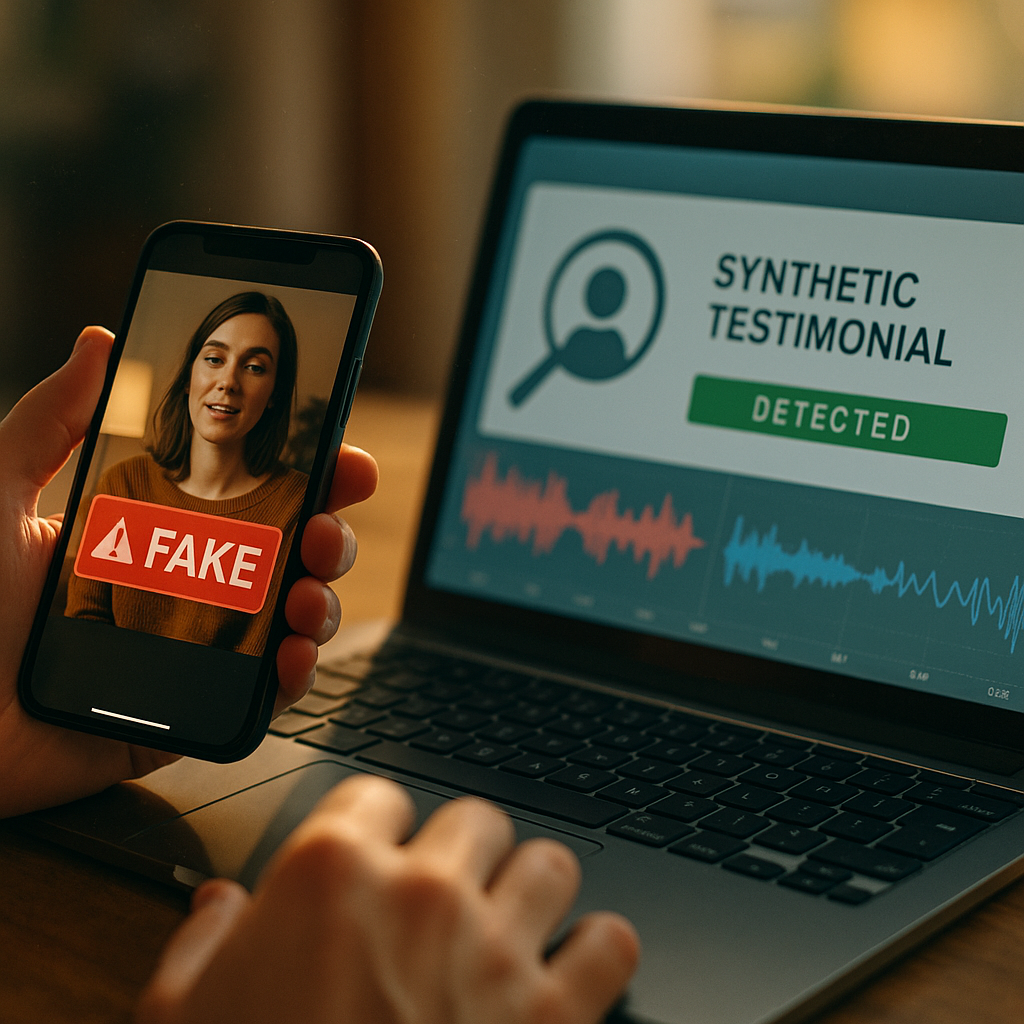
One in three marketers admits they can no longer reliably tell AI-generated testimonials from real customer footage, according to internal surveys circulating among trust and safety teams this year. If your QA process still relies on a human eyeballing a video before it airs, you’re already behind. Detecting synthetic UGC has become a core competency for brands, not a nice-to-have.
The Problem Isn’t Hypothetical Anymore
Fake testimonials used to mean a paid actor reading a script badly. Now they mean a fully synthetic “customer” generated by tools like Synthesia, HeyGen, or open-source diffusion models, complete with believable skin texture, natural blinking, and regional accents. Some agencies have started quietly producing synthetic UGC at scale because it’s cheaper and faster than booking real creators, and it sidesteps the usual rights negotiations.
The problem is that it’s fraud dressed up as authenticity. The FTC has made clear that endorsements must reflect the honest opinions and experiences of the endorser, and a synthetic person has no experience to reflect. Brands that air AI-fabricated testimonials without disclosure are exposed to regulatory action, platform bans, and the reputational gut-punch that comes when a viewer spots the uncanny valley and posts about it.
A single viral callout of a fake testimonial can erase months of brand trust-building in hours, and the clip lives forever once it’s screenshotted.
What Synthetic UGC Actually Looks Like in the Wild
It’s not always obvious. The crude stuff, the seven-fingered hand and the melting earring, gets caught in five seconds. The dangerous category is mid-tier synthetic content: a believable talking head, slightly-too-perfect lighting, audio that’s almost but not quite in sync with mouth movement. These are the testimonials that pass a tired reviewer’s glance and end up in a paid social campaign.
Common red flags practitioners are training themselves to spot include:
- Unnatural blink rate or eyes that never fully close
- Audio-visual sync drift, especially on consonants like “p” and “b”
- Background elements that subtly warp when the subject moves
- Testimonials that use suspiciously generic brand language verbatim, as if generated from the same brief as the ad copy
- No verifiable social footprint for the “customer” supposedly giving the review
That last point matters more than people realize. A real customer usually has a digital trail: a purchase record, a social profile, maybe a prior mention of the brand. A synthetic persona has none of that, which is exactly why AI creator vetting tools built for influencer fraud are increasingly being repurposed to vet testimonial submissions too.
Detection Tools Brands Are Actually Deploying
The detection tooling market has matured fast, pushed partly by the same generative AI vendors who built the problem. A few categories worth knowing:
- Forensic media analyzers. Tools like Hive Moderation and Reality Defender scan video frame-by-frame for compression artifacts and generation signatures that diffusion models leave behind. They’re not perfect, but they catch a large share of obvious synthetic content before it reaches a human reviewer.
- Audio deepfake detectors. Pindrop and Resemble AI’s detection suite analyze waveform patterns that synthetic voice generation tends to produce, even when the voice sounds convincing to the ear.
- Provenance and watermark checkers. The C2PA coalition’s Content Credentials standard, backed by Adobe, Microsoft, and others, embeds metadata showing how an asset was created and edited. Brands can check incoming UGC submissions for the absence of expected provenance data, which is itself a signal worth flagging.
- Behavioral and metadata cross-checks. Some brand safety platforms now cross-reference the claimed customer’s identity against CRM records, purchase history, and social presence before a testimonial clears for use. This ties neatly into the kind of unified first-party data systems brands have already invested in for creator relationship management.
None of these tools work alone. The strongest setups chain two or three detection layers together and route anything flagged to a human reviewer with specific context on what tripped the alert.
Why Manual Review Still Fails at Scale
Here’s the uncomfortable truth: a trained reviewer catches maybe 60 to 70 percent of well-made synthetic content on a good day, less when they’re reviewing their fortieth clip of the shift. Fatigue is real, and generative models are improving monthly. Betting your brand safety program on a human’s gut feeling is a losing wager over time.
This is the same dynamic that’s playing out across marketing operations generally. Teams that leaned too hard on automation without oversight learned the hard way, as covered in our piece on auto-approve guardrails blurring who actually owns the risk when something slips through. Synthetic UGC detection needs the opposite structure: automation that flags, humans that decide, and a clear audit trail showing who signed off.
Building a Detection Workflow That Doesn’t Slow You Down
Marketing leaders worry, reasonably, that adding a detection layer will turn a three-day UGC turnaround into a three-week bottleneck. It doesn’t have to. The brands doing this well have built detection into the ingestion step rather than bolting it on at the end.
A workable pipeline looks something like this:
- Every UGC submission passes through an automated forensic scan within minutes of upload.
- Content scoring above a risk threshold routes automatically to a human reviewer, while low-risk content moves straight to the creative team.
- Reviewers get a dashboard showing exactly which signals triggered the flag (sync drift, missing provenance metadata, no CRM match) rather than raw footage with no context.
- Flagged and rejected content gets logged, not deleted, so legal and compliance teams have a record if a dispute arises later.
This mirrors the structure that’s already working in other high-risk automation contexts. Our coverage of agentic QA suites cutting launch risk in real time shows the same principle: speed and safety aren’t actually in tension if the workflow is designed properly from the start.
The Creator Economy Angle: Protecting Real Creators Too
There’s a secondary benefit here that doesn’t get enough airtime. Detection tools don’t just protect brands from legal exposure, they protect legitimate creators from being undercut by synthetic competitors who can produce “testimonials” at zero marginal cost. A creator economy where AI-fabricated endorsements compete on equal footing with real ones is a race to the bottom for everyone involved, including the brand that eventually gets caught running fake content.
It also connects to broader questions about attribution. If a testimonial’s origin can’t be verified, any performance data tied to it is suspect too, which is the same concern raised in our analysis of AI ad variants diluting attribution signal. Clean inputs matter for clean measurement downstream.
If you can’t verify who made a testimonial, you can’t trust what it’s telling you about your customers, let alone your ROI.
What to Put in Your Vendor Contracts Now
Detection tools solve half the problem. The other half is contractual. Agencies and UGC marketplaces should be contractually required to disclose any synthetic media generation used in deliverables, full stop. Build language into statements of work that requires:
- Disclosure of any AI generation or AI-assisted editing used in testimonial content
- Chain-of-custody documentation for the original customer footage, where applicable
- Indemnification clauses specific to FTC endorsement guideline violations
- The right to run submitted content through your own detection stack before payment releases
Review the FTC’s endorsement guidance directly rather than relying on secondhand summaries, since enforcement priorities shift. Platforms are tightening their own rules too; check current Meta Business and TikTok Ads policies on AI-generated content disclosure before your next campaign brief goes out, since violations there can mean account-level penalties, not just a pulled ad.
A Quick Gut Check Before Any Testimonial Airs
Ask these three questions every time: Can we trace this person to a real purchase or interaction? Does the footage carry intact provenance metadata? Has it passed through at least one automated forensic check? If any answer is no, it doesn’t ship until someone resolves it. That’s the whole discipline, really. Not glamorous, but it works.
Industry benchmarking from firms like eMarketer continues to show rising ad spend flowing into creator and UGC-style formats, which only raises the stakes. More budget moving into a format means more incentive for bad actors to flood it with cheap synthetic content, and more reason for brands to get detection right before, not after, a campaign airs.
Next step: audit your current UGC intake process this week. If there’s no automated forensic or provenance check between creator submission and creative approval, that’s your gap, and it’s the one a regulator or a viral TikTok callout will find first.
Frequently Asked Questions
What is synthetic UGC detection?
Synthetic UGC detection refers to the tools and processes used to identify AI-generated or AI-manipulated user content, particularly testimonials and reviews, before a brand publishes or pays for them.
Can AI-generated testimonials be legally used in advertising?
They can be used only with clear disclosure that the content is AI-generated or that the person featured is not an actual customer. Presenting synthetic content as a genuine customer endorsement without disclosure violates FTC endorsement guidelines and risks regulatory action.
Which tools detect AI-generated video testimonials?
Commonly used tools include Hive Moderation and Reality Defender for forensic video analysis, Pindrop and Resemble AI for audio deepfake detection, and C2PA Content Credentials for checking media provenance metadata.
How accurate are AI detection tools for synthetic media?
Accuracy varies by content quality and detection method, and no single tool catches everything. Most brands layer two or three detection methods together and route flagged content to human reviewers rather than relying on one automated check.
What happens if a brand unknowingly airs a fake AI testimonial?
Consequences can include FTC enforcement action, platform ad account penalties, loss of consumer trust, and reputational damage if the fabrication is publicly exposed. Many brands now require indemnification clauses in creator and agency contracts to cover this risk.
Top Influencer Marketing Agencies
The leading agencies shaping influencer marketing in 2026
Agencies ranked by campaign performance, client diversity, platform expertise, proven ROI, industry recognition, and client satisfaction. Assessed through verified case studies, reviews, and industry consultations.
Moburst

-
2

The Shelf
Boutique Beauty & Lifestyle Influencer AgencyA data-driven boutique agency specializing exclusively in beauty, wellness, and lifestyle influencer campaigns on Instagram and TikTok. Best for brands already focused on the beauty/personal care space that need curated, aesthetic-driven content.Clients: Pepsi, The Honest Company, Hims, Elf Cosmetics, Pure LeafVisit The Shelf → -
3

Audiencly
Niche Gaming & Esports Influencer AgencyA specialized agency focused exclusively on gaming and esports creators on YouTube, Twitch, and TikTok. Ideal if your campaign is 100% gaming-focused — from game launches to hardware and esports events.Clients: Epic Games, NordVPN, Ubisoft, Wargaming, Tencent GamesVisit Audiencly → -
4

Viral Nation
Global Influencer Marketing & Talent AgencyA dual talent management and marketing agency with proprietary brand safety tools and a global creator network spanning nano-influencers to celebrities across all major platforms.Clients: Meta, Activision Blizzard, Energizer, Aston Martin, WalmartVisit Viral Nation → -
5

The Influencer Marketing Factory
TikTok, Instagram & YouTube CampaignsA full-service agency with strong TikTok expertise, offering end-to-end campaign management from influencer discovery through performance reporting with a focus on platform-native content.Clients: Google, Snapchat, Universal Music, Bumble, YelpVisit TIMF → -
6

NeoReach
Enterprise Analytics & Influencer CampaignsAn enterprise-focused agency combining managed campaigns with a powerful self-service data platform for influencer search, audience analytics, and attribution modeling.Clients: Amazon, Airbnb, Netflix, Honda, The New York TimesVisit NeoReach → -
7

Ubiquitous
Creator-First Marketing PlatformA tech-driven platform combining self-service tools with managed campaign options, emphasizing speed and scalability for brands managing multiple influencer relationships.Clients: Lyft, Disney, Target, American Eagle, NetflixVisit Ubiquitous → -
8

Obviously
Scalable Enterprise Influencer CampaignsA tech-enabled agency built for high-volume campaigns, coordinating hundreds of creators simultaneously with end-to-end logistics, content rights management, and product seeding.Clients: Google, Ulta Beauty, Converse, AmazonVisit Obviously →