


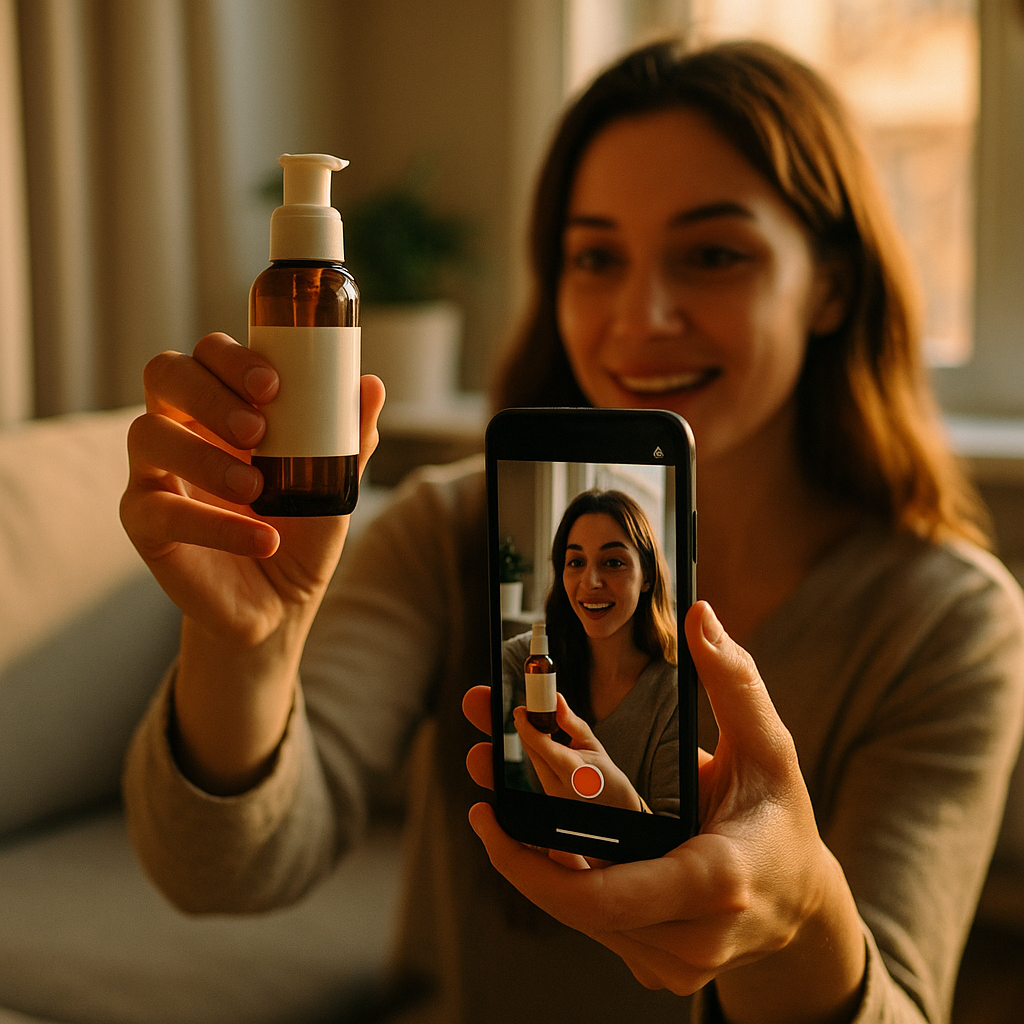
Scroll-stopping lifestyle imagery gets the likes. Product in hand UGC gets the add to cart. A Billo-commissioned analysis of thousands of paid social ads found that demo-style creator content, where a real hand holds, opens, or uses the product, consistently outperformed polished lifestyle shots on click-through and conversion metrics. If your influencer program is still chasing beautifully staged flat lays, you might be optimizing for the wrong outcome entirely.
This isn’t a design preference. It’s a trust mechanic. Shoppers can’t touch what they see on a screen, so the closest substitute is watching someone else touch it first.
What “Product in Hand” Actually Means
Product in hand UGC is exactly what it sounds like: a creator physically holding, using, or demonstrating a product in frame, usually with minimal styling and zero studio polish. Think a hand twisting open a serum cap, fingers testing fabric stretch, or a thumb scrolling through an app interface. The camera stays close. The focus stays on function, not aesthetics.
Lifestyle imagery, by contrast, places the product in an aspirational scene: a skincare bottle on a marble counter bathed in golden light, a sneaker photographed mid-stride on a mountain trail. It sells a feeling. Demo content sells a fact.
Both have a place in a media plan. But when the goal is conversion rather than brand awareness, the data keeps pointing toward hands-on proof over curated mood.
Why Demo Shots Win on Conversion
Three psychological levers explain the performance gap.
- Scale and proportion. A hand holding a bottle instantly tells a shopper how big or small it is, something no product listing photo reliably communicates. Returns driven by size confusion drop when buyers can see the item against a human reference point.
- Perceived authenticity. Viewers have learned to discount staged lifestyle content as advertising. A slightly shaky, close-up demo reads as unscripted, even when it’s fully briefed and approved. That perceived rawness lowers skepticism.
- Functional proof. Demo content answers the question lifestyle imagery avoids: does this actually work? A closure that snaps shut, a texture that blends into skin, a zipper that glides, these micro-moments resolve hesitation faster than any caption copy.
Lifestyle imagery sells an aspiration. Demo footage sells an answer to the one question every shopper is silently asking: will this work for me?
eMarketer and other research groups have repeatedly flagged that consumer trust in branded content keeps eroding while trust in peer-generated content holds steady or climbs. You can review broader consumer trust benchmarks at eMarketer, which tracks shifting attitudes toward influencer and UGC advertising year over year.
The Scroll-Stopping Problem Lifestyle Imagery Creates
Here’s an uncomfortable truth for creative teams that love a beautiful shot: polished lifestyle imagery increasingly looks like an ad, and ads get scrolled past. Feed algorithms on TikTok, Instagram, and YouTube Shorts reward watch time, not aesthetic quality. A demo video that opens mid-action (a hand already mid-unboxing, product already in motion) tends to hold attention longer in the first three seconds than a static, art-directed frame.
This connects directly to a point we’ve covered before: the hook matters more than the polish. If you haven’t already built a swipe file of proven openers, our piece on reusable hook systems breaks down how top-performing brands structure the first three seconds to stop the scroll before the demo even begins.
Where This Fits in the Funnel
Product in hand UGC isn’t a top-of-funnel awareness play. It’s a mid-to-bottom funnel conversion tool. Brands running retargeting campaigns or product detail page ads see the strongest lift when demo content replaces or sits alongside lifestyle creative at that stage.
Think of it this way: lifestyle imagery earns the click from a cold audience who doesn’t know your brand yet. Demo content closes the sale for someone who’s already considering the purchase and needs one final nudge of proof. Mixing the two in a sequenced ad set, lifestyle for the top, demo for retargeting, tends to outperform using either format alone across the whole funnel.
This is why many performance marketers now brief creators for both formats in a single shoot. One lifestyle cutdown for cold prospecting, one tight demo cutdown for warm retargeting. It’s efficient, and it respects how differently a cold scroller and a warm, considering buyer actually watch video.
The Compliance Angle Brands Keep Underestimating
There’s a risk mitigation layer here too, and it’s worth taking seriously. The FTC has sharpened its scrutiny of influencer content that implies a product does something it doesn’t, particularly in beauty, supplements, and tech categories. Demo footage, precisely because it shows the product functioning in real time, tends to be more defensible from a compliance standpoint than lifestyle imagery that relies on implication and mood.
If a creator says “this serum absorbs in seconds” while visibly rubbing it into skin on camera, that’s a demonstrable claim. If a brand implies the same thing through a soft-focus lifestyle shot and suggestive copy, that’s closer to the gray area regulators have flagged repeatedly. Review the FTC’s own endorsement guidance at ftc.gov before greenlighting claims-heavy creative of either format.
Agencies managing multi-market campaigns should also check regional guidance, since UK brands working with creators need to account for ICO data and disclosure expectations that differ slightly from US FTC rules.
Briefing Creators for Demo-First Content
Getting good product in hand footage isn’t about handing a creator the product and hoping for the best. It requires a tighter brief than lifestyle content, counterintuitively, because the margin for a bad demo (fumbled packaging, awkward silence, unclear function) is much less forgiving on camera.
A few briefing principles that consistently produce usable footage:
- Specify the hero moment. Tell the creator exactly which product interaction needs to be crystal clear: the snap of a clasp, the pour consistency, the texture on first touch. Don’t leave this to improvisation.
- Request multiple angles of the same action. A close-up and a slightly wider shot of the identical demo give editors flexibility without requiring a reshoot.
- Keep hands and nails neutral unless brand-relevant. Overly styled manicures or jewelry can distract from the product and make footage feel staged again, undercutting the entire point of the format.
- Ask for natural audio, not voiceover-only. The click, snap, or pour sound reinforces authenticity even on platforms where most viewers watch muted. For sound-dependent categories, pair this with guidance from our sound-driven content breakdown, which covers how texture and audio cues influence beauty and food purchase intent specifically.
Brands sourcing this content at scale through creator marketplaces should also build demo-specific briefs into their UGC pipeline rather than treating it as an afterthought bolted onto lifestyle shoots. The format deserves its own creative brief, its own shot list, and its own success metrics.
Pairing Demo Footage With Other High-Performing Formats
Product in hand content doesn’t have to stand alone. It pairs well with formats that already lean on proof and specificity. A comparison video structure, for instance, benefits enormously from demo-style close-ups showing two products side by side in real use. Similarly, split-screen before and after formats rely on the same close, unglamorous camera work that makes demo content credible in the first place.
If you’re running retail-adjacent campaigns, this same principle extends to in-store content. A retail walkthrough format works best when it includes product in hand moments at shelf, not just wide shots of a creator browsing aisles.
Measuring the Difference
Don’t just swap formats on instinct. Run a controlled test. Split your retargeting budget between a lifestyle cutdown and a demo cutdown of the same creator’s content, same spend, same audience, same flight dates. Track click-through rate, add-to-cart rate, and cost per acquisition separately for each.
Most brands running this test for the first time are surprised by the margin. Demo content frequently posts a lower cost per acquisition even when its raw engagement numbers (likes, shares) trail the more visually striking lifestyle version. That’s the entire point: engagement and conversion are not the same metric, and optimizing creative for one doesn’t guarantee the other.
Tools like Meta’s ad platform make this split test straightforward to set up. Review Meta’s Meta Business creative testing tools or TikTok’s TikTok Ads Manager experimentation features to run a structured A/B comparison instead of guessing based on vibes.
Next step: audit your current influencer brief template. If it doesn’t explicitly request a product in hand demo cutdown alongside lifestyle footage, add it this week, then run a two-week split test against your best-performing lifestyle creative to see the conversion delta for yourself.
FAQs
What makes product in hand UGC different from a regular unboxing video?
An unboxing video is a content format focused on the reveal moment. Product in hand UGC is a broader category that includes any footage where the creator physically interacts with the product on camera, whether that’s unboxing, applying, testing, or demonstrating a specific feature.
Does product in hand content work for every product category?
It performs best for categories where function, texture, scale, or fit are purchase concerns, think beauty, apparel, food, tech accessories, and household goods. For purely digital or service-based products, demo content often shifts toward screen recordings rather than literal hand-held footage.
How many demo shots should a creator brief request?
Most effective briefs ask for three to five distinct demo moments per shoot, giving editors enough raw footage to cut multiple ad variants without scheduling a reshoot.
Is product in hand UGC cheaper to produce than lifestyle content?
Generally yes. Demo footage requires less set styling, lighting setup, and location scouting, which lowers production cost even though the briefing process needs to be more precise.
Can demo content be used for top-of-funnel awareness campaigns too?
It can, but it tends to underperform lifestyle imagery at that stage because cold audiences respond more to aspirational framing before they’re evaluating functional details. Save demo content for consideration and retargeting stages where it does the most work.
FAQs
What makes product in hand UGC different from a regular unboxing video? An unboxing video is a content format focused on the reveal moment. Product in hand UGC is a broader category that includes any footage where the creator physically interacts with the product on camera, whether that’s unboxing, applying, testing, or demonstrating a specific feature.
Does product in hand content work for every product category? It performs best for categories where function, texture, scale, or fit are purchase concerns, think beauty, apparel, food, tech accessories, and household goods. For purely digital or service-based products, demo content often shifts toward screen recordings rather than literal hand-held footage.
How many demo shots should a creator brief request? Most effective briefs ask for three to five distinct demo moments per shoot, giving editors enough raw footage to cut multiple ad variants without scheduling a reshoot.
Is product in hand UGC cheaper to produce than lifestyle content? Generally yes. Demo footage requires less set styling, lighting setup, and location scouting, which lowers production cost even though the briefing process needs to be more precise.
Can demo content be used for top-of-funnel awareness campaigns too? It can, but it tends to underperform lifestyle imagery at that stage because cold audiences respond more to aspirational framing before they’re evaluating functional details. Save demo content for consideration and retargeting stages where it does the most work.
Top Influencer Marketing Agencies
The leading agencies shaping influencer marketing in 2026
Agencies ranked by campaign performance, client diversity, platform expertise, proven ROI, industry recognition, and client satisfaction. Assessed through verified case studies, reviews, and industry consultations.
Moburst

-
2

The Shelf
Boutique Beauty & Lifestyle Influencer AgencyA data-driven boutique agency specializing exclusively in beauty, wellness, and lifestyle influencer campaigns on Instagram and TikTok. Best for brands already focused on the beauty/personal care space that need curated, aesthetic-driven content.Clients: Pepsi, The Honest Company, Hims, Elf Cosmetics, Pure LeafVisit The Shelf → -
3

Audiencly
Niche Gaming & Esports Influencer AgencyA specialized agency focused exclusively on gaming and esports creators on YouTube, Twitch, and TikTok. Ideal if your campaign is 100% gaming-focused — from game launches to hardware and esports events.Clients: Epic Games, NordVPN, Ubisoft, Wargaming, Tencent GamesVisit Audiencly → -
4

Viral Nation
Global Influencer Marketing & Talent AgencyA dual talent management and marketing agency with proprietary brand safety tools and a global creator network spanning nano-influencers to celebrities across all major platforms.Clients: Meta, Activision Blizzard, Energizer, Aston Martin, WalmartVisit Viral Nation → -
5

The Influencer Marketing Factory
TikTok, Instagram & YouTube CampaignsA full-service agency with strong TikTok expertise, offering end-to-end campaign management from influencer discovery through performance reporting with a focus on platform-native content.Clients: Google, Snapchat, Universal Music, Bumble, YelpVisit TIMF → -
6

NeoReach
Enterprise Analytics & Influencer CampaignsAn enterprise-focused agency combining managed campaigns with a powerful self-service data platform for influencer search, audience analytics, and attribution modeling.Clients: Amazon, Airbnb, Netflix, Honda, The New York TimesVisit NeoReach → -
7

Ubiquitous
Creator-First Marketing PlatformA tech-driven platform combining self-service tools with managed campaign options, emphasizing speed and scalability for brands managing multiple influencer relationships.Clients: Lyft, Disney, Target, American Eagle, NetflixVisit Ubiquitous → -
8

Obviously
Scalable Enterprise Influencer CampaignsA tech-enabled agency built for high-volume campaigns, coordinating hundreds of creators simultaneously with end-to-end logistics, content rights management, and product seeding.Clients: Google, Ulta Beauty, Converse, AmazonVisit Obviously →