


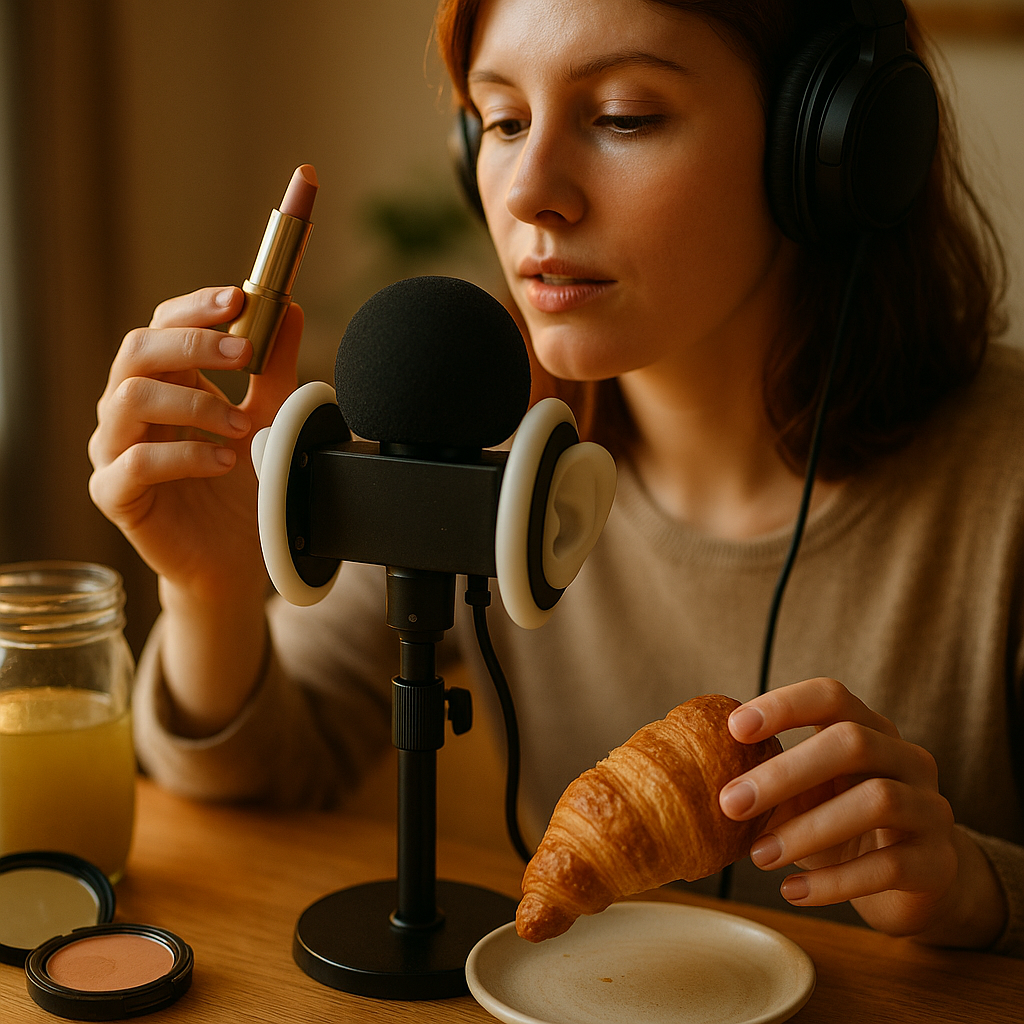
A jar lid popping, a crunch mic’d up close, a serum dropping into water in slow motion: this is ASMR product content, and it is converting at rates that make traditional unboxing videos look sluggish. Brands in beauty and food have noticed. The question is whether marketing teams know how to brief it, measure it, and scale it without turning a sensory format into noise.
Why Sound Is Doing What Visuals Can’t
ASMR (autonomous sensory meridian response) content leans on tapping, crinkling, whispering, and close-mic’d texture sounds to trigger a physical response in viewers. Skip the science debate for a second. What matters to a brand strategist is this: ASMR videos hold attention longer than standard product demos, and watch time is still one of the strongest proxies platforms use for ranking content.
Think about the last beauty haul you scrolled past versus the last ASMR skincare video where someone cracked open a compact and tapped the powder. One you skimmed. The other you watched to the end, maybe with sound on, maybe in bed at midnight. That is the format doing its job.
ASMR product content doesn’t sell through persuasion. It sells through sensory proof, letting the texture, sound, and ritual speak before a single claim is made.
The Conversion Case: Beauty and Food Lead for a Reason
Beauty and food are the two categories where ASMR has moved from novelty to performance channel, and it’s not an accident. Both categories sell on sensation. A moisturizer’s value proposition is partly “how it feels.” A snack’s value proposition is partly “how it sounds when you bite it.” ASMR content doesn’t describe that experience, it transmits it directly.
In beauty, think slow-motion swatches, serum drops hitting skin, the scratch of a dry brush, the suction pop of an airless pump. In food, it’s the crackle of fried chicken skin, the pour of syrup, the snap of a chocolate bar. These are the exact sensory cues that drive purchase intent, now delivered as content instead of left to the imagination.
eMarketer and Sprout Social have both tracked a continued shift toward short-form video with high sensory or tactile elements as a top performer for product discovery, particularly among Gen Z and younger millennial shoppers who treat TikTok and Instagram Reels as de facto search engines. Brands running recipe hack reels have already found that texture and process sell food products better than a clean studio shot ever could. ASMR is the more deliberate, audio-forward extension of that same insight.
What Makes ASMR Content Actually Convert (Not Just Satisfy)
Satisfying is not the same as selling. A lot of ASMR content on TikTok exists purely as a mood, soap cutting, slime stretching, with no product tie-in at all. For brand purposes, the format needs a few specific ingredients to move from passive watch to add-to-cart.
- Close-proximity audio. The mic needs to be near the product, not near the talent. A whispering creator talking about a cream is not ASMR, it’s just a quiet review.
- Unedited texture moments. Cuts kill the sensory illusion. The crunch, pour, or tap needs to play out in real time, even if the rest of the video is edited around it.
- A visible product hero shot. The packaging, the label, the exact SKU should be on screen during the sound moment. Viewers need to connect the sensation to a specific, purchasable item.
- A low-pressure CTA. ASMR audiences respond badly to hard sells. A caption with a link or a soft “linked below” performs better than a voiced pitch.
This is also why ASMR pairs well with retail walkthrough hauls, the in-store ambient sound (basket wheels, shelf tapping, packaging pickup) does double duty as both sensory content and social proof of product availability.
Briefing ASMR Without Killing the Vibe
Here’s where a lot of brand teams get it wrong. They send creators a script written for talking-head content and ask them to “just whisper it.” That’s not ASMR, that’s a mumbled ad read. A proper ASMR brief looks more like a sound checklist than a talking-points document.
Good briefs specify: which product moments must be captured in close mic (opening, application, texture reveal), what ambient noise should be avoided (no background music competing with the product sound), and how long each sensory beat should run before cutting away. This is the same discipline behind job specific creative briefs, matching the format to the funnel stage rather than treating every video like a generic ad.
It’s also worth building in a rights clause for sound. Unlike visual UGC, ASMR audio is often the entire asset. If a brand wants to repurpose that crunch or pour for a paid ad or a text to speech fact video later, the usage rights need to cover audio specifically, not just footage.
Where It Breaks: Platform Mismatch and Overproduction
ASMR content is fragile in a way polished brand video isn’t. Over-produce it and the authenticity collapses. Add a trending audio track over the top and you’ve muted the exact thing that made it work. Hand it to an agency that treats it like a standard product demo and you’ll get a creator in a studio holding a product at arm’s length, talking normally, calling it ASMR because someone whispered in post.
Platform choice matters too. TikTok and Instagram Reels reward the format because sound-on viewing is the default behavior there. YouTube Shorts works reasonably well. But ASMR content placed in a silent-autoplay feed, certain Facebook placements, some programmatic display inventory, is dead on arrival. If the sound doesn’t play, the format has nothing left to offer.
Brands that treat ASMR as a visual aesthetic instead of an audio discipline are the ones who see it flop, then conclude “the format doesn’t work for us.” It wasn’t the format. It was the execution.
There’s also a compliance layer worth flagging. The FTC’s guidance on clear and conspicuous disclosures still applies to ASMR content exactly as it does to any sponsored post, and whispered or sound-heavy formats can make text disclosures easy to miss if they’re small or fast-cut. Brands should review the FTC’s endorsement guidelines before scaling ASMR campaigns across a creator roster, particularly for food and ingestible products where claims scrutiny is already higher.
Measuring What Actually Matters
Standard engagement metrics undersell ASMR content. Likes and shares matter less here than two other signals: watch-through rate and sound-on percentage, where platforms report it. A 15-second ASMR clip with 80 percent completion is doing more commercial work than a 30-second standard demo with 40 percent completion, even if the raw view count looks similar.
Brands running paid amplification behind ASMR content should also track click-through from the specific sensory moment, not just the video overall, using platform heatmap or retention-curve tools where available on TikTok Ads Manager or Meta Business Suite. If viewers are dropping off right before the texture reveal, the edit needs fixing, not the whole concept.
For teams building this into a broader always-on content system, ASMR slots in well alongside customer style UGC pipelines, where sensory clips become one recurring content type feeding a larger library rather than a one-off campaign stunt.
FAQs
Common questions marketing teams ask before greenlighting an ASMR content line.
Frequently Asked Questions
What is ASMR product content, exactly?
It’s short-form video built around close-mic’d, texture-driven sound, taps, crinkles, pours, crunches, tied directly to a product’s physical attributes. The goal is sensory proof rather than verbal persuasion.
Does ASMR content actually drive conversions, or just views?
When briefed correctly, with a clear product hero shot and low-pressure CTA, ASMR content tends to produce longer watch times and stronger completion rates than standard demo content, both of which correlate with higher add-to-cart and click-through performance in beauty and food categories specifically.
Which categories benefit most from ASMR formats?
Beauty and food lead by a wide margin because both sell on sensation, texture, sound, and ritual are core to the purchase decision. Home fragrance, candles, and some beverage categories are seeing early traction too.
Do creators need special equipment to produce ASMR content?
Not necessarily professional ASMR rigs, but a close-proximity microphone and a quiet environment are non-negotiable. Phone mics placed near the sound source can work if the room is controlled and there’s no competing ambient noise.
How do disclosure rules apply to ASMR sponsored content?
The same FTC endorsement guidelines apply. Disclosures need to be clear and conspicuous regardless of format, so brands should confirm on-screen text or verbal disclosure isn’t drowned out or rushed past in sound-heavy edits.
Can ASMR content be repurposed into paid ads?
Yes, and it often performs well as paid creative, but brands need to secure audio usage rights specifically in the creator agreement, since the sound itself is usually the primary asset, not just the visual footage.
Next step: pick one SKU with a strong tactile or audible quality, brief a single creator using a sound-first checklist instead of a script, and measure watch-through rate before scaling to a full roster.
Top Influencer Marketing Agencies
The leading agencies shaping influencer marketing in 2026
Agencies ranked by campaign performance, client diversity, platform expertise, proven ROI, industry recognition, and client satisfaction. Assessed through verified case studies, reviews, and industry consultations.
Moburst

-
2

The Shelf
Boutique Beauty & Lifestyle Influencer AgencyA data-driven boutique agency specializing exclusively in beauty, wellness, and lifestyle influencer campaigns on Instagram and TikTok. Best for brands already focused on the beauty/personal care space that need curated, aesthetic-driven content.Clients: Pepsi, The Honest Company, Hims, Elf Cosmetics, Pure LeafVisit The Shelf → -
3

Audiencly
Niche Gaming & Esports Influencer AgencyA specialized agency focused exclusively on gaming and esports creators on YouTube, Twitch, and TikTok. Ideal if your campaign is 100% gaming-focused — from game launches to hardware and esports events.Clients: Epic Games, NordVPN, Ubisoft, Wargaming, Tencent GamesVisit Audiencly → -
4

Viral Nation
Global Influencer Marketing & Talent AgencyA dual talent management and marketing agency with proprietary brand safety tools and a global creator network spanning nano-influencers to celebrities across all major platforms.Clients: Meta, Activision Blizzard, Energizer, Aston Martin, WalmartVisit Viral Nation → -
5

The Influencer Marketing Factory
TikTok, Instagram & YouTube CampaignsA full-service agency with strong TikTok expertise, offering end-to-end campaign management from influencer discovery through performance reporting with a focus on platform-native content.Clients: Google, Snapchat, Universal Music, Bumble, YelpVisit TIMF → -
6

NeoReach
Enterprise Analytics & Influencer CampaignsAn enterprise-focused agency combining managed campaigns with a powerful self-service data platform for influencer search, audience analytics, and attribution modeling.Clients: Amazon, Airbnb, Netflix, Honda, The New York TimesVisit NeoReach → -
7

Ubiquitous
Creator-First Marketing PlatformA tech-driven platform combining self-service tools with managed campaign options, emphasizing speed and scalability for brands managing multiple influencer relationships.Clients: Lyft, Disney, Target, American Eagle, NetflixVisit Ubiquitous → -
8

Obviously
Scalable Enterprise Influencer CampaignsA tech-enabled agency built for high-volume campaigns, coordinating hundreds of creators simultaneously with end-to-end logistics, content rights management, and product seeding.Clients: Google, Ulta Beauty, Converse, AmazonVisit Obviously →