


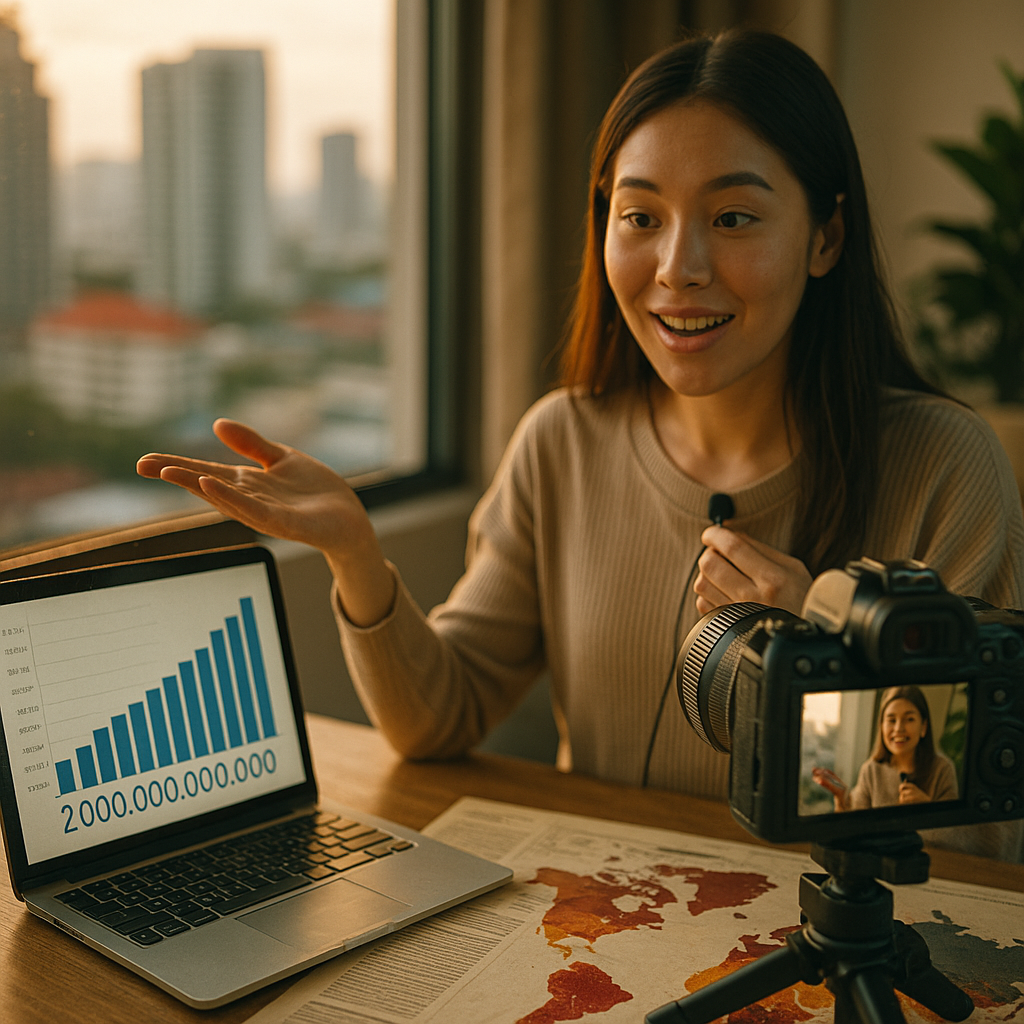
Two trillion dollars. That’s the number Precedence Research attaches to the global creator economy by the end of its forecast window, and it’s the kind of figure that gets quoted in board decks without anyone asking how it was built. Creator economy market sizing matters less as a headline and more as a budgeting tool, and the regional breakdown inside that forecast tells a very different story than the top-line number suggests.
The $2 Trillion Headline: What’s Actually Being Counted
Before you redirect next year’s budget based on a single forecast, it helps to know what’s inside the box. Precedence Research’s model rolls up creator platform revenue, sponsored content spend, affiliate and commerce-linked creator sales, subscription and tipping income, and the agency and tooling layer that sits around all of it. That’s a broad basket. It’s not just influencer marketing fees, it includes platform take rates, creator-owned product lines, and livestream commerce volume.
That breadth is why the number looks so big compared to narrower influencer marketing spend estimates from firms like Statista or eMarketer. Those trackers often isolate paid sponsorship spend. Precedence is measuring the whole economy, creators as a labor market and a commerce channel, not just a media line item.
For brand strategists, the distinction matters. If your CFO sees “$2 trillion creator economy” and asks why your influencer budget is still a rounding error, you need the regional and category breakdown ready, not just the headline.
North America Still Leads, But the Growth Rate Tells a Different Story
North America holds the largest single-region share of that $2 trillion pool, driven by mature platform monetization (YouTube, Instagram, TikTok Shop in its US rollout) and the deepest base of professional creator agencies and MCNs. US brands also spend the most per creator deal on average, which inflates the region’s dollar share even when deal volume elsewhere outpaces it.
But the growth rate story belongs to Asia Pacific. North America’s creator spend is growing in the high single digits to low double digits annually. That’s healthy, mature-market growth. It’s not the compounding curve that’s reshaping where new budget actually flows.
Asia Pacific Is Where the Forecast’s Growth Curve Actually Lives
Asia Pacific is projected to post the fastest regional CAGR inside Precedence’s model, and if you’ve been tracking TikTok Shop’s GMV numbers out of Southeast Asia, that shouldn’t surprise you. China’s livestream commerce ecosystem (Taobao Live, Douyin) was doing creator-driven commerce at scale years before Western markets caught up, and that infrastructure advantage is compounding.
Asia Pacific isn’t catching up to North America’s creator economy. It’s building a different one, commerce-first rather than media-first, and that structural difference is exactly why regional budget allocation can’t be a flat percentage split.
This matters operationally. Brands treating APAC as a smaller copy of their US creator strategy are misallocating. The region skews heavily toward shoppable livestream formats and commission-based creator deals rather than flat sponsorship fees. Our coverage of APAC budget decisions found that regional marketing leaders are already leaning on AI-driven allocation tools precisely because the format mix shifts so fast quarter to quarter. A static annual plan doesn’t survive contact with that market.
India deserves its own mention here. Regional reports consistently flag it as a standout within APAC, fueled by low-cost mobile data, a massive regional-language creator base, and brands finally building dedicated vernacular creator programs instead of English-first campaigns.
Europe and the Rest of the World: Steady, Not Spectacular
Europe sits in the middle of the pack: meaningful absolute spend, driven by the UK, Germany, and France, but growth that’s constrained by stricter advertising disclosure rules and a more fragmented, multi-language market. The ICO and national regulators across the EU have been more aggressive than US counterparts on influencer disclosure enforcement, which adds compliance overhead that slows campaign velocity even when budgets are available.
Latin America and the Middle East make up a smaller slice individually but are flagged in most forecasts, including Precedence’s, as high-growth pockets worth watching. Brazil’s creator commerce scene and the Gulf region’s luxury and beauty creator partnerships are both punching above their current dollar weight.
Why Regional Share Should Reshape How You Measure Success
Here’s the practical problem with any global market sizing report: it tells you where the money is, not where your money should go. A $2 trillion global figure with North America at the top doesn’t mean North America is your best ROI region. It might mean North America is simply the most expensive one.
This is where CAC payback period benchmarking becomes more useful than regional market share data. A market sizing report tells you the size of the pie. It doesn’t tell you your cost to acquire a customer inside that pie, and that’s the number finance teams actually want.
Similarly, our piece on how GMV as core KPI is replacing engagement metrics applies directly here. If you’re evaluating whether to shift spend toward APAC based on its growth rate, you need GMV attribution data from your own campaigns in that region, not just a macro forecast.
Platform Concentration Is the Hidden Risk Inside Regional Numbers
One thing regional breakdowns tend to flatten: platform concentration risk. Within APAC’s fast growth, a huge share runs through TikTok’s ecosystem and its regional equivalents. Our analysis of budget reallocation pressure found that brands overexposed to a single platform in a high-growth region are taking on real operational risk, not just media risk. If a platform policy shifts, a regional growth story can stall fast.
The same logic applies to supply chain and sourcing. As creator commerce scales in APAC and North America alike, brands are discovering that fulfillment, not creative, is the bottleneck. Our report on creator SKU sourcing is a good companion read if you’re planning to chase regional growth without a matching operations build-out.
Finance teams are also tightening scrutiny as creator spend crosses internal thresholds. If your organization is approaching the point where creator budget lines require board-level sign-off, the finance rigor conversation is worth having before a regional expansion, not after.
How Should Brands Actually Use a Forecast Like This?
Treat the $2 trillion figure, and its regional breakdown, as a directional signal, not a planning input. Here’s a more useful way to apply it:
- Use regional CAGR data to prioritize where to run pilot campaigns, not where to make permanent budget commitments.
- Cross-reference any regional growth claim against platform-specific GMV data from TikTok Shop, Instagram Shopping, or Amazon Influencer, since that’s where commerce-linked creator revenue actually surfaces.
- Build your own CAC and payback benchmarks per region before reallocating spend. Macro forecasts move slower than platform algorithms and ad costs.
- Factor in compliance overhead per region. A market that looks 20 percent bigger on paper can still be slower and costlier to activate if disclosure and influencer contract laws are stricter.
Tools from HubSpot and Sprout Social can help operationalize regional performance tracking so you’re not relying on annual third-party forecasts to make quarterly decisions.
FAQs
Frequently Asked Questions
What does the $2 trillion creator economy forecast actually measure?
Precedence Research’s figure includes creator platform revenue, sponsored content spend, affiliate and commerce-linked creator sales, subscriptions and tipping, and the surrounding agency and tooling market, not just traditional influencer marketing fees.
Which region leads the creator economy by total spend?
North America holds the largest dollar share, driven by mature platform monetization and the highest average spend per creator deal, though its growth rate is slower than Asia Pacific’s.
Why is Asia Pacific growing faster than other regions?
APAC’s creator economy is built around livestream commerce and shoppable content first, with infrastructure from platforms like Douyin and Taobao Live giving the region a head start over media-first Western markets.
How should brands use regional market sizing data in budget planning?
Use it as a directional signal for where to pilot campaigns, then validate with your own CAC, payback period, and GMV data before committing permanent budget to a region.
Does a bigger regional market automatically mean better ROI?
No. A larger regional market can carry higher costs, more platform concentration risk, or stricter compliance overhead that offsets its size advantage. Regional revenue share and regional ROI are different metrics entirely.
The regional breakdown behind the $2 trillion figure is a map, not a directive. Pull your own CAC, payback, and GMV data per region before you let a global forecast move a single dollar of next quarter’s budget.
Top Influencer Marketing Agencies
The leading agencies shaping influencer marketing in 2026
Agencies ranked by campaign performance, client diversity, platform expertise, proven ROI, industry recognition, and client satisfaction. Assessed through verified case studies, reviews, and industry consultations.
Moburst

-
2

The Shelf
Boutique Beauty & Lifestyle Influencer AgencyA data-driven boutique agency specializing exclusively in beauty, wellness, and lifestyle influencer campaigns on Instagram and TikTok. Best for brands already focused on the beauty/personal care space that need curated, aesthetic-driven content.Clients: Pepsi, The Honest Company, Hims, Elf Cosmetics, Pure LeafVisit The Shelf → -
3

Audiencly
Niche Gaming & Esports Influencer AgencyA specialized agency focused exclusively on gaming and esports creators on YouTube, Twitch, and TikTok. Ideal if your campaign is 100% gaming-focused — from game launches to hardware and esports events.Clients: Epic Games, NordVPN, Ubisoft, Wargaming, Tencent GamesVisit Audiencly → -
4

Viral Nation
Global Influencer Marketing & Talent AgencyA dual talent management and marketing agency with proprietary brand safety tools and a global creator network spanning nano-influencers to celebrities across all major platforms.Clients: Meta, Activision Blizzard, Energizer, Aston Martin, WalmartVisit Viral Nation → -
5

The Influencer Marketing Factory
TikTok, Instagram & YouTube CampaignsA full-service agency with strong TikTok expertise, offering end-to-end campaign management from influencer discovery through performance reporting with a focus on platform-native content.Clients: Google, Snapchat, Universal Music, Bumble, YelpVisit TIMF → -
6

NeoReach
Enterprise Analytics & Influencer CampaignsAn enterprise-focused agency combining managed campaigns with a powerful self-service data platform for influencer search, audience analytics, and attribution modeling.Clients: Amazon, Airbnb, Netflix, Honda, The New York TimesVisit NeoReach → -
7

Ubiquitous
Creator-First Marketing PlatformA tech-driven platform combining self-service tools with managed campaign options, emphasizing speed and scalability for brands managing multiple influencer relationships.Clients: Lyft, Disney, Target, American Eagle, NetflixVisit Ubiquitous → -
8

Obviously
Scalable Enterprise Influencer CampaignsA tech-enabled agency built for high-volume campaigns, coordinating hundreds of creators simultaneously with end-to-end logistics, content rights management, and product seeding.Clients: Google, Ulta Beauty, Converse, AmazonVisit Obviously →