


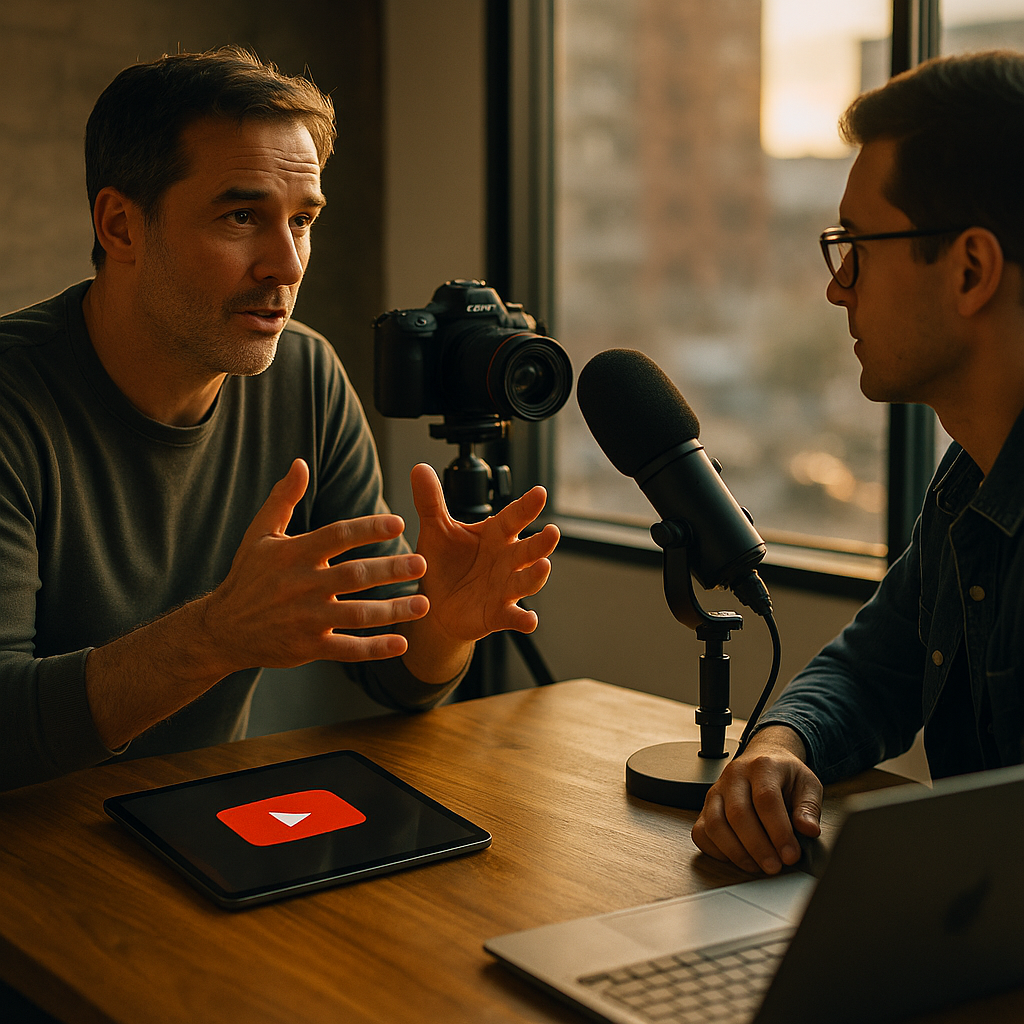
Here’s an uncomfortable number for anyone still chasing six second hooks: the average YouTube viewing session on connected TVs now runs past 60 minutes, and founder led interview content is one of the fastest growing categories on the platform. YouTube long form founder conversations aren’t a side project anymore. They’re becoming the backbone of how B2B and DTC brands build trust at scale. If your 2026 content calendar still treats YouTube as a dumping ground for repurposed clips, you’re leaving distribution value on the table.
Why Founder Led Long Form Is Eating the Feed
Something shifted in audience behavior over the last two years. Viewers got tired of polished, scripted brand content and started gravitating toward unscripted, conversational formats where a founder actually says something risky. Think Lex Fridman style pacing, but applied to CEOs, operators, and category builders talking shop for 45 to 90 minutes.
This isn’t nostalgia for podcasts. It’s a distribution strategy. YouTube’s recommendation engine rewards watch time and session continuation, and long form interviews are exceptionally good at both. A 50 minute founder conversation that holds attention for 30 minutes sends stronger signals to the algorithm than ten short clips with higher drop off rates. That’s a structural advantage brands can’t replicate on TikTok or Instagram, where the ceiling on video length still caps engagement depth.
There’s also a trust dividend. B2B buyers and even consumer audiences are more skeptical of brand messaging than at any point in the last decade. A founder who shows up for an hour, answers hard questions, and doesn’t dodge controversy reads as credible in a way a 15 second ad never will. That credibility compounds across every other channel the clips get sliced into.
Long form founder interviews aren’t competing with short form content for attention. They’re competing with Netflix and podcasts for a share of leisure time, and that’s a fundamentally different distribution problem.
The Numbers Brands Can’t Ignore
Marketers love to dismiss long form as a vanity format with no measurable ROI. The data says otherwise. Industry trackers at eMarketer have repeatedly flagged long form video as the fastest growing watch time category on connected TV, and Statista benchmarks show YouTube retaining the largest share of daily video minutes among adults 25 to 54, a demographic most B2B and premium DTC brands are chasing.
What matters more than raw view counts is what happens after the video ends. Brands running founder conversation series consistently report longer session depth on their owned properties when traffic originates from YouTube versus short form platforms. Viewers who sit through 40 minutes of unscripted conversation arrive at your landing page already sold on the person, not just the product. That changes the entire conversion math.
It also changes how you should think about paid support. If you’re already running amplification against creator content, the same logic applies here, and it’s worth reviewing the framework in our YouTube paid amplification guide before allocating budget to a founder series.
What Makes a Founder Conversation Actually Work?
Not every CEO sit down earns a second episode. The ones that work share a few traits, and they’re worth stealing.
- A real interviewer, not a yes man. Audiences can smell softball questions from a mile away. The best founder series hire or partner with hosts who push back.
- Specificity over platitudes. “We grew 40 percent by fixing our onboarding flow” beats “we’re passionate about customer success” every time.
- Visual texture. Multi camera setups, B roll inserts, and on screen data call outs keep a 50 minute conversation from feeling like a static webcam recording.
- A hook in the first 90 seconds. YouTube’s own creator guidance, available through Google’s support documentation, still emphasizes early retention as a ranking signal even for long form uploads.
Founders who treat this like a press interview instead of a conversation tend to flop. The format rewards vulnerability and specificity, not talking points refined by legal.
Building the Distribution Playbook
Publishing a great founder conversation and hoping the algorithm finds it is not a strategy. Here’s the operational sequence brands running this well in 2026 are following.
Step one: treat the long form cut as the source asset, not the end product. Every 60 minute episode should generate 8 to 15 short form clips for YouTube Shorts, TikTok, and Reels. If you haven’t mapped how Shorts placement actually works, our YouTube Shorts algorithm breakdown is a useful primer before you start cutting.
Step two: stagger the release. Drop the full episode first, let it build initial watch time signal for 48 to 72 hours, then release clips over the following two weeks to drive traffic back to the long form video. Reversing this order dilutes the algorithm’s read on your flagship asset.
Step three: cross post the audio. Strip the video into a podcast feed. Founder conversations perform well on commute and gym listening occasions, and the audio only audience rarely overlaps with your YouTube subscribers. If you’re also exploring sponsored audio placements, the vetting framework in our Spotify podcast ad reads guide translates well here.
Step four: syndicate quote cards and transcript snippets to LinkedIn. Founder credibility content performs disproportionately well on LinkedIn’s native video feed, and the thought leadership positioning compounds when the same founder is active there. Our LinkedIn native video playbook covers how to adapt the tone for that audience without sounding like a press release.
Step five: build a refresh cadence before wear out sets in. Founder series have a shelf life. Once a format feels repetitive, retention drops even if the founder is still compelling. Apply the same discipline you’d use for paid creative, which our creator ad wear out guide addresses in more depth.
Measuring ROI Beyond Views
If your dashboard only tracks views and subscriber growth, you’re measuring the wrong things. The metrics that actually correlate with pipeline and revenue for founder conversation content are:
- Average view duration as a percentage of total runtime, not raw watch minutes
- Click through rate on end screen cards and description links to owned landing pages
- Branded search lift in the weeks following a high performing episode
- Assisted conversions in attribution models that credit video view as an upper funnel touchpoint
Platforms like Sprout Social and HubSpot both offer attribution tooling that can tie YouTube referral traffic to downstream form fills and demo requests, which is the clearest signal for B2B teams trying to justify continued investment in a founder series.
A 45 minute founder conversation with a 55 percent average view duration is worth more to your pipeline than a viral 15 second clip with 2 million views and no context attached.
Compliance Still Matters, Even for Owned Content
Because the founder is speaking on behalf of the brand, every episode carries legal and reputational exposure that short form posts rarely do. Claims made in conversation, even casually, can trigger scrutiny. The FTC’s endorsement guidance primarily targets paid influencer relationships, but the same disclosure logic applies if a founder references a paid partnership or sponsored segment within the episode. If your series ever expands to include guest founders from partner companies, build a lightweight review process before publishing, not after a legal team flags something in the comments.
Common Mistakes Brands Make
Three patterns show up repeatedly in underperforming founder series. First, inconsistent cadence. A monthly episode schedule that slips to quarterly kills audience habit formation. Second, over editing. Audiences notice when a conversation feels sanitized, and trust drops accordingly. Third, ignoring the clip pipeline entirely, which means the long form investment never reaches the audiences who’d discover it through short form discovery feeds in the first place.
The brands winning with this format in 2026 aren’t the ones with the biggest production budgets. They’re the ones treating founder conversation as a system, with a repeatable publishing cadence, a clip distribution pipeline, and attribution models built before the first episode goes live. Start with one episode, measure average view duration against your existing video benchmarks, and scale the cadence only once retention proves the format earns it.
Frequently Asked Questions
How long should a founder conversation video be for YouTube?
Most high performing episodes run between 35 and 70 minutes. The exact length matters less than retention. A 40 minute episode with strong average view duration outperforms a 90 minute episode that loses half the audience by minute 20.
Do founder led YouTube videos need paid promotion to work?
Organic distribution through Shorts clips and search can carry a well made episode, but modest paid amplification against warm audiences in the first week often accelerates the watch time signal the algorithm uses to recommend the video further.
How do we measure ROI on long form founder content?
Track average view duration percentage, click through rate on end screens and description links, branded search lift, and assisted conversions in your attribution model rather than relying on raw view counts alone.
Should founders appear solo or with a host or interviewer?
A skilled interviewer who asks direct, occasionally uncomfortable questions almost always outperforms a solo monologue format. The tension and back and forth keeps retention higher through the middle of the episode, where most videos lose viewers.
What’s the ideal publishing cadence for a founder conversation series?
Biweekly or monthly cadences tend to build the strongest habit loop without overextending production resources. Sporadic or quarterly releases struggle to build a returning audience and lose algorithmic momentum between episodes.
Top Influencer Marketing Agencies
The leading agencies shaping influencer marketing in 2026
Agencies ranked by campaign performance, client diversity, platform expertise, proven ROI, industry recognition, and client satisfaction. Assessed through verified case studies, reviews, and industry consultations.
Moburst

-
2

The Shelf
Boutique Beauty & Lifestyle Influencer AgencyA data-driven boutique agency specializing exclusively in beauty, wellness, and lifestyle influencer campaigns on Instagram and TikTok. Best for brands already focused on the beauty/personal care space that need curated, aesthetic-driven content.Clients: Pepsi, The Honest Company, Hims, Elf Cosmetics, Pure LeafVisit The Shelf → -
3

Audiencly
Niche Gaming & Esports Influencer AgencyA specialized agency focused exclusively on gaming and esports creators on YouTube, Twitch, and TikTok. Ideal if your campaign is 100% gaming-focused — from game launches to hardware and esports events.Clients: Epic Games, NordVPN, Ubisoft, Wargaming, Tencent GamesVisit Audiencly → -
4

Viral Nation
Global Influencer Marketing & Talent AgencyA dual talent management and marketing agency with proprietary brand safety tools and a global creator network spanning nano-influencers to celebrities across all major platforms.Clients: Meta, Activision Blizzard, Energizer, Aston Martin, WalmartVisit Viral Nation → -
5

The Influencer Marketing Factory
TikTok, Instagram & YouTube CampaignsA full-service agency with strong TikTok expertise, offering end-to-end campaign management from influencer discovery through performance reporting with a focus on platform-native content.Clients: Google, Snapchat, Universal Music, Bumble, YelpVisit TIMF → -
6

NeoReach
Enterprise Analytics & Influencer CampaignsAn enterprise-focused agency combining managed campaigns with a powerful self-service data platform for influencer search, audience analytics, and attribution modeling.Clients: Amazon, Airbnb, Netflix, Honda, The New York TimesVisit NeoReach → -
7

Ubiquitous
Creator-First Marketing PlatformA tech-driven platform combining self-service tools with managed campaign options, emphasizing speed and scalability for brands managing multiple influencer relationships.Clients: Lyft, Disney, Target, American Eagle, NetflixVisit Ubiquitous → -
8

Obviously
Scalable Enterprise Influencer CampaignsA tech-enabled agency built for high-volume campaigns, coordinating hundreds of creators simultaneously with end-to-end logistics, content rights management, and product seeding.Clients: Google, Ulta Beauty, Converse, AmazonVisit Obviously →