


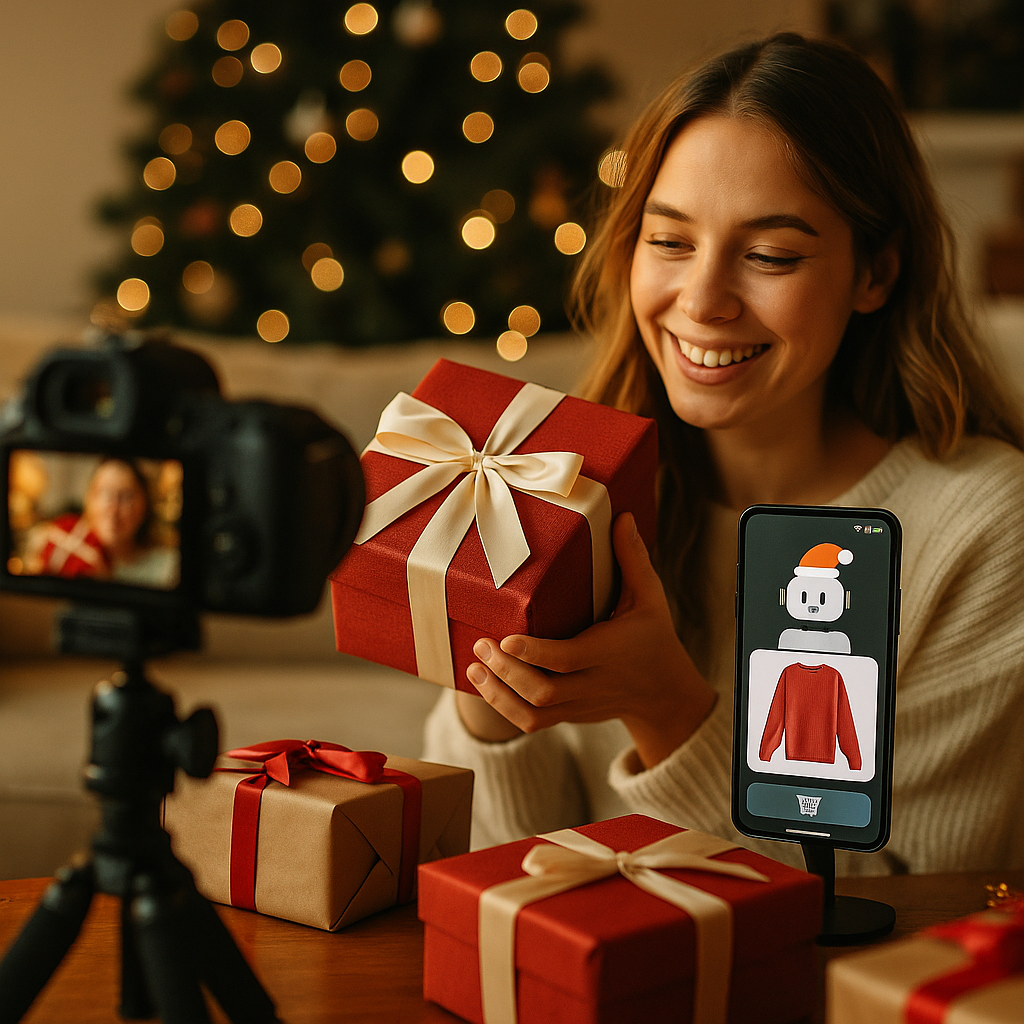
By next holiday season, a meaningful share of gift shopping won’t start with a human typing a query into Google. It’ll start with an AI shopping agent making the decision on a shopper’s behalf. Microsoft, Perplexity, OpenAI, and Amazon have all shipped agentic shopping tools in the past year, and Google’s AI Mode is pulling product recommendations straight into search results. If your creator content isn’t built for machines to parse, summarize, and recommend, you’re invisible to a growing slice of holiday traffic.
That’s the uncomfortable reality facing brand and agency teams heading into the next peak season. AI shopping agents don’t browse the way people do. They query structured data, cross-reference reviews, and synthesize creator content into terse recommendations, often without a click back to the original post. For an industry built on influencer storytelling and visual proof, that’s a structural shift, not a minor algorithm tweak.
What AI Shopping Agents Actually Do During Holiday Browsing
An AI shopping agent isn’t just a chatbot with a shopping cart bolted on. Tools like OpenAI’s shopping features, Perplexity’s product search, and Amazon’s Rufus are designed to complete a task: find the best gift under $75, compare three skincare sets, or pick a running shoe based on a friend’s recommendation. The agent reads product listings, review aggregates, and increasingly, creator content, then returns a condensed answer.
That means your campaign’s job is no longer “get a human to watch this video and click the link.” It’s “get an AI system to extract the right signal from this content and surface it as the answer.” Those are very different optimization targets.
Holiday shoppers using agentic tools often never see your creator’s face, caption, or brand mention directly. They see a synthesized recommendation pulled from dozens of sources, your content included or excluded based on how machine-readable it is.
This echoes a shift Influencers Time has tracked closely. Our coverage of voice and visual search in creator discovery flagged this trend months ago: search is becoming conversational and synthesized, not keyword-matched. Holiday agent shopping is that trend at scale, with real purchase intent and real budget behind it.
Why Holiday Discovery Breaks the Old Creator Playbook
Holiday campaigns have always run on a predictable rhythm: seed product in October, push gift guides in November, chase urgency through December. That rhythm assumed a human was reading the gift guide top to bottom. Agents don’t read top to bottom. They extract.
Consider a typical “Top 10 Holiday Gifts” creator post. A human scrolls, lingers on the product with the best b-roll, maybe clicks through on instinct. An AI agent instead parses the entire list, cross-references pricing and availability through retail APIs, checks sentiment across comments, and decides which one or two items actually make it into its recommendation. Position ten doesn’t matter anymore if the agent judges it the best match. Position one doesn’t guarantee survival if the agent can’t verify the claim.
That changes what “winning” a holiday placement looks like. A few practical shifts worth flagging for your planning cycle:
- Agents favor content with specific, verifiable claims (price, materials, sizing, return policy) over vague enthusiasm.
- Structured product mentions, think consistent naming, clear specs, visible pricing, get pulled into agent summaries more reliably than stylized captions.
- Review density and consistency across platforms matters more than a single viral post.
- Video content needs accurate, descriptive transcripts and alt text since agents increasingly parse multimodal content, not just captions.
According to eMarketer research on conversational commerce adoption, a growing share of consumers already use AI tools for pre-purchase research during peak shopping periods, and that number climbs every holiday cycle. Brands that treat this as a 2027 problem are already behind.
Creator Content Needs a Machine-Readable Layer
Here’s the part most brand teams miss: making content agent-friendly isn’t about writing differently for humans versus machines. It’s about adding structure underneath content that already performs well with people.
That means working with creators to standardize how product details appear in captions, descriptions, and pinned comments. It means pushing for consistent naming conventions across a campaign so an agent can confidently match “the blue puffer jacket” in five different creator posts to the same SKU. It means ensuring UGC and affiliate links carry clean, trackable metadata, because agents often rely on structured data feeds (schema markup, product catalogs, retailer APIs) more than loose creator prose.
This is closely tied to work we’ve covered on semantic creator search, where meaning, not exact keyword match, determines whether content surfaces. The same logic now governs whether an AI shopping agent trusts your creator’s recommendation enough to repeat it.
It also means collaborating with retail media teams earlier than usual. If your creator content isn’t feeding into the product data retail AI engines actually use, it’s effectively invisible to agent-led discovery no matter how good the video is. Our analysis of retail media AI engines and creator rights data covers why this handoff between creator teams and retail media teams is becoming non-negotiable, not a nice-to-have.
Attribution Gets Harder Before It Gets Easier
Here’s the uncomfortable part for anyone building a holiday ROI report. When an AI agent makes the recommendation and completes the purchase within its own interface, your tracking link might never fire. The click, if there is one, often goes to the agent’s checkout flow, not your UTM-tagged creator post.
If your holiday attribution model depends entirely on last-click data from creator links, you’ll systematically undercount the influence of content that AI agents are already using to drive purchases.
This isn’t a new problem exactly, it’s an extension of the zero-click search challenge brands have been wrestling with for a while. We broke down the mechanics of this in zero-click search and creator attribution, and the holiday agent scenario is the sharpest version of that problem yet. Expect more reliance on media mix modeling, incrementality testing, and reconstructed journey analysis rather than clean click paths this season.
Practically, that means briefing your measurement team now, not in December. Ask whether your current MMP or attribution stack can account for agent-assisted conversions at all. Many can’t, yet. If you’re choosing between platforms, our comparison of creator attribution platforms is a useful starting point for evaluating who’s actually building for this shift versus who’s still optimizing for 2022-era click tracking.
Governance Can’t Be an Afterthought This Time
Agent-led shopping introduces a new compliance wrinkle too. If an AI shopping agent pulls a creator’s product claim and repeats it as fact to a consumer, who’s responsible when that claim is wrong or outdated? The FTC’s endorsement guidance already holds brands accountable for creator disclosures and accurate claims. Agent-mediated recommendations don’t remove that liability, they just obscure the chain of custody.
This is exactly the kind of governance gap we flagged in our piece on autonomous AI agents and governance. Before you lean into agent-led discovery for holiday campaigns, make sure legal and compliance teams understand that your creator claims are now being redistributed by systems you don’t control. Build in a review step for pricing accuracy, availability, and disclosure language before creator content goes live, because an agent repeating a stale discount code or discontinued SKU is a brand headache nobody wants to inherit in peak season.
What to Actually Do Before the Holiday Push
Theory is nice. Here’s the operational checklist worth running through with your creator and retail media teams before briefs go out:
- Audit top-performing holiday creator content from last cycle for structured product data: is pricing, sizing, and availability clearly stated and consistent across posts?
- Confirm your product feeds (retailer, Google Shopping, affiliate networks) are synced with the SKUs creators are actually featuring.
- Brief creators on using consistent, specific product language rather than stylized or ambiguous phrasing.
- Pressure-test your attribution stack for agent-assisted conversion gaps, and set expectations with finance that some holiday lift won’t show up in last-click reports.
- Loop in legal early on disclosure language that survives being paraphrased by a third-party AI system.
None of this requires abandoning the creative instincts that make influencer marketing work. It requires adding a structural layer underneath the creativity so machines can actually find it.
Frequently Asked Questions
What are AI shopping agents, and how are they different from regular search?
AI shopping agents are AI tools (like those from OpenAI, Perplexity, and Amazon) that complete shopping tasks on a user’s behalf: comparing products, checking reviews, and sometimes completing checkout. Unlike traditional search, which returns links for a human to evaluate, shopping agents synthesize information and deliver a condensed recommendation, often without the user visiting the original source.
How does agent-led search affect influencer marketing specifically?
Agents parse creator content for verifiable product details rather than engaging with the storytelling or personality that typically drives human engagement. Content with clear, consistent product information is more likely to be surfaced in an agent’s recommendation than content optimized purely for emotional appeal or virality.
Will tracking links still work if a shopper uses an AI shopping agent?
Not reliably. Many agent-led purchases happen within the agent’s own interface, which means traditional UTM links and last-click attribution may not capture the full influence of creator content. Brands should expect to rely more on incrementality testing and media mix modeling to account for this gap.
Do creators need to change how they talk about products for AI to pick them up?
Mostly, it’s about adding clarity and consistency rather than changing tone. Creators should state product names, prices, and key specs clearly and consistently across posts, which helps AI systems match the content to the correct product and recommend it with confidence.
Is this relevant to brands outside of e-commerce?
Yes. Any brand whose products or services get recommended through conversational or comparison-style queries, including travel, software, and local services, will see similar dynamics as AI agents mediate more discovery and recommendation traffic.
Next step: Run an audit of your last holiday campaign’s top creator content against a simple test: could an AI agent extract accurate price, availability, and product specs from it without visiting the brand site? If the answer’s no, that’s your starting brief for this cycle.
Frequently Asked Questions
What are AI shopping agents, and how are they different from regular search?
AI shopping agents are AI tools (like those from OpenAI, Perplexity, and Amazon) that complete shopping tasks on a user’s behalf: comparing products, checking reviews, and sometimes completing checkout. Unlike traditional search, which returns links for a human to evaluate, shopping agents synthesize information and deliver a condensed recommendation, often without the user visiting the original source.
How does agent-led search affect influencer marketing specifically?
Agents parse creator content for verifiable product details rather than engaging with the storytelling or personality that typically drives human engagement. Content with clear, consistent product information is more likely to be surfaced in an agent’s recommendation than content optimized purely for emotional appeal or virality.
Will tracking links still work if a shopper uses an AI shopping agent?
Not reliably. Many agent-led purchases happen within the agent’s own interface, which means traditional UTM links and last-click attribution may not capture the full influence of creator content. Brands should expect to rely more on incrementality testing and media mix modeling to account for this gap.
Do creators need to change how they talk about products for AI to pick them up?
Mostly, it’s about adding clarity and consistency rather than changing tone. Creators should state product names, prices, and key specs clearly and consistently across posts, which helps AI systems match the content to the correct product and recommend it with confidence.
Is this relevant to brands outside of e-commerce?
Yes. Any brand whose products or services get recommended through conversational or comparison-style queries, including travel, software, and local services, will see similar dynamics as AI agents mediate more discovery and recommendation traffic.
Top Influencer Marketing Agencies
The leading agencies shaping influencer marketing in 2026
Agencies ranked by campaign performance, client diversity, platform expertise, proven ROI, industry recognition, and client satisfaction. Assessed through verified case studies, reviews, and industry consultations.
Moburst

-
2

The Shelf
Boutique Beauty & Lifestyle Influencer AgencyA data-driven boutique agency specializing exclusively in beauty, wellness, and lifestyle influencer campaigns on Instagram and TikTok. Best for brands already focused on the beauty/personal care space that need curated, aesthetic-driven content.Clients: Pepsi, The Honest Company, Hims, Elf Cosmetics, Pure LeafVisit The Shelf → -
3

Audiencly
Niche Gaming & Esports Influencer AgencyA specialized agency focused exclusively on gaming and esports creators on YouTube, Twitch, and TikTok. Ideal if your campaign is 100% gaming-focused — from game launches to hardware and esports events.Clients: Epic Games, NordVPN, Ubisoft, Wargaming, Tencent GamesVisit Audiencly → -
4

Viral Nation
Global Influencer Marketing & Talent AgencyA dual talent management and marketing agency with proprietary brand safety tools and a global creator network spanning nano-influencers to celebrities across all major platforms.Clients: Meta, Activision Blizzard, Energizer, Aston Martin, WalmartVisit Viral Nation → -
5

The Influencer Marketing Factory
TikTok, Instagram & YouTube CampaignsA full-service agency with strong TikTok expertise, offering end-to-end campaign management from influencer discovery through performance reporting with a focus on platform-native content.Clients: Google, Snapchat, Universal Music, Bumble, YelpVisit TIMF → -
6

NeoReach
Enterprise Analytics & Influencer CampaignsAn enterprise-focused agency combining managed campaigns with a powerful self-service data platform for influencer search, audience analytics, and attribution modeling.Clients: Amazon, Airbnb, Netflix, Honda, The New York TimesVisit NeoReach → -
7

Ubiquitous
Creator-First Marketing PlatformA tech-driven platform combining self-service tools with managed campaign options, emphasizing speed and scalability for brands managing multiple influencer relationships.Clients: Lyft, Disney, Target, American Eagle, NetflixVisit Ubiquitous → -
8

Obviously
Scalable Enterprise Influencer CampaignsA tech-enabled agency built for high-volume campaigns, coordinating hundreds of creators simultaneously with end-to-end logistics, content rights management, and product seeding.Clients: Google, Ulta Beauty, Converse, AmazonVisit Obviously →