


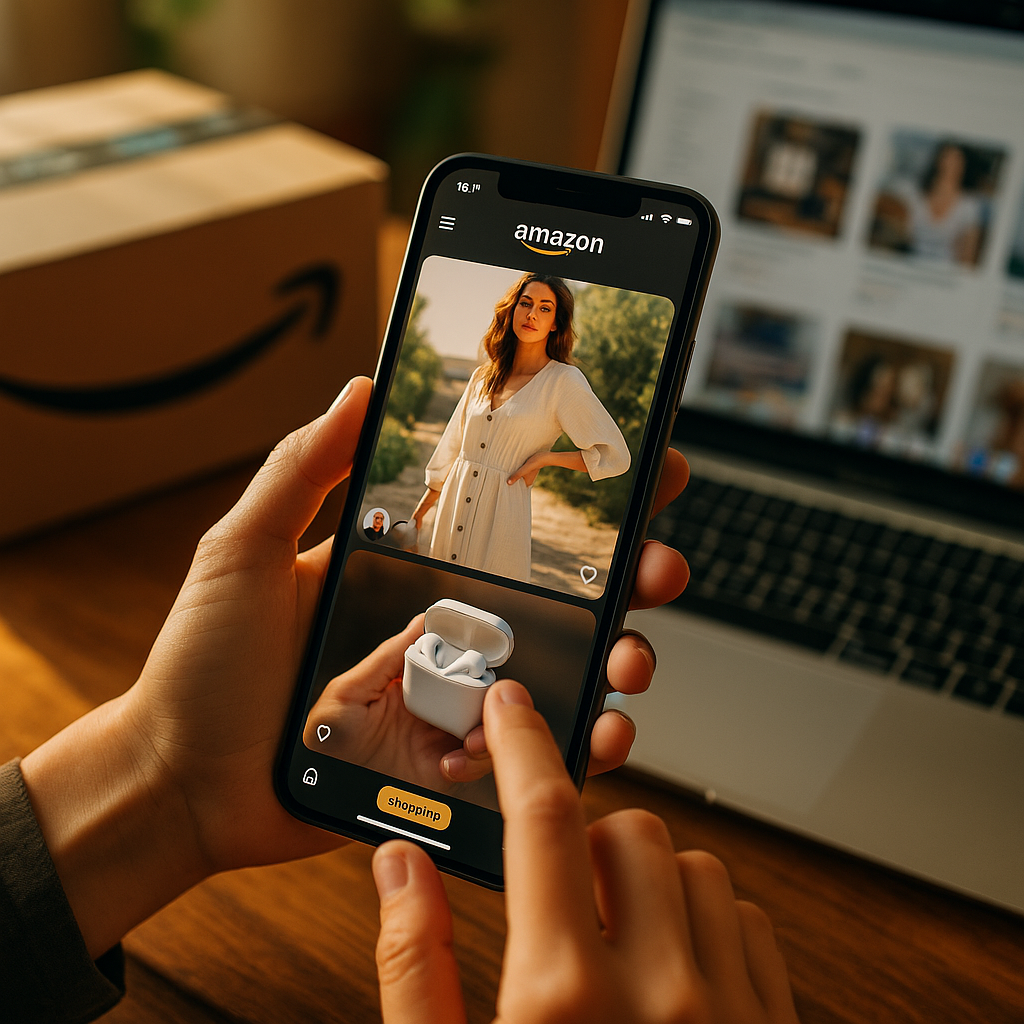
Amazon’s Inspire feed now reaches shoppers across the app’s home screen, but most brands are feeding it content that never gets seen. Internal Amazon data has suggested session times on Inspire run several minutes longer than average browsing sessions, yet agencies still treat it as an afterthought upload destination. The Amazon Inspire feed rewards specific signals, and if your creator content doesn’t hit them, it dies in the scroll. Here’s the playbook for getting found, not just posted.
What the Inspire Feed Actually Rewards
Inspire is Amazon’s shoppable, TikTok style video and photo feed, baked directly into the shopping app. It sits one tap from checkout, which is the whole pitch: no click-out, no link-in-bio friction, no retargeting needed. A shopper watches a video, taps the product tag, and buys. That proximity to purchase is why brand teams keep asking about it in quarterly planning, but proximity alone doesn’t guarantee impressions.
The feed’s ranking logic leans heavily on engagement velocity in the first hours after posting, product tag completeness, and account history. Amazon has not published a full ranking methodology (no platform ever does), but creator and seller forum reports consistently point to the same early-engagement window mattering most. Miss that window with a slow launch and the content effectively vanishes from discovery, even if it’s evergreen and well produced.
Content that performs on Inspire in the first two hours tends to keep surfacing for weeks. Content that doesn’t gets buried permanently, regardless of quality.
Discoverability, Not Production Value, Is the Real Battle
Brands routinely over-invest in polish and under-invest in structure. A crisp four-second hook with a clear product reveal and accurate tagging will outperform a beautifully shot thirty-second brand film almost every time. Inspire users are in browse-to-buy mode, not storytelling mode. That’s a mindset shift for teams used to optimizing for TikTok watch time or Instagram Reels completion rate, where narrative arcs matter more.
This isn’t unique to Amazon. The same principle shows up in short-form review funnels and native shop checkout flows, where the distance between the hook and the “add to cart” moment determines conversion far more than cinematography does.
Signals the Algorithm Actually Weighs
Based on seller community reporting and pattern observation across hundreds of Inspire posts, a handful of factors consistently correlate with better placement:
- Complete product tagging. Content with every visible product tagged (not just the hero item) tends to get wider distribution than single-tag posts.
- Vertical, native-feeling video. Repurposed TikTok or Reels content with visible watermarks or platform-specific UI underperforms. Amazon’s system seems to deprioritize content that reads as recycled.
- Early saves and add-to-carts, not just views. A post with modest views but high save-to-view ratio often outranks a high-view, low-action post within days.
- Posting cadence from the same creator account. Accounts that post consistently (several times weekly) see compounding reach, similar to how consistency drives reach on TikTok’s For You Page.
- Caption and keyword alignment with Amazon search terms. Captions that mirror actual product search queries help surface content in both Inspire and Amazon’s on-site search results.
Notice how closely this mirrors the signal-chasing brands already do elsewhere. The logic behind TikTok FYP signal optimization translates surprisingly well here: front-load the hook, earn fast engagement, avoid anything that screams “ad.”
Building a Content Pipeline That Actually Gets Found
Treat Inspire as its own production lane, not a repurposing dumping ground. That means briefing creators specifically for the feed rather than asking them to “also post it on Amazon.”
Brief for native format from day one
Give creators the exact aspect ratio, a sub-five-second hook requirement, and a mandate to film with Amazon’s native tools or at minimum re-export without platform watermarks. Creators accustomed to cross-posting will need explicit instruction here, because their default habit is to upload the same file everywhere.
Use affiliate and storefront creators you already trust
Creators already enrolled in Amazon’s Influencer Program or your affiliate storefront network already understand Amazon’s shopper intent better than someone parachuted in from Instagram. This overlaps with the same vetting logic covered in our affiliate bonus tier guide, where creator quality and platform fluency drive disproportionate returns.
Don’t skip nano and micro creators
Inspire’s feed doesn’t appear to weight follower count heavily, which makes it a rare platform where nano creators can genuinely outperform bigger names on raw discoverability. Pair this with whitelisting tactics similar to those in our nano creator whitelisting playbook to stretch a limited content budget further.
Batch content, stagger releases
Because the first-hours window matters so much, don’t dump ten pieces of content at once. Stagger releases across days so each piece gets its own uncontested engagement window, rather than competing against your own content for the same audience attention.
Where Brands Get It Wrong
A few recurring mistakes show up across the brands and agencies testing Inspire right now:
- Treating it as a syndication channel. Auto-posting TikTok content via third-party tools without re-editing for native format is the single fastest way to get buried.
- Ignoring disclosure requirements. Paid partnership content still needs to be clearly labeled per FTC endorsement guidelines, and Amazon’s own content policies enforce this at the platform level too. Skipping disclosure risks both regulatory exposure and content removal.
- No tagging audit. Teams tag the hero product and forget the supporting items visible in frame, leaving reach on the table.
- Measuring success by views alone. Views are vanity here. Add-to-cart rate and attributed sales are the metrics that map to actual ROI.
- Inconsistent posting. One-off campaign bursts don’t build the account history that seems to compound reach over time.
Measuring Inspire Performance Without Guessing
Amazon’s seller and brand dashboards now surface Inspire-specific metrics including views, clicks, add-to-carts, and attributed sales, typically with a short attribution window. Pull these weekly, not monthly. The feed moves fast, and a creator’s content can go from flat to trending within 48 hours, which means monthly reporting cycles will miss the optimization window entirely.
Benchmark against your other shoppable video channels. If a piece of Inspire content converts at a materially lower rate than equivalent content on retargeted Reels or TikTok funnels, that’s a signal to revisit your hook structure or tagging before blaming the platform. According to eMarketer research on social commerce trends, shoppable video conversion rates vary enormously based on execution quality rather than platform choice alone, which tracks with what we’re seeing on Inspire specifically.
If your Inspire content isn’t converting at parity with your other shoppable video channels, the problem is almost always format, not platform.
Track creator-level performance separately from campaign-level performance too. A handful of creators will consistently outperform the rest once you have a few weeks of data, and that’s where you should concentrate future budget and content briefs. This is the same prioritization logic brands apply when evaluating social performance benchmarks across any emerging feed: let the data pick your winners, not your gut.
Frequently Asked Questions
What is the Amazon Inspire feed?
The Amazon Inspire feed is a shoppable, short-form video and photo feed built into the Amazon shopping app, letting users browse creator content and tap directly into product pages without leaving the app.
How is Inspire different from TikTok or Instagram Reels?
Inspire sits inside the Amazon shopping app with checkout one tap away, so it’s built for purchase intent rather than entertainment or discovery. Content formatted for TikTok or Reels often underperforms on Inspire unless it’s re-edited to remove platform branding and front-load the product.
Do creators need to be in the Amazon Influencer Program to post on Inspire?
Not strictly, but creators already enrolled in Amazon’s Influencer Program or affiliate storefront network typically understand shopper intent and tagging requirements better, which tends to produce stronger early engagement.
How quickly does content need to perform to get distribution on Inspire?
Engagement in the first few hours after posting appears to heavily influence ongoing distribution, based on consistent patterns reported by sellers and creators. Content that performs early tends to keep surfacing for weeks afterward.
What metrics should brands track for Inspire campaigns?
Prioritize add-to-cart rate and attributed sales over raw view counts. Views are a vanity metric on Inspire, while save-to-view ratio and conversion rate are better indicators of actual algorithmic favor and ROI.
Does follower count matter for Inspire visibility?
Not as much as on other platforms. Inspire’s discovery mechanics appear to weight engagement signals and tagging completeness over follower count, giving nano and micro creators a real shot at strong placement.
Start by auditing your last five pieces of creator content for native format, complete tagging, and disclosure compliance, then re-release the strongest one as a standalone, Inspire-specific post rather than a cross-platform repost. That single test will tell you more about your Inspire readiness than any dashboard metric will.
Top Influencer Marketing Agencies
The leading agencies shaping influencer marketing in 2026
Agencies ranked by campaign performance, client diversity, platform expertise, proven ROI, industry recognition, and client satisfaction. Assessed through verified case studies, reviews, and industry consultations.
Moburst

-
2

The Shelf
Boutique Beauty & Lifestyle Influencer AgencyA data-driven boutique agency specializing exclusively in beauty, wellness, and lifestyle influencer campaigns on Instagram and TikTok. Best for brands already focused on the beauty/personal care space that need curated, aesthetic-driven content.Clients: Pepsi, The Honest Company, Hims, Elf Cosmetics, Pure LeafVisit The Shelf → -
3

Audiencly
Niche Gaming & Esports Influencer AgencyA specialized agency focused exclusively on gaming and esports creators on YouTube, Twitch, and TikTok. Ideal if your campaign is 100% gaming-focused — from game launches to hardware and esports events.Clients: Epic Games, NordVPN, Ubisoft, Wargaming, Tencent GamesVisit Audiencly → -
4

Viral Nation
Global Influencer Marketing & Talent AgencyA dual talent management and marketing agency with proprietary brand safety tools and a global creator network spanning nano-influencers to celebrities across all major platforms.Clients: Meta, Activision Blizzard, Energizer, Aston Martin, WalmartVisit Viral Nation → -
5

The Influencer Marketing Factory
TikTok, Instagram & YouTube CampaignsA full-service agency with strong TikTok expertise, offering end-to-end campaign management from influencer discovery through performance reporting with a focus on platform-native content.Clients: Google, Snapchat, Universal Music, Bumble, YelpVisit TIMF → -
6

NeoReach
Enterprise Analytics & Influencer CampaignsAn enterprise-focused agency combining managed campaigns with a powerful self-service data platform for influencer search, audience analytics, and attribution modeling.Clients: Amazon, Airbnb, Netflix, Honda, The New York TimesVisit NeoReach → -
7

Ubiquitous
Creator-First Marketing PlatformA tech-driven platform combining self-service tools with managed campaign options, emphasizing speed and scalability for brands managing multiple influencer relationships.Clients: Lyft, Disney, Target, American Eagle, NetflixVisit Ubiquitous → -
8

Obviously
Scalable Enterprise Influencer CampaignsA tech-enabled agency built for high-volume campaigns, coordinating hundreds of creators simultaneously with end-to-end logistics, content rights management, and product seeding.Clients: Google, Ulta Beauty, Converse, AmazonVisit Obviously →