


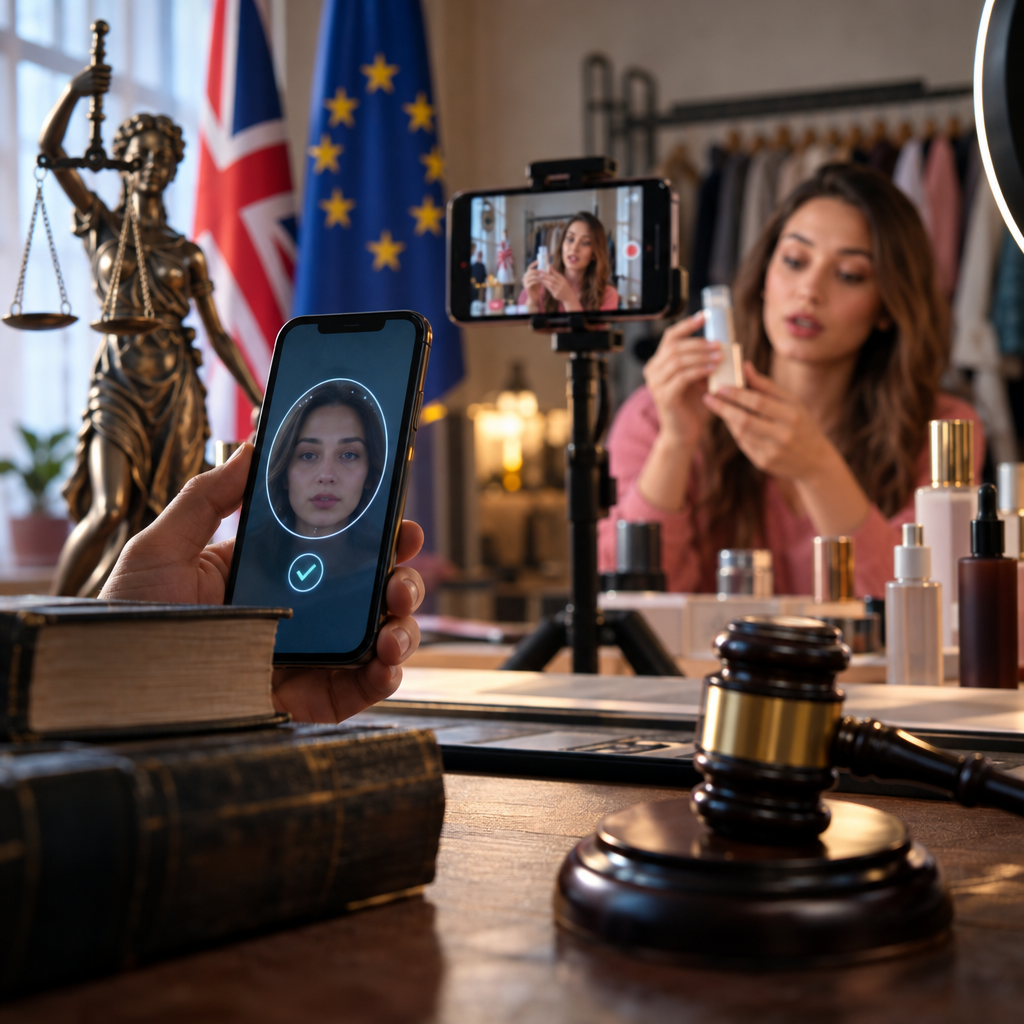
One in six euros of TikTok Shop’s live-shopping revenue in Europe now flows through a channel that two separate regulators consider a minor-safety risk zone. That is the collision brands are walking into. EU and UK age verification laws are no longer background compliance noise. They are becoming a direct constraint on who can host a livestream, who can gift during one, and whether a single creator broadcast can legally reach five different markets at once.
The UK Just Redrew the Livestream Map
Ofcom’s “highly effective age assurance” standard has moved from theory to enforcement fast. Ofcom’s guidance has moved toward expecting technical controls that materially reduce under-18 access, with self-declaration explicitly identified as insufficient. A simple checkbox confirming a viewer is over 18 does not satisfy the law anymore, and that matters enormously for any brand running a UK-facing livestream with gifting or checkout built in.
Then came the bigger shift. On June 15, 2026, the U.K. government officially announced a ban on social media for anyone under 16, with protections expected to take effect in spring 2027. Livestream commerce sits directly inside the fallout. The package also restricts under-16s’ access to features like livestreaming and strangers communicating with children, while ensuring these features are turned off by default for 16- and 17-year-olds. That default-off rule for 16 and 17 year olds is the detail most brand compliance teams are missing. It means a creator can no longer assume a 17 year old viewer has live and DM access just because they’re logged in.
Under the UK’s incoming rules, livestreaming isn’t just age-gated at 16. It’s switched off by default for 16 and 17 year olds too, unless a platform actively re-enables it.
The penalties back this up with teeth. Penalties under the OSA include fines up to £18 million or 10% of global annual revenue, and the possibility of service blocking for non-compliant platforms. Ofcom isn’t bluffing on enforcement either: it has already opened scrutiny into platforms’ age-assurance rollouts, and a related public tracker of UK age verification changes shows the scope expanding well beyond adult content sites into mainstream social and livestreaming features.
For brands, the practical question isn’t “do we need age verification.” It’s “whose job is it, and can we prove it in an audit.” That’s the exact gap we unpacked in host age and follower vetting rules, and it’s worth revisiting now that the under-16 ban gives Ofcom a second, parallel enforcement lever.
Brussels Takes a Different Path, With the Same Destination
The EU hasn’t set a hard age cliff the way the UK has. Instead, it leans on the Digital Services Act’s risk-based framework, which is messier for brands operating across borders but ultimately points toward the same operational demands.
Article 35 DSA requires providers of very large online platforms and very large online search engines to put in place reasonable, proportionate and effective mitigation measures to protect against risks to children, and specifies that such measures may include age verification. That obligation only binds the biggest platforms, defined by a specific threshold: less than 45 million monthly active users in the EU keeps a platform outside the VLOP category entirely. But a second, broader duty catches everyone else. Article 28(1) DSA requires providers of online platforms that are accessible to minors to put in place appropriate and proportionate measures to ensure a high level of privacy, safety and security of minors on their service. Crucially, Article 28(3) clarifies that such online platforms are not obliged to process personal data in order to assess whether the recipient of the service is a minor. That tension, protect minors without collecting more data on everyone, is exactly why the EU’s rollout has been slower and more contested than the UK’s.
The Commission’s July 2025 guidance narrowed the ambiguity somewhat, laying out when age verification (as opposed to lighter estimation methods) is actually warranted. The EC now claims that age verification is appropriate and proportionate in four scenarios: when EU or national law prohibits minors from accessing certain content such as alcohol, tobacco, gambling or pornography; when a platform’s terms of service state only adult users are allowed; when risks cannot be mitigated by less intrusive measures; and when a law prescribes a minimum age for a service. Livestream shopping that includes alcohol sampling, age-restricted product drops, or virtual currency gifting can trip more than one of those triggers simultaneously.
The long-term fix the Commission is banking on is a harmonized digital identity layer. Methods that rely on verified and trusted government-issued IDs may constitute an effective age verification method, such as the EU Digital Identity Wallet, which Member States are expected to make available by the end of 2026, and in the meantime the Commission is developing an “EU age verification solution” that can be used as a device-based age verification method. Until that wallet is live everywhere, brands are stuck reconciling national rules with EU-level guidance that isn’t formally binding but shapes enforcement anyway.
France Didn’t Wait for Brussels
If you want a preview of where EU-wide enforcement is heading, look at France’s SREN law. It’s already the toughest national regime in the bloc, and it applies regardless of where a platform is based. The requirement, enforced by the French broadcasting and digital regulator Arcom, applies to all websites accessible in France, regardless of where they are hosted. The standout feature is “double anonymity,” a model where pornographic websites remain unaware of the identity of the user being verified, while the age verification provider cannot see which platform the individual is accessing.
France’s penalties are smaller than the UK’s in absolute terms but still material for a cross-border creator business: financial administrative penalties of up to €150,000 or 2% of worldwide turnover excluding VAT for the previous financial year, whichever is greater, with the possibility of an increased fine in the event of a repeat breach. ARCOM has shown it will use ISP-level blocking, not just fines, against non-compliant operators, which is the kind of market-access risk that should be in every livestream commerce risk register, not just the legal team’s inbox.
Why Livestream Commerce Is the Hard Case
Livestream shopping blends three things regulators already worry about separately: real-time video, direct payment flows, and parasocial creator relationships. Put age-gating pressure on top of that, and you get a format that’s genuinely harder to compliance-proof than a static product page.
The scale of what’s at stake keeps growing. France, Germany, Spain and Italy generated €498,779,919 on TikTok Shop in the ninety days to 9 July 2026, a window that covers most of the second quarter, according to Kalodata’s estimated data for the four markets. Live specifically isn’t the biggest slice, but it’s far from trivial: live accounted for 17.2% of GMV across the four markets, with live doing one euro in six, and in Germany one in eight. That’s real commerce volume flowing through a format that platforms, brands, and regulators all treat as higher-risk for minor exposure than a shoppable video or static product card.
Live commerce in the EU’s four biggest TikTok Shop markets already moves roughly one euro in six through a format regulators consider higher risk for minors. Age-gating that channel isn’t optional friction anymore, it’s table stakes.
Virtual gifting adds another layer entirely. A minor who slips past age gates into a livestream can still spend real money on virtual gifts, a liability question we’ve broken down in detail in livestream gifting liability exposure and again from the audience-composition angle in age verification and livestream audience risk. Brands sponsoring or co-hosting a live session don’t automatically inherit the platform’s legal duty, but they absolutely inherit the reputational and contractual fallout if a host’s audience turns out to be mostly under-16 viewers using borrowed accounts.
The Cross-Border Problem Nobody’s Pricing In
Here’s the operational headache: a single livestream broadcast to UK, French, German, and Spanish viewers simultaneously is now subject to four different legal standards at once, with different age thresholds, different acceptable verification methods, and different penalty structures. The UK wants “highly effective age assurance” with no self-declaration. France wants session-level double-anonymity checks. The EU’s broader guidance wants proportionate, risk-based measures that avoid excess data collection. None of these three frameworks fully agree on method, and a brand running pan-European “Sell Across Europe” campaigns through TikTok Shop has to satisfy all three in a single broadcast.
This is the same structural problem we flagged in cross-border creator contract gaps, just applied to age compliance instead of data transfer. The fix looks similar too: don’t assume a single compliance checklist covers every market a livestream reaches. Build market-specific gating logic, document which standard applies to which audience segment, and make sure contracts with hosts and agencies spell out who owns the liability if a gate fails.
Host vetting matters just as much as viewer-side gating. If a brand is casting creators for live shopping events, platform eligibility scoring for live hosts is now a legitimate part of the casting brief, not just a platform-side metric. A host who can’t clear eligibility thresholds in one market may still be eligible in another, which is exactly the kind of inconsistency that trips up agencies running the same creator across multiple EU storefronts.
What Brands Should Actually Do Before Year-End
- Map your live-commerce footprint against jurisdiction, not just platform. A UK-facing livestream and a France-facing one need different gating logic even if they run on the same app.
- Audit virtual gifting flows separately from checkout. Age-gating a purchase doesn’t automatically age-gate a gift, and regulators are treating them as distinct risk vectors.
- Push age-assurance method questions to platforms in writing. Get documented answers on whether self-declaration, facial estimation, or ID verification applies to your specific campaign type and market.
- Build host vetting into casting contracts, not just platform onboarding. Eligibility status can and does change market by market.
- Treat France’s double-anonymity standard as a preview, not an outlier. Other member states are watching Arcom’s enforcement closely, and EU-wide convergence is the stated long-term goal.
FAQs
Does the UK’s under-16 social media ban apply to livestream shopping specifically?
Yes. The restrictions package announced alongside the ban covers livestreaming features directly, with under-16 access blocked and the feature turned off by default for 16 and 17 year olds unless a platform re-enables it, meaning livestream commerce formats are explicitly in scope.
Is age verification mandatory for all EU platforms, or just the largest ones?
Only very large online platforms and search engines, those with more than 45 million monthly active users in the EU, face the specific Article 35 mitigation duty that names age verification as an option. Smaller platforms still have a broader obligation under Article 28 to take “appropriate and proportionate” measures to protect minors, which can include age verification depending on risk.
Can a brand be held liable if a livestream host’s audience includes minors?
Platforms, not brands, typically carry the direct statutory compliance burden under the OSA and DSA. But brands sponsoring or co-producing a livestream can face contractual, reputational, and in some jurisdictions regulatory exposure if they knowingly ran campaigns, including gifting mechanics, on a stream with a substantial underage audience.
What makes France’s SREN law different from the UK’s Online Safety Act?
France’s framework centers on “double anonymity,” requiring at least one verification method where the platform never learns the user’s identity and the verification provider never learns which platform the user accessed. The UK’s standard is outcome-based (“highly effective age assurance”) without mandating a specific privacy architecture, giving platforms more flexibility in method but less flexibility in required accuracy.
Will the EU eventually adopt a single, harmonized age verification standard?
That’s the stated direction. The European Commission is developing an interim “EU age verification solution” and expects the EU Digital Identity Wallet to roll out to member states by the end of the year, which is designed to replace the current patchwork of national rules like France’s SREN law with one interoperable system.
The brands that win here won’t be the ones waiting for a single unified standard. They’ll be the ones that already know which age-assurance method applies to which market, have it written into host and agency contracts, and can produce that documentation the moment a regulator asks.
Top Influencer Marketing Agencies
The leading agencies shaping influencer marketing in 2026
Agencies ranked by campaign performance, client diversity, platform expertise, proven ROI, industry recognition, and client satisfaction. Assessed through verified case studies, reviews, and industry consultations.
Moburst

-
2

The Shelf
Boutique Beauty & Lifestyle Influencer AgencyA data-driven boutique agency specializing exclusively in beauty, wellness, and lifestyle influencer campaigns on Instagram and TikTok. Best for brands already focused on the beauty/personal care space that need curated, aesthetic-driven content.Clients: Pepsi, The Honest Company, Hims, Elf Cosmetics, Pure LeafVisit The Shelf → -
3

Audiencly
Niche Gaming & Esports Influencer AgencyA specialized agency focused exclusively on gaming and esports creators on YouTube, Twitch, and TikTok. Ideal if your campaign is 100% gaming-focused — from game launches to hardware and esports events.Clients: Epic Games, NordVPN, Ubisoft, Wargaming, Tencent GamesVisit Audiencly → -
4

Viral Nation
Global Influencer Marketing & Talent AgencyA dual talent management and marketing agency with proprietary brand safety tools and a global creator network spanning nano-influencers to celebrities across all major platforms.Clients: Meta, Activision Blizzard, Energizer, Aston Martin, WalmartVisit Viral Nation → -
5

The Influencer Marketing Factory
TikTok, Instagram & YouTube CampaignsA full-service agency with strong TikTok expertise, offering end-to-end campaign management from influencer discovery through performance reporting with a focus on platform-native content.Clients: Google, Snapchat, Universal Music, Bumble, YelpVisit TIMF → -
6

NeoReach
Enterprise Analytics & Influencer CampaignsAn enterprise-focused agency combining managed campaigns with a powerful self-service data platform for influencer search, audience analytics, and attribution modeling.Clients: Amazon, Airbnb, Netflix, Honda, The New York TimesVisit NeoReach → -
7

Ubiquitous
Creator-First Marketing PlatformA tech-driven platform combining self-service tools with managed campaign options, emphasizing speed and scalability for brands managing multiple influencer relationships.Clients: Lyft, Disney, Target, American Eagle, NetflixVisit Ubiquitous → -
8

Obviously
Scalable Enterprise Influencer CampaignsA tech-enabled agency built for high-volume campaigns, coordinating hundreds of creators simultaneously with end-to-end logistics, content rights management, and product seeding.Clients: Google, Ulta Beauty, Converse, AmazonVisit Obviously →