


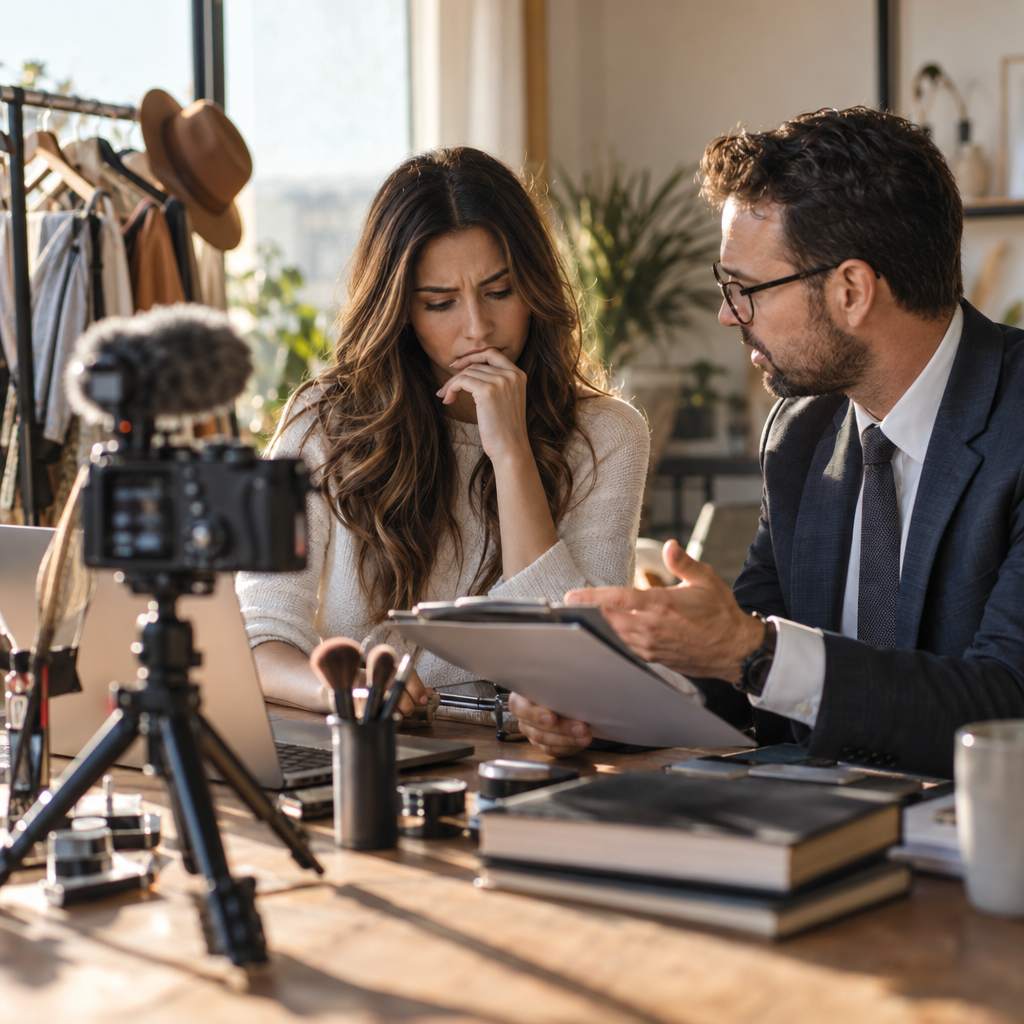
Your general liability policy probably does not cover your influencer campaigns. Insureon notes that advertising injuries are typically excluded from general liability policies for media and advertising professionals. That makes influencer marketing errors and omissions insurance the policy that decides who pays when a creator’s post goes wrong. Most brands find out which policy they own only after the claim letter arrives.
What E&O insurance actually does for an influencer program
Errors and omissions (E&O) coverage protects against claims that your work, or your content, caused someone financial harm. In media and advertising, the product is often called media liability. The two terms overlap heavily, and carriers use them differently, so ask which one you are being quoted.
For brands, the covered perils usually look like this:
- Copyright and trademark claims when a creator uses unlicensed music, imagery, or a third party’s mark in sponsored content.
- Defamation when a creator disparages a competitor in a comparison video you approved.
- Invasion of privacy and right of publicity when someone’s face or voice appears without permission.
- Defense costs, which matter most. Vouch reports that the average cost to defend a media liability claim now exceeds $100,000, even when the allegations have no merit.
Read that last point again. You can win and still lose six figures.
Cost of entry is modest by comparison. Insureon says the median media and advertising business pays $78 per month for media liability coverage. Your premium will differ, because content volume and subject sensitivity drive pricing, but the order of magnitude is worth knowing before a CFO calls it a luxury.
The expensive part of an influencer claim is rarely the settlement. It is the defense bill you pay before anyone proves you did nothing wrong.
Why your other policies will not step in
Brand teams often assume a commercial general liability (CGL) policy, a cyber policy, or D&O will catch influencer content problems. Mostly, they will not.
OneGroup, an insurance broker, warns that a commercial general liability policy will not cover you under advertising and personal injury, and that it contains exclusionary language for this. D&O may respond in some cases, but only if your coverage is broad and the issue traces to board-level decisions.
So the gap is structural. CGL handles slip-and-fall. Cyber handles breaches. Nobody handles the creator who borrowed a song, named a rival, and hit publish on a Friday night. Media liability does. Media liability does.
What E&O will not cover (read this before you sign)
This is where programs get burned. Policies vary, but Vouch lists typical exclusions: intentional illegal acts, bodily injury or property damage, employment disputes, patent infringement, and breach of contract unless specifically added.
Two of those deserve a closer look for influencer work.
Intentional illegal acts. If your team knowingly runs undisclosed paid posts, an insurer has an argument. Disclosure failures sit in a gray zone: sloppy process reads as negligence, while a documented decision to skip labels reads as intent. Your paper trail decides which one you get.
Breach of contract. Creator disputes over payment, exclusivity, or usage rights are contract fights, not content claims. If you want those covered, ask for the endorsement by name.
Regulatory fines are another question to put to your broker. Many policies treat government penalties as uninsurable or sublimit them heavily. Do not assume. Get the answer in writing.
Where influencer campaigns create claims
Insurance responds to events. Knowing the likeliest ones helps you decide limits and what to tighten operationally.
Disclosure failures
The FTC’s endorsement guidance hub covers disclosure of material connections between advertisers and endorsers and how those principles apply to social media. Platform tools help but do not absolve you. See our audits of the Instagram paid partnership toggle and the TikTok disclosure toggle for where brands assume the toggle is enough.
The FTC has also gained sharper tools. Its final rule on fake reviews and testimonials, announced in August 2024, lets the agency seek civil penalties against knowing violators. If an agency incentivizes five-star language in creator content, that is your exposure to watch, and a likely exclusion fight with your carrier.
Likeness, voice, and synthetic content
AI makes this the fastest-growing claim category for brand teams. A creator’s cloned voice, a deepfaked testimonial, or a digital avatar used beyond the contract term all invite right-of-publicity suits. Our guides on AI likeness and voice clauses and the right of publicity gap show where contracts leave brands exposed. Ask your carrier whether synthetic media claims are covered, excluded, or silently ambiguous.
AI-generated copy
If your team uses generative tools to draft creator briefs or captions, the liability question changes again. We examined it in AI ad copy liability, including where traditional policies fall short.
How to buy the policy without overbuying
You do not need a perfect policy. You need one that matches how your program really operates. Walk through these steps with your broker.
- Inventory your content flow. Count creators, posts per month, paid usage and whitelisting, and any AI-assisted production. Underwriters price on volume and sensitivity.
- Confirm who is the insured. Does coverage extend to content your agency produces? To creators as additional insureds? Many brands discover their agency’s policy excludes work done for clients, or the reverse.
- Check the definition of “media content.” It should explicitly include social media, influencer posts, and user-generated content published on your channels.
- Ask about prior acts and retroactive dates. Claims over a viral post can surface months later. A retroactive date that starts the day you bought the policy leaves old campaigns uncovered.
- Test the exclusions. Ask directly about regulatory proceedings, contractual liability, AI-generated content, and regulated categories.
- Match limits to reach, not revenue. A small brand with a huge viral campaign has more exposure than its revenue suggests.
Regulated verticals deserve special attention. Insurers often impose conditions or exclusions for alcohol, gambling, and pharma-adjacent content. Our piece on casino, alcohol, and pharma UGC explains the review gaps that tend to trigger them.
Insurance is the backstop, not the plan
A policy pays after something breaks. Underwriters know this, and they reward brands that prevent breakage. Expect questions about your process, and expect better terms if you can answer them well.
The documents that help most:
- Creator contracts with indemnification, usage terms, disclosure obligations, and approval rights.
- A written content review workflow with sign-off records.
- Music and asset licensing logs.
- Disclosure audits of live posts.
Indemnification clauses, incidentally, are only as good as the creator’s ability to pay. A micro-influencer rarely has the resources to fund a serious defense. That is why your own coverage matters, and why you should check whether the creator carries any policy. Our review of California AB 2602 and creator contract consent shows how contract drafting standards are tightening in one major market.
An indemnity clause from a creator with no assets is a promise, not protection. Your policy is the only thing that pays on day one.
FAQs
Is influencer marketing errors and omissions insurance legally required?
No law requires it for brands. Contracts often do, though. Retailers, platforms, and enterprise clients increasingly ask agencies and brands for proof of media liability or E&O coverage before approving campaigns.
What is the difference between E&O and media liability insurance?
E&O generally covers professional mistakes in delivering services. Media liability covers harm from content you create or publish, such as defamation or infringement. Insureon notes the policy may go by either name, so confirm the actual coverage grants rather than relying on the label.
Does a general liability policy cover influencer content claims?
Typically not. Sources such as OneGroup and Insureon explain that advertising injury and personal injury from media work are commonly excluded from general liability, which is why brands need separate media coverage.
Do creators need their own policy?
It is smart to ask, especially for high-reach creators and agencies. Many individual creators carry nothing. Whether you add them as additional insureds or rely on your own policy depends on the contract and carrier terms, so raise it with your broker.
Will E&O pay FTC fines?
Do not count on it. Coverage for regulatory fines and penalties varies widely and is often limited or excluded. Defense costs for a regulatory inquiry may be covered in some policies. Get the specific wording confirmed in writing.
How much does it cost?
Pricing varies by business, so use the $78 per month median Insureon cites for media and advertising businesses only as a rough benchmark. Brands with heavy content volume, regulated categories, or large reach can pay more.
Your next step
Pull your current policies this week and search each for the words “advertising injury,” “media,” and “social.” Then send your broker three questions: does coverage include creator content, what is excluded, and what is the retroactive date.
Top Influencer Marketing Agencies
The leading agencies shaping influencer marketing in 2026
Agencies ranked by campaign performance, client diversity, platform expertise, proven ROI, industry recognition, and client satisfaction. Assessed through verified case studies, reviews, and industry consultations.
Moburst

-
2

The Shelf
Boutique Beauty & Lifestyle Influencer AgencyA data-driven boutique agency specializing exclusively in beauty, wellness, and lifestyle influencer campaigns on Instagram and TikTok. Best for brands already focused on the beauty/personal care space that need curated, aesthetic-driven content.Clients: Pepsi, The Honest Company, Hims, Elf Cosmetics, Pure LeafVisit The Shelf → -
3

Audiencly
Niche Gaming & Esports Influencer AgencyA specialized agency focused exclusively on gaming and esports creators on YouTube, Twitch, and TikTok. Ideal if your campaign is 100% gaming-focused — from game launches to hardware and esports events.Clients: Epic Games, NordVPN, Ubisoft, Wargaming, Tencent GamesVisit Audiencly → -
4

Viral Nation
Global Influencer Marketing & Talent AgencyA dual talent management and marketing agency with proprietary brand safety tools and a global creator network spanning nano-influencers to celebrities across all major platforms.Clients: Meta, Activision Blizzard, Energizer, Aston Martin, WalmartVisit Viral Nation → -
5

The Influencer Marketing Factory
TikTok, Instagram & YouTube CampaignsA full-service agency with strong TikTok expertise, offering end-to-end campaign management from influencer discovery through performance reporting with a focus on platform-native content.Clients: Google, Snapchat, Universal Music, Bumble, YelpVisit TIMF → -
6

NeoReach
Enterprise Analytics & Influencer CampaignsAn enterprise-focused agency combining managed campaigns with a powerful self-service data platform for influencer search, audience analytics, and attribution modeling.Clients: Amazon, Airbnb, Netflix, Honda, The New York TimesVisit NeoReach → -
7

Ubiquitous
Creator-First Marketing PlatformA tech-driven platform combining self-service tools with managed campaign options, emphasizing speed and scalability for brands managing multiple influencer relationships.Clients: Lyft, Disney, Target, American Eagle, NetflixVisit Ubiquitous → -
8

Obviously
Scalable Enterprise Influencer CampaignsA tech-enabled agency built for high-volume campaigns, coordinating hundreds of creators simultaneously with end-to-end logistics, content rights management, and product seeding.Clients: Google, Ulta Beauty, Converse, AmazonVisit Obviously →