


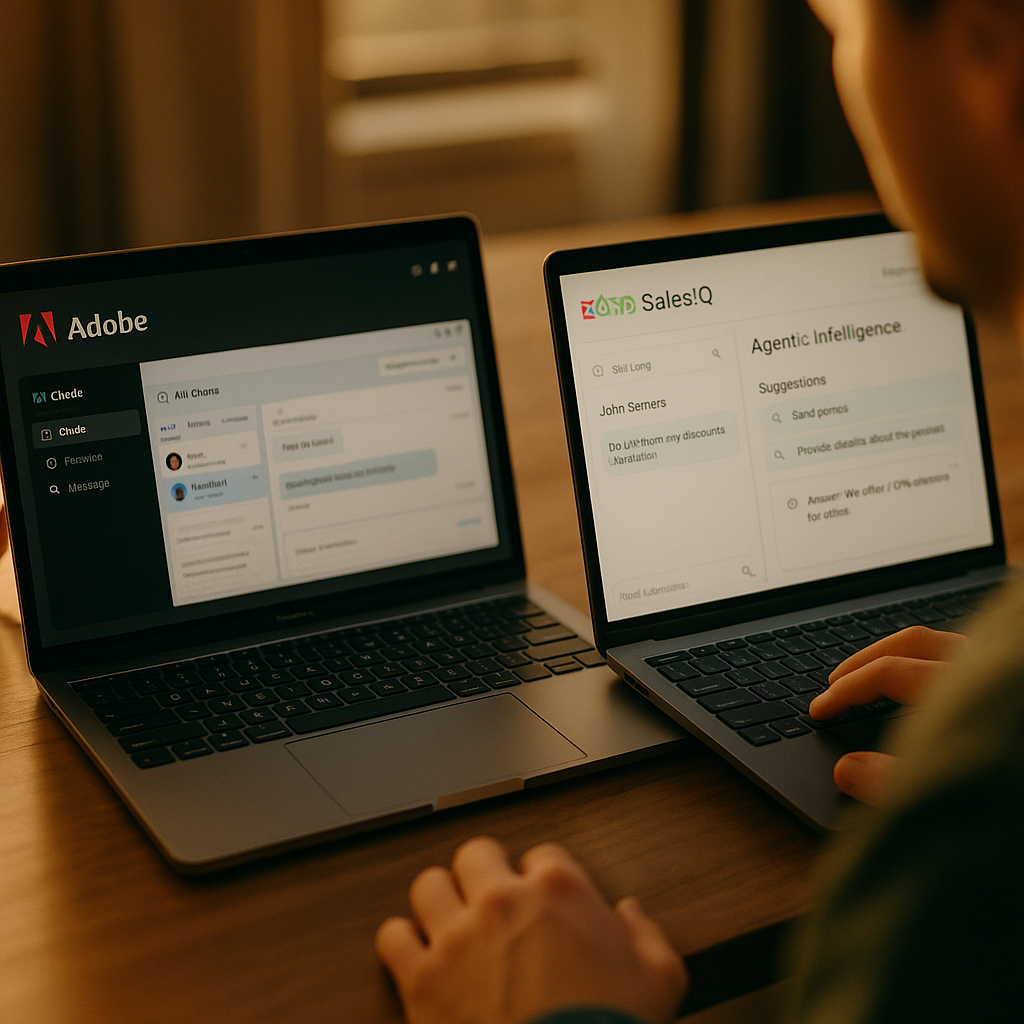
Sixty-eight percent of B2B buyers say they’ve abandoned a purchase because the brand’s digital engagement felt generic and unresponsive. That’s not a chatbot problem. That’s an intelligence problem. This evaluation of Adobe CX Enterprise Coworker vs. Zoho SalesIQ Agentic Intelligence cuts through the vendor positioning to tell brand-side teams which platform actually moves the needle on intent-driven, real-time customer interaction.
What “Agentic” Actually Means for Brand Teams
The word gets thrown around loosely. Vendors slap “agentic AI” on anything that auto-replies to a form submission. For the purposes of this evaluation, agentic means the system can autonomously interpret intent signals, take multi-step actions without human handholding, adapt its response logic based on session behavior, and escalate intelligently when it can’t close the loop alone.
Both Adobe and Zoho claim this. The gap is in execution scope and where in the funnel each platform earns its keep.
Before even comparing features, brands should do what most skip: define the problem space first. Are you trying to convert mid-funnel visitors faster? Rescue cart abandoners? Qualify inbound leads before an AE touches them? The answer shapes which platform’s architecture actually fits.
Adobe CX Enterprise Coworker: Built for Orchestration at Scale
Adobe’s CX Enterprise Coworker sits inside the Experience Cloud ecosystem, which is its biggest structural advantage and, honestly, its biggest risk factor. If your stack already runs on Adobe Real-Time CDP, Journey Optimizer, or Marketo Engage, the Coworker agent operates with first-party behavioral data that most standalone platforms can’t touch. It knows what content a user has consumed, which campaign touchpoint brought them in, what their predicted LTV segment is, and what Journey they’re currently enrolled in.
That context depth is genuinely hard to replicate. When a returning visitor hits a product page after clicking a Creator Partnership email, the Coworker can surface a proactive engagement trigger tied to that specific campaign sequence. No scripting. It reasons from the Journey data.
Adobe’s edge is context density: the Coworker agent surfaces intent signals from across the full Experience Cloud stack, giving it a behavioral richness that most standalone agentic tools simply cannot match without expensive data pipeline work.
The operational tradeoff: implementation complexity is significant. Adobe Professional Services involvement is nearly mandatory for enterprise deployments. Expect a 3-to-6-month onboarding window if you’re standing up Real-Time CDP alongside the Coworker agent. For brands already embedded in Adobe’s ecosystem, this is a natural extension. For everyone else, it’s a large bet.
Compliance and governance teams should also note that Adobe’s data processing architecture gives it strong GDPR and CCPA alignment out of the box, with consent management baked into the Journey Optimizer layer. That matters when your agentic system is making real-time personalization decisions at volume. Regulatory exposure is a real risk in autonomous engagement — see guidance from the Federal Trade Commission on AI-driven customer interactions for baseline requirements.
Zoho SalesIQ Agentic Intelligence: Leaner, Faster, Surprisingly Deep
Zoho SalesIQ’s Agentic Intelligence layer doesn’t get the enterprise press coverage Adobe commands, but brand teams evaluating it seriously come away with a different story than the analyst reports suggest.
The core play here is speed-to-value and operational flexibility. Zoho’s agentic framework, built on their proprietary Zia AI engine layered with intent classification models, can be deployed against a live site in days rather than months. The agent handles lead qualification, visitor scoring, proactive chat triggers, and CRM routing without requiring the customer to already live inside a complex data architecture.
What’s underreported is how SalesIQ handles creator attribution and agentic engagement together. For brands running influencer or creator programs that drive significant inbound traffic, SalesIQ’s UTM-aware session intelligence lets the agent serve contextually relevant engagement based on the creator channel that sourced the visit. A viewer coming in from a specific creator’s link gets a different engagement thread than organic search traffic. That’s genuinely useful for brands running multi-channel programs where creator traffic has distinct conversion behavior.
SalesIQ also integrates cleanly with Zoho CRM, Zoho Campaigns, and third-party stacks via API. The Zoho platform is deliberately modular, which means marketing ops teams don’t have to rebuild their entire stack to unlock the agentic features.
The honest limitations: Zoho’s predictive LTV modeling is less mature than Adobe’s. Deep behavioral sequencing across complex multi-channel journeys requires more manual configuration. And for enterprise brands with 10+ market deployments, governance and localization tooling lags behind what Adobe provides natively.
Head-to-Head: Where Each Platform Wins
For enterprise brands inside the Adobe ecosystem, the Coworker is a logical evolution, not an add-on purchase. The ROI case is strongest when you’re already paying for Real-Time CDP and Journey Optimizer and you need the engagement layer to operate on that full behavioral graph.
For mid-market and growth brands, or enterprises that run lean marketing tech stacks, SalesIQ Agentic Intelligence offers a more pragmatic path. The cost-per-engaged-session economics favor Zoho significantly at lower traffic volumes. Implementation risk is lower. And the creator channel intelligence is a genuine differentiator for brands where influencer traffic is a meaningful acquisition source.
On the question of AI autonomy, both platforms support human-in-the-loop escalation, but their default posture differs. Adobe’s Coworker defaults to higher automation confidence thresholds before escalating, reflecting its data richness. Zoho’s agent escalates more readily in ambiguous sessions, which reduces the risk of a bad autonomous interaction but increases agent handoff volume. Neither approach is wrong. They reflect different risk tolerance calibrations. This is worth reviewing in the context of automation platform efficiency frameworks your team may already be using.
Attribution and ROI Measurement: The Part Most Evaluations Skip
Here’s where brand-side teams need to press both vendors hard. Autonomous engagement platforms create a new attribution gap: when an AI agent converts a visitor, which touchpoint gets credit?
Adobe’s answer lives in Journey Optimizer’s attribution modeling, which can assign the Coworker interaction as a mid-funnel assist event tied to the broader campaign journey. That’s clean if your team has configured Journey-level attribution correctly, but it requires deliberate setup. For teams already using GA4 for attribution, the integration path matters. Proper GA4 channel attribution setup becomes critical when agentic touchpoints start appearing in your conversion paths.
Zoho SalesIQ’s attribution logic is more CRM-centric, routing session engagement data into Zoho CRM deal stages or syncing to third-party CRMs via webhook. It works well for lead-based revenue models. For complex multi-touch attribution across creator-driven and paid channels, you may need a dedicated attribution layer on top, such as Viant or a CDP like Segment.
The attribution configuration question should come before the demo. Ask each vendor: “Show me exactly how an agentic conversion event flows from our site session into our CRM and our attribution model.” If they can’t demo that live, treat it as a red flag.
It’s also worth auditing how these platforms handle creator-sourced traffic specifically. For brands where AI CRM attribution for creator campaigns is already in scope, the agentic engagement layer adds a new touchpoint that needs to be mapped into your existing attribution stack before deployment, not after.
Compliance, Data, and Risk Posture
Autonomous customer engagement at scale means your AI is making hundreds of real-time decisions per hour about what to say to real people. Regulatory and brand safety risk is not hypothetical. The UK ICO has explicit guidance on automated decision-making under UK GDPR that applies directly to agentic engagement systems operating in European markets.
Adobe’s compliance architecture is more mature here, with granular consent signal inheritance from its CDP layer. Zoho has solid GDPR tooling but requires more deliberate configuration to achieve the same consent-signal fidelity. Neither platform is a compliance liability out of the box, but smaller marketing ops teams should budget for compliance configuration time on the Zoho side.
Vendor Selection Criteria for Your Evaluation Committee
- Existing stack alignment: Adobe ecosystem depth vs. best-of-breed flexibility
- Time to production: Zoho wins significantly for mid-market deployment timelines
- Creator traffic intelligence: Zoho SalesIQ offers native UTM-aware agentic routing
- Attribution model maturity: Adobe wins for complex multi-touch Journey attribution
- Compliance configuration burden: Adobe lighter lift for regulated markets
- Total cost of ownership: Zoho significantly lower for sub-enterprise deployments
- Escalation risk tolerance: Adobe autonomy-first vs. Zoho escalation-first posture
For teams running a structured vendor selection framework, these criteria map directly onto standard AI platform evaluation scorecards. Weight them against your specific program scale, channel mix, and existing infrastructure before entering any vendor negotiation.
Research from Gartner indicates that by the mid-decade point, over 40% of enterprise customer interactions will be managed by autonomous AI agents. The question isn’t whether to adopt agentic engagement. It’s which platform fits your brand’s operational reality without creating a new layer of technical debt or compliance exposure.
Run a 60-day parallel pilot with defined conversion benchmarks on one high-intent traffic segment before committing to either platform at full scale. That’s the only evaluation that actually answers the question your CFO will ask.
FAQs
What is the difference between Adobe CX Enterprise Coworker and a traditional chatbot?
Adobe CX Enterprise Coworker is an agentic AI system that interprets real-time behavioral intent signals, draws on first-party data from the Adobe Experience Cloud, and takes multi-step autonomous actions to engage visitors. A traditional chatbot follows pre-scripted decision trees without contextual reasoning or adaptive behavior based on live session data.
Is Zoho SalesIQ Agentic Intelligence suitable for enterprise brands?
Zoho SalesIQ Agentic Intelligence is well-suited for mid-market and growth-stage brands and works for enterprise deployments that prefer modular stack integration. It becomes less competitive against Adobe for large enterprises already running Adobe Real-Time CDP and Journey Optimizer, where the Coworker agent benefits from deep ecosystem data access.
How does each platform handle attribution for creator-driven traffic?
Zoho SalesIQ uses UTM-aware session intelligence to deliver contextually different agentic engagement based on the source channel, including creator or influencer traffic. Adobe CX Enterprise Coworker handles attribution through Journey Optimizer, assigning agentic interactions as mid-funnel events within campaign-level attribution models.
What compliance risks should brands evaluate before deploying agentic engagement platforms?
Brands operating in European markets must ensure their agentic systems comply with GDPR and UK GDPR rules on automated decision-making. Adobe’s CX Enterprise architecture inherits consent signals from its CDP layer, reducing configuration burden. Zoho SalesIQ requires deliberate compliance configuration but is not non-compliant by default. Legal and privacy teams should review both platforms against current regulatory standards before production deployment.
Can these platforms integrate with existing CRM and attribution stacks?
Yes. Adobe CX Enterprise Coworker integrates natively with Adobe’s ecosystem, including Marketo Engage and Analytics, and supports third-party integrations. Zoho SalesIQ integrates with Zoho CRM natively and connects to third-party CRMs and attribution tools via API and webhook. For complex multi-touch attribution setups, additional configuration or a dedicated attribution platform may be required alongside either tool.
Top Influencer Marketing Agencies
The leading agencies shaping influencer marketing in 2026
Agencies ranked by campaign performance, client diversity, platform expertise, proven ROI, industry recognition, and client satisfaction. Assessed through verified case studies, reviews, and industry consultations.
Moburst

-
2

The Shelf
Boutique Beauty & Lifestyle Influencer AgencyA data-driven boutique agency specializing exclusively in beauty, wellness, and lifestyle influencer campaigns on Instagram and TikTok. Best for brands already focused on the beauty/personal care space that need curated, aesthetic-driven content.Clients: Pepsi, The Honest Company, Hims, Elf Cosmetics, Pure LeafVisit The Shelf → -
3

Audiencly
Niche Gaming & Esports Influencer AgencyA specialized agency focused exclusively on gaming and esports creators on YouTube, Twitch, and TikTok. Ideal if your campaign is 100% gaming-focused — from game launches to hardware and esports events.Clients: Epic Games, NordVPN, Ubisoft, Wargaming, Tencent GamesVisit Audiencly → -
4

Viral Nation
Global Influencer Marketing & Talent AgencyA dual talent management and marketing agency with proprietary brand safety tools and a global creator network spanning nano-influencers to celebrities across all major platforms.Clients: Meta, Activision Blizzard, Energizer, Aston Martin, WalmartVisit Viral Nation → -
5

The Influencer Marketing Factory
TikTok, Instagram & YouTube CampaignsA full-service agency with strong TikTok expertise, offering end-to-end campaign management from influencer discovery through performance reporting with a focus on platform-native content.Clients: Google, Snapchat, Universal Music, Bumble, YelpVisit TIMF → -
6

NeoReach
Enterprise Analytics & Influencer CampaignsAn enterprise-focused agency combining managed campaigns with a powerful self-service data platform for influencer search, audience analytics, and attribution modeling.Clients: Amazon, Airbnb, Netflix, Honda, The New York TimesVisit NeoReach → -
7

Ubiquitous
Creator-First Marketing PlatformA tech-driven platform combining self-service tools with managed campaign options, emphasizing speed and scalability for brands managing multiple influencer relationships.Clients: Lyft, Disney, Target, American Eagle, NetflixVisit Ubiquitous → -
8

Obviously
Scalable Enterprise Influencer CampaignsA tech-enabled agency built for high-volume campaigns, coordinating hundreds of creators simultaneously with end-to-end logistics, content rights management, and product seeding.Clients: Google, Ulta Beauty, Converse, AmazonVisit Obviously →