


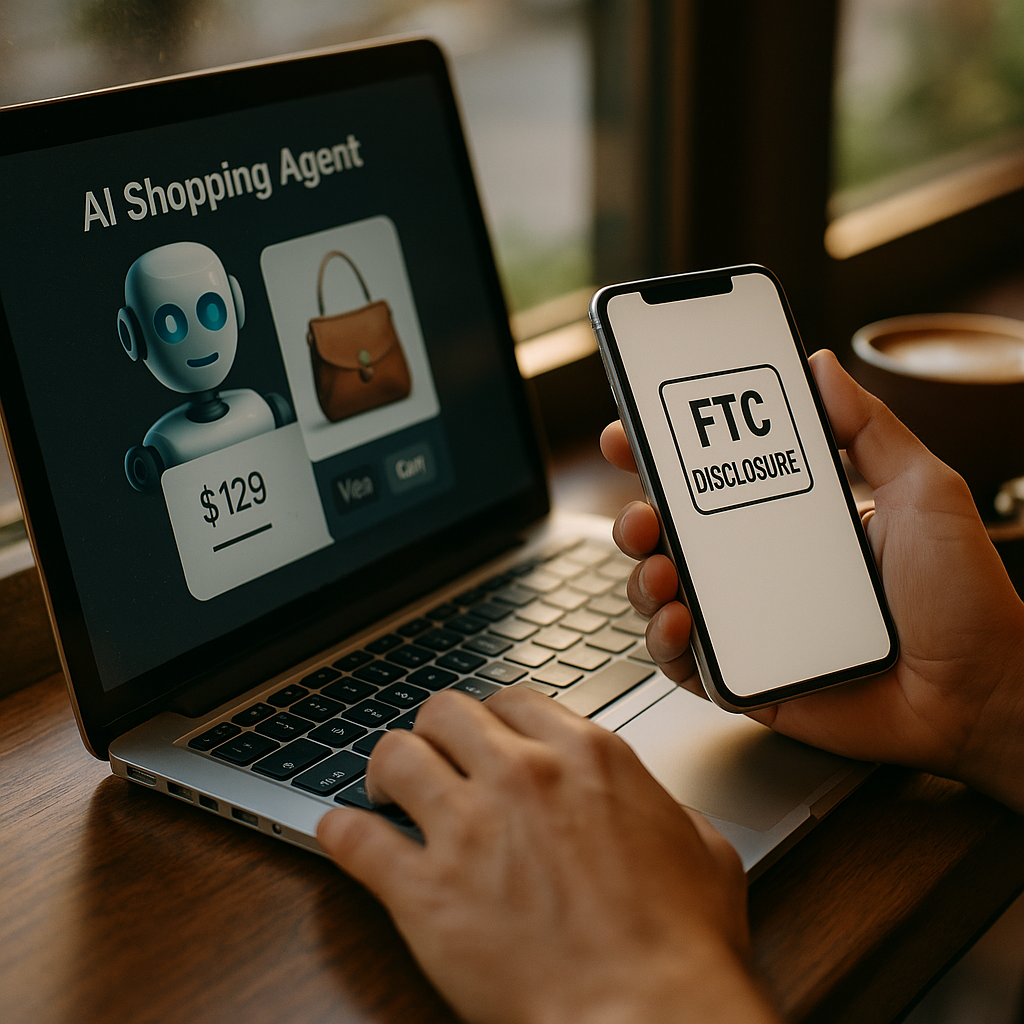
When #Ad Doesn’t Exist: The AI Commerce Disclosure Crisis
By 2026, an estimated 100 million U.S. consumers will interact with AI shopping agents at least monthly, according to eMarketer projections. Here’s the problem: when an AI agent recommends a product a creator was paid to promote, there is no feed, no caption, and no hashtag. The disclosure gap in AI-mediated commerce is not a future hypothetical — it’s an active compliance crisis unfolding right now, and most brand teams haven’t updated a single contract clause to address it.
How We Got Here: From Hashtags to Headless Commerce
For a decade, the FTC’s endorsement guidance framework leaned on a simple premise: disclosures should be “clear and conspicuous” within the medium where the endorsement appears. Instagram captions. YouTube descriptions. TikTok overlays. The machinery worked (imperfectly, but it worked) because the consumer could see the content, see the creator, and — if brands did their jobs — see the disclosure.
AI shopping agents obliterate that chain.
When a consumer asks ChatGPT’s shopping feature, Google’s Gemini agent, or Amazon’s Rufus to recommend a moisturizer for sensitive skin, the response is a conversational answer. It might pull from creator reviews, affiliate content, sponsored blog posts, or product seeding campaigns. The consumer never sees the original creator content. They see a synthesized recommendation. And the “#ad” disclosure that may have existed in the original post? It’s been stripped away by the AI’s summarization layer.
The fundamental compliance assumption — that disclosures travel with the content — collapses the moment an AI agent ingests, summarizes, and re-presents creator-influenced recommendations without any visual or textual disclosure inheritance.
This isn’t an edge case. Perplexity, Microsoft Copilot, and Meta AI are all building or expanding commerce-capable conversational interfaces. Every one of them can surface product recommendations shaped by paid creator endorsements. None of them have standardized disclosure mechanisms.
What the FTC Actually Requires — and Where the Gap Lives
The FTC’s endorsement guidelines, updated in 2023, explicitly state that disclosures must be unavoidable to consumers and presented in a way that’s hard to miss within the endorsement itself. The guidelines also clarified that brands — not just creators — bear liability when they know or should know that endorsements are being made without proper disclosure.
Here’s where it gets uncomfortable for brand legal teams.
If your brand runs an affiliate program and a creator’s product review gets surfaced by an AI shopping agent without disclosure, the FTC’s position is clear: the material connection still exists, and someone is responsible for disclosing it. The question is who — the brand, the creator, or the AI platform — and how, given that conversational interfaces have no established disclosure convention.
The current guidelines don’t answer this. Not specifically. And the FTC’s enforcement posture has historically been to hold brands to a higher standard than individual creators, particularly when the brand had the resources and sophistication to anticipate the compliance gap. If you’re a brand marketer reading this, that means the burden is landing on your desk whether you like it or not. Our breakdown of influencer disclosure failures details exactly how the FTC has pursued brands in analogous situations.
Global Regulators Are Moving Faster Than You Think
The FTC isn’t alone. The EU’s Digital Services Act and the forthcoming AI Act impose transparency obligations on AI systems that make recommendations with commercial intent. The UK’s Information Commissioner’s Office and the Advertising Standards Authority have both signaled interest in AI-generated commercial recommendations.
In practice, this means:
- EU AI Act (effective August 2026): AI systems used in consumer-facing recommendation contexts must disclose when content is AI-generated and when commercial relationships influence outputs.
- UK ASA guidance: Any “marketing communication” — including AI-surfaced recommendations traceable to a paid relationship — falls under existing advertising codes.
- Australia’s ACCC: Active investigations into algorithmic recommendations that obscure commercial relationships from consumers.
Brands operating across borders already navigate complex disclosure regimes. But AI shopping agents add a new variable: the recommendation may be generated in one jurisdiction, consumed in another, and influenced by creator content governed by a third. For cross-border contract strategies, see our guide on cross-border influencer contract clauses.
A Practical Framework for Updating Your Disclosure Stack
Waiting for regulators to issue AI-specific disclosure rules is a losing strategy. The FTC has never hesitated to apply existing principles to new media formats — they did it with blogs, then Instagram, then TikTok. They’ll do it with AI agents. Brands that get ahead of this will avoid both enforcement risk and the far more likely reputational damage of a viral “your AI lied to me” moment.
Here’s a five-layer framework we recommend brand compliance teams adopt immediately:
1. Metadata-Level Disclosure Tagging
Every piece of sponsored creator content should carry machine-readable disclosure metadata — not just human-readable hashtags. Think of it as structured data for sponsorship. If an AI agent crawls a creator’s blog post or product review, the metadata should signal “material connection: paid sponsorship by [Brand]” in a format the AI can parse and pass through to the consumer. Work with your SEO and engineering teams to implement this using schema.org or similar vocabularies.
2. Contractual Disclosure Inheritance Clauses
Update every creator contract to include language requiring that disclosure obligations persist across derivative uses, including AI summarization, aggregation, and conversational commerce surfaces. This doesn’t solve the technical problem, but it establishes a legal paper trail that demonstrates good faith and shifts some liability. Our deep dive on AI creator contract addendums provides template language you can adapt.
3. Platform-Level Advocacy and API Requirements
Brands with significant ad spend have leverage. Use it. Push OpenAI, Google, Amazon, and Meta to build disclosure pass-through mechanisms into their AI shopping interfaces. Some of this is already happening — Google’s Shopping Graph includes limited provenance signaling — but it’s inconsistent and opt-in. Make participation a requirement in your platform partnership agreements.
4. Affiliate and Seeding Program Audits
Audit every affiliate link, product seeding program, and creator partnership to map which content is most likely to be ingested by AI shopping agents. Blog posts, long-form YouTube reviews, and product comparison articles are prime AI training and retrieval data. Prioritize disclosure upgrades for these formats. Your FTC compliance audit process should now include an AI-surface risk score for every content asset.
5. Consumer-Facing Transparency Pages
Create a publicly accessible page on your brand site listing all active creator partnerships, affiliate programs, and sponsored content relationships. This serves as a fallback disclosure mechanism — if an AI agent surfaces a recommendation without proper disclosure, the consumer can verify the relationship. It’s not a perfect solution, but it’s a defensible one.
The brands that treat AI disclosure as a metadata engineering problem — not just a legal copywriting problem — will be the ones best positioned when enforcement actions begin.
Who Owns the Liability? It’s Messier Than You Want It to Be
Let’s be direct: there is no settled law on liability allocation when an AI shopping agent strips disclosure from creator content and presents an undisclosed recommendation to a consumer. The most likely enforcement scenario, based on FTC precedent, is joint liability — the brand, the creator, and potentially the AI platform all face exposure.
But regulators will follow the money. And the money flows from brands.
If your brand paid a creator, and that creator’s content influenced an AI recommendation, and the consumer had no way of knowing, you’re the deepest pocket and the most sophisticated actor in the chain. The FTC’s 2023 guidance updates made it explicit that brands cannot hide behind intermediaries. AI agents are just the latest intermediary. For a broader look at how autonomous AI agents create liability risks, we’ve mapped the full exposure landscape.
The operational takeaway? Don’t wait to be told what to do. Build the disclosure infrastructure now, document your good-faith efforts, and pressure the AI platforms to build pass-through disclosure into their commerce APIs.
The Bottom Line
Audit your creator content library for AI-surface risk within the next 90 days, implement metadata-level disclosure tagging on all new sponsored content immediately, and add disclosure inheritance clauses to every creator contract before your next campaign launches. The brands that move first will set the standard — and avoid becoming the FTC’s test case.
FAQs
What is the disclosure gap in AI-mediated commerce?
The disclosure gap refers to the loss of sponsorship disclosures when AI shopping agents summarize or re-present creator-influenced product recommendations in conversational interfaces. Standard hashtag disclosures like #ad do not carry over when AI systems strip original content formatting, leaving consumers unaware of paid material connections between brands and creators.
Are brands liable when AI shopping agents remove disclosure from creator content?
Based on current FTC guidance, brands bear significant liability when they know or should know that endorsements reach consumers without proper disclosure. The FTC has consistently held that brands cannot rely on intermediaries to handle disclosure obligations, and AI shopping agents are treated as another intermediary in the endorsement chain.
How can brands ensure FTC compliance when AI agents surface sponsored content?
Brands should implement machine-readable disclosure metadata on all sponsored creator content, update creator contracts with disclosure inheritance clauses, audit affiliate and seeding programs for AI-surface risk, advocate for platform-level disclosure pass-through mechanisms, and maintain public transparency pages listing active creator partnerships.
Do global regulations like the EU AI Act affect AI commerce disclosures?
Yes. The EU AI Act, effective August 2026, requires AI systems making consumer-facing recommendations to disclose when commercial relationships influence outputs. The UK ASA and Australia’s ACCC also apply existing advertising codes to AI-surfaced recommendations, creating a multi-jurisdictional compliance obligation for brands operating internationally.
What is metadata-level disclosure tagging for sponsored content?
Metadata-level disclosure tagging involves embedding machine-readable structured data — such as schema.org markup — into sponsored creator content that signals a paid material connection. Unlike visual hashtags, this metadata can be parsed by AI systems and potentially passed through to consumers even when the original content format is not preserved.
Top Influencer Marketing Agencies
The leading agencies shaping influencer marketing in 2026
Agencies ranked by campaign performance, client diversity, platform expertise, proven ROI, industry recognition, and client satisfaction. Assessed through verified case studies, reviews, and industry consultations.
Moburst

-
2

The Shelf
Boutique Beauty & Lifestyle Influencer AgencyA data-driven boutique agency specializing exclusively in beauty, wellness, and lifestyle influencer campaigns on Instagram and TikTok. Best for brands already focused on the beauty/personal care space that need curated, aesthetic-driven content.Clients: Pepsi, The Honest Company, Hims, Elf Cosmetics, Pure LeafVisit The Shelf → -
3

Audiencly
Niche Gaming & Esports Influencer AgencyA specialized agency focused exclusively on gaming and esports creators on YouTube, Twitch, and TikTok. Ideal if your campaign is 100% gaming-focused — from game launches to hardware and esports events.Clients: Epic Games, NordVPN, Ubisoft, Wargaming, Tencent GamesVisit Audiencly → -
4

Viral Nation
Global Influencer Marketing & Talent AgencyA dual talent management and marketing agency with proprietary brand safety tools and a global creator network spanning nano-influencers to celebrities across all major platforms.Clients: Meta, Activision Blizzard, Energizer, Aston Martin, WalmartVisit Viral Nation → -
5

The Influencer Marketing Factory
TikTok, Instagram & YouTube CampaignsA full-service agency with strong TikTok expertise, offering end-to-end campaign management from influencer discovery through performance reporting with a focus on platform-native content.Clients: Google, Snapchat, Universal Music, Bumble, YelpVisit TIMF → -
6

NeoReach
Enterprise Analytics & Influencer CampaignsAn enterprise-focused agency combining managed campaigns with a powerful self-service data platform for influencer search, audience analytics, and attribution modeling.Clients: Amazon, Airbnb, Netflix, Honda, The New York TimesVisit NeoReach → -
7

Ubiquitous
Creator-First Marketing PlatformA tech-driven platform combining self-service tools with managed campaign options, emphasizing speed and scalability for brands managing multiple influencer relationships.Clients: Lyft, Disney, Target, American Eagle, NetflixVisit Ubiquitous → -
8

Obviously
Scalable Enterprise Influencer CampaignsA tech-enabled agency built for high-volume campaigns, coordinating hundreds of creators simultaneously with end-to-end logistics, content rights management, and product seeding.Clients: Google, Ulta Beauty, Converse, AmazonVisit Obviously →