


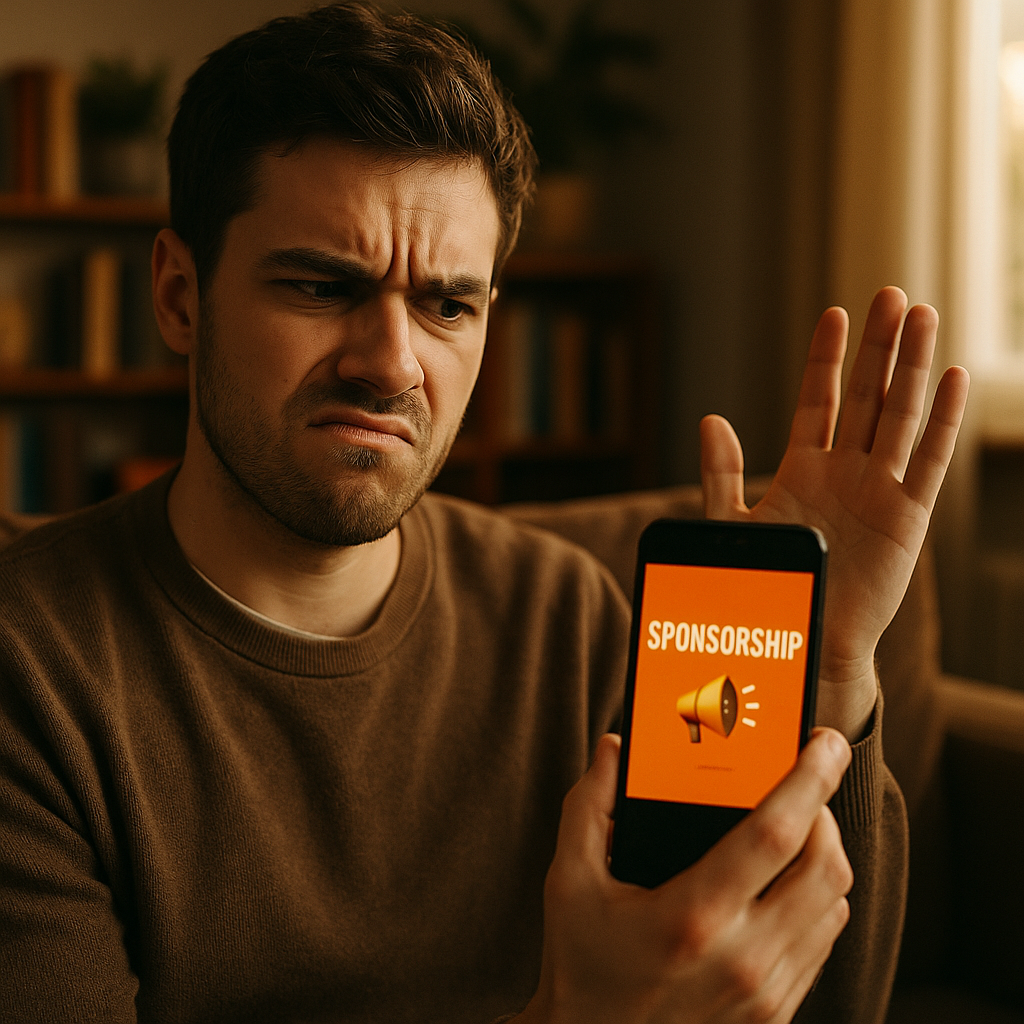
Skip rates on traditional branded content hover north of 40% on some platforms, and viewers can smell a scripted testimonial from three seconds out. So brands are trying something that sounds like malpractice on paper: telling creators to trash-talk the sponsorship itself, on camera, before pivoting into an honest pitch. The anti-ad ad format is the fastest-growing briefing trend nobody wants to put in a case study yet — but it’s converting.
What This Format Actually Looks Like
Picture a creator staring into the lens, deadpan: “So the brand paid me to say this feels ‘life-changing.’ It doesn’t feel life-changing. It’s a decent water bottle.” Then, thirty seconds later, they’re explaining why they’ve actually used it every day for two months and why it replaced three other bottles in their cabinet.
That’s the format. It’s not parody for parody’s sake — it’s a structured brief that front-loads audience skepticism, says the quiet part out loud, and then earns the right to sell. The joke is the trust bridge. The product pitch is still the destination.
This isn’t entirely new. Creators have been winking at sponsorships since branded content existed. What’s changed is that brands are now briefing the mockery deliberately, with legal sign-off, instead of hoping a creator improvises something charming. That shift — from tolerated irreverence to scripted irreverence — is what makes this a format worth studying rather than a fluke.
Why It’s Working When Straight Ads Aren’t
Audiences have developed what researchers and marketers alike now call ad blindness, and Gen Z and younger millennials in particular have near-instant pattern recognition for sponsored content cadence: the smile, the product reveal, the discount code. The anti-ad format breaks that pattern by refusing to perform sincerity on cue. It says, “I know you know this is an ad,” which — counterintuitively — makes the sincerity that follows land harder.
The format works because it spends its first ten seconds burning audience distrust instead of building brand enthusiasm — and that trade pays off in watch time and conversion.
There’s also a structural benefit: self-aware content gets shared and commented on differently than polished ads. Viewers screenshot the “I can’t believe they let me say this” line. That’s earned distribution a media buy can’t replicate. Compare it to the comment-section format, which also weaponizes audience skepticism, or the mockumentary format, which leans into the same “we’re all in on the joke” energy but with more production scaffolding.
Marketers running both formats side by side report similar engagement lifts — the difference is that anti-ad content requires almost no set dressing, just a strong script and a creator with comic timing.
The Psychology, Briefly
Reactance theory explains a chunk of this. When people feel persuaded, they resist. When they feel like they’re being let in on the manipulation, resistance drops because they no longer feel like the target — they feel like a co-conspirator. The anti-ad format essentially recruits the viewer into the joke about advertising, then sells to them as an ally rather than a mark.
It’s the same instinct behind why rebuttal video briefs work: acknowledging the criticism before anyone else voices it disarms it. The anti-ad format just applies that logic to the sponsorship relationship itself, not to a product complaint.
How to Brief It Without Losing Control of the Message
This is where most brands get nervous, and rightly so. Handing a creator license to mock your sponsorship sounds like a fast track to a viral clip that only lands the “this is a scam” half of the joke. The brief has to be engineered tightly.
- Lock the ratio. Most successful executions run roughly 60-70% honest product information to 30-40% self-aware commentary about the ad itself. Too much snark and the CTA gets lost; too little and it just reads as another ad with a wink.
- Script the pivot line. The turn from mockery to genuine endorsement needs an anchor sentence the creator can’t drift away from — something like “but here’s the part I’d say even if you weren’t paying me.” Give them the line verbatim, let them deliver it in their voice.
- Ban brand-disparaging specifics. Creators can joke about the concept of being paid to talk about the product. They cannot joke about the product failing, the company being shady, or the price being a rip-off. That’s the legal red line, and it needs to be explicit in the brief, not assumed.
- Require disclosure inside the joke, not instead of it. “Yes, this is sponsored, obviously” satisfies FTC disclosure guidance far better than a buried #ad tag, and it doubles as material for the bit.
- Pre-approve the mock-script and the sincere-script separately. Legal and brand teams should review both halves independently. A joke that’s fine alone can become a problem paired with a specific product claim.
Brands running this at scale are essentially applying the same discipline used in creator rebuttal video briefs — structured spontaneity, not actual improvisation. The creator sounds unscripted. The brand knows exactly what’s coming.
Where the Risk Actually Lives
The compliance conversation here isn’t really about disclosure — that part’s arguably easier than standard influencer posts, since the mockery makes the sponsorship impossible to miss. The real risk is reputational drift: a creator ad-libbing past the approved script and landing on a joke that reads as genuine brand criticism to anyone who scrolls past the first eight seconds.
Short-form platforms chop context ruthlessly. A viewer who sees only the mocking half, out of sequence via a duet or a screen-recorded repost, gets a different message entirely than the one you briefed.
Mitigate this with a few operational habits:
- Require the sincere pivot to happen before any natural cut point a platform’s algorithm might favor for previews or thumbnails.
- Add on-screen text reinforcing the sponsored context throughout, not just in the caption, since captions often get stripped in reposts.
- Monitor comment sentiment in the first 24 hours — this format has a wider variance in reception than a standard testimonial, and you want to catch a misfire before it compounds.
- Keep a legal contact reachable same-day during the first week post-publish, the way you would for any format with elevated FTC endorsement guideline exposure.
Brands that have handled crisis-adjacent formats well — see the discipline behind rebuttal video briefs — already have most of this infrastructure. Repurpose it rather than building new approval chains from scratch.
Which Creators Can Actually Pull This Off
Not every creator has the comic control this format demands. You need someone with strong deadpan delivery and a track record of sarcasm that doesn’t read as bitterness. Comedy-adjacent creators and those with a strong “reviewer” persona — the ones who already build audience trust by being critical of products generally — tend to outperform lifestyle or beauty creators who built their following on polish.
Vet this the same way you’d vet for the customer-handoff format or blind taste-test briefs: pull three to five past videos, check whether the creator’s humor has ever tipped into genuine negativity toward a sponsor, and ask directly how comfortable they are delivering a scripted pivot line without it sounding forced.
A creator who can’t sell the sincerity in the back half will only leave audiences with the mockery in the front half — and that’s a net negative for brand sentiment, not a wash.
Measuring It Correctly
Standard branded-content metrics undersell this format if you only look at completion rate or CTR in isolation. Track these instead:
- Comment sentiment ratio — what percentage of comments reference the joke positively versus reading the mockery as genuine complaint.
- Share-to-view ratio — this format tends to outperform standard UGC on shares because the “I can’t believe they said this” hook drives forwarding behavior.
- Save rate on the sincere half — if viewers are saving the clip at the pivot point, the sell landed.
- Post-view search lift — branded search volume tends to spike differently with this format than with straightforward testimonials, since the novelty drives curiosity clicks.
Platforms like Sprout Social and native analytics from TikTok Ads Manager can segment sentiment at the comment level, which matters more here than for almost any other creator format. According to eMarketer, creator-led content already outperforms brand-owned social posts on engagement by wide margins — the anti-ad format is essentially betting that self-awareness widens that gap further, at the cost of tighter creative control.
Where It Fits Against Other Formats
This isn’t a replacement for your entire influencer roster’s output — it’s a wedge format, best used sparingly so the mockery doesn’t become predictable. Brands running high-volume creator programs, the kind described in UGC content harvesting workflows, should treat anti-ad content as a distinct content bucket with its own approval track, not a variant folded into standard briefs. Overuse and the joke stops disarming skepticism — it becomes the new cliché, and audiences will clock it just as fast as they clocked the smile-and-reveal format before it.
Start small: brief one creator, one product, one script with a hard-locked pivot line, and measure sentiment before scaling the format across a roster. The format’s entire value proposition is novelty plus trust — protect both by rationing how often you deploy it.
Frequently Asked Questions
Is the anti-ad ad format compliant with FTC disclosure rules?
Yes, often more clearly than standard sponsored posts, since the creator explicitly states the content is paid within the joke itself. Brands should still include a standard #ad or #sponsored tag per FTC guidance — the in-content acknowledgment supplements disclosure, it doesn’t replace it.
What industries does this format work best for?
Consumer products with lower price points and lighter regulatory scrutiny — beauty, food and beverage, apparel, tech accessories — tend to have the most creative room. Regulated categories like finance, health, and pharma face tighter constraints on what can be joked about at all.
How is this different from a standard testimonial ad?
A testimonial asks the audience to trust the creator’s sincerity from the first frame. The anti-ad format spends its opening seconds acknowledging skepticism directly, then earns trust through the pivot to a genuine endorsement — it’s a two-act structure rather than a single sustained pitch.
What’s the biggest risk brands underestimate?
Context collapse from reposts and duets. If a viewer only sees the mocking half of the clip, out of sequence, the message reads as genuine criticism rather than a bit. Structuring on-screen text and cut points to survive fragmentation is essential.
Can this format work for a brand’s own owned channels, not just creator content?
It’s riskier there. Audiences forgive creators for self-aware humor about being paid; the same joke from a brand’s own account can read as tone-deaf or defensive. Keep the mockery in creator voice, not brand voice.
Frequently Asked Questions
Is the anti-ad ad format compliant with FTC disclosure rules?
Yes, often more clearly than standard sponsored posts, since the creator explicitly states the content is paid within the joke itself. Brands should still include a standard #ad or #sponsored tag per FTC guidance — the in-content acknowledgment supplements disclosure, it doesn’t replace it.
What industries does this format work best for?
Consumer products with lower price points and lighter regulatory scrutiny — beauty, food and beverage, apparel, tech accessories — tend to have the most creative room. Regulated categories like finance, health, and pharma face tighter constraints on what can be joked about at all.
How is this different from a standard testimonial ad?
A testimonial asks the audience to trust the creator’s sincerity from the first frame. The anti-ad format spends its opening seconds acknowledging skepticism directly, then earns trust through the pivot to a genuine endorsement — it’s a two-act structure rather than a single sustained pitch.
What’s the biggest risk brands underestimate?
Context collapse from reposts and duets. If a viewer only sees the mocking half of the clip, out of sequence, the message reads as genuine criticism rather than a bit. Structuring on-screen text and cut points to survive fragmentation is essential.
Can this format work for a brand’s own owned channels, not just creator content?
It’s riskier there. Audiences forgive creators for self-aware humor about being paid; the same joke from a brand’s own account can read as tone-deaf or defensive. Keep the mockery in creator voice, not brand voice.
Top Influencer Marketing Agencies
The leading agencies shaping influencer marketing in 2026
Agencies ranked by campaign performance, client diversity, platform expertise, proven ROI, industry recognition, and client satisfaction. Assessed through verified case studies, reviews, and industry consultations.
Moburst

-
2

The Shelf
Boutique Beauty & Lifestyle Influencer AgencyA data-driven boutique agency specializing exclusively in beauty, wellness, and lifestyle influencer campaigns on Instagram and TikTok. Best for brands already focused on the beauty/personal care space that need curated, aesthetic-driven content.Clients: Pepsi, The Honest Company, Hims, Elf Cosmetics, Pure LeafVisit The Shelf → -
3

Audiencly
Niche Gaming & Esports Influencer AgencyA specialized agency focused exclusively on gaming and esports creators on YouTube, Twitch, and TikTok. Ideal if your campaign is 100% gaming-focused — from game launches to hardware and esports events.Clients: Epic Games, NordVPN, Ubisoft, Wargaming, Tencent GamesVisit Audiencly → -
4

Viral Nation
Global Influencer Marketing & Talent AgencyA dual talent management and marketing agency with proprietary brand safety tools and a global creator network spanning nano-influencers to celebrities across all major platforms.Clients: Meta, Activision Blizzard, Energizer, Aston Martin, WalmartVisit Viral Nation → -
5

The Influencer Marketing Factory
TikTok, Instagram & YouTube CampaignsA full-service agency with strong TikTok expertise, offering end-to-end campaign management from influencer discovery through performance reporting with a focus on platform-native content.Clients: Google, Snapchat, Universal Music, Bumble, YelpVisit TIMF → -
6

NeoReach
Enterprise Analytics & Influencer CampaignsAn enterprise-focused agency combining managed campaigns with a powerful self-service data platform for influencer search, audience analytics, and attribution modeling.Clients: Amazon, Airbnb, Netflix, Honda, The New York TimesVisit NeoReach → -
7

Ubiquitous
Creator-First Marketing PlatformA tech-driven platform combining self-service tools with managed campaign options, emphasizing speed and scalability for brands managing multiple influencer relationships.Clients: Lyft, Disney, Target, American Eagle, NetflixVisit Ubiquitous → -
8

Obviously
Scalable Enterprise Influencer CampaignsA tech-enabled agency built for high-volume campaigns, coordinating hundreds of creators simultaneously with end-to-end logistics, content rights management, and product seeding.Clients: Google, Ulta Beauty, Converse, AmazonVisit Obviously →