


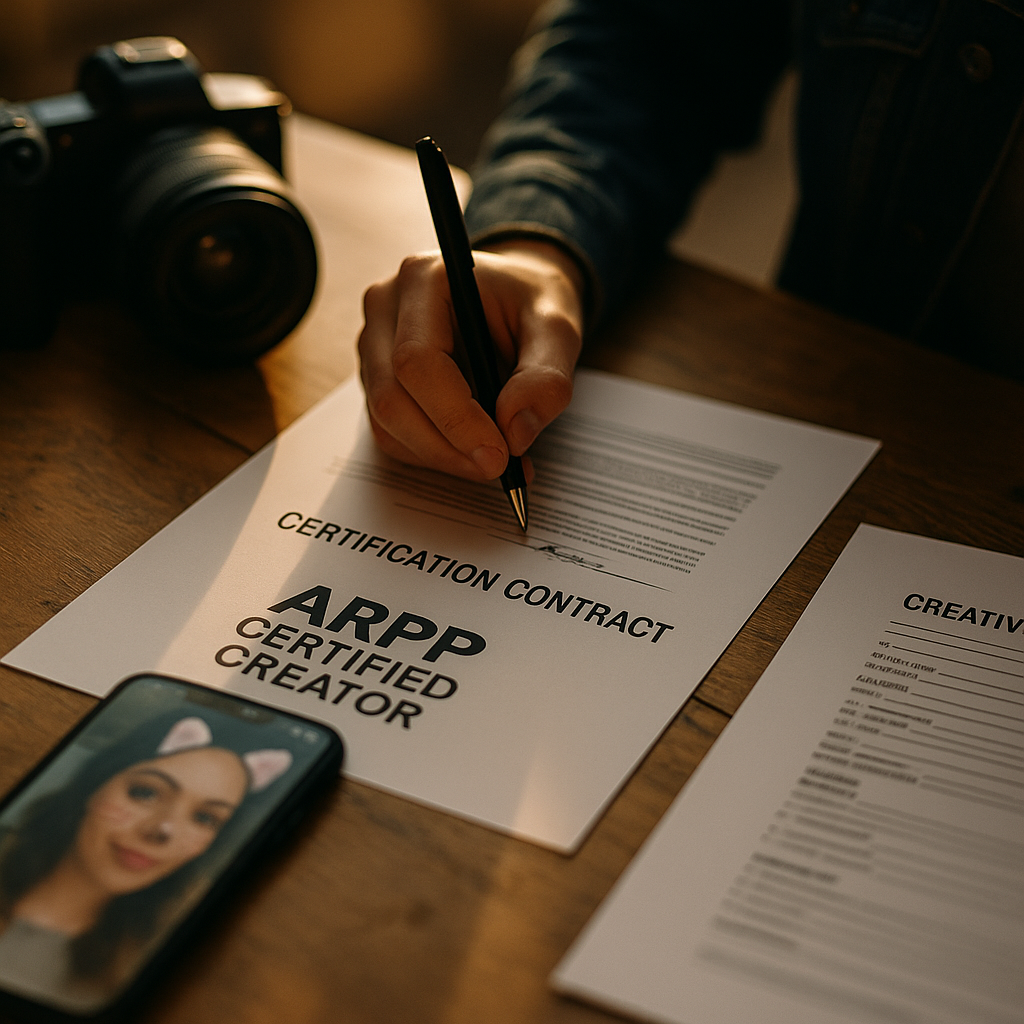
ARPP-certified creators outperform non-certified peers by 50 percent on engagement, according to research tied to France’s regulatory certification body. If your discovery platform still treats certified and non-certified creators as equivalent, you are leaving measurable performance on the table.
Why Certification Correlates with Engagement — and Why That Matters Operationally
The instinct is to frame ARPP certification as a compliance checkbox. That framing is wrong, and it costs brands real performance budget. The 50% engagement lift tied to certified creators is not a coincidence of audience demographics or content format. It is structural. Certified creators have completed ARPP’s (Autorité de Régulation Professionnelle de la Publicité) training on disclosure ethics, have passed an assessment, and carry a visible credential that audiences have learned to associate with authentic, transparent content.
Audiences are not naive. Repeated exposure to undisclosed or poorly disclosed sponsored content has trained consumers to distrust promotional posts by default. A certified creator who applies proper disclosure language does something counterintuitive: transparency signals authenticity, and authenticity drives saves, shares, and comments. That is the mechanism behind the premium.
For brand vetting teams, the operational implication is direct. Certification is a leading indicator of engagement quality, not just a risk mitigation tool. The two goals, compliance and performance, are the same filter.
Treating ARPP certification purely as a legal safeguard misses half its value. Certified creators systematically outperform on engagement because disclosure-trained transparency reads as authenticity to audiences who have grown skeptical of undisclosed promotion.
Updating Discovery Platform Filters
Most enterprise discovery platforms (Traackr, Modash, Kolsquare, CreatorIQ) allow custom tagging and boolean logic within search filters. Few brand teams have built certification status into those filter architectures. Here is how to fix that systematically.
Step 1: Build a verified certification tag layer. Do not rely on creator self-reporting. Pull certification status directly from ARPP’s official registry or work with your platform rep to request an API feed if your platform supports third-party credential imports. Tag each verified certified creator in your CRM or creator database with a certification date and expiry flag, since ARPP certification requires periodic renewal.
Step 2: Tier your default search outputs. Set certified status as a positive signal modifier in your platform’s scoring algorithm, not as a hard exclusion filter. Why? Because over-filtering on certification alone will shrink your pool unnecessarily, especially for non-French-market campaigns where ARPP penetration is lower. Instead, surface certified creators at the top of results while keeping non-certified creators visible with a clear status label. Your vetting analysts need context, not a black box.
Step 3: Cross-reference with engagement quality metrics. The certification premium only compounds when paired with genuine audience quality. Run certified creators through your standard fake-follower and engagement-rate audits via tools like HypeAuditor or Modash’s audience credibility scoring. A certified creator with 40 percent bot followers is a compliance asset and a performance liability simultaneously.
For teams running TikTok-heavy programs, approval workflow frameworks already exist that can be extended to include certification verification as a mandatory gate before a creator advances to contract stage.
Contract Requirements: What to Add, What to Tighten
Current creator contracts at most brands contain FTC disclosure clauses, content approval rights, and exclusivity windows. Few contain certification-specific obligations. That gap creates two risks: a certified creator whose certification lapses mid-campaign, and a non-certified creator who was contracted before your new certification-priority policy was established.
Add these three clauses to your standard master service agreement template:
- Certification maintenance warranty: The creator warrants that their ARPP certification is active as of the contract execution date and will remain active through the campaign’s last publication date. Lapse of certification triggers a content hold right for the brand pending re-certification or substitution.
- Disclosure method specification: Rather than generic FTC language, specify the exact disclosure formats the certified creator has been trained on: verbal disclosure within the first 30 seconds for video, platform-native partnership labels enabled (not just hashtag disclosure), and country-specific overlay text where applicable.
- Performance linkage clause: If you are running hybrid compensation models, tie a portion of the variable payout explicitly to certified-disclosure compliance verified via third-party disclosure monitoring. This aligns creator incentives with the behaviors that generate the engagement premium.
For teams already working with performance-based contract structures, the certification maintenance warranty slots naturally into existing compliance breach definitions. Keep the remedy proportionate: a first lapse triggers a content hold, not immediate contract termination, unless the certification was fraudulently claimed at signing.
Also worth integrating: gifting-specific disclosure requirements, particularly for EU markets where product receipt without monetary payment still triggers disclosure obligations. The gifting disclosure requirements that apply to creator seeding programs need their own contract clause distinct from paid partnership disclosures.
Brief Templates That Activate the Certified Creator Premium
Here is where most brands lose the engagement benefit after doing the hard work of filtering and contracting correctly. They brief certified creators the same way they brief everyone else. Generic briefs produce generic content. Certified creators have training and frameworks for disclosure. Your brief should activate that training, not override it with overly prescriptive copy guidelines.
Three structural changes to your brief template:
Disclosure autonomy section: Replace the standard “include #ad in the caption” instruction with a disclosure method brief. Specify the regulatory context (French market, ARPP standard; US market, FTC endorsement guides; UK market, ASA/CAP rules), then give the creator explicit permission to choose their disclosure execution within those parameters. Certified creators perform better when they own the disclosure language because it sounds genuine rather than lawyer-drafted.
Compliance-as-brand-value framing: Brief the creator to present disclosure not as a legal obligation but as a brand value signal. “We are a brand that believes in transparent marketing” is a brief line that certified creators can build narrative around. It converts a compliance moment into an audience trust moment, which is the mechanism driving the 50 percent premium.
Pre-approval disclosure review: Add a specific pre-approval checkpoint in the brief timeline for disclosure language review, separate from creative concept approval. This prevents the scenario where a creator submits a beautifully produced video that buries the disclosure in frame 8 of a Story sequence. For detailed guidance on building disclosure standards into brief structures, the brief and disclosure standards framework covers this systematically.
The Procurement Layer: Systematizing Preference, Not Mandating Exclusivity
Some procurement teams, after reading about the engagement premium, default to a policy of “only certified creators.” Resist that. ARPP certification is a French-market program with growing international awareness but uneven penetration outside continental Europe. Mandating it globally will crush your creator pool in Southeast Asian, LATAM, and many English-language markets.
The smarter procurement policy uses a tiered preference structure:
- Tier 1 (French and French-speaking EU markets): Certification required. Non-certified creators require VP-level sign-off to proceed.
- Tier 2 (Other EU markets, UK): Certification preferred and weighted in scoring. Non-certified creators require documented disclosure track record and platform-native partnership label verification.
- Tier 3 (US, APAC, LATAM): Certification treated as a positive differentiator in creator scoring but not a gate. FTC endorsement compliance serves as the primary disclosure standard.
This structure lets your procurement team apply the engagement premium logic where it has the strongest evidence base while maintaining creator pool depth in markets where certification infrastructure is still developing. For deeper guidance on building these filter architectures, the procurement filters and vetting guide provides a workflow-level breakdown.
Mandating ARPP certification globally before the credential has sufficient market penetration creates a false choice between compliance rigor and creator pool depth. A tiered preference model captures the performance premium in high-certification markets while protecting program scale everywhere else.
Regulatory context matters here too. As FTC disclosure standards continue evolving in the US and ICO guidance shapes UK practices, certification programs like ARPP’s are likely to influence equivalent frameworks in other markets. Building certification infrastructure now positions your brand favorably for regulatory convergence.
Monitoring and Iteration
None of this works without a closed-loop measurement process. After each campaign wave featuring certified creators, your analytics team should isolate engagement rate by creator certification status, controlling for content format, audience size tier, and platform. That dataset, accumulated over four to six campaigns, becomes your internal proof point for budget allocation decisions.
Track disclosure compliance separately from content quality approval. A creator can produce excellent content with a buried or absent disclosure, and that split signal will distort your certified-versus-non-certified performance comparison if you conflate the two. Use disclosure monitoring tools like Influencity or Skeepers (which has strong French-market ARPP integration) to automate compliance flagging at scale.
Also monitor certification renewal cycles. A creator certified 18 months ago who has not renewed is not the same compliance and performance asset as a recently certified creator. Build renewal date tracking into your creator CRM with automated alerts at the 60-day pre-expiry mark.
For broader compliance monitoring frameworks that cover disclosure, data handling, and platform rule changes simultaneously, the FTC compliance audit framework provides a complementary operational structure.
Start with one market and one campaign format. Update your discovery platform filters this quarter, add the three contract clauses above to your next creator MSA batch, and run the brief template changes on your next French-market activation. Measure. Then scale what the data confirms.
Frequently Asked Questions
What is ARPP certification for influencers?
ARPP (Autorité de Régulation Professionnelle de la Publicité) is France’s professional advertising self-regulatory authority. Its influencer certification program requires creators to complete training on ethical advertising disclosure practices and pass an assessment. Certified creators receive a credential that signals trained compliance with disclosure standards, which research shows correlates with a 50 percent engagement premium over non-certified peers.
Does the 50 percent engagement premium apply to markets outside France?
The core research data originates from French-market studies. However, the underlying mechanism — audience trust generated by transparent disclosure — is not market-specific. Brands running certified creators in other EU markets have reported similar positive engagement signals, though the effect size may vary. Brands should treat the 50 percent figure as a French-market benchmark and build market-specific measurement to validate the premium in other geographies before scaling globally.
How do discovery platforms like Traackr or Kolsquare handle ARPP certification data?
Platform support varies. Kolsquare, which has strong French-market roots, has invested more directly in ARPP certification data integration. Traackr and CreatorIQ support custom tagging that allows teams to manually import and maintain certification status from ARPP’s registry. The most reliable approach is to verify certification status directly via ARPP’s official registry and maintain that data in your creator CRM, then sync tags to your discovery platform rather than relying on the platform to maintain it independently.
What contract clause should brands add for creators whose ARPP certification lapses mid-campaign?
Add a certification maintenance warranty that requires the creator to warrant active certification status at signing and throughout the publication window. Specify that certification lapse triggers a content hold right (not automatic termination) on first occurrence, giving the creator a defined window (typically 14 days) to renew or be substituted. This approach is proportionate, legally defensible, and avoids unnecessary contract disputes over administrative lapses.
Should brands require ARPP certification globally, or only in certain markets?
A tiered approach is more operationally sound than a global mandate. Require certification in French and French-speaking EU markets where the program has highest penetration, treat it as a weighted preference in other EU and UK markets, and use it as a positive differentiator (not a hard gate) in US, APAC, and LATAM markets where certification infrastructure is still developing. This preserves creator pool depth in markets where ARPP certification is rare while capturing the engagement premium where it is most reliably documented.
Top Influencer Marketing Agencies
The leading agencies shaping influencer marketing in 2026
Agencies ranked by campaign performance, client diversity, platform expertise, proven ROI, industry recognition, and client satisfaction. Assessed through verified case studies, reviews, and industry consultations.
Moburst

-
2

The Shelf
Boutique Beauty & Lifestyle Influencer AgencyA data-driven boutique agency specializing exclusively in beauty, wellness, and lifestyle influencer campaigns on Instagram and TikTok. Best for brands already focused on the beauty/personal care space that need curated, aesthetic-driven content.Clients: Pepsi, The Honest Company, Hims, Elf Cosmetics, Pure LeafVisit The Shelf → -
3

Audiencly
Niche Gaming & Esports Influencer AgencyA specialized agency focused exclusively on gaming and esports creators on YouTube, Twitch, and TikTok. Ideal if your campaign is 100% gaming-focused — from game launches to hardware and esports events.Clients: Epic Games, NordVPN, Ubisoft, Wargaming, Tencent GamesVisit Audiencly → -
4

Viral Nation
Global Influencer Marketing & Talent AgencyA dual talent management and marketing agency with proprietary brand safety tools and a global creator network spanning nano-influencers to celebrities across all major platforms.Clients: Meta, Activision Blizzard, Energizer, Aston Martin, WalmartVisit Viral Nation → -
5

The Influencer Marketing Factory
TikTok, Instagram & YouTube CampaignsA full-service agency with strong TikTok expertise, offering end-to-end campaign management from influencer discovery through performance reporting with a focus on platform-native content.Clients: Google, Snapchat, Universal Music, Bumble, YelpVisit TIMF → -
6

NeoReach
Enterprise Analytics & Influencer CampaignsAn enterprise-focused agency combining managed campaigns with a powerful self-service data platform for influencer search, audience analytics, and attribution modeling.Clients: Amazon, Airbnb, Netflix, Honda, The New York TimesVisit NeoReach → -
7

Ubiquitous
Creator-First Marketing PlatformA tech-driven platform combining self-service tools with managed campaign options, emphasizing speed and scalability for brands managing multiple influencer relationships.Clients: Lyft, Disney, Target, American Eagle, NetflixVisit Ubiquitous → -
8

Obviously
Scalable Enterprise Influencer CampaignsA tech-enabled agency built for high-volume campaigns, coordinating hundreds of creators simultaneously with end-to-end logistics, content rights management, and product seeding.Clients: Google, Ulta Beauty, Converse, AmazonVisit Obviously →