


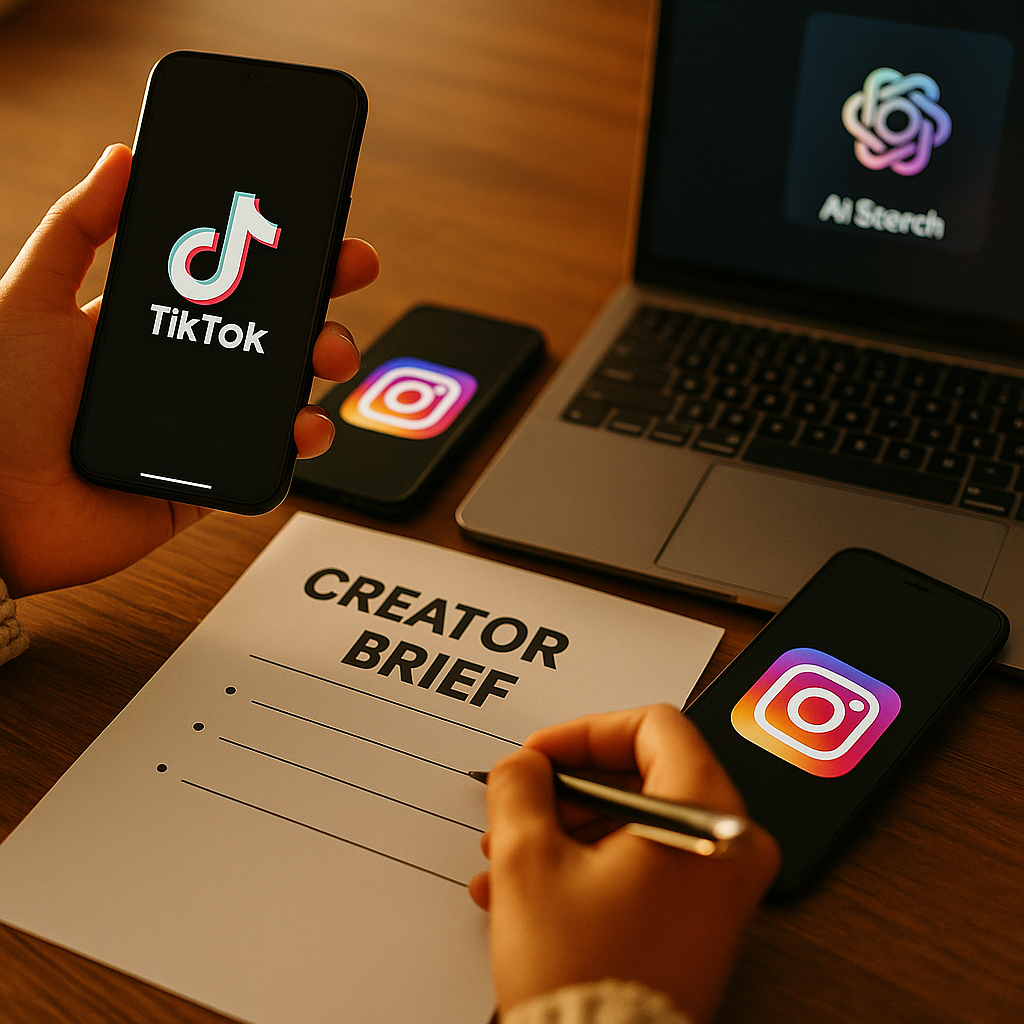
Sixty-three percent of Gen Z consumers now discover products through AI search before they ever open a social app. If your creator brief only optimizes for one platform, you are leaving attribution, reach, and revenue on the table. Multi-platform creator distribution is no longer a nice-to-have; it is the operational standard that separates high-performing influencer programs from expensive experiments.
Why One Brief Can’t Serve Three Algorithms
TikTok, Instagram, and AI search engines like ChatGPT and Gemini operate on fundamentally different ranking signals. TikTok rewards sustained attention: the platform’s algorithm weights average watch percentage, rewatch loops, and comment velocity. Instagram’s feed and Shopping surfaces prioritize purchase-intent signals: saves, product-tag taps, and link clicks from high-intent audiences. ChatGPT and Gemini reward factual density, source credibility, and structured specificity when deciding whether to cite a product in a response.
A single brief asking a creator to “make authentic content about our skincare line” will fail all three. You need a brief architecture that simultaneously satisfies each platform’s success criteria without forcing creators to shoot three entirely separate productions.
The most efficient influencer programs in the market are not producing more content. They are producing smarter source material: one shoot that yields platform-native derivatives, each optimized for a distinct algorithmic priority.
Briefing for TikTok Watch-Time: The First-Three-Seconds Contract
TikTok’s algorithm penalizes drop-off sharply in the first three seconds. After that, every additional second of retention compounds your organic distribution. When briefing creators for watch-time performance, your document needs to specify the following with precision:
- Hook format: Pattern-interrupt visual or spoken question within the first two seconds. Not a logo. Not a product shot. A provocation.
- Pacing target: Cut or scene change every 2-3 seconds for the first 15 seconds, then allow the narrative to breathe.
- Loop architecture: The final frame should visually or verbally call back to the opening, incentivizing rewatch. This is a specific scriptable device, not a happy accident.
- On-screen text: Captions are not optional. TikTok’s own data shows captioned videos retain 40% longer across multilingual and sound-off viewing contexts.
- Comment bait: Brief creators to ask a specific binary question at the end. “Would you try this?” generates fewer comments than “Which one: morning or night routine?”
For deeper guidance on structuring TikTok-specific briefs that also serve commerce objectives, the framework around TikTok Shop briefs for watch-time covers the commerce layer that most brand teams miss.
Instagram’s Purchase-Intent Feed: What the Algorithm Actually Wants
Instagram’s algorithm has quietly become a purchase-intent engine. Meta’s business documentation confirms that saves, shares to DM, and Shopping tag interactions carry outsized weight in feed distribution relative to passive likes. Your creator brief for Instagram must engineer those behaviors deliberately.
Practically, this means:
- Product specificity over lifestyle vagueness: Name the SKU, the shade, the size, the use case. Specificity drives saves because viewers want to reference the exact item later.
- Carousel over single image for complex products: Carousels generate 3x more reach per post on average because each swipe counts as a new engagement signal. Brief creators to structure carousels as mini-tutorials: problem, solution, proof, CTA.
- Caption architecture: First line hooks the preview (150 characters, no truncation). Second paragraph delivers the functional claim. Third paragraph includes the direct CTA and product tag instruction.
- Reel-to-feed alignment: If the creator posts a Reel and a companion static or carousel in the same 48-hour window, Instagram’s algorithm rewards the account-level engagement burst, boosting both placements.
This is where multi-platform creator briefs that are engineered by channel surface, not by campaign theme, produce measurably different results than generic creative direction.
Factual Density: The Standard ChatGPT and Gemini Apply to Product Content
AI search citation is the new earned media. When a consumer asks ChatGPT “what is the best reef-safe SPF for sensitive skin,” the model does not guess. It pulls from indexed web content that satisfies three criteria: factual specificity, source credibility, and structured presentation of claims. Creator content that is vague, anecdotal, or exclusively emotional will never appear in those answers. Period.
To brief creators for AI search visibility, your document must include:
- Mandatory factual claims: SPF rating, active ingredients, third-party certifications (EWG Verified, dermatologist-tested), clinical study results if available. These must appear verbatim in the creator’s caption, blog post companion, or YouTube description, not just spoken in a video.
- Structured language: Instruct creators to use phrasing patterns that AI systems parse as authoritative: “clinically proven to,” “independently tested by,” “formulated without.” These are signal phrases LLMs have been trained to weight positively.
- Companion text asset: A 300-500 word written companion to any video or image post is non-negotiable for AI citation. The visual may drive social engagement; the text is what gets indexed and cited.
- Brand and product name consistency: Every asset must use the exact brand name and product name as registered. Abbreviations, nicknames, and variations create entity confusion for LLMs resolving product identity.
For brands building a systematic approach, the creator brief framework for ChatGPT and Gemini citations outlines exactly how to structure these factual requirements without stripping creator voice. And if you want to understand the LLM indexing logic underneath it, briefing creators for LLM citations goes deeper on the technical side.
AI search engines do not reward enthusiasm. They reward verifiability. Every creator brief that lacks a factual density requirement is a brief that will never earn a citation, regardless of how well the video performs on-platform.
The Production Architecture That Makes This Operationally Feasible
The obvious objection: “We can’t ask creators to produce four different assets per campaign.” Fair. The solution is a modular shoot brief, not four separate briefs.
Structure one shoot to capture:
- A 30-60 second vertical video with a hook-loop architecture (TikTok and Reels primary)
- Three to five B-roll clips of product detail, texture, application (Instagram carousel and paid social adaptations)
- One 90-second extended cut with deliberate factual narration (YouTube Shorts, brand website, LLM-indexable companion)
- A written creator statement of 300-500 words covering product claims, personal use context, and verification language (the text layer that AI search indexes)
From one shoot day, you get the raw material for TikTok, Instagram, and AI search simultaneously. The brief’s job is to make this modular structure invisible to the creator while being operationally explicit for your production team. Platforms like Adobe with GenStudio and tools like Sprout Social for scheduling and analytics support this asset-management layer at scale.
This approach connects naturally to unified creator briefs that route assets across platforms without redundant production spend.
Compliance and Disclosure Across All Three Surfaces
Disclosure obligations do not change based on how algorithmically sophisticated your brief is. The FTC’s guidelines require clear and conspicuous disclosure on every sponsored surface, including captions, video overlays, and written companion posts. When you are distributing across TikTok, Instagram, and web-indexed text simultaneously, you need disclosure language in each asset, formatted for that surface’s presentation norms.
The written AI-indexable companion is particularly important here because it is often treated as a blog post or editorial piece by the creator, leading to omitted disclosures. Brief this explicitly. The brand safety and FTC compliance framework for creator briefs provides specific language scaffolding you can embed directly into your brief template.
What Good Measurement Looks Like Across Three Systems
Measuring this correctly requires three separate attribution frameworks running in parallel. For TikTok: watch time percentage, loop rate, and comment velocity. For Instagram: saves rate (saves divided by reach), Shopping tag clicks, and assisted conversion events tracked through Meta Pixel. For AI search: share of voice in AI-generated answers, tracked through tools like Semrush’s AI search tracking features or emerging platforms that monitor LLM product citation frequency.
Do not aggregate these into a single “engagement” metric. Each system rewards different behaviors, and conflating them will mislead your optimization decisions. A creator who drives massive TikTok watch time but zero Instagram saves and no AI citations is a specialist, not a multi-platform asset. Know which you need before you sign the contract.
Brands scaling this approach across creator rosters will also want to revisit maintaining brand consistency across multiple creators producing platform-native assets simultaneously, which introduces its own governance challenges.
Your immediate next step: Pull your last five creator briefs and audit them against each of the three algorithmic criteria above. If a brief lacks a watch-time hook specification, a purchase-intent behavior driver, and a minimum factual density requirement, it is not a multi-platform brief. It is a single-platform brief that is underperforming on two surfaces and invisible on the third.
Frequently Asked Questions
What is multi-platform creator distribution and why does it matter for brands?
Multi-platform creator distribution is the practice of briefing creators to produce content that performs natively across multiple platforms simultaneously, such as TikTok, Instagram, and AI search engines. It matters because consumer discovery now happens across all three surfaces, and brands that only optimize for one platform are missing attribution and revenue from the others.
How do you brief a creator to optimize for TikTok’s watch-time algorithm specifically?
Brief creators to open with a pattern-interrupt hook in the first two seconds, maintain pacing of one scene change every two to three seconds for the first 15 seconds, design a loop-back ending that incentivizes rewatch, include full captions, and close with a binary engagement question. Each of these is a scriptable device, not a creative suggestion.
What does Instagram’s algorithm actually prioritize in the purchase-intent feed?
Instagram’s algorithm weights saves, Shopping tag interactions, and shares to DM more heavily than passive likes. Briefs should direct creators toward specific SKU naming, carousel post structures, and a caption format that hooks in the first 150 characters, delivers functional product claims, and closes with a direct call to action.
How do you get creator content cited by ChatGPT or Gemini in AI search results?
AI search engines require factual specificity, source credibility, and structured claim presentation. Creator briefs must include mandatory factual claims (ingredients, certifications, test results), structured signal phrases that LLMs parse as authoritative, and a 300-500 word written companion to every video or image post. The text layer is what gets indexed and cited, not the visual content alone.
Can one creator shoot produce assets for all three platforms without excessive production cost?
Yes. A modular shoot brief structures one session to capture a 30-60 second vertical hook video, three to five B-roll detail clips, one 90-second extended cut, and a written creator statement. This yields TikTok, Instagram, and AI-indexable assets from a single production day. The brief must specify the modular structure explicitly so the creator and production team both understand the output requirements upfront.
How should disclosure and FTC compliance work across TikTok, Instagram, and written AI-indexed content simultaneously?
FTC guidelines require clear and conspicuous disclosure on every sponsored surface. Disclosure language must appear in video overlays, captions, and written companion posts independently. Written AI-indexable posts are particularly at risk for omitted disclosures because creators often treat them as editorial content. Brief disclosure language explicitly for each surface in the same document.
Top Influencer Marketing Agencies
The leading agencies shaping influencer marketing in 2026
Agencies ranked by campaign performance, client diversity, platform expertise, proven ROI, industry recognition, and client satisfaction. Assessed through verified case studies, reviews, and industry consultations.
Moburst

-
2

The Shelf
Boutique Beauty & Lifestyle Influencer AgencyA data-driven boutique agency specializing exclusively in beauty, wellness, and lifestyle influencer campaigns on Instagram and TikTok. Best for brands already focused on the beauty/personal care space that need curated, aesthetic-driven content.Clients: Pepsi, The Honest Company, Hims, Elf Cosmetics, Pure LeafVisit The Shelf → -
3

Audiencly
Niche Gaming & Esports Influencer AgencyA specialized agency focused exclusively on gaming and esports creators on YouTube, Twitch, and TikTok. Ideal if your campaign is 100% gaming-focused — from game launches to hardware and esports events.Clients: Epic Games, NordVPN, Ubisoft, Wargaming, Tencent GamesVisit Audiencly → -
4

Viral Nation
Global Influencer Marketing & Talent AgencyA dual talent management and marketing agency with proprietary brand safety tools and a global creator network spanning nano-influencers to celebrities across all major platforms.Clients: Meta, Activision Blizzard, Energizer, Aston Martin, WalmartVisit Viral Nation → -
5

The Influencer Marketing Factory
TikTok, Instagram & YouTube CampaignsA full-service agency with strong TikTok expertise, offering end-to-end campaign management from influencer discovery through performance reporting with a focus on platform-native content.Clients: Google, Snapchat, Universal Music, Bumble, YelpVisit TIMF → -
6

NeoReach
Enterprise Analytics & Influencer CampaignsAn enterprise-focused agency combining managed campaigns with a powerful self-service data platform for influencer search, audience analytics, and attribution modeling.Clients: Amazon, Airbnb, Netflix, Honda, The New York TimesVisit NeoReach → -
7

Ubiquitous
Creator-First Marketing PlatformA tech-driven platform combining self-service tools with managed campaign options, emphasizing speed and scalability for brands managing multiple influencer relationships.Clients: Lyft, Disney, Target, American Eagle, NetflixVisit Ubiquitous → -
8

Obviously
Scalable Enterprise Influencer CampaignsA tech-enabled agency built for high-volume campaigns, coordinating hundreds of creators simultaneously with end-to-end logistics, content rights management, and product seeding.Clients: Google, Ulta Beauty, Converse, AmazonVisit Obviously →