


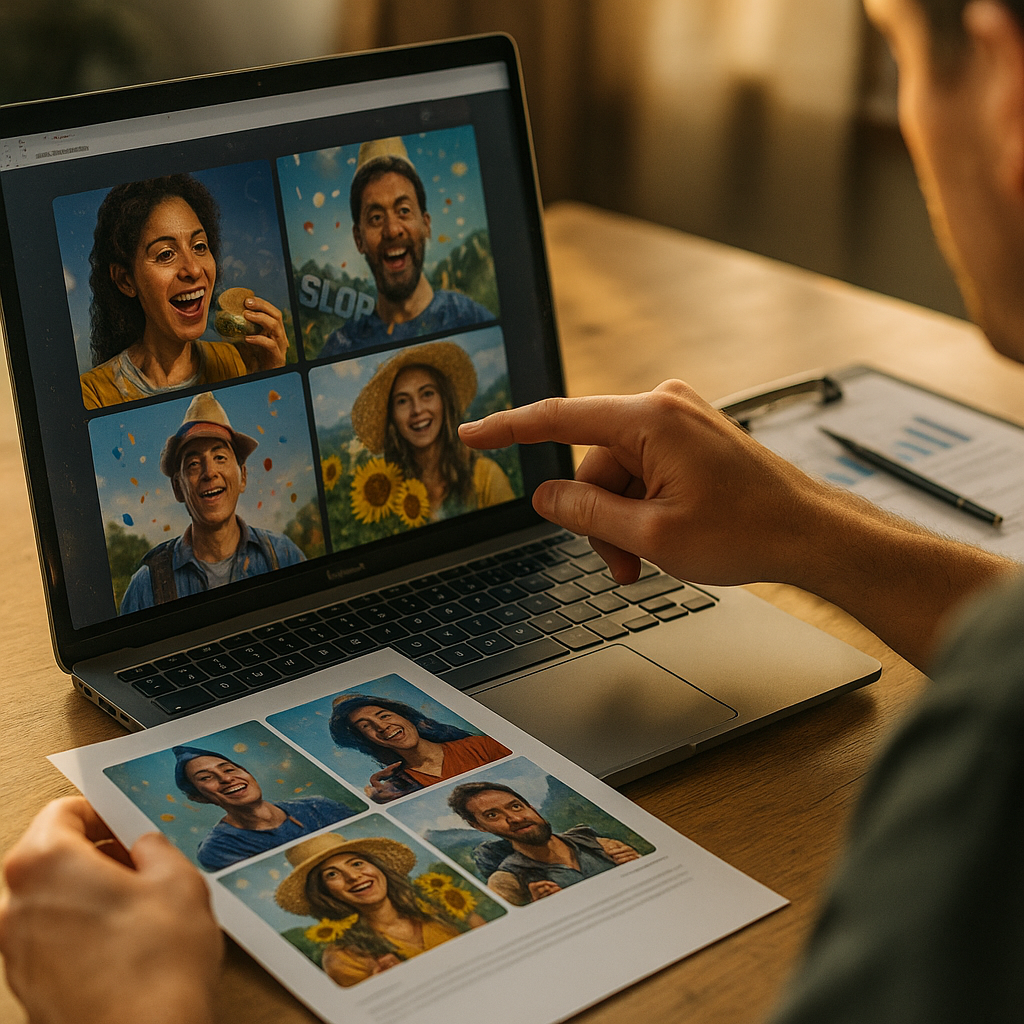
Marketing teams now produce more visual assets in a month than most agencies made in a year a decade ago. The catch? A growing share of it is what creative directors privately call “AI slop”: generic, off-brand, occasionally embarrassing output from generative design tools like Canva’s Magic Studio. Auditing AI slop has quietly become one of the most urgent operational disciplines in brand management, and most companies are improvising their way through it.
This isn’t a design problem anymore. It’s a governance problem, and it sits squarely with the marketing leaders who approved the tools in the first place.
What “AI Slop” Actually Costs Your Brand
Let’s define terms, because “slop” gets thrown around loosely. In a brand context, AI slop is any generative output that ships without meeting brand, legal, or quality standards, usually because nobody checked before it went live. It’s the LinkedIn carousel with a slightly warped logo. The product photo with six fingers nobody noticed until a customer screenshotted it. The Canva-generated ad variant that used a stock font that isn’t actually your brand font, deployed across forty social accounts before someone flagged it.
None of this is hypothetical. Teams running high-volume creative testing programs, the kind covered in generative ad variation audits, are already dealing with drift at scale. Add in self-serve tools like Canva, where anyone on the team from junior social managers to regional sales reps can generate branded assets in seconds, and the surface area for error multiplies fast.
The real cost of AI slop isn’t the one bad graphic. It’s the erosion of brand consistency across hundreds of touchpoints that nobody is centrally reviewing.
According to HubSpot’s marketing benchmarking data, brand consistency remains one of the top three factors influencing purchase trust. When your Instagram Story looks polished but your regional franchise’s Canva-built flyer looks like it was made by a different company, that trust erodes quietly, one impression at a time.
The Democratization Trap
Canva’s entire pitch is democratization: anyone can design. That’s genuinely useful for small teams without in-house creative. But democratization without a governance layer is how brand guidelines die a death by a thousand exports. Enterprise Canva accounts do offer brand kits and locked templates, yet Sprout Social’s research on marketing team workflows consistently shows that adoption of those guardrails lags far behind adoption of the tool itself. Teams turn on Canva for everyone. Few turn on the controls that keep everyone inside the lines.
Building an Audit Framework: Four Checkpoints Before Assets Ship
Auditing generative design output at scale requires a framework, not a vibe check. The brands doing this well have converged on roughly the same four checkpoints, regardless of industry.
- Source verification. Was the asset built from a locked brand template, or from a blank canvas with AI-suggested elements? Templates originating outside the approved kit should trigger automatic review.
- Visual QA against brand tokens. Logo placement, color hex codes, typography, and spacing get checked against a style guide, ideally with automated tools rather than a human squinting at a PDF.
- Claims and compliance review. Generative design tools increasingly auto-suggest copy alongside visuals. Any text claim needs the same legal eyes that a paid ad would get.
- Disclosure and labeling check. If the asset touches paid media or influencer content, AI-generation disclosure rules now apply in several major markets, similar to the labeling requirements discussed in platform AI labeling rules.
Skip any one of these and you’re not auditing, you’re hoping. Most brands that get burned by AI slop skipped the second and fourth checkpoints specifically, because they seem like someone else’s job.
Who Owns the Audit?
Here’s the uncomfortable question nobody wants to answer in the planning meeting: whose job is this? Brand teams assume design ops owns it. Design ops assumes legal owns it. Legal assumes nobody told them Canva was even in use across regional offices.
The functional answer, based on what’s working at brands running high creative volume, is a rotating hybrid model. Brand or creative ops owns the visual QA layer and maintains the locked template library. Legal or compliance owns the claims and disclosure layer, ideally with a lightweight automated pre-check rather than manual review of every asset. A single named owner, not a committee, signs off on exceptions.
This mirrors the accountability structures that emerged around agentic AI contract negotiation, where brands learned the hard way that “the AI did it” is not a defense regulators or customers accept.
Governance at Scale: Templates, Permissions, Kill Switches
Manual review does not scale past a certain volume, full stop. Once you’re generating hundreds of assets a week across regions and channels, you need structural controls, not just process controls.
Three things matter most:
- Locked brand kits with no override permission for anyone outside a small creative admin group. Canva Enterprise and similar tools support this; most accounts just never configure it tightly enough.
- Template versioning with expiry dates. Old templates built on outdated logos or discontinued color palettes should auto-archive, not linger for a well-meaning regional manager to rediscover.
- A kill switch for flagged assets. When a compliance issue surfaces post-publish, brands need the ability to pull an asset across every channel it touched within minutes, not days. This is the same logic behind mid-flight creative swaps in paid media, applied to organic and owned design output.
If your only defense against a bad AI-generated asset is “someone will notice eventually,” you don’t have a governance program. You have a rumor of one.
Where This Intersects with Content Automation
Auditing AI slop doesn’t happen in isolation. It’s connected to the broader wave of generative automation reshaping marketing content, from auto-generated captions to model training built on top-performing creative. Brands that have already invested in structured data for creative decisions, the kind described in training content models on proven creator assets, have an advantage here. They already know what “good” looks like in measurable terms, which makes automated visual QA far easier to build because you’re checking against defined benchmarks instead of subjective taste.
This is also where influencer content specifically gets tricky. Brand-safe design governance for owned channels is one thing. Extending that same discipline to creator-generated content, where the brand doesn’t control the source file, is a different operational challenge entirely, and one that overlaps with disclosure requirements covered in AI video disclosure labeling.
Measuring the ROI of Design Governance
Governance programs get cut in budget season if they can’t show numbers. So show numbers. The metrics that hold up in front of a CFO:
- Rework hours saved. Track how many assets get flagged and corrected pre-publish versus post-publish. Pre-publish catches are cheap. Post-publish catches, especially ones requiring platform-wide takedowns, are expensive and reputationally costly.
- Time-to-publish. Locked templates and automated QA should speed up approval cycles, not slow them down. If your audit process is adding friction without reducing errors, the framework is wrong.
- Compliance incident rate. Track flagged disclosure or claims issues per quarter. This is the number regulators and platforms increasingly care about, and FTC guidance on endorsement disclosures makes clear that ignorance of an AI tool’s output isn’t a defense.
According to Statista’s data on marketing technology adoption, generative design tool usage among marketing teams has grown sharply year over year, but investment in governance tooling has grown at a fraction of that rate. That gap is exactly where the next wave of brand risk lives, and where budget conversations should be heading.
The Practical Starting Point
If you’re starting from zero, don’t try to build the full framework in one quarter. Start with the locked brand kit and a single named approver for anything generated outside it. Add automated visual QA once you have volume data to justify it. Layer in disclosure checks last, once the first two are stable.
The brands that treat generative design governance as an ongoing operational discipline, not a one-time policy memo, will be the ones whose creative still looks like theirs a year from now. Everyone else will be quietly explaining to their CMO why the regional office’s Canva flyer went viral for the wrong reasons.
FAQs
What is “AI slop” in a marketing context?
AI slop refers to generative design or content output, often from tools like Canva, that ships without meeting brand, legal, or quality standards. It typically results from a lack of review checkpoints rather than the tool itself being flawed.
Why is Canva specifically a governance risk for brands?
Canva’s self-serve model lets employees across departments generate branded assets quickly, which is efficient but bypasses traditional creative review unless brand kits, locked templates, and permission controls are actively configured and enforced.
Who should own the audit process for generative design output?
A hybrid model works best: brand or creative ops owns visual quality checks and template libraries, legal or compliance owns claims and disclosure review, and a single named person signs off on exceptions rather than a committee.
How do disclosure rules apply to AI-generated design assets?
If the asset touches paid media, influencer content, or video, several major markets now require AI-generation disclosure. Brands should build this check into the same workflow as visual and legal QA rather than treating it separately.
What metrics prove a design governance program is working?
Rework hours saved through pre-publish catches, time-to-publish speed, and quarterly compliance incident rate are the three metrics that hold up best when justifying governance budget to leadership.
Top Influencer Marketing Agencies
The leading agencies shaping influencer marketing in 2026
Agencies ranked by campaign performance, client diversity, platform expertise, proven ROI, industry recognition, and client satisfaction. Assessed through verified case studies, reviews, and industry consultations.
Moburst

-
2

The Shelf
Boutique Beauty & Lifestyle Influencer AgencyA data-driven boutique agency specializing exclusively in beauty, wellness, and lifestyle influencer campaigns on Instagram and TikTok. Best for brands already focused on the beauty/personal care space that need curated, aesthetic-driven content.Clients: Pepsi, The Honest Company, Hims, Elf Cosmetics, Pure LeafVisit The Shelf → -
3

Audiencly
Niche Gaming & Esports Influencer AgencyA specialized agency focused exclusively on gaming and esports creators on YouTube, Twitch, and TikTok. Ideal if your campaign is 100% gaming-focused — from game launches to hardware and esports events.Clients: Epic Games, NordVPN, Ubisoft, Wargaming, Tencent GamesVisit Audiencly → -
4

Viral Nation
Global Influencer Marketing & Talent AgencyA dual talent management and marketing agency with proprietary brand safety tools and a global creator network spanning nano-influencers to celebrities across all major platforms.Clients: Meta, Activision Blizzard, Energizer, Aston Martin, WalmartVisit Viral Nation → -
5

The Influencer Marketing Factory
TikTok, Instagram & YouTube CampaignsA full-service agency with strong TikTok expertise, offering end-to-end campaign management from influencer discovery through performance reporting with a focus on platform-native content.Clients: Google, Snapchat, Universal Music, Bumble, YelpVisit TIMF → -
6

NeoReach
Enterprise Analytics & Influencer CampaignsAn enterprise-focused agency combining managed campaigns with a powerful self-service data platform for influencer search, audience analytics, and attribution modeling.Clients: Amazon, Airbnb, Netflix, Honda, The New York TimesVisit NeoReach → -
7

Ubiquitous
Creator-First Marketing PlatformA tech-driven platform combining self-service tools with managed campaign options, emphasizing speed and scalability for brands managing multiple influencer relationships.Clients: Lyft, Disney, Target, American Eagle, NetflixVisit Ubiquitous → -
8

Obviously
Scalable Enterprise Influencer CampaignsA tech-enabled agency built for high-volume campaigns, coordinating hundreds of creators simultaneously with end-to-end logistics, content rights management, and product seeding.Clients: Google, Ulta Beauty, Converse, AmazonVisit Obviously →