


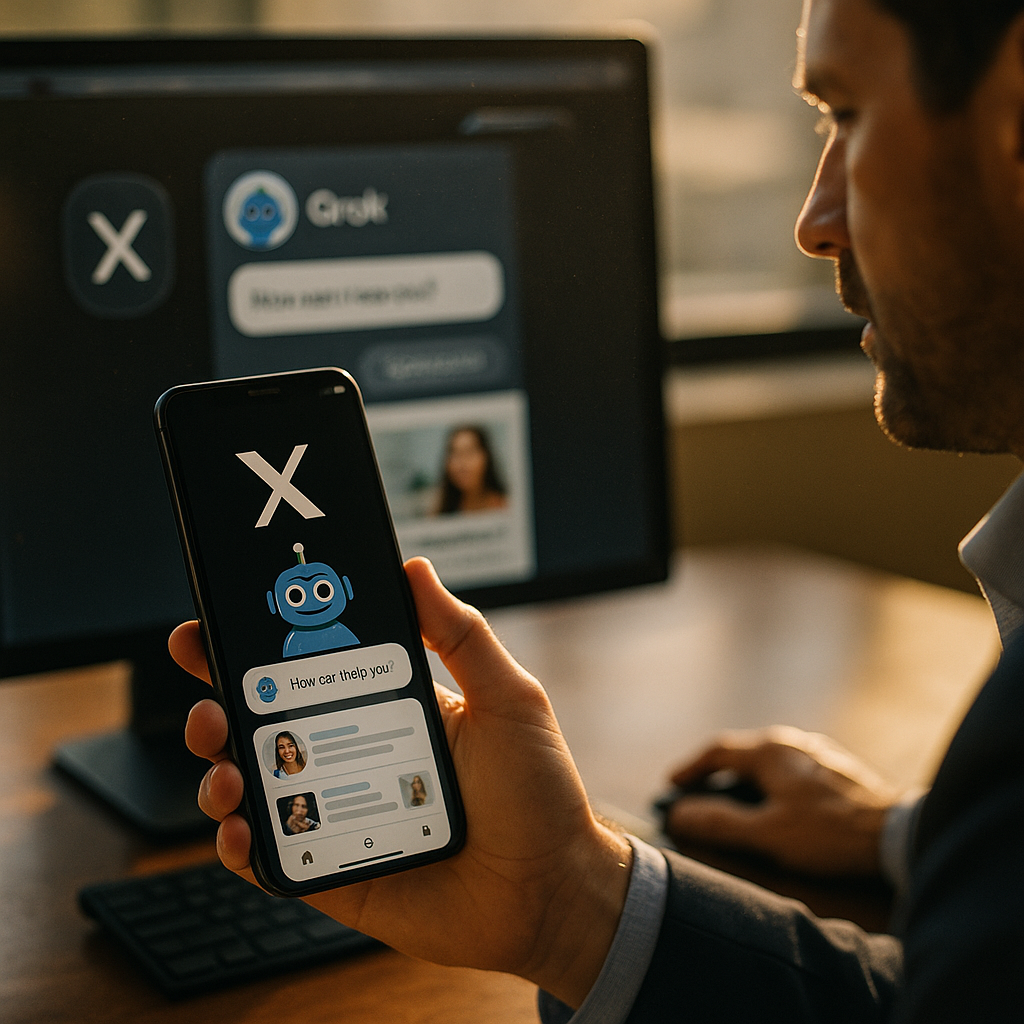
Grok now answers product questions inside X’s ad units, and early pilot partners are reporting engagement rates that make traditional carousel ads look prehistoric. But before you brief your agency on a conversational AI ad, ask yourself: do you actually want your brand voice sitting inside a chatbot you don’t control, on a platform with a moderation record that keeps risk teams up at night? X’s brand chatbot push is real, it’s moving fast, and it deserves scrutiny before budget.
What X Is Actually Rolling Out
X has been quietly expanding Grok’s role from a standalone assistant into an embedded ad format. Brands can now deploy a conversational widget directly inside promoted posts, letting users ask follow-up questions about a product, get sizing recommendations, or compare features without leaving the timeline. Think of it as a hybrid between a chatbot and a rich media ad unit, powered by Grok’s underlying model and trained (to varying degrees) on brand-supplied data.
The pitch to marketers is simple: reduce friction, keep users on-platform, and let AI do the qualifying work that a landing page usually does. X is positioning this as a direct answer to the growing volume of AI-mediated discovery, where consumers increasingly ask a chatbot instead of scrolling a feed. That shift is well documented elsewhere. Research on AI assistant traffic patterns shows a huge share of this activity never shows up cleanly in standard analytics, which should already make you nervous about measurement before you even touch the ad format.
Why Brands Are Tempted
Conversational ads solve a real problem. Static creative can’t answer “does this work with my skin type” or “what’s your return policy on final sale items.” A chatbot can, instantly, without a human agent. For categories with high consideration cycles, beauty, consumer electronics, financial services, that responsiveness could plausibly lift conversion.
There’s also a novelty premium right now. Early X pilot data (shared informally by agency partners, not independently audited) suggests click-through rates 2 to 3 times higher than standard video ads. Novelty always inflates early numbers. The real test is whether engagement holds once users have seen a hundred of these and the format stops feeling new.
A chatbot that answers questions well but can’t be fully audited in real time isn’t a conversion tool, it’s a liability wearing a conversion tool’s clothes.
The Moderation Problem Nobody Wants to Say Out Loud
Grok has had public missteps around generating inappropriate or off-brand responses. That track record matters enormously the moment you attach it to a paid ad unit with your logo on it. A static ad says what you approved. A conversational ad says whatever the model generates in response to whatever a user types, including bad-faith prompts designed to embarrass the brand.
Ask your platform rep these questions directly, in writing, before you commit spend:
- What guardrails prevent the chatbot from responding to off-topic or adversarial prompts?
- Can we see a log of every conversation the bot has in real time, not just aggregated reports?
- What’s the escalation path if the bot says something false about our product, pricing, or claims?
- Who is liable if the bot makes a regulated claim (health, financial, safety) that we didn’t approve?
If your rep can’t answer all four clearly, that’s your answer. The FTC has been increasingly active on AI-generated marketing claims, and “the chatbot said it, not us” is not a defense that holds up.
Measurement Is Still the Weak Link
Here’s the uncomfortable truth: most brands can’t yet cleanly attribute conversions that pass through a conversational interface. A user chats with the bot, gets convinced, then leaves the platform to buy on a different device three days later. Standard last-click models miss this entirely.
This isn’t unique to X. It’s the same attribution gap already showing up across AI-mediated commerce. Work already published on attribution gaps in AI referrals and AI attribution adoption trends both point to the same conclusion: brands are flying partially blind, and the gap tends to widen exactly where the AI interaction happens closest to the point of decision, which is precisely what a conversational ad is designed to do.
Before you launch, get your analytics team to answer one question honestly: can we currently distinguish a conversion influenced by a chatbot interaction from one that wasn’t? If the answer is no, you’re buying engagement data you can’t turn into ROI reporting, which makes the format very hard to defend in a budget review.
Data Ownership and Training Rights
This is the part that gets glossed over in sales decks. When you feed product data, FAQs, and brand voice guidelines into a platform’s chatbot to make it “on-brand,” where does that data go afterward? Does it improve the general model, get siloed to your account only, or sit in some ambiguous middle ground X hasn’t clarified publicly?
Get this in writing, ideally reviewed by legal before your team uploads a single product spec sheet. Compare it against how you’d handle any other third-party data governance arrangement. If X’s terms don’t specify data segregation and deletion rights on contract termination, treat that as a material risk, not a footnote.
A Quick Gut Check Before You Pilot
Run this checklist internally before any brief goes out:
- Can legal confirm claims liability for AI-generated responses in writing?
- Does your analytics stack support conversational touchpoint tracking, or will you need a custom build?
- Has your brand safety team reviewed X’s moderation history in the last quarter, not just at launch?
- Is there a kill switch that pulls the bot instantly if it generates a harmful response?
- Does the contract specify what happens to your training data if you cancel?
If you can’t check all five boxes, you’re not ready to pilot, no matter how good the demo looked.
How This Compares to Building Your Own
Some brands are asking the smarter question: why rent a chatbot inside someone else’s ad platform when we could build a governed one on owned channels? The tradeoff is reach versus control. X’s chatbot ads sit inside a massive existing audience with zero infrastructure lift. A brand-built assistant on your own site or app gives you full control over data, claims, and moderation, but you lose the discovery surface.
For most mid-size brands, the pragmatic path is a hybrid: test small on X with tightly scoped use cases (order status, sizing, basic FAQ) where the risk of a bad response is low, while reserving anything claims-sensitive (health benefits, pricing guarantees, financial advice) for owned, fully audited channels. This mirrors the caution already applied to AI disclosure requirements across other platforms, where the safest rollout strategy is narrow scope first, expansion only after the data proves out.
It’s also worth benchmarking your team’s general readiness here. The four pillar AI readiness framework is a useful gut check for whether your data infrastructure, governance, and team skills can actually support a conversational ad pilot responsibly, rather than bolting one on because a competitor announced theirs first.
What Industry Benchmarks Suggest
Broader industry data supports caution over rush. eMarketer has tracked rising marketer interest in conversational commerce for several years, but adoption has consistently lagged interest because of exactly the measurement and governance gaps outlined above. Statista survey data on consumer trust in AI-generated brand responses also shows meaningful skepticism, particularly among users over 35, a demographic that still drives significant purchase volume in most categories.
None of this means skip the format entirely. It means treat X’s brand chatbot push the way you’d treat any new ad unit from a platform with a spotty moderation track record: promising upside, real downside, and worth a small controlled test before a full budget commitment.
The brands that win here won’t be the fastest to launch a chatbot ad, they’ll be the ones who can prove, with clean data, that it moved a real business metric.
Frequently Asked Questions
FAQs
What is X’s brand chatbot ad format exactly?
It’s a conversational widget embedded inside promoted posts on X, powered by Grok, that lets users ask questions about a product or brand directly within the ad unit instead of clicking through to a landing page.
Is this the same as a general chatbot integration?
Not quite. General chatbot integrations (like a customer service bot on your website) are owned and fully controlled by the brand. X’s version runs inside X’s infrastructure, on X’s model, with X’s moderation policies applying, which changes the risk and control equation significantly.
How risky is it to use Grok in a paid ad unit?
Grok has had public moderation incidents involving inappropriate or off-brand responses. Any brand considering this format should get written clarity from X on guardrails, real-time monitoring access, and liability for false or problematic claims before launching a live ad.
Can we measure ROI on a conversational ad accurately?
Most brands currently cannot cleanly attribute conversions that pass through a chatbot interaction using standard last-click models. Confirm with your analytics team whether conversational touchpoint tracking is supported before committing budget.
What happens to the data we feed the chatbot to train it on our brand voice?
This varies and is often unclear in current platform terms. Get written confirmation on data segregation, whether it improves the general model, and deletion rights if you cancel the contract, ideally reviewed by legal beforehand.
Should we build our own chatbot instead of using X’s ad format?
It depends on your risk tolerance and reach needs. Owned chatbots offer full control over data and claims but lack built-in discovery. A hybrid approach, testing low-risk use cases on X while keeping claims-sensitive interactions on owned channels, is the safer starting point for most brands.
Run one narrow, low-risk pilot before you scale anything: pick a single low-stakes use case like order status or sizing FAQ, get moderation and data terms in writing first, and measure it against a control group for 30 days before touching your core budget.
Top Influencer Marketing Agencies
The leading agencies shaping influencer marketing in 2026
Agencies ranked by campaign performance, client diversity, platform expertise, proven ROI, industry recognition, and client satisfaction. Assessed through verified case studies, reviews, and industry consultations.
Moburst

-
2

The Shelf
Boutique Beauty & Lifestyle Influencer AgencyA data-driven boutique agency specializing exclusively in beauty, wellness, and lifestyle influencer campaigns on Instagram and TikTok. Best for brands already focused on the beauty/personal care space that need curated, aesthetic-driven content.Clients: Pepsi, The Honest Company, Hims, Elf Cosmetics, Pure LeafVisit The Shelf → -
3

Audiencly
Niche Gaming & Esports Influencer AgencyA specialized agency focused exclusively on gaming and esports creators on YouTube, Twitch, and TikTok. Ideal if your campaign is 100% gaming-focused — from game launches to hardware and esports events.Clients: Epic Games, NordVPN, Ubisoft, Wargaming, Tencent GamesVisit Audiencly → -
4

Viral Nation
Global Influencer Marketing & Talent AgencyA dual talent management and marketing agency with proprietary brand safety tools and a global creator network spanning nano-influencers to celebrities across all major platforms.Clients: Meta, Activision Blizzard, Energizer, Aston Martin, WalmartVisit Viral Nation → -
5

The Influencer Marketing Factory
TikTok, Instagram & YouTube CampaignsA full-service agency with strong TikTok expertise, offering end-to-end campaign management from influencer discovery through performance reporting with a focus on platform-native content.Clients: Google, Snapchat, Universal Music, Bumble, YelpVisit TIMF → -
6

NeoReach
Enterprise Analytics & Influencer CampaignsAn enterprise-focused agency combining managed campaigns with a powerful self-service data platform for influencer search, audience analytics, and attribution modeling.Clients: Amazon, Airbnb, Netflix, Honda, The New York TimesVisit NeoReach → -
7

Ubiquitous
Creator-First Marketing PlatformA tech-driven platform combining self-service tools with managed campaign options, emphasizing speed and scalability for brands managing multiple influencer relationships.Clients: Lyft, Disney, Target, American Eagle, NetflixVisit Ubiquitous → -
8

Obviously
Scalable Enterprise Influencer CampaignsA tech-enabled agency built for high-volume campaigns, coordinating hundreds of creators simultaneously with end-to-end logistics, content rights management, and product seeding.Clients: Google, Ulta Beauty, Converse, AmazonVisit Obviously →