


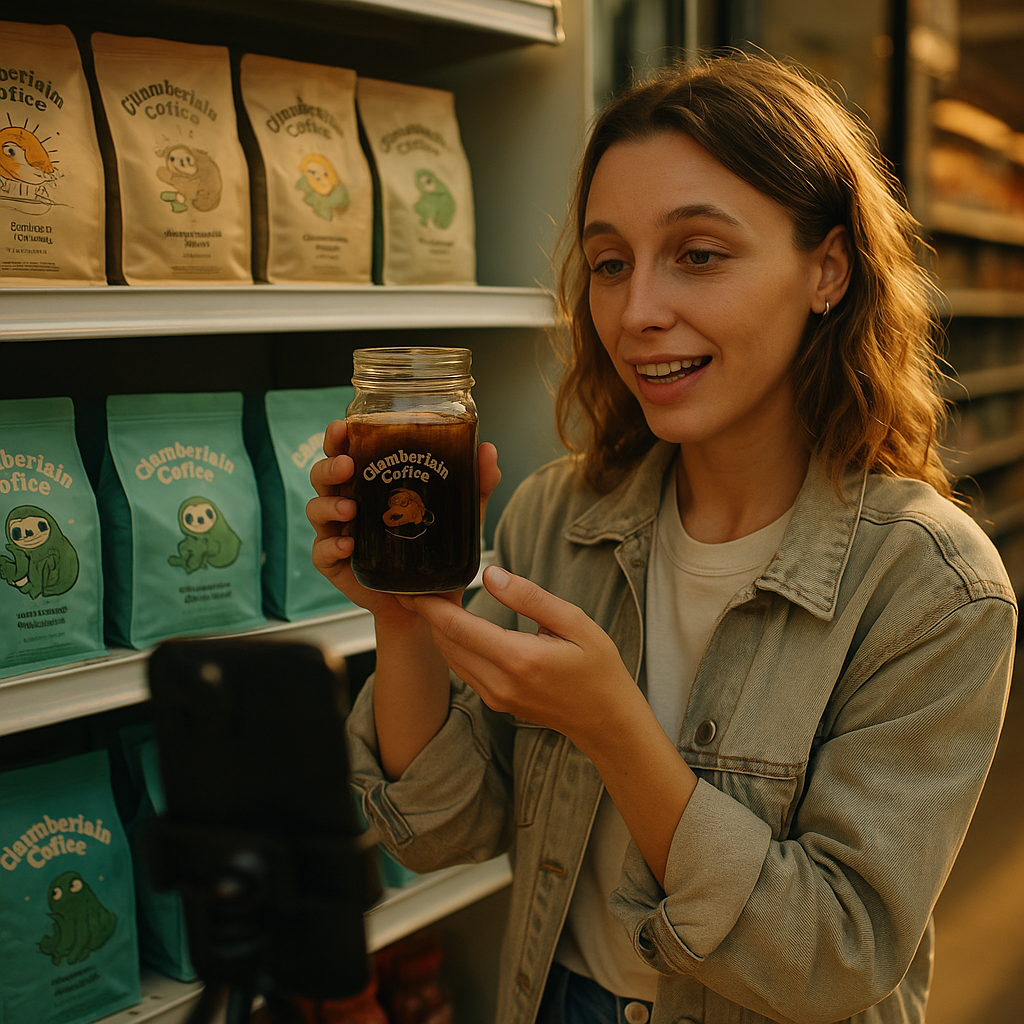
Emma Chamberlain has 12 million YouTube subscribers. Her coffee brand barely used her face to win retail shelf space. That’s the counterintuitive bet behind Chamberlain Coffee’s nano-creator seeding strategy, and it’s paying off in a channel most founder-led brands struggle to crack: physical retail distribution.
While competitors leaned on celebrity halo effect to court buyers at Target and Kroger, Chamberlain Coffee built a grassroots network of small creators generating the one thing retail buyers actually trust: proof of organic demand at the shelf level.
The Problem With Founder Fame as a Distribution Strategy
Founder-fame brands hit a ceiling fast. Retail buyers have seen a hundred celebrity-backed CPG launches flame out after the initial press cycle. A famous face gets you a meeting. It doesn’t get you a reorder.
Target, Kroger, and Whole Foods category managers care about velocity, not vanity metrics. They want to see repeat purchase data, regional demand signals, and proof that a product moves without a media buy propping it up. A founder’s follower count doesn’t answer any of those questions. It just gets the SKU on a Powerpoint slide.
Chamberlain Coffee’s team apparently understood this early. Instead of running Emma Chamberlain’s personal platform as the primary growth lever, they built a distributed network of nano-creators (generally defined as accounts with 1,000 to 10,000 followers) to generate localized, authentic demand signals in the specific geographic markets where retail expansion was being negotiated.
Retail buyers don’t fund brands on follower count. They fund brands on proof that demand exists without a media budget behind it — and nano-creators generate exactly that kind of unpaid, organic signal.
What Nano-Creator Seeding Actually Looks Like
This isn’t influencer marketing in the traditional sense. There’s no big brand deal, no usage rights negotiation, no six-figure campaign brief. Nano-creator seeding is closer to product sampling with a content layer attached.
The mechanics are simple and, frankly, unglamorous:
- Identify creators in target retail markets with small but highly engaged, niche-relevant audiences (coffee enthusiasts, dorm-life content, budget lifestyle creators)
- Send product free, with zero contractual content requirement in many cases
- Let organic posting happen on its own timeline, rather than forcing a campaign calendar
- Track earned mentions, geotagged content, and hashtag usage as a proxy for regional demand
- Compile that content into retail sell-sheets and buyer pitch decks as evidence of grassroots traction
The brand’s own retail launch playbook, detailed in Chamberlain Coffee’s creator-first retail launch strategy, shows how this content gets repurposed directly into buyer conversations. It’s not a coincidence. It’s the point.
Compare this to a founder-fame approach, where a single piece of celebrity content might generate huge reach but tells a retail buyer almost nothing about whether the product will sell in, say, suburban Ohio versus urban Austin. Nano-creators, scattered across dozens of micro-markets, generate exactly that kind of granular signal.
Why Retail Buyers Respond to Small Creators, Not Big Ones
Here’s the uncomfortable truth most DTC founders don’t want to hear: a celebrity endorsement can actually work against you in a buyer meeting.
Buyers have been burned before. They’ve watched celebrity-fronted beverage and snack brands get initial placement, spike briefly on curiosity purchases, then collapse once the paid promotion stops. That pattern is well-documented enough that category managers now discount celebrity buzz as a predictor of sustained velocity.
Nano-creator content reads differently. When forty separate accounts in forty separate zip codes are organically posting about a product they paid nothing to promote, that looks like real demand, not manufactured hype. It’s the same logic driving grocery and CPG brands elsewhere in the category. Aldi’s nano-creator grocery hauls outperformed traditional CPG ad spend on cost-per-acquisition for similar reasons: dispersed, authentic-feeling content beats centralized, obviously-paid media when the buyer is evaluating long-term shelf viability.
Chamberlain Coffee reportedly used this same principle when pitching regional grocery chains ahead of national expansion. Instead of leading with Emma Chamberlain’s platform, the sales team led with maps: clusters of nano-creator content concentrated in the exact trade areas under negotiation.
The Numbers Behind the Approach
Public data on Chamberlain Coffee’s specific creator spend is limited, since it’s a privately held company. But the broader category trend backs up the logic. According to eMarketer, nano and micro-influencer segments now command a disproportionate share of engagement rate relative to follower count compared to macro and celebrity tiers, a gap that’s widened as platforms increasingly favor niche, community-driven content in distribution algorithms.
Retail-specific data reinforces this too. Brands using dispersed nano-creator seeding ahead of retail negotiations have reported meaningfully lower cost-per-acquisition figures than celebrity or macro-influencer campaigns run in parallel, a pattern also seen in Liquid I.V.’s nano-creator seeding program, which similarly prioritized trust-building over reach.
A single celebrity post might reach two million people once. Two hundred nano-creators posting over six months build a durable, geographically distributed trust signal that retail buyers can actually verify.
This is a fundamentally different resource allocation. Instead of one large payment to one famous person, budget gets spread across hundreds of small, low-cost or product-only seeding relationships. The per-unit cost is tiny. The aggregate signal, if managed well, is bigger and more credible than a single celebrity moment.
Operational Realities: What This Costs and Who Runs It
None of this happens by accident. Running a nano-creator seeding program at the scale needed to influence retail buyer decisions requires real operational infrastructure, not a spreadsheet and an intern.
Brands doing this well typically build or buy:
- A creator discovery and CRM system to track thousands of small-account relationships
- A product fulfillment pipeline for free-sample seeding at volume
- Social listening tools to capture and geotag organic mentions
- A lightweight rights-management process for repurposing UGC into buyer-facing sell sheets
- Clear internal ownership, usually sitting inside brand marketing rather than sales, but with a direct feed into the retail sales team’s pitch materials
This is closer to a marketing operations function than a traditional influencer campaign. Tools built for creator relationship management and UGC rights tracking, the kind referenced in coverage of CPG ad-ops production efficiency, are increasingly standard infrastructure for brands running seeding at this scale.
The compliance layer matters here too. Even unpaid product seeding triggers disclosure obligations under FTC endorsement guidelines when there’s a material connection between brand and creator, including free product. Brands running seeding programs at scale need clear creator education on disclosure, plus a monitoring process to catch non-compliant posts before they become a liability. Skipping this step isn’t just risky, it undermines the entire premise of “authentic” demand signals if regulators or media later flag undisclosed relationships.
Where This Strategy Has Limits
Nano-creator seeding isn’t a universal replacement for founder-led marketing or paid media. It works best as a distribution-focused tactic layered under a broader brand strategy, not as a standalone growth engine.
A few honest caveats:
- It’s slow. Organic seeding builds signal over months, not weeks. Brands under pressure for a fast retail win may not have the runway.
- It requires genuine product quality. Nano-creators posting organically will just as easily post negative or lukewarm reactions. There’s no script forcing enthusiasm.
- It doesn’t replace brand awareness building. Founder fame still helps with top-of-funnel discovery; nano-seeding is more of a mid-funnel trust and proof mechanism.
- Measurement is messier than paid campaigns. Attributing retail lift directly to organic seeding requires disciplined geotagging and a willingness to work with directional, not perfectly clean, data.
Chamberlain Coffee still leans on Emma Chamberlain’s platform for top-of-funnel brand awareness. The nano-creator layer exists specifically to solve the retail trust problem that founder fame alone can’t solve. Brands considering a similar approach, including those studied in Poppi’s nano-creator trust rebuild, tend to run both layers simultaneously rather than choosing one over the other.
What This Means for Brand and Retail Teams Right Now
If you’re a brand marketer sitting on a founder with real personal reach, don’t assume that reach automatically converts to retail wins. Buyers are increasingly numb to celebrity halo. What moves them is distributed, verifiable, low-cost proof that real people in real trade areas are buying and talking about your product without being paid to.
Build the nano-creator layer before the retail pitch meeting, not after. By the time you’re in the room with a category manager, you want maps and screenshots, not just a follower count on a slide.
Frequently Asked Questions
FAQs
What is nano-creator seeding?
Nano-creator seeding is the practice of sending free product to small-audience creators (typically 1,000 to 10,000 followers) with little or no content requirement, in order to generate organic, low-cost social proof rather than paid campaign reach.
Why would a brand use nano-creators instead of its own famous founder?
Founder fame drives awareness but doesn’t prove regional demand to retail buyers. Nano-creators, distributed across specific trade areas, generate authentic, geotagged signal that buyers trust more than a single celebrity endorsement.
How does nano-creator content actually help win retail distribution?
Brands compile organic nano-creator posts, geotagged by market, into sell sheets and buyer pitch decks as evidence that unpaid demand already exists in the exact regions where distribution is being negotiated.
Is nano-creator seeding cheaper than celebrity or macro-influencer marketing?
Generally yes. Per-creator cost is minimal, often just product, but running the program at scale requires investment in creator CRM, fulfillment, and social listening infrastructure.
Do brands need to disclose unpaid product seeding to creators?
Yes. Under FTC endorsement guidelines, free product constitutes a material connection that must be disclosed, even without a formal contract or payment involved.
Does nano-creator seeding replace paid media entirely?
No. It works best as a complementary, trust-building layer under broader brand and paid media strategy, particularly for solving retail buyer skepticism rather than driving top-of-funnel awareness.
The takeaway for marketing leaders: stop pitching retail buyers with reach numbers and start pitching them with proof. Build a nano-creator seeding pipeline at least two quarters ahead of your next retail negotiation, and let the geotagged content do the talking.
Top Influencer Marketing Agencies
The leading agencies shaping influencer marketing in 2026
Agencies ranked by campaign performance, client diversity, platform expertise, proven ROI, industry recognition, and client satisfaction. Assessed through verified case studies, reviews, and industry consultations.
Moburst

-
2

The Shelf
Boutique Beauty & Lifestyle Influencer AgencyA data-driven boutique agency specializing exclusively in beauty, wellness, and lifestyle influencer campaigns on Instagram and TikTok. Best for brands already focused on the beauty/personal care space that need curated, aesthetic-driven content.Clients: Pepsi, The Honest Company, Hims, Elf Cosmetics, Pure LeafVisit The Shelf → -
3

Audiencly
Niche Gaming & Esports Influencer AgencyA specialized agency focused exclusively on gaming and esports creators on YouTube, Twitch, and TikTok. Ideal if your campaign is 100% gaming-focused — from game launches to hardware and esports events.Clients: Epic Games, NordVPN, Ubisoft, Wargaming, Tencent GamesVisit Audiencly → -
4

Viral Nation
Global Influencer Marketing & Talent AgencyA dual talent management and marketing agency with proprietary brand safety tools and a global creator network spanning nano-influencers to celebrities across all major platforms.Clients: Meta, Activision Blizzard, Energizer, Aston Martin, WalmartVisit Viral Nation → -
5

The Influencer Marketing Factory
TikTok, Instagram & YouTube CampaignsA full-service agency with strong TikTok expertise, offering end-to-end campaign management from influencer discovery through performance reporting with a focus on platform-native content.Clients: Google, Snapchat, Universal Music, Bumble, YelpVisit TIMF → -
6

NeoReach
Enterprise Analytics & Influencer CampaignsAn enterprise-focused agency combining managed campaigns with a powerful self-service data platform for influencer search, audience analytics, and attribution modeling.Clients: Amazon, Airbnb, Netflix, Honda, The New York TimesVisit NeoReach → -
7

Ubiquitous
Creator-First Marketing PlatformA tech-driven platform combining self-service tools with managed campaign options, emphasizing speed and scalability for brands managing multiple influencer relationships.Clients: Lyft, Disney, Target, American Eagle, NetflixVisit Ubiquitous → -
8

Obviously
Scalable Enterprise Influencer CampaignsA tech-enabled agency built for high-volume campaigns, coordinating hundreds of creators simultaneously with end-to-end logistics, content rights management, and product seeding.Clients: Google, Ulta Beauty, Converse, AmazonVisit Obviously →