


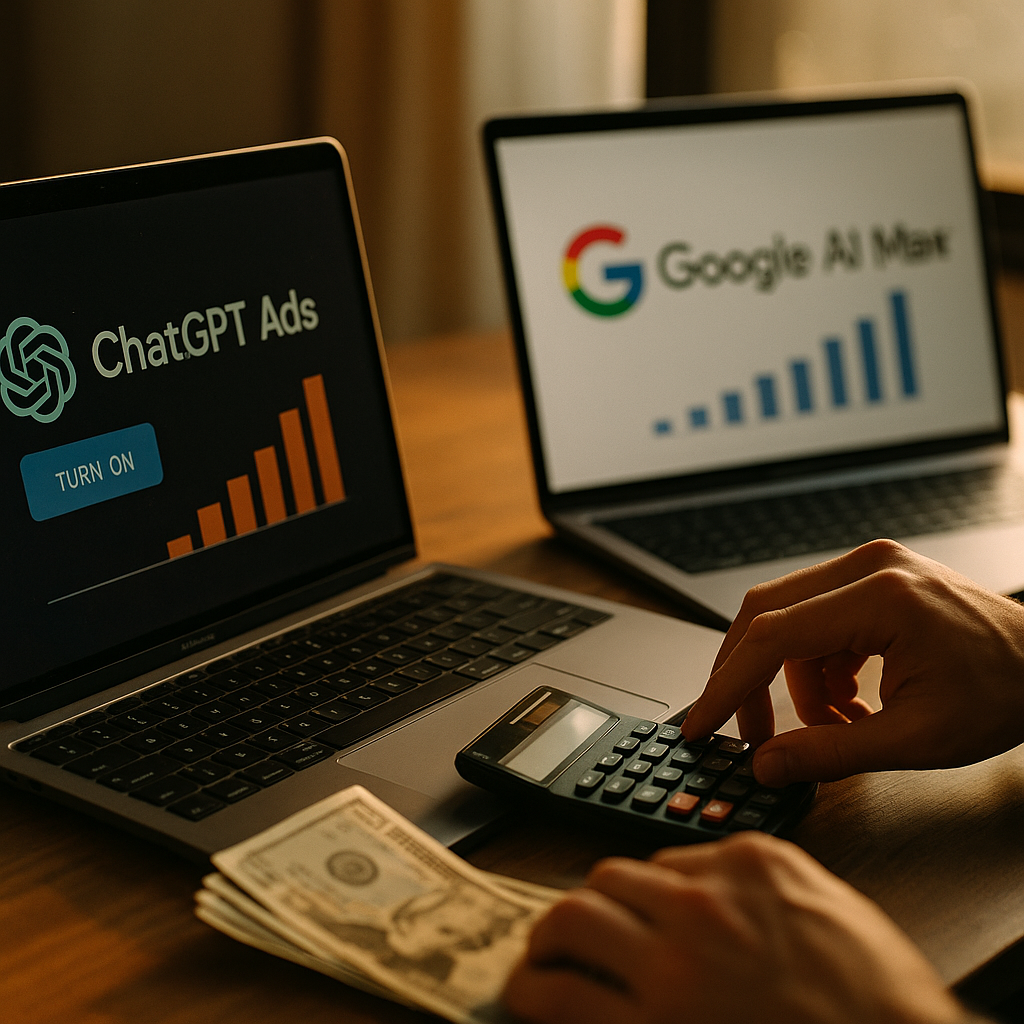
OpenAI is reportedly testing ad units inside ChatGPT with weekly active users north of 800 million, while Google’s AI Max campaigns now blend Search, AI Overviews, and creator-style content into one bidding pool. Two AI ad surfaces, one shrinking attention span, and a real question for anyone managing ChatGPT Ads vs Google AI Max budgets: which one actually earns creator-adjacent spend, and which one just borrows it?
This isn’t a philosophical debate. It’s a budget-allocation problem, and most marketing teams are flying blind because both products are moving targets. Here’s how to evaluate them without betting the quarter on a beta.
Why “Creator-Adjacent” Spend Needs Its Own Evaluation Lens
Creator-adjacent spend covers the budget lines that sit next to influencer programs but aren’t pure creator fees: paid amplification of creator content, discovery-surface ads that compete with organic creator mentions, and retargeting built on creator-driven engagement. It’s grown fast because brands realized organic creator reach alone doesn’t scale predictably. You need paid muscle behind it.
The problem is that ChatGPT Ads and Google AI Max don’t behave like traditional paid social or search line items. They sit inside conversational or generative interfaces where users ask questions rather than scroll feeds. That changes what “creator-adjacent” even means. A ChatGPT ad might surface next to a synthesized answer that references a creator’s product review without linking to it. A Google AI Max placement might blend an AI Overview citation with a paid unit in the same visual block. Neither behaves like a Instagram Reels ad slot.
If your media plan still treats generative AI surfaces as “just another search channel,” you’re underpricing the risk and overpaying for reach you can’t verify.
What ChatGPT Ads Actually Offer Right Now
OpenAI’s ad tests, as reported by eMarketer and others, focus on placements inside chat responses and shopping-style queries — closer to sponsored recommendations than banner ads. For brands running creator programs, the appeal is obvious: ChatGPT users are asking product questions in a research mindset, often the same questions a creator’s review would answer.
The catch: early ad formats are still narrow, inventory is limited, and there’s no mature creative library equivalent to what you’d build for Meta or TikTok. You’re also not bidding into a keyword auction you understand. You’re bidding into a black box shaped by conversational intent signals, and OpenAI hasn’t published granular targeting documentation the way Google has for decades.
For teams that have already done the work of tracking influencer ROI when AI answers kill the click, this should sound familiar. ChatGPT Ads face the same attribution fog — if a user gets a satisfying answer inside the chat window, they may never click through to a landing page at all.
Google AI Max: More Mature, More Automated, Less Transparent
Google AI Max campaigns extend Performance Max logic into AI Overviews and generative search results. It’s less experimental than ChatGPT Ads in the sense that it’s built on Google’s existing auction infrastructure, feeding off Search, Display, and YouTube signals. That maturity is a real advantage: reporting exists, conversion tracking exists, and most marketing teams already have Google Ads accounts wired into their MarTech stack.
But AI Max inherits Performance Max’s core weakness: automation swallows granularity. You hand Google a budget, some assets, and a conversion goal, and the algorithm decides where creator-adjacent content shows up relative to AI-generated answers. You often can’t isolate spend by placement type. That’s a governance problem for brands that need to prove which dollars touched creator-influenced discovery versus pure brand search.
Teams that have already built governance checklists for autonomous bidding should apply the same rigor here. AI Max’s automation ceiling means you need guardrails before launch, not after you’ve burned a quarter’s test budget.
The Core Comparison, Stripped of Hype
- Inventory maturity: Google AI Max wins. It’s built on an ad system with 25+ years of auction data. ChatGPT Ads are early-stage, with limited placement types and shifting eligibility rules.
- Intent quality: ChatGPT Ads may win here. Users typing multi-turn conversational queries often show higher purchase intent than a generic search query, though there’s no independent third-party data yet confirming conversion lift at scale.
- Attribution clarity: Google AI Max integrates with GA4 and existing conversion tracking. ChatGPT Ads currently offer thinner reporting, which complicates blended attribution models like those discussed in blended CRM-DSP-web attribution work.
- Creator-content compatibility: Both platforms can surface or reference creator content indirectly, but neither guarantees creator attribution or compensation structures. That’s a legal and brand-safety gap worth flagging to your compliance team early.
- Cost predictability: Google AI Max auction dynamics are known quantities, even if automated. ChatGPT Ads pricing is still forming, and early-mover CPMs could swing wildly as OpenAI tests monetization models.
The Attribution Problem Nobody’s Solved Yet
Here’s the uncomfortable truth: neither platform gives you a clean line from “creator content influenced this” to “this ad closed the sale.” Google AI Max blends AI Overview citations with paid placements in ways that make it hard to isolate creator-adjacent lift from generic brand-search lift. ChatGPT Ads, meanwhile, sit inside a conversational UI where the “click” itself may not happen — the user gets an answer and moves on.
This is why identity resolution work matters more than ever. If you haven’t already fixed CRM identity resolution for AI referral traffic, do that before you scale spend on either platform. Otherwise you’ll be reporting on vanity impressions while your CFO asks why creator-adjacent spend doesn’t show up in pipeline.
A media plan that can’t distinguish AI-Overview-influenced conversions from ChatGPT-influenced conversions isn’t a media plan. It’s a guess with a dashboard attached.
A Practical Framework for Splitting Budget
Rather than picking a winner, most brands should run a structured test allocation. Here’s a framework that’s worked in early pilots across mid-market retail and DTC accounts:
- Reserve 70-80% for Google AI Max if you already have mature Performance Max campaigns. It’s the lower-risk, higher-data-maturity option, and you can layer creator-adjacent creative into existing asset groups without rebuilding infrastructure.
- Cap ChatGPT Ads at 10-20% as a learning budget. Treat it like you’d treat a new social platform launch — set clear KPIs (assisted conversions, branded search lift, not last-click ROAS), and accept that early data will be noisy.
- Hold 5-10% in reserve for reallocation once you have 60-90 days of comparative data. Both platforms are changing fast enough that quarterly re-evaluation isn’t optional.
This mirrors the logic in predictive targeting shifts toward real sales data — you’re not chasing platform hype, you’re following measurable conversion signal and adjusting incrementally.
Questions to Ask Before You Commit Budget
Before signing off on either platform for creator-adjacent spend, push your team (or your agency) to answer these:
- Can we isolate spend and performance by placement type, or are we buying a black-box bundle?
- Does the platform’s reporting integrate with our existing attribution stack without custom engineering work?
- What’s our fallback if inventory pricing spikes 3x in a quarter, which has happened with other new AI ad products?
- Are we compensating or crediting creators whose content may be referenced or paraphrased in AI-generated answers alongside our ads?
- Who owns compliance review if an AI-generated response near our ad makes an inaccurate claim about our product?
That last point matters more than most teams initially think. The FTC has been increasingly vocal about disclosure and endorsement rules extending into AI-mediated content, and brand safety teams should treat AI Overview and ChatGPT ad adjacency with the same scrutiny they’d apply to influencer disclosure compliance.
Where Creative Strategy Has to Adapt
Both platforms punish generic ad creative. Google’s AI Max leans on asset diversity, feeding multiple headline and image variants into its automated system, similar to the creative flexibility discussed in generative AI search ad copy controls. ChatGPT Ads, based on early tests, favor concise, direct-answer-style copy that mirrors how the model itself responds to queries. Stuffing keyword-heavy, SEO-style ad copy into either surface is likely to underperform.
If your creator content already performs well because it answers a specific question in a specific voice, that’s actually a strength here. Both AI ad surfaces reward specificity over breadth. Repurpose your best-performing creator scripts as the seed copy for AI Max asset groups, and test conversational phrasing (not keyword strings) in any ChatGPT Ads pilot you run.
Next Step
Don’t wait for a “winner” to emerge. Run a capped, time-boxed test on ChatGPT Ads now, keep the bulk of budget in Google AI Max where your data infrastructure already works, and re-evaluate the split every quarter based on assisted-conversion data, not platform hype.
FAQs
Is ChatGPT Ads available to all advertisers right now?
No. OpenAI has been testing ad formats with a limited set of advertisers and use cases. Availability and targeting options are expected to expand, but as of now, access and documentation remain far less mature than Google’s ad products.
How is Google AI Max different from standard Performance Max?
AI Max extends Performance Max’s automation into AI Overviews and generative search surfaces, pulling from the same asset groups and bidding signals but expanding where those ads can appear, including alongside AI-generated answers.
Can I track which conversions came from creator-adjacent AI ad placements?
Only partially, and only with additional setup. Neither platform natively isolates creator-adjacent placements from broader AI ad inventory. You’ll need custom UTM structures, CRM identity resolution work, and blended attribution modeling to approximate it.
Should small and mid-size brands test ChatGPT Ads at all?
Yes, but with a capped, learning-focused budget. Treat it as a pilot rather than a scaled channel until reporting, targeting, and pricing stabilize.
Do these platforms create new compliance risks for creator content?
Potentially. If an AI Overview or ChatGPT response references or paraphrases creator content near a paid placement, disclosure and endorsement rules can get murky. Brand and legal teams should review FTC guidance and build review checkpoints before scaling spend.
FAQs
Is ChatGPT Ads available to all advertisers right now?
No. OpenAI has been testing ad formats with a limited set of advertisers and use cases. Availability and targeting options are expected to expand, but as of now, access and documentation remain far less mature than Google’s ad products.
How is Google AI Max different from standard Performance Max?
AI Max extends Performance Max’s automation into AI Overviews and generative search surfaces, pulling from the same asset groups and bidding signals but expanding where those ads can appear, including alongside AI-generated answers.
Can I track which conversions came from creator-adjacent AI ad placements?
Only partially, and only with additional setup. Neither platform natively isolates creator-adjacent placements from broader AI ad inventory. You’ll need custom UTM structures, CRM identity resolution work, and blended attribution modeling to approximate it.
Should small and mid-size brands test ChatGPT Ads at all?
Yes, but with a capped, learning-focused budget. Treat it as a pilot rather than a scaled channel until reporting, targeting, and pricing stabilize.
Do these platforms create new compliance risks for creator content?
Potentially. If an AI Overview or ChatGPT response references or paraphrases creator content near a paid placement, disclosure and endorsement rules can get murky. Brand and legal teams should review FTC guidance and build review checkpoints before scaling spend.
Top Influencer Marketing Agencies
The leading agencies shaping influencer marketing in 2026
Agencies ranked by campaign performance, client diversity, platform expertise, proven ROI, industry recognition, and client satisfaction. Assessed through verified case studies, reviews, and industry consultations.
Moburst

-
2

The Shelf
Boutique Beauty & Lifestyle Influencer AgencyA data-driven boutique agency specializing exclusively in beauty, wellness, and lifestyle influencer campaigns on Instagram and TikTok. Best for brands already focused on the beauty/personal care space that need curated, aesthetic-driven content.Clients: Pepsi, The Honest Company, Hims, Elf Cosmetics, Pure LeafVisit The Shelf → -
3

Audiencly
Niche Gaming & Esports Influencer AgencyA specialized agency focused exclusively on gaming and esports creators on YouTube, Twitch, and TikTok. Ideal if your campaign is 100% gaming-focused — from game launches to hardware and esports events.Clients: Epic Games, NordVPN, Ubisoft, Wargaming, Tencent GamesVisit Audiencly → -
4

Viral Nation
Global Influencer Marketing & Talent AgencyA dual talent management and marketing agency with proprietary brand safety tools and a global creator network spanning nano-influencers to celebrities across all major platforms.Clients: Meta, Activision Blizzard, Energizer, Aston Martin, WalmartVisit Viral Nation → -
5

The Influencer Marketing Factory
TikTok, Instagram & YouTube CampaignsA full-service agency with strong TikTok expertise, offering end-to-end campaign management from influencer discovery through performance reporting with a focus on platform-native content.Clients: Google, Snapchat, Universal Music, Bumble, YelpVisit TIMF → -
6

NeoReach
Enterprise Analytics & Influencer CampaignsAn enterprise-focused agency combining managed campaigns with a powerful self-service data platform for influencer search, audience analytics, and attribution modeling.Clients: Amazon, Airbnb, Netflix, Honda, The New York TimesVisit NeoReach → -
7

Ubiquitous
Creator-First Marketing PlatformA tech-driven platform combining self-service tools with managed campaign options, emphasizing speed and scalability for brands managing multiple influencer relationships.Clients: Lyft, Disney, Target, American Eagle, NetflixVisit Ubiquitous → -
8

Obviously
Scalable Enterprise Influencer CampaignsA tech-enabled agency built for high-volume campaigns, coordinating hundreds of creators simultaneously with end-to-end logistics, content rights management, and product seeding.Clients: Google, Ulta Beauty, Converse, AmazonVisit Obviously →