


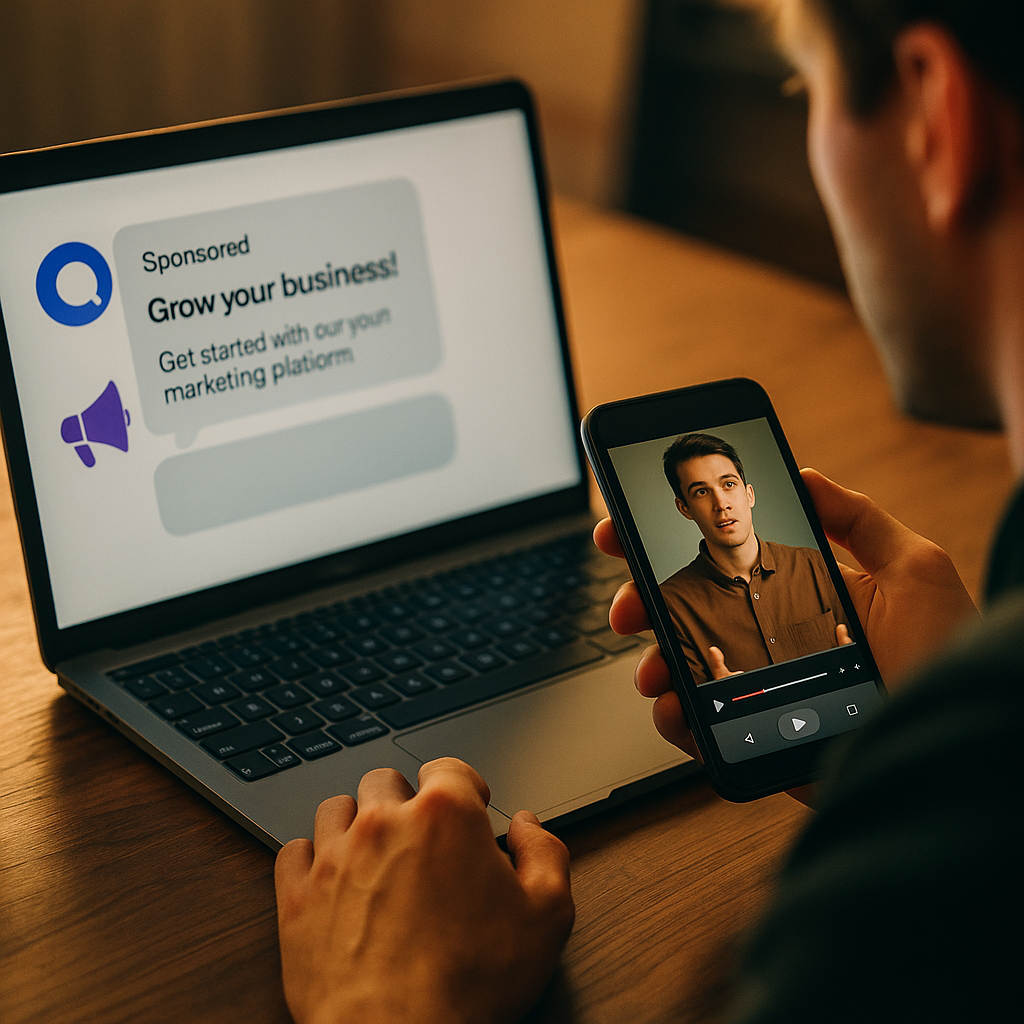
Google says Demand Gen ads with chat-based extensions are converting inbound leads at rates that outpace standard click-to-site creative by double digits. That should stop you mid-scroll. The chat-native ad format isn’t a minor UI tweak, it’s a structural shift in how AI-generated video and conversational messaging work together inside a single unit, and most creative teams are still briefing it like a 2022 bumper ad.
What Is the Chat-Native Ad Format, Exactly?
Google’s Demand Gen placements now let advertisers pair AI-generated video creative with an embedded messaging surface, essentially a chat window that opens without leaving the ad environment. The viewer watches a short video, then gets prompted to ask a question, request a quote, or start a guided conversation, all inside the same unit. No landing page hop. No app switch.
This matters because Demand Gen already runs across YouTube, Discover, and Gmail, three surfaces where attention is fragmented and intent is murky. Adding a chat layer turns a passive viewing moment into an active, trackable exchange. For B2B and considered-purchase brands, that’s the whole game: capturing intent before the viewer bounces.
Why Video Made for Silence Doesn’t Work Here
Most video creative is still built around the assumption that the viewer watches, then leaves. Hook, story, CTA, done. The chat-native format breaks that arc on purpose. Your video’s job is no longer to close the sale, it’s to open a conversation. That’s a different creative brief entirely.
If your video ends on a hard sell with no room for a follow-up question, you’ve built a dead end. The best-performing units treat the video as act one of a two-part exchange, ending on a prompt that naturally invites a reply: “Curious how this fits your team size?” instead of “Buy now.”
Treat the video as the opening line of a conversation, not the closing argument. If your last frame doesn’t invite a reply, the chat layer sits there unused.
This is the same discipline covered in our watch time first creative briefs piece, except here the pacing has to leave a doorway open rather than close the loop tightly.
Directing AI Video for a Conversational Handoff
Briefing AI video for chat-native placements requires a few structural changes most teams skip:
- End on an open question, not a resolution. The video should raise a specific, answerable question that the chat bot or live rep picks up immediately.
- Match tone across video and chat script. If the AI video is warm and conversational, a robotic chat response kills the momentum instantly.
- Segment by intent signal. A viewer who watches to completion versus one who drops at three seconds should get different opening chat prompts.
- Keep video under fifteen seconds. Demand Gen’s chat trigger performs best when the video doesn’t overstay its welcome before the messaging prompt appears.
Teams already working with modular AI video pipelines have an advantage here. If you’re generating multiple cuts from one shoot, as outlined in our modular storyboard design approach, you can build chat-specific endings without reshooting the whole asset. Similarly, brands using AI multi-angle shot generation can swap the closing frame per audience segment while keeping the core footage identical.
Scripting the Chat Layer: It’s Copywriting, Not Customer Service
Here’s where a lot of brands get sloppy. They treat the chat script as an afterthought, something the support team bolts on after the creative is locked. Wrong order. The chat opening lines need to be written alongside the video script, by the same team, with the same brand voice guidelines.
Adaptive dialogue is already part of how AI video briefs work for dynamic creative, and the same logic extends into the chat layer. If you’ve read our guide on briefing AI video ads for adaptive dialogue, you already know the principle: script variables, not just static lines, so the tone adjusts based on what triggered the ad in the first place (a search query, a remarketing list, a lookalike audience).
A few practical rules for the chat script itself:
- Open with a question that references what the viewer just saw, not a generic greeting.
- Offer a menu of two or three quick-reply options before free text, most users won’t type a paragraph on mobile.
- Route to a human within two exchanges if the query gets specific. Nobody wants to argue with a bot about pricing tiers.
- Log every conversation as a first-party data point, this is a zero-party goldmine if you’re capturing preferences directly.
That last point connects directly to the broader shift toward zero-party data capture strategies. A chat exchange inside a Demand Gen ad is arguably richer signal than a form fill, because the viewer volunteered the information in a conversational context rather than clicking through a gate.
Compliance: Who’s Liable for What the Bot Says?
This is the question legal teams ask first, and rightly so. If your chat layer is powered by an AI assistant making claims about pricing, availability, or product performance, you need the same review rigor you’d apply to a human sales rep’s script. The Federal Trade Commission has been explicit that automated claims carry the same disclosure and accuracy obligations as any other advertising statement, bot or not.
Build a review layer before launch, not after a complaint. That means:
- Pre-approving every scripted chat response, even the “smart” adaptive ones.
- Setting hard guardrails on what the AI can and cannot claim about price, availability, or guarantees.
- Documenting the escalation path when a conversation gets flagged as a complaint or a legal question.
Our team’s process for this mirrors the discipline in short-form sales briefs that pass legal review fast. The same pre-clearance logic applies here, just with a conversational script instead of a voiceover.
Measurement: The Metric That Actually Matters
Demand Gen reporting will show you view rate, click rate, and conversion rate. None of those fully capture what’s happening in a chat-native unit. The metric that matters is conversation completion rate: how many chat sessions reach a qualified outcome (booking, quote request, lead form) versus how many stall after the opening prompt.
Track this separately from your standard CPA math. A viewer who starts a chat and drops off after one message isn’t a wasted impression, they’re a warm signal you can retarget with a different opening line next time. According to eMarketer, conversational ad formats are seeing meaningful lift in engaged session duration compared to static CTA units, though completion rates still vary wildly by industry and script quality.
A dropped chat isn’t a lost conversion, it’s mid-funnel data you didn’t have before. Retarget the drop-off point, not just the impression.
If you’re running this alongside creator-led content, the measurement discipline should feel familiar. It’s the same logic used in blended UGC-plus-influencer briefs, where mid-funnel engagement gets tracked as its own conversion event rather than lumped into a single top-line number. For broader benchmarking, Statista and Sprout Social both publish engagement benchmarks worth cross-checking against your own conversation completion data.
Building the Brief: A Practical Checklist
Before you send this to production, make sure the creative brief includes:
- A defined “handoff moment” in the video script where the chat prompt appears.
- Chat opening lines written in the same voice as the video, reviewed by the same copywriter.
- Legal sign-off on every automated claim the chat layer might make.
- A tagging plan so conversation completion sits alongside standard Demand Gen metrics in your dashboard.
- A fallback human escalation path for anything beyond basic FAQ territory.
Skip any of these and you’ll end up with a technically functional ad unit that nobody actually talks to. Google’s own Demand Gen documentation covers the technical setup well, but it won’t tell you how to write a chat script that doesn’t sound like a form letter. That part’s on your creative team.
Next Step
Don’t retrofit an old video script with a chat button bolted on. Brief the video’s ending and the chat’s opening line as one connected exchange, get legal to clear the automated responses before launch, and track conversation completion as its own KPI from day one.
FAQs
What makes the chat-native ad format different from a standard Demand Gen video ad?
The chat-native format embeds a messaging interface directly inside the ad unit, letting viewers start a conversation without leaving the ad environment. Standard Demand Gen video ads rely on a single click-through CTA, while chat-native units treat the video as the first half of a two-part exchange.
Do I need a live agent for the chat layer, or can it be fully automated?
Most brands run a hybrid model: an automated assistant handles the first one or two exchanges, then routes to a live rep once the query gets specific about pricing, availability, or contracts. Fully automated chat works for simple FAQ-style queries but tends to underperform on considered purchases.
How do I keep the AI-generated chat responses FTC compliant?
Pre-approve every scripted response the AI can give, set hard limits on pricing and performance claims, and document an escalation path for flagged conversations. Automated statements carry the same disclosure obligations as human-written ad copy under FTC guidance.
What’s the best way to measure success on a chat-native unit?
Track conversation completion rate (chats that reach a qualified outcome like a lead form or booking) alongside standard Demand Gen metrics like view rate and CPA. A dropped chat still generates useful mid-funnel data you can use for retargeting.
Can I reuse existing AI video creative for chat-native placements?
Yes, if the video was built with a modular ending. Swap the closing frame to end on an open question rather than a hard CTA, and pair it with a chat script written in the same voice. Full reshoots usually aren’t necessary if your original creative pipeline supports multiple cuts.
Top Influencer Marketing Agencies
The leading agencies shaping influencer marketing in 2026
Agencies ranked by campaign performance, client diversity, platform expertise, proven ROI, industry recognition, and client satisfaction. Assessed through verified case studies, reviews, and industry consultations.
Moburst

-
2

The Shelf
Boutique Beauty & Lifestyle Influencer AgencyA data-driven boutique agency specializing exclusively in beauty, wellness, and lifestyle influencer campaigns on Instagram and TikTok. Best for brands already focused on the beauty/personal care space that need curated, aesthetic-driven content.Clients: Pepsi, The Honest Company, Hims, Elf Cosmetics, Pure LeafVisit The Shelf → -
3

Audiencly
Niche Gaming & Esports Influencer AgencyA specialized agency focused exclusively on gaming and esports creators on YouTube, Twitch, and TikTok. Ideal if your campaign is 100% gaming-focused — from game launches to hardware and esports events.Clients: Epic Games, NordVPN, Ubisoft, Wargaming, Tencent GamesVisit Audiencly → -
4

Viral Nation
Global Influencer Marketing & Talent AgencyA dual talent management and marketing agency with proprietary brand safety tools and a global creator network spanning nano-influencers to celebrities across all major platforms.Clients: Meta, Activision Blizzard, Energizer, Aston Martin, WalmartVisit Viral Nation → -
5

The Influencer Marketing Factory
TikTok, Instagram & YouTube CampaignsA full-service agency with strong TikTok expertise, offering end-to-end campaign management from influencer discovery through performance reporting with a focus on platform-native content.Clients: Google, Snapchat, Universal Music, Bumble, YelpVisit TIMF → -
6

NeoReach
Enterprise Analytics & Influencer CampaignsAn enterprise-focused agency combining managed campaigns with a powerful self-service data platform for influencer search, audience analytics, and attribution modeling.Clients: Amazon, Airbnb, Netflix, Honda, The New York TimesVisit NeoReach → -
7

Ubiquitous
Creator-First Marketing PlatformA tech-driven platform combining self-service tools with managed campaign options, emphasizing speed and scalability for brands managing multiple influencer relationships.Clients: Lyft, Disney, Target, American Eagle, NetflixVisit Ubiquitous → -
8

Obviously
Scalable Enterprise Influencer CampaignsA tech-enabled agency built for high-volume campaigns, coordinating hundreds of creators simultaneously with end-to-end logistics, content rights management, and product seeding.Clients: Google, Ulta Beauty, Converse, AmazonVisit Obviously →