


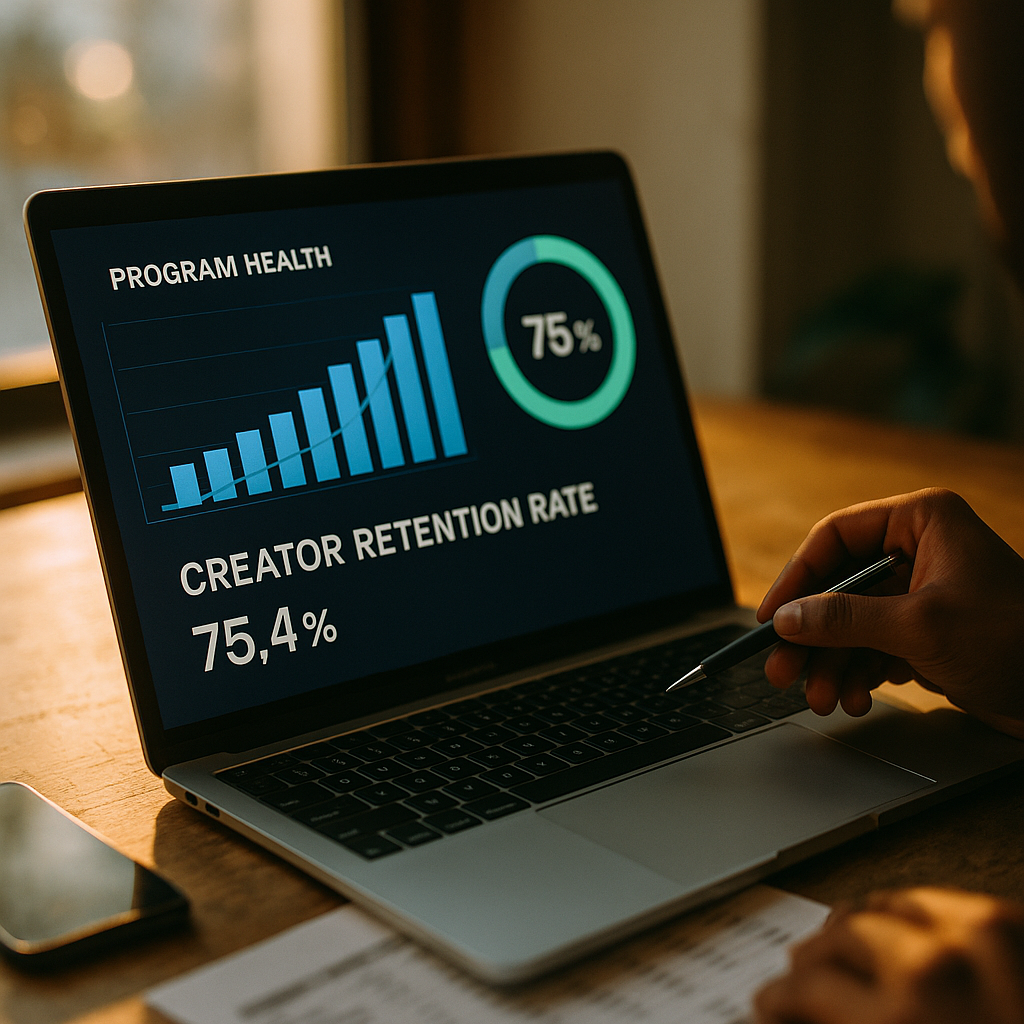
A creator who works with your brand three times converts better than one you hire once, every single time. Yet most influencer programs still report reach, impressions, and one-off engagement rates to leadership, ignoring the metric that actually predicts long-term ROI: creator retention. As budgets tighten and CFOs demand proof of compounding returns, retention rate is fast becoming the number that separates mature influencer programs from expensive experiments.
Why Reach Stopped Being the Metric That Matters
For years, influencer marketing dashboards looked the same across every brand: follower count, impressions, engagement rate, maybe a cost-per-mille comparison against paid media. Those numbers still get reported. But they no longer answer the question CMOs actually ask in budget reviews: is this program getting more efficient over time, or are we just buying the same result at a higher price every quarter?
That question is why marketing leaders distrust their own performance data in the first place. Reach numbers get inflated, bots skew impressions, and one-off campaign metrics tell you nothing about whether a partnership is building brand equity or just renting attention for thirty days. Retention, by contrast, is hard to fake. Either a creator came back for a second, third, or fifth campaign, or they didn’t.
Programs with creator retention rates above 60 percent report significantly lower cost-per-acquisition than programs that rebuild their roster every quarter, largely because negotiation friction and onboarding time drop with every repeat engagement.
What Creator Retention Rate Actually Measures
Creator retention rate, at its simplest, tracks the percentage of creators from a given campaign or quarter who work with the brand again within a defined window, usually two to four quarters. It sounds almost too simple to matter. But when you break it into components, it exposes almost everything else that’s broken or working in a program.
- Repeat engagement rate: the share of a roster that returns for a second deal without renegotiation friction.
- Time-to-recontract: how long it takes between campaign wrap and the next signed agreement. Shorter cycles usually mean stronger relationships and cleaner briefs.
- Rate escalation on renewal: whether repeat creators command higher fees because performance justified it, or whether the brand is simply overpaying to avoid churn.
- Voluntary opt-out rate: creators who decline future work despite being invited back. This one is the canary in the coal mine for brand reputation among talent.
None of these show up on a standard influencer marketing platform export by default. Teams have to build them, which is exactly why retention tracking has become a differentiator instead of table stakes.
The Business Case: Retention Is Cheaper Than Acquisition
This isn’t a new idea. Customer marketing has known for decades that retaining an existing customer costs a fraction of acquiring a new one. Creator programs are catching up to the same math. Every new creator relationship carries hidden costs: vetting for brand safety, negotiating rates from scratch, briefing on tone and product knowledge, and waiting through a learning curve before content performance stabilizes.
Compare that to a creator who already understands your product, has your brand guidelines memorized, and has a documented track record inside your own analytics. The second campaign is almost always cheaper to produce and faster to approve. That’s the operational efficiency angle procurement teams care about, and it’s why delivery scoring rubrics are increasingly used to decide who gets invited back, not just who gets cast in the first place.
There’s also a compounding brand-equity argument. Audiences notice when a creator keeps showing up with the same brand. It reads as endorsement rather than transaction. One-off posts get filed under “sponsored content and forgotten.” Repeat partnerships build the kind of association that social engagement research consistently links to higher trust scores among followers.
How Roster Churn Quietly Inflates Your Budget
Here’s a scenario that plays out at almost every mid-size CPG or DTC brand at some point: the influencer budget grows 20 percent year over year, but the number of unique creators used also grows by roughly the same amount. Leadership assumes this means expanded reach. What it actually means is the program never stopped starting over.
Every fresh creator relationship resets the negotiation clock. Rates get re-quoted, often higher than the last cycle because CPG influencer rate inflation has made first-time asks more expensive across the board. Briefs need rewriting because a new creator doesn’t have institutional context. Approval workflows slow down because trust hasn’t been established. None of this shows up as a line item, but it shows up in the total cost of the program.
Brands that track retention alongside spend can spot this pattern immediately: rising budget, flat or falling retention, is a red flag that the program is bleeding efficiency even if campaign-level metrics look fine.
Building a Retention Dashboard That Leadership Will Actually Use
Retention metrics only matter if they get reported alongside the numbers executives already trust. That means pairing retention rate with revenue attribution, not presenting it as a soft, relationship-y metric off to the side. A few practical steps:
- Set a retention window that matches your campaign cadence. Quarterly for fast-moving categories like beauty or gaming, semiannual for considered-purchase categories.
- Segment retention by tier. Nano and micro creators churn differently than mid-tier or celebrity talent, and blending them into one number hides the real story.
- Cross-reference retention with performance, not just tenure. A creator you keep re-hiring because they’re easy to work with, but who underperforms on conversion, is a retention number you don’t want.
- Tie retention to attribution data. If your team already uses transaction level attribution, layer retention on top to see whether repeat creators actually drive incremental revenue or just recycled reach.
This is also where platform selection matters. Not every influencer marketing platform surfaces recontract history cleanly, and plenty of brands still track this manually in spreadsheets because their tech stack wasn’t built for longitudinal creator relationships. If you’re evaluating vendors, ask specifically how they handle multi-campaign creator history before you sign anything, and check how that pricing interacts with broader martech consolidation happening across your stack.
What Kills Retention (And It’s Rarely the Money)
Ask creators why they don’t come back to a brand and the answer is almost never “the rate was too low.” It’s usually operational: slow payment cycles, unclear briefs, last-minute revision requests, or a brand that treats every campaign like the first time they’ve ever worked together. HubSpot’s research on partner relationships shows the same pattern across B2B partnerships broadly: friction, not price, drives churn.
The rise of rapid response rosters has actually made this worse in some organizations. Speed-focused programs sometimes sacrifice relationship management to move fast, treating creators as interchangeable inventory rather than long-term partners. That’s a short-term win and a long-term retention problem.
Compliance friction matters too. Creators who get burned by unclear disclosure requirements or brands that leave them exposed to FTC enforcement risk simply don’t renew, regardless of pay. Protecting creators operationally is now part of retaining them.
Where This Is Headed
Expect retention rate to show up in RFPs within the next few procurement cycles, the same way engagement rate and follower verification did a few years ago. Agencies pitching new business will need to show not just who they can cast, but who they’ve kept. Roster size alone already hides real fit problems; retention data is the layer that exposes them.
Brands that get ahead of this now, building the tracking infrastructure before it’s mandatory, will walk into next year’s budget conversations with a number nobody else in the room has: proof that their creator program gets cheaper and more effective the longer it runs.
Frequently Asked Questions
What is a good creator retention rate for an influencer program?
Most mature programs target 50 to 65 percent retention within a two-to-four quarter window, though benchmarks vary by category. Fast-moving verticals like gaming or beauty tend to run lower due to trend cycles, while considered-purchase categories often retain creators longer.
How is creator retention different from engagement rate?
Engagement rate measures how an audience responds to a single piece of content. Retention rate measures whether the creator who made that content chooses to work with the brand again. One is audience behavior, the other is a relationship metric.
Why do brands struggle to track creator retention?
Most influencer marketing platforms are built around campaign-level reporting rather than longitudinal creator history, so tracking recontract rates often requires manual spreadsheet work or custom dashboards pulled from CRM and payment data.
Does higher creator retention always mean lower cost?
Not automatically. Retained creators often negotiate rate increases over time. The savings come from reduced onboarding, negotiation, and vetting time, not necessarily from flat or falling fees.
Can small brands with limited budgets use retention metrics too?
Yes. Smaller programs actually benefit more from tracking retention early since it prevents budget waste on constant roster rebuilding, which is often the biggest hidden cost for lean marketing teams.
Top Influencer Marketing Agencies
The leading agencies shaping influencer marketing in 2026
Agencies ranked by campaign performance, client diversity, platform expertise, proven ROI, industry recognition, and client satisfaction. Assessed through verified case studies, reviews, and industry consultations.
Moburst

-
2

The Shelf
Boutique Beauty & Lifestyle Influencer AgencyA data-driven boutique agency specializing exclusively in beauty, wellness, and lifestyle influencer campaigns on Instagram and TikTok. Best for brands already focused on the beauty/personal care space that need curated, aesthetic-driven content.Clients: Pepsi, The Honest Company, Hims, Elf Cosmetics, Pure LeafVisit The Shelf → -
3

Audiencly
Niche Gaming & Esports Influencer AgencyA specialized agency focused exclusively on gaming and esports creators on YouTube, Twitch, and TikTok. Ideal if your campaign is 100% gaming-focused — from game launches to hardware and esports events.Clients: Epic Games, NordVPN, Ubisoft, Wargaming, Tencent GamesVisit Audiencly → -
4

Viral Nation
Global Influencer Marketing & Talent AgencyA dual talent management and marketing agency with proprietary brand safety tools and a global creator network spanning nano-influencers to celebrities across all major platforms.Clients: Meta, Activision Blizzard, Energizer, Aston Martin, WalmartVisit Viral Nation → -
5

The Influencer Marketing Factory
TikTok, Instagram & YouTube CampaignsA full-service agency with strong TikTok expertise, offering end-to-end campaign management from influencer discovery through performance reporting with a focus on platform-native content.Clients: Google, Snapchat, Universal Music, Bumble, YelpVisit TIMF → -
6

NeoReach
Enterprise Analytics & Influencer CampaignsAn enterprise-focused agency combining managed campaigns with a powerful self-service data platform for influencer search, audience analytics, and attribution modeling.Clients: Amazon, Airbnb, Netflix, Honda, The New York TimesVisit NeoReach → -
7

Ubiquitous
Creator-First Marketing PlatformA tech-driven platform combining self-service tools with managed campaign options, emphasizing speed and scalability for brands managing multiple influencer relationships.Clients: Lyft, Disney, Target, American Eagle, NetflixVisit Ubiquitous → -
8

Obviously
Scalable Enterprise Influencer CampaignsA tech-enabled agency built for high-volume campaigns, coordinating hundreds of creators simultaneously with end-to-end logistics, content rights management, and product seeding.Clients: Google, Ulta Beauty, Converse, AmazonVisit Obviously →