


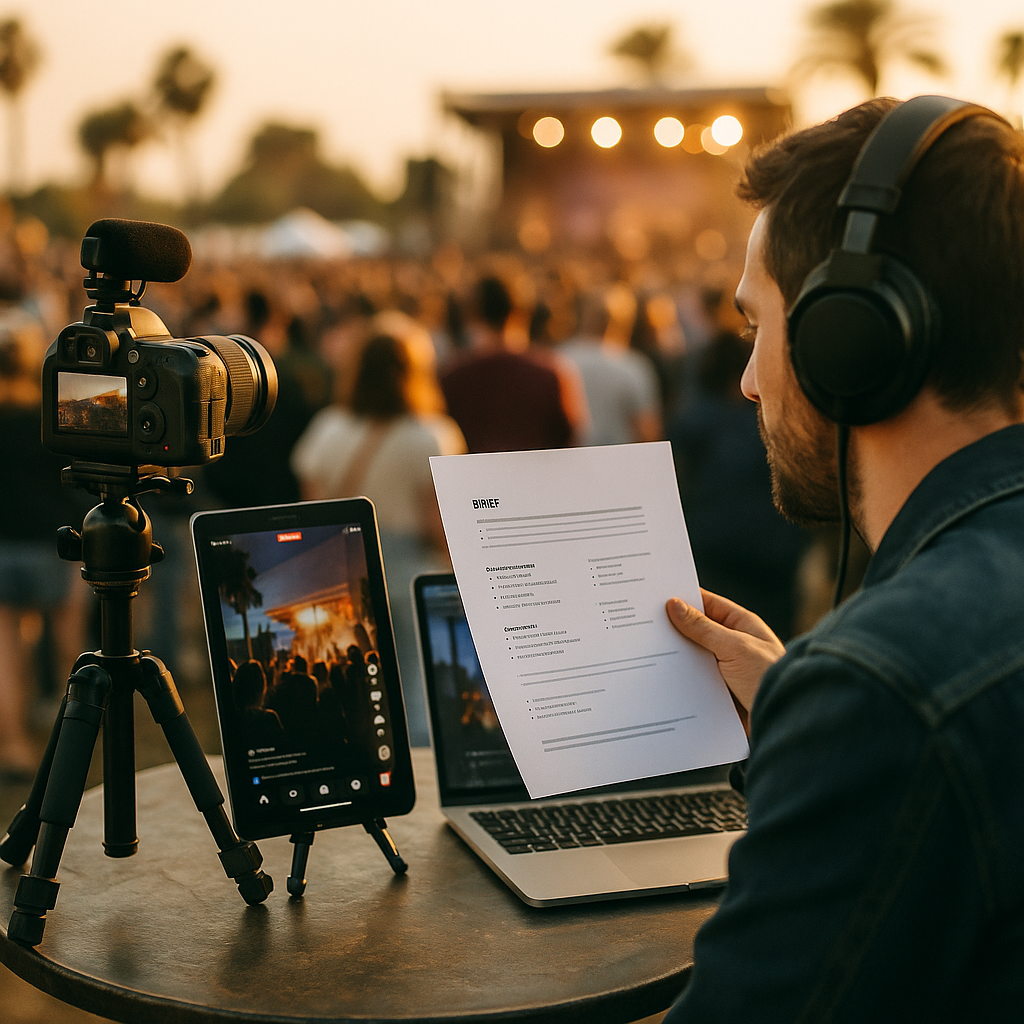
One Brief. Three Platforms. Zero Wasted Hours.
During the last FIFA World Cup cycle, brands running separate creative sessions for each platform burned an estimated 40% of their live-event budget before a single frame went live. That is the problem a cross-platform creator brief for real-time cultural moments is designed to solve — not by dumbing down the creative, but by engineering the production direction so one shoot feeds every channel simultaneously.
Why Live Events Break Standard Briefing Models
A standard creator brief assumes time. Time to revise, to test, to iterate. Live cultural moments — World Cup knockout rounds, Grammy night, the Oscars — give you none of that. The cultural window is measured in hours, sometimes minutes. A creator who has to re-shoot for TikTok after delivering an Instagram cut is already late.
The other failure mode is platform myopia. Brands brief for their primary channel and treat everything else as an afterthought. The result: vertical video that looks cropped on Discord embeds, captions written for TikTok’s auto-scroll that read as incoherent fragments in Meta’s Search Hub interface, and community posts that lack the context Discord members actually need to engage.
Real-time cultural content requires a brief architecture that treats all three destinations as first-class citizens from the first line of production direction.
The Three-Layer Brief Structure
Think of the cross-platform live-event brief in three layers: the cultural anchor, the modular asset plan, and the platform-specific delivery specs. Each layer serves a different function, and each one has to be written before the event starts — not assembled in Slack at halftime.
Layer 1: The Cultural Anchor. This is the single creative idea that holds across all platforms. It answers: what is the brand’s point of view on this moment? Not a tagline. A genuine editorial stance. For a sportswear brand during the World Cup, it might be “underdogs change the game” — a frame that works whether the creator is doing a 15-second reaction on TikTok, a deeper breakdown in a Meta Search Hub post, or a live text thread in a Discord channel.
Layer 2: The Modular Asset Plan. Creators should know before the event which specific footage moments they need to capture. A cross-platform brief lists these as “asset modules”: a raw reaction clip (no cuts, no captions, 10-20 seconds), a structured take (talking head with three clear beats, 30-45 seconds), and a text-native commentary unit (written in the creator’s voice, no video required). Each module serves a different platform without requiring a separate creative concept.
Layer 3: Platform Delivery Specs. This is where most briefs either over-engineer or collapse entirely. Keep it operational. For each destination, the brief should specify aspect ratio, caption treatment, mention format, and one behavioral signal the algorithm rewards. For TikTok’s FYP, that means a hard hook within the first two seconds and native caption style. For Meta’s Search Hubs, it means keyword-rich descriptive text and a searchable title frame. For Discord, it means the creator posts the text-native commentary unit directly into the designated channel with a pinned context thread — not a link to their Instagram.
The brief is not a channel-by-channel instruction manual. It is a decision framework that lets a creator make the right call in the moment without calling their brand contact at 11pm during a penalty shootout.
Writing Production Direction for Simultaneous Capture
The phrase “simultaneous capture” is doing a lot of work here. What it means in practice: the creator sets up their environment once and captures footage that is genuinely usable across formats, without reshooting. That requires specific production direction in the brief.
Brief the creator to shoot in 9:16 with a safe zone for 1:1 crop. This is non-negotiable for a live-event environment where the creator is working alone or with minimal crew. Give explicit safe-zone measurements — not a vague “leave headroom.” Specify that the creator’s face and any on-screen product should sit between 15% and 85% of the vertical frame, which preserves composition across both TikTok’s full-screen and Meta’s square crop. If you need deeper guidance on format specs, the principles in our vertical video specs for one production run apply directly here.
Brief the creator to capture clean audio separately from reaction audio. Live event environments are noisy. A 10-second clean-audio voiceover recorded immediately after a key moment — same energy, same outfit, quiet corner — gives you usable audio for Meta Search Hub videos where auto-captions are less forgiving of ambient noise.
Brief the creator to log timestamps in real time. A simple note in their phone (“goal reaction — 67min mark”) makes post-event clipping take 20 minutes instead of two hours. Build this into the brief explicitly. Creators who have not been briefed on this will not do it.
Platform-Specific Direction: What Changes and What Doesn’t
The cultural anchor does not change. The modular assets do not change. What changes is framing, caption strategy, and community engagement behavior.
TikTok FYP: The raw reaction clip goes here, minimally edited, with a hook text overlay added in CapCut or natively in TikTok. The creator’s caption should use conversational language and two to three relevant hashtags — not a wall of tags. The brief should specify the hook format explicitly. For live sports, “I cannot believe what just happened” outperforms analytical framing in the first three seconds. See our breakdown of hook structures for TikTok FYP for the specific patterns that drive completion rate during high-volume event periods.
Meta Search Hubs: This destination rewards structure and searchability. The creator posts the structured take (the 30-45 second talking head) with a descriptive title frame and a written caption that reads like a short editorial — not a reaction. Include the event name, team names, and any culturally specific terms a fan might search. Meta’s search behavior during live events spikes significantly as viewers look for takes, highlights, and analysis. Our Meta World Cup Search Hub playbook covers the UGC amplification mechanics in detail.
Discord Community Channels: This is where brands consistently under-brief creators. Discord is not a video platform. It is a conversation platform. The text-native commentary unit — 150 to 300 words written in the creator’s authentic voice — drops into the designated brand or community server channel with a brief context note. Brief the creator to reply to at least five community responses within 60 minutes of posting. That engagement behavior is what makes Discord community content valuable; without it, the post is just a link dump.
The Compliance and Rights Layer Nobody Writes Into the Brief
Live events carry specific rights restrictions that standard evergreen content does not. FIFA, the Academy of Motion Picture Arts and Sciences, and major music award bodies all have explicit restrictions on broadcast footage used in sponsored content. The brief must specify what the creator can and cannot show: arena atmospherics are generally permitted, direct broadcast footage is not. Creators caught embedding protected footage in sponsored posts create liability for the brand, not just themselves.
Add a single compliance block at the end of the brief. Keep it short. Three bullet points: what footage is cleared, what requires clearance, and what is prohibited. Include a direct contact (not just “check with legal”) for real-time questions during the event. The FTC’s endorsement guidelines also require clear disclosure on all paid posts, including live-event reaction content — #ad or #sponsored must appear in each platform post regardless of format.
Briefing Velocity: Getting the Document Into the Creator’s Hands
A cross-platform live-event brief that arrives 48 hours before the event is functionally useless. Creators need time to internalize the cultural anchor, source their setup materials, and plan their capture logistics. The operational standard should be seven days out for the full brief, with a one-page “game day cheat sheet” delivered 24 hours before the event starts. The cheat sheet covers: the three asset modules, per-platform post timing targets, the compliance block, and the emergency contact. Nothing else.
Brevity at game time is a feature, not a shortcut. A creator who can execute from a single page under live-event pressure is worth more to a brand than one who needs a 20-slide deck to find their hook.
For teams managing multiple creators across a single event, a shared Notion or Airtable workspace with pre-built post templates for each platform cuts per-creator delivery time significantly. Pair that with the shoot-once repurposing framework and you have an operational model that scales to a roster without scaling the brief-writing workload. Platforms like Sprout Social also offer scheduling infrastructure that supports multi-platform simultaneous publishing, which is worth building into your post-event workflow.
The cross-platform brief for real-time cultural moments is ultimately a risk management document as much as a creative one. It removes ambiguity at the moment creators can least afford to seek clarification, and it ensures that the production effort of one event generates channel-native content for three destinations without a single additional creative session. Write the brief before the opening whistle. Everything after that should be execution.
Frequently Asked Questions
How is a cross-platform live-event creator brief different from a standard creator brief?
A standard creator brief assumes a sequential workflow where the creator can revise and reformat content after the initial shoot. A live-event brief is built for simultaneous capture and deployment across multiple platforms within a narrow time window. It front-loads all platform-specific direction, asset module definitions, and compliance requirements so the creator can execute independently during the event without needing additional brand input.
How far in advance should a live-event creator brief be delivered?
The full brief should be delivered at least seven days before the event to give creators time to prepare their environment, equipment, and production logistics. A condensed one-page cheat sheet should follow 24 hours before the event, covering only the essential execution details: asset modules, platform post timing, compliance notes, and an emergency contact.
Can one creator realistically produce content for Meta Search Hubs, TikTok, and Discord simultaneously during a live event?
Yes, when the brief is structured around modular asset capture rather than platform-specific shoots. A single 9:16 recording session with a clean-audio voiceover and real-time timestamp logging produces the raw material for all three platforms. The differentiation happens in post — minimal editing for TikTok, structured framing for Meta Search Hubs, and text-native commentary for Discord — which can each be completed in under 30 minutes per platform.
What are the biggest compliance risks in live-event creator content?
The primary risks are unauthorized use of broadcast footage and failure to disclose paid partnerships. Major sports and entertainment events carry strict footage rights restrictions that prohibit direct broadcast clips in sponsored content. All paid posts must include FTC-compliant disclosure language such as #ad or #sponsored, regardless of platform or content format. Brands should include a clear compliance block in the brief specifying exactly what footage is cleared for use and what is prohibited.
How should Discord-specific content differ from TikTok or Meta content in the brief?
Discord is a conversation platform, not a video feed. The brief should direct creators to produce a text-native commentary unit of 150 to 300 words for Discord, written in their authentic voice, and to engage with community replies within 60 minutes of posting. Video links can supplement the text post but should not replace it. This approach matches Discord’s community behavior patterns and drives the kind of sustained engagement that makes the channel valuable for brands.
Top Influencer Marketing Agencies
The leading agencies shaping influencer marketing in 2026
Agencies ranked by campaign performance, client diversity, platform expertise, proven ROI, industry recognition, and client satisfaction. Assessed through verified case studies, reviews, and industry consultations.
Moburst

-
2

The Shelf
Boutique Beauty & Lifestyle Influencer AgencyA data-driven boutique agency specializing exclusively in beauty, wellness, and lifestyle influencer campaigns on Instagram and TikTok. Best for brands already focused on the beauty/personal care space that need curated, aesthetic-driven content.Clients: Pepsi, The Honest Company, Hims, Elf Cosmetics, Pure LeafVisit The Shelf → -
3

Audiencly
Niche Gaming & Esports Influencer AgencyA specialized agency focused exclusively on gaming and esports creators on YouTube, Twitch, and TikTok. Ideal if your campaign is 100% gaming-focused — from game launches to hardware and esports events.Clients: Epic Games, NordVPN, Ubisoft, Wargaming, Tencent GamesVisit Audiencly → -
4

Viral Nation
Global Influencer Marketing & Talent AgencyA dual talent management and marketing agency with proprietary brand safety tools and a global creator network spanning nano-influencers to celebrities across all major platforms.Clients: Meta, Activision Blizzard, Energizer, Aston Martin, WalmartVisit Viral Nation → -
5

The Influencer Marketing Factory
TikTok, Instagram & YouTube CampaignsA full-service agency with strong TikTok expertise, offering end-to-end campaign management from influencer discovery through performance reporting with a focus on platform-native content.Clients: Google, Snapchat, Universal Music, Bumble, YelpVisit TIMF → -
6

NeoReach
Enterprise Analytics & Influencer CampaignsAn enterprise-focused agency combining managed campaigns with a powerful self-service data platform for influencer search, audience analytics, and attribution modeling.Clients: Amazon, Airbnb, Netflix, Honda, The New York TimesVisit NeoReach → -
7

Ubiquitous
Creator-First Marketing PlatformA tech-driven platform combining self-service tools with managed campaign options, emphasizing speed and scalability for brands managing multiple influencer relationships.Clients: Lyft, Disney, Target, American Eagle, NetflixVisit Ubiquitous → -
8

Obviously
Scalable Enterprise Influencer CampaignsA tech-enabled agency built for high-volume campaigns, coordinating hundreds of creators simultaneously with end-to-end logistics, content rights management, and product seeding.Clients: Google, Ulta Beauty, Converse, AmazonVisit Obviously →