


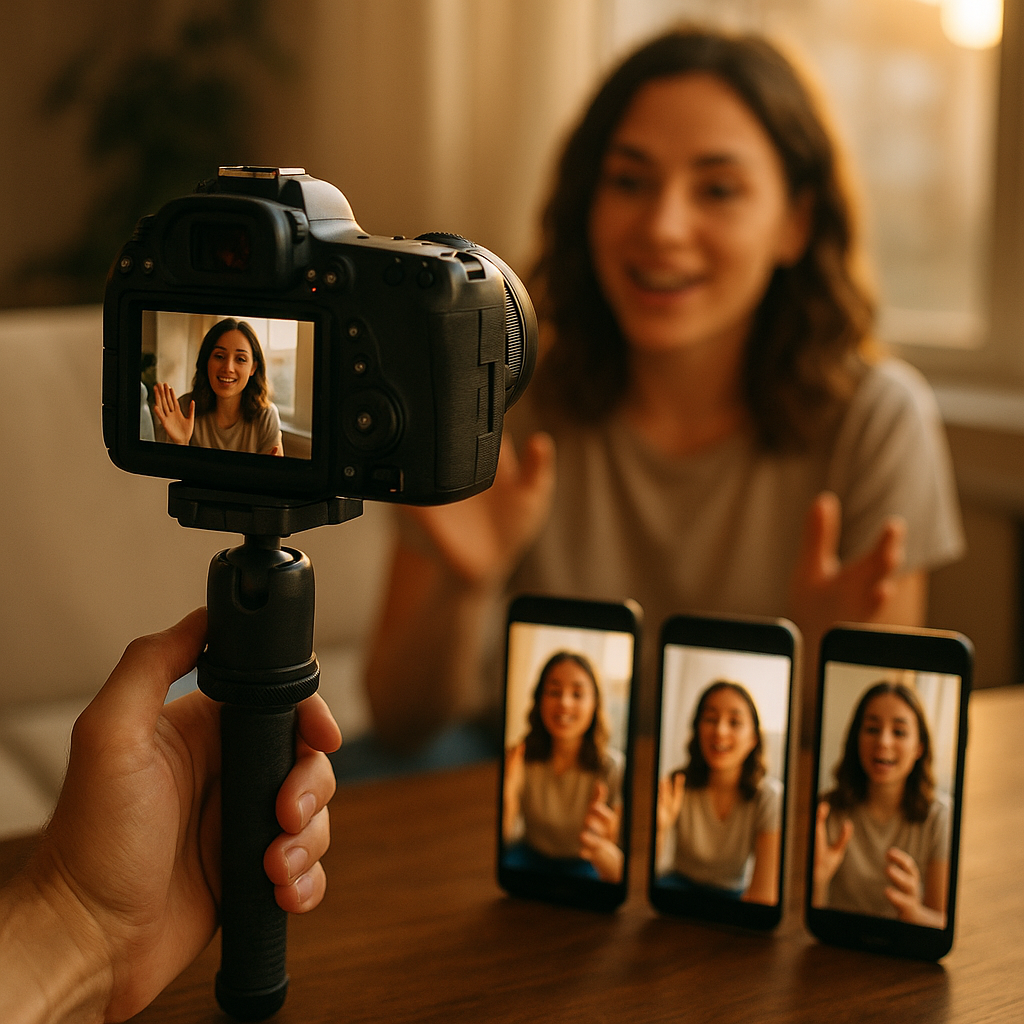
Brands that shoot once and post once are leaving serious money on the table. Research from Sprout Social confirms that multi-platform content strategies drive up to 3x higher engagement than single-channel approaches — yet most influencer productions are still briefed for one destination. Repurposing creator assets across AI-curated platforms is no longer a nice-to-have; it’s a production discipline that separates efficient programs from expensive ones.
Why AI Curation Changes the Repurposing Equation
The old repurposing playbook — shoot a hero video, crop it, repost it — is dead. TikTok’s For You Page algorithm, Instagram’s Reels recommendation engine, YouTube Shorts’ discovery layer, and emerging streaming partner surfaces like Amazon Freevee and Peacock ad slots each run distinct AI curation logic. They reward native-feeling content. They penalize recycled assets that look like they were meant for somewhere else.
This is the core tension brands need to resolve: how do you build a single production that generates genuinely platform-native outputs, not just reformatted versions of the same clip?
The answer isn’t to shoot more. It’s to shoot smarter — designing modular asset libraries at the brief stage, before cameras roll.
When you brief creators for multi-format production from day one, you gain the ability to feed each platform’s algorithm with content that was intentionally designed for it, not grudgingly adapted. That shift happens upstream, in the creative brief, not in post-production.
Designing the Brief for a Modular Shoot
Most production briefs describe a finished video. A modular brief describes a shoot architecture. The distinction matters enormously for repurposing at scale.
A well-designed modular brief will specify:
- Multiple hook variations — at least three distinct opening five seconds, each designed for a different platform context (lean-back streaming, active scroll, search-intent YouTube)
- Aspect ratio coverage — mandatory 9:16 capture for TikTok and Reels, 16:9 or 4:3 coverage for Shorts thumbnails and streaming pre-rolls, and 1:1 capture for Meta feed placements
- Action isolation shots — product interaction, facial reaction, and demonstration moments captured clean, without text overlays, so AI editing tools can remix them freely
- CTA variants — at least two recorded call-to-action segments: one friction-light for social (“tap the link”) and one longer for streaming contexts where brand recall, not immediate click-through, is the objective
- Ambient audio clean tracks — isolated room tone and on-camera dialogue without music, so each platform’s preferred audio environment can be layered in post
This architecture is what enables modular UGC pipelines to function at scale. You’re not editing one video into five. You’re assembling five videos from a shared component library.
Platform-Specific Requirements Your Production Team Must Know
TikTok. The For You Page rewards hooks that create pattern interruption in the first 1.5 seconds. TikTok for Business data consistently shows that videos where the hook contains motion, text pop, or a direct question outperform static openings. Brief your creator to shoot at least three distinct openers. The AI curation system A/B tests organically; your job is to give it options.
Instagram Reels. Meta’s algorithm places significant weight on watch-through rate and reshare velocity. Reels that feel conversational — not produced — tend to win. Your creator should capture a “low-fi” take alongside polished versions. That rough take often outperforms the hero edit. For feed placement compliance, see how to avoid Meta feed suppression with correct format specs.
YouTube Shorts. Shorts operates closer to a search-intent platform than a social scroll. Titles and spoken keywords matter. Brief your creator to verbalize product category terms naturally in dialogue, not just display them as lower-thirds. Google’s guidance on Shorts confirms that transcript-matched search queries improve discovery significantly.
Streaming partner variants. Connected TV ad placements through platforms like Roku, Amazon, and Peacock require 15-second and 30-second formats with broadcast-safe audio levels, no overlaid social UI elements, and in many cases a static end-card. These are fundamentally different from social assets. If you’re not capturing clean, UI-free footage with proper color grading during your shoot, you cannot retrofit these assets affordably in post.
Where AI Editing Agents Fit Into the Workflow
Once your shoot is complete and you have a modular asset library, AI video editing agents become the force multiplier. Tools like Runway, Descript, and OpusClip can ingest raw footage and generate platform-specific edits at a fraction of traditional post-production cost. But they are only as good as the raw material they receive.
This is why the brief stage is non-negotiable. AI tools can recut, reframe, and add captions. They cannot manufacture a clean hook that wasn’t shot, or generate a 9:16 close-up from footage that was only captured wide. Garbage in, garbage out applies at machine speed.
For brands running performance-driven programs, connecting your AI editing layer to your testing framework is where the real compounding begins. AI video testing for hook and CTA variants allows you to systematically identify which modular components outperform across each platform, then brief future shoots around proven creative signals rather than gut instinct.
The Rights and Licensing Layer Most Brands Miss
Repurposing creator assets across additional platforms is not automatically covered by a standard influencer agreement. Most creator contracts specify deliverables by platform, usage period, and format. Deploying a TikTok asset in a streaming pre-roll or a Reels clip in a programmatic display unit typically requires an extended rights clause, and often a usage fee.
Brands building modular shoot productions must negotiate multi-platform rights upfront. This means specifying in the contract: which platforms are covered, whether paid amplification is permitted on each, the usage term, and whether the brand retains the raw footage for AI editing purposes. Failing to do this creates legal exposure when you attempt to repurpose assets months later, especially as FTC disclosure requirements evolve to address AI-generated and AI-edited creator content.
The production efficiency gains from modular shooting disappear fast if you’re retroactively negotiating rights with creators or re-shooting because your license was too narrow.
Measuring Repurposed Asset Performance Correctly
A common mistake: brands evaluate repurposed assets against the same KPIs regardless of platform. Streaming partner variants should be measured on brand recall lift and upper-funnel reach, not click-through rate. TikTok assets should be evaluated on earned reach and comment sentiment alongside conversion data. Reels performance ties more directly to saves and shares than views.
Applying the wrong measurement framework to repurposed content leads to false conclusions about what’s working. Build a platform-specific measurement matrix before your campaign launches, not after. Your performance-linked creator briefs should specify which platform KPIs each asset variant is being optimized for, so there’s no ambiguity when results come in.
Production efficiency is only half the equation. Measurement clarity is what turns repurposed assets into compounding ROI rather than just cheaper content.
For teams managing cross-platform campaigns at scale, eMarketer’s research on connected TV and social video attribution models offers a useful framework for separating platform-level signal from blended campaign noise.
The Operational Playbook
Start with the brief. Map every intended distribution platform before the shoot date. Specify modular components required for each. Negotiate multi-platform rights upfront. Brief your creator on hook variations, aspect ratio requirements, and clean isolation shots. Deploy AI editing agents against a modular asset library, not a single hero export. Test variants systematically. Feed performance data back into future briefs.
For brands running cross-platform creator programs involving TV and streaming, the once-for-TV-and-social briefing model is worth studying as a structural template.
This is how you turn a single creator day-rate into a multi-platform content engine.
Frequently Asked Questions
What does “modular” mean in a creator shoot context?
A modular shoot captures individual content components — hooks, product shots, CTAs, reaction moments — as discrete elements rather than one linear video. These components can be assembled in different sequences and combinations to produce native-feeling outputs for TikTok, Reels, Shorts, streaming, and other platforms from a single production day.
How many platform variants should one creator shoot generate?
A well-briefed single-day shoot can realistically generate five to eight distinct platform variants: at least three social short-form edits (TikTok, Reels, Shorts), one or two streaming pre-roll formats (15-second and 30-second), and one Meta feed placement. AI editing tools can expand this further once the modular asset library is built.
Do I need separate contracts for each platform if I’m repurposing creator content?
Not necessarily separate contracts, but your primary agreement must include explicit multi-platform usage rights. Specify each platform by name, the usage period, whether paid amplification is permitted, and whether the brand retains raw footage rights for AI-assisted editing. Ambiguous contracts create costly retroactive negotiations.
Will AI-curated algorithms penalize repurposed content?
They will if the content looks like a repost rather than a native asset. Algorithms on TikTok, Instagram, and YouTube Shorts detect reused content signatures including embedded watermarks, cropped aspect ratios, and recycled audio fingerprints. Modular production avoids this by generating genuinely platform-native edits from shared raw components, rather than re-exporting a finished video.
What’s the biggest mistake brands make when repurposing creator assets?
Treating repurposing as a post-production problem rather than a pre-production decision. If the shoot isn’t briefed for modular output, the raw footage won’t support it. The most expensive repurposing workflow is trying to retrofit a single-destination video into multi-platform assets after the shoot has wrapped.
Top Influencer Marketing Agencies
The leading agencies shaping influencer marketing in 2026
Agencies ranked by campaign performance, client diversity, platform expertise, proven ROI, industry recognition, and client satisfaction. Assessed through verified case studies, reviews, and industry consultations.
Moburst

-
2

The Shelf
Boutique Beauty & Lifestyle Influencer AgencyA data-driven boutique agency specializing exclusively in beauty, wellness, and lifestyle influencer campaigns on Instagram and TikTok. Best for brands already focused on the beauty/personal care space that need curated, aesthetic-driven content.Clients: Pepsi, The Honest Company, Hims, Elf Cosmetics, Pure LeafVisit The Shelf → -
3

Audiencly
Niche Gaming & Esports Influencer AgencyA specialized agency focused exclusively on gaming and esports creators on YouTube, Twitch, and TikTok. Ideal if your campaign is 100% gaming-focused — from game launches to hardware and esports events.Clients: Epic Games, NordVPN, Ubisoft, Wargaming, Tencent GamesVisit Audiencly → -
4

Viral Nation
Global Influencer Marketing & Talent AgencyA dual talent management and marketing agency with proprietary brand safety tools and a global creator network spanning nano-influencers to celebrities across all major platforms.Clients: Meta, Activision Blizzard, Energizer, Aston Martin, WalmartVisit Viral Nation → -
5

The Influencer Marketing Factory
TikTok, Instagram & YouTube CampaignsA full-service agency with strong TikTok expertise, offering end-to-end campaign management from influencer discovery through performance reporting with a focus on platform-native content.Clients: Google, Snapchat, Universal Music, Bumble, YelpVisit TIMF → -
6

NeoReach
Enterprise Analytics & Influencer CampaignsAn enterprise-focused agency combining managed campaigns with a powerful self-service data platform for influencer search, audience analytics, and attribution modeling.Clients: Amazon, Airbnb, Netflix, Honda, The New York TimesVisit NeoReach → -
7

Ubiquitous
Creator-First Marketing PlatformA tech-driven platform combining self-service tools with managed campaign options, emphasizing speed and scalability for brands managing multiple influencer relationships.Clients: Lyft, Disney, Target, American Eagle, NetflixVisit Ubiquitous → -
8

Obviously
Scalable Enterprise Influencer CampaignsA tech-enabled agency built for high-volume campaigns, coordinating hundreds of creators simultaneously with end-to-end logistics, content rights management, and product seeding.Clients: Google, Ulta Beauty, Converse, AmazonVisit Obviously →