


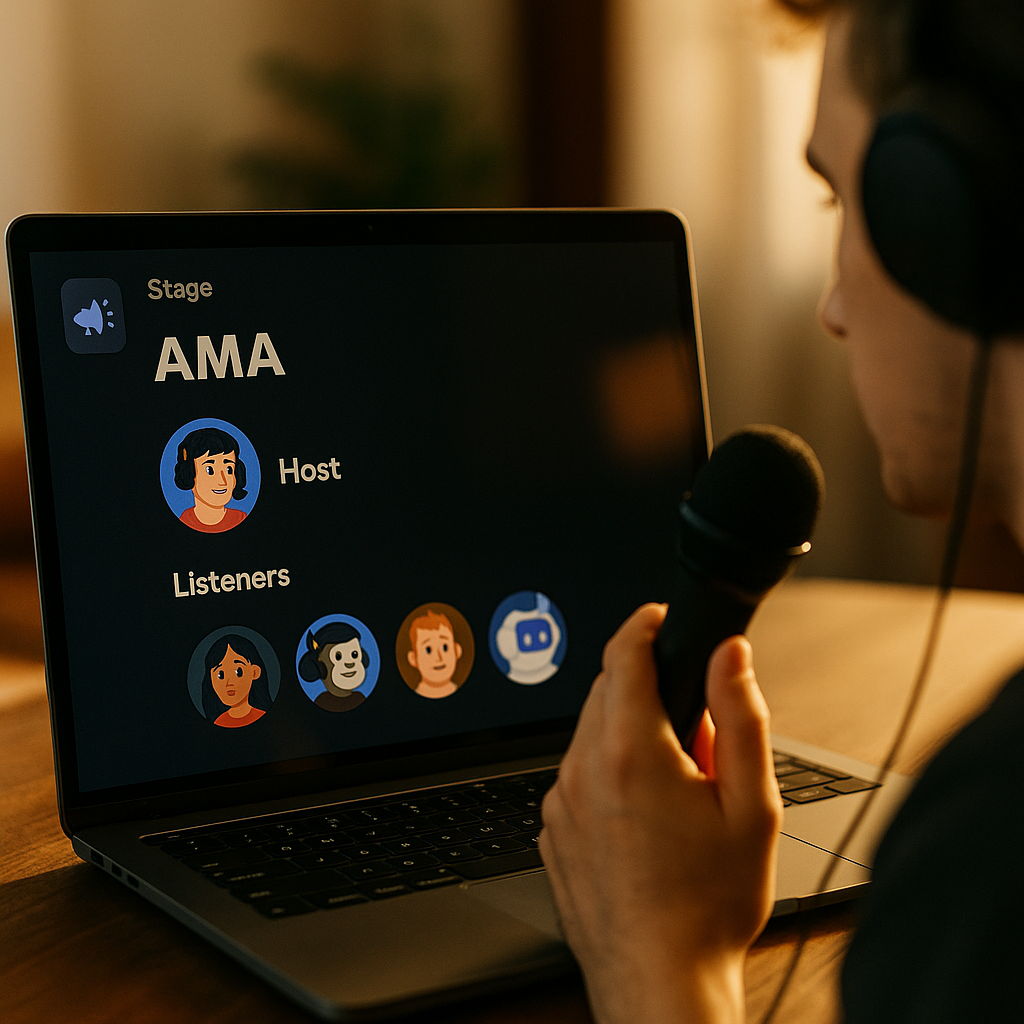
Discord’s own data shows over 150 million people use the platform monthly, and most of them can smell a marketing pitch before it finishes loading. Run a Discord Stage Channel AMA like a webinar and you’ll get a silent room, a dead chat, and a screenshot circulating on Reddit by morning. Run it like a community member who happens to work for a brand, and you get something rarer: attention that wasn’t paid for.
This is the operational gap most brands miss. A Stage Channel isn’t a livestream tool. It’s a stage inside someone else’s living room, and you were invited in on the condition you behave like a guest.
Why Discord AMAs Fail Before They Start
Most brand-led AMAs collapse for one reason: they’re built by teams who think of Discord as “Zoom with emojis.” It’s not. Discord servers are governed by norms that predate any brand’s involvement — inside jokes, mod hierarchies, unwritten pacing rules for how fast a channel should move. Walk in with a corporate deck mentality and the community clocks it in seconds.
The second failure point is logistics. Stage Channels have a strict structure: Speakers, Moderators, and Audience. If your team doesn’t understand how to promote someone from audience to speaker mid-session, or how to hand off the mic without dead air, the AMA feels amateurish fast. Compare that to the polish expected on structured live broadcasts on other platforms — Discord’s bar is different, but it’s not lower. It’s a bar for authenticity, not production value.
A Discord AMA succeeds or fails based on whether the community believes the brand rep would still be in the server if the marketing budget disappeared tomorrow.
Pick the Right Server, Not Just the Right Community
Brands often assume “gaming community” is a monolith. It isn’t. A 40,000-member server built around a competitive shooter has completely different pacing expectations than a 3,000-member hobbyist server for tabletop miniature painting. The first wants speed, banter, and zero fluff. The second wants depth, craft talk, and patience.
Before locking a Stage Channel date, audit three things:
- Mod culture — do mods actively police off-topic promo, or is the server loosely run?
- Existing AMA history — has this server hosted brand AMAs before, and how did they land? Check pinned messages and #feedback channels.
- Peak activity windows — Discord servers have activity patterns tied to time zone concentration and game release cycles, not generic “best time to post” data.
This is where a lot of brand social teams stumble: they apply the same scheduling logic they’d use for Instagram or TikTok. Discord doesn’t reward the algorithm-friendly windows other platforms do — it rewards showing up when the community is already there, not when your analytics dashboard says engagement peaks. If you’re used to timing drops around urgency-driven release windows, unlearn that instinct here. Discord punishes urgency and rewards presence.
Co-Host With a Server-Native Voice
Never send a brand rep into a Stage Channel alone unless that rep has a genuine history in the space. The safer, more effective structure: pair your subject-matter expert with a creator or mod who already has standing in that server. Think of it as a translator role — someone who can rephrase a brand talking point into server dialect in real time.
This mirrors what’s already working in gaming-focused creator operations, where local trust brokers outperform centrally-scripted brand voices every time. The creator doesn’t need to be a mega-influencer. A respected mid-tier community figure with 8,000 followers and three years of server history will outperform a 500K-follower creator who’s never posted in that Discord before.
Structuring the Stage: A Working Runsheet
Here’s a format that’s held up across multiple gaming and hobbyist AMAs, adaptable by community size:
- Pre-show float (10-15 min): Open the Stage early, let people trickle in, play light music or just chat casually as Speakers. Never start cold at the scheduled time — Discord audiences arrive in waves.
- Soft open (5 min): Community co-host introduces the brand guest informally. No script-reading. Should sound like introducing a friend, not a keynote speaker.
- Structured Q&A (25-35 min): Pull questions from a pinned thread submitted beforehand, mixed with live hand-raises. Pre-submitted questions prevent dead air; live questions keep it feeling real.
- Unscripted tangent window (10 min): Deliberately leave room for off-topic community banter. This is counterintuitive for brand teams trained to stay on message, but it’s the section that builds the most goodwill.
- Close with a concrete give (5-10 min): Codes, early access, a giveaway, or a direct promise (“we’re fixing X based on tonight’s feedback”). Vague thank-yous kill momentum; specific follow-through builds it.
Total runtime: 60-75 minutes. Longer AMAs in gaming servers tend to bleed engagement after the 80-minute mark, based on patterns across community Discord events tracked informally by server mod teams and event organizers.
The Moderation Layer Nobody Budgets For
Brands allocate budget for the speaker, the creator co-host, sometimes even a production assistant. They almost never budget for a dedicated moderation lead inside the text chat running alongside the Stage.
This is a mistake. The text channel underneath a Stage is where the real sentiment lives — it’s where trolls test boundaries, where genuine fans post reaction GIFs, and where questions pile up faster than the Speaker can address them. Without a moderator actively curating that chat (flagging good questions to promote, muting bad-faith actors, keeping pace with the room), the Stage speaker is flying blind.
Assign one person whose only job during the AMA is chat triage. This person feeds the speaker questions via a private channel or a quiet hand signal system agreed on beforehand. It sounds basic. Most brands skip it anyway, and it shows.
The text chat is the real-time focus group running underneath your AMA. Ignore it and you’ll miss the sentiment shift happening in front of you.
Compliance and Disclosure Still Apply Here
Just because Discord feels informal doesn’t mean disclosure obligations disappear. If a brand is compensating a creator co-host, paying for server sponsorship, or providing product for giveaways, FTC endorsement guidelines still apply — even in voice-based, ephemeral formats like Stage Channels. The FTC’s endorsement guidance doesn’t carve out an exception for voice chat.
Practically, this means:
- The co-host should verbally disclose the paid relationship at the top of the session, not bury it in a pinned message nobody reads.
- Giveaway rules should be posted in a linked text channel with clear eligibility terms.
- If the AMA is recorded and later republished as marketing content, treat the recording with the same disclosure rigor as a scripted ad — because your legal team will, eventually, ask.
Brands operating in the UK should also cross-check server activity against ICO guidance if any data collection (email capture for a giveaway, for instance) happens during or after the event. This is the same diligence increasingly required around livestream compliance rules on commerce platforms — the format changes, the regulatory logic doesn’t.
Measuring an AMA When There’s No “Buy Now” Button
Discord Stage Channels don’t have native purchase attribution. No shoppable overlay, no checkout flow. So how do you prove ROI to a CFO who thinks in conversion rate?
Reframe the metrics conversation before the event, not after. The measurable signals that actually matter:
- Peak concurrent listeners vs. server’s average active member count (a ratio above 15-20% is strong for most gaming servers).
- Post-AMA server growth in the 48 hours following, if the server is public-facing.
- Sentiment in the text chat, reviewed manually or via export — this is qualitative gold that a dashboard won’t capture.
- Follow-through rate on the closing give (code redemption, sign-up link clicks, whatever the CTA was).
- Recording replay counts if the Stage was recorded and shared to owned channels afterward.
None of this replaces hard commerce data, but it’s directionally similar to how brands justify spend on other live-format investments where the value is trust-building rather than immediate transaction. According to eMarketer, community-based engagement increasingly factors into brand lift measurement even when direct attribution is thin. Frame the AMA as a trust and retention play, not a direct-response channel, and the ROI conversation gets easier.
What Hobbyist Communities Specifically Expect
Gaming servers and hobbyist servers (think: cardmakers, model builders, home-brewing, vintage synths) share Discord’s technical shell but differ sharply in tone expectations.
Hobbyist communities tend to reward:
- Craft-level specificity. Vague brand talking points get called out fast. If your speaker can’t answer a technical question about materials, sourcing, or process, don’t send them.
- Slower pacing. These communities often skew older and more patient than gaming servers. Rushing the Q&A reads as dismissive.
- Long memory. Hobbyist server members often remember brand interactions from years back. One bad AMA can shadow every future attempt.
The takeaway: don’t run a one-size-fits-all AMA template across a gaming server and a hobbyist server. The structure can stay similar, but tone, pacing, and speaker selection need separate playbooks entirely.
Next Step
Before booking your next Stage Channel, spend two weeks lurking in the target server as a listener, not a marketer. Read the pinned rules, watch how mods handle conflict, and note which brand mentions got a warm reception versus which got muted. That reconnaissance will do more for your AMA’s success than any script you write.
FAQs
What is a Discord Stage Channel, and how does it differ from a regular voice channel?
A Stage Channel is a structured audio format on Discord that separates participants into Speakers, Moderators, and Audience roles, similar to a panel discussion. Unlike a regular voice channel where anyone can talk freely, Stage Channels require explicit promotion to speak, making them better suited for hosted events like brand AMAs.
How do I get permission to host a brand AMA in a community-run Discord server?
Reach out directly to server admins or mods well in advance, ideally through an existing relationship or a respected creator who can make an introduction. Most well-run servers have specific rules about promotional content, and skipping that approval process is the fastest way to get banned before you start.
Should the AMA be recorded and reused as marketing content?
Yes, but disclose that intent to the community beforehand. Recording without notice erodes trust quickly, while transparent recording (with consent from participants who ask questions) lets you repurpose the content for owned channels without damaging server relationships.
How many people need to run a Discord AMA properly?
At minimum three: the brand speaker, a community-native co-host, and a dedicated chat moderator. Larger events may add a producer to manage speaker queues and timing, but cutting below three roles usually results in a chaotic or under-moderated session.
What’s a realistic attendance benchmark for a Discord Stage AMA?
It depends heavily on server size, but a strong turnout is typically 15-20% of the server’s average active member count showing up as concurrent listeners. Raw numbers matter less than the ratio relative to the community’s normal activity level.
Top Influencer Marketing Agencies
The leading agencies shaping influencer marketing in 2026
Agencies ranked by campaign performance, client diversity, platform expertise, proven ROI, industry recognition, and client satisfaction. Assessed through verified case studies, reviews, and industry consultations.
Moburst

-
2

The Shelf
Boutique Beauty & Lifestyle Influencer AgencyA data-driven boutique agency specializing exclusively in beauty, wellness, and lifestyle influencer campaigns on Instagram and TikTok. Best for brands already focused on the beauty/personal care space that need curated, aesthetic-driven content.Clients: Pepsi, The Honest Company, Hims, Elf Cosmetics, Pure LeafVisit The Shelf → -
3

Audiencly
Niche Gaming & Esports Influencer AgencyA specialized agency focused exclusively on gaming and esports creators on YouTube, Twitch, and TikTok. Ideal if your campaign is 100% gaming-focused — from game launches to hardware and esports events.Clients: Epic Games, NordVPN, Ubisoft, Wargaming, Tencent GamesVisit Audiencly → -
4

Viral Nation
Global Influencer Marketing & Talent AgencyA dual talent management and marketing agency with proprietary brand safety tools and a global creator network spanning nano-influencers to celebrities across all major platforms.Clients: Meta, Activision Blizzard, Energizer, Aston Martin, WalmartVisit Viral Nation → -
5

The Influencer Marketing Factory
TikTok, Instagram & YouTube CampaignsA full-service agency with strong TikTok expertise, offering end-to-end campaign management from influencer discovery through performance reporting with a focus on platform-native content.Clients: Google, Snapchat, Universal Music, Bumble, YelpVisit TIMF → -
6

NeoReach
Enterprise Analytics & Influencer CampaignsAn enterprise-focused agency combining managed campaigns with a powerful self-service data platform for influencer search, audience analytics, and attribution modeling.Clients: Amazon, Airbnb, Netflix, Honda, The New York TimesVisit NeoReach → -
7

Ubiquitous
Creator-First Marketing PlatformA tech-driven platform combining self-service tools with managed campaign options, emphasizing speed and scalability for brands managing multiple influencer relationships.Clients: Lyft, Disney, Target, American Eagle, NetflixVisit Ubiquitous → -
8

Obviously
Scalable Enterprise Influencer CampaignsA tech-enabled agency built for high-volume campaigns, coordinating hundreds of creators simultaneously with end-to-end logistics, content rights management, and product seeding.Clients: Google, Ulta Beauty, Converse, AmazonVisit Obviously →