


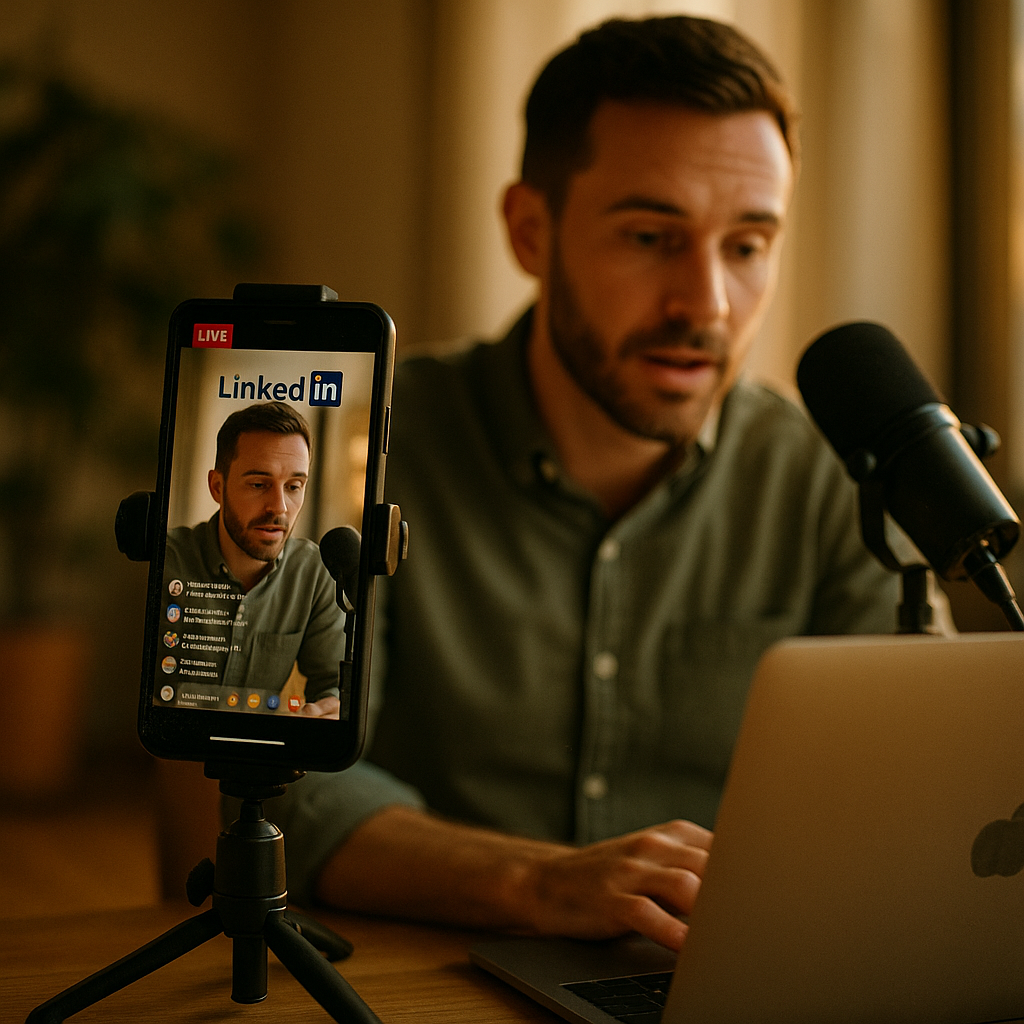
LinkedIn now pushes live video up to 24 times more than static posts in some feed tests. If your B2B software brand is still treating LinkedIn Live as an occasional webinar rebroadcast, you’re leaving reach on the table. The LinkedIn Live-Video playbook that wins now isn’t about going live more often. It’s about structuring broadcasts the algorithm is specifically built to reward.
LinkedIn’s feed weighting has shifted hard toward content that keeps people on the platform longer, and live video does that better than almost anything else in the format mix. But most B2B marketers are still running live sessions like it’s a Zoom webinar with a LinkedIn logo slapped on top. That approach worked in 2021. It doesn’t work now.
Why LinkedIn Is Betting on Live Video
LinkedIn has spent the past two years reorienting its feed algorithm around dwell time and “knowledge and advice” content, a category the platform explicitly says it prioritizes. Live video checks both boxes. It’s inherently longer-form, it signals real-time expertise, and it generates comment threads that keep the post surfacing in feeds for hours, sometimes days, after the broadcast ends.
We covered the mechanics of this shift in detail in our piece on the LinkedIn algorithm shift toward niche content and live video, but the short version is this: LinkedIn’s ranking model now treats live broadcasts as a distinct content type with its own distribution curve, separate from standard video posts. That curve rewards sustained engagement over viral spikes, which is exactly the kind of signal a well-run product demo or analyst Q&A can generate.
LinkedIn’s own data suggests live videos generate roughly seven times more reactions and 24 times more comments than native video posts. For B2B brands starved of organic reach, that’s not a marginal gain, it’s a different growth channel entirely.
The Feed Weighting Nobody’s Talking About
Here’s the part most playbooks skip: LinkedIn’s 2026 weighting model isn’t just rewarding “live” as a format. It’s rewarding specificity. Broadcasts tied to a narrow professional niche, a specific job function, a specific vertical problem, get boosted into more relevant feeds than generic “state of the industry” streams. This is an extension of the same logic LinkedIn applied to written posts, which we broke down in our piece on rebuilding B2B creator briefs for the feed shift.
Translation for software brands: a broadcast titled “How Fintech Compliance Teams Are Automating SOC 2 Evidence Collection” will outperform “Product Update: Q1 Release” nearly every time, even with a smaller invite list. Niche beats broad. Every time.
What “Industry-Specific” Actually Means in Practice
Don’t confuse industry-specific with narrow-audience. A well-structured vertical broadcast can still pull thousands of views if it’s built around a problem that a defined buyer persona actually loses sleep over. Think:
- Healthcare IT directors navigating HIPAA-compliant AI deployment
- Revenue operations leads reconciling CRM data across M&A integrations
- DevOps managers debugging Kubernetes cost overruns at scale
Each of these is narrow enough to trigger LinkedIn’s relevance-matching for niche professional cohorts, but broad enough within that cohort to fill a 45-minute session with real substance.
Structuring the Broadcast: A Four-Part Framework
Most B2B live videos fail not because of bad topics but because of bad pacing. LinkedIn’s audience skims. They tab in and out. A broadcast structured like a keynote speech loses them by minute six. Here’s the structure we’ve seen consistently outperform on the platform.
1. The Cold Open (0–90 seconds)
Skip the “thanks for joining, let me pull up my slides” preamble. State the problem, name the stakes, and tell viewers exactly what they’ll walk away with. LinkedIn’s algorithm weighs early watch-through rate heavily, similar to how YouTube’s hook architecture works for retention, and a slow open kills your distribution before the session even gets going.
2. The Framework Segment (Minutes 2–15)
This is where you deliver the core teaching point, ideally a named framework, model, or process the audience can screenshot and reuse. Software brands have an advantage here: product data. Pull anonymized usage patterns, benchmark numbers, or workflow breakdowns that only your platform could surface. Generic advice doesn’t hold attention. Proprietary insight does.
3. The Live Demo or Case Walkthrough (Minutes 15–30)
This is your commercial payload, but it shouldn’t feel like a sales pitch. Walk through a real customer workflow, screen-share the actual product, and narrate decisions the way you’d explain them to a colleague, not a prospect. Comments during this segment are gold: LinkedIn’s live comment velocity is one of the strongest signals feeding the feed weighting algorithm right now.
4. The Open Floor (Minutes 30–45)
Live Q&A isn’t filler, it’s the engagement engine. Every comment, reaction, and question extends your dwell time and comment count, both of which LinkedIn’s ranking model treats as high-value signals long after the stream ends. Have a moderator seeding questions in the first five minutes if the chat is slow to start. Dead air kills momentum, and momentum is what gets rewarded.
Cadence Matters More Than Production Value
A common misconception: LinkedIn rewards polish. It doesn’t, particularly. It rewards consistency and topical authority built over time. A monthly series tied to a recognizable name, “The RevOps Realignment,” “Compliance Corner,” whatever framing fits your category, builds a subscriber-like following that shows up live and drives the comment velocity that fuels distribution.
This mirrors what we’ve seen play out across other platforms, where format consistency outperforms one-off production quality. Our analysis of TikTok’s watch-time feed rebuild found nearly identical logic: platforms reward creators (and brands) who train the algorithm on a repeatable format rather than chasing one viral swing.
Aim for a predictable slot, same day, same time, ideally tied to a recurring theme your target buyer already associates with a pain point. B2B buying committees are creatures of habit. Give them a reason to block the calendar.
Who Should Be On Camera?
This is where a lot of software brands get it wrong. Putting your CMO on every broadcast might satisfy internal politics, but it rarely satisfies the algorithm or the audience. LinkedIn’s live weighting favors accounts with established topical credibility, which increasingly means subject-matter experts and named creators rather than executive talking heads.
Consider a rotating format: a product manager for technical deep dives, a customer success lead for workflow walkthroughs, an external analyst or customer champion for credibility broadcasts. This is essentially the same operating model brands have adopted through the LinkedIn Creator Marketplace, where matching the right voice to the right format matters more than seniority.
And if you’re bringing in outside voices, brief them properly. Our guide on building B2B trust before the sale covers how to structure creator briefs that keep third-party speakers on-message without sounding scripted, which matters even more in a live, unscripted format where there’s no editing safety net.
Compliance and Risk: Don’t Skip This Part
Live video removes your usual editing buffer, which means legal and compliance review has to happen before the stream, not after. Software brands operating in regulated verticals, fintech, healthtech, adtech, need pre-approved talking points for any claims made on camera, especially around data handling, security certifications, or competitive comparisons.
Build a one-page “guardrails doc” for every host: approved claims, banned comparisons, and an escalation path if a viewer asks something legally sensitive in the comments. This isn’t paranoia. It’s the same operational discipline brands are being forced to adopt around FTC disclosure guidance for any promotional or comparative claims made in real time, live or not.
Measuring What Actually Matters
Vanity metrics lie. Peak concurrent viewers feels good in a screenshot but tells you almost nothing about pipeline impact. Track instead:
- Comment-to-viewer ratio — the strongest proxy for the engagement signal LinkedIn’s algorithm weighs most heavily
- Post-broadcast replay watch time — LinkedIn continues distributing the recorded version for days, sometimes weeks
- Follow-through registration for gated replays — a genuine intent signal for sales handoff
- Attendee-to-opportunity conversion tracked in your CRM, not just LinkedIn’s native analytics
Tools like HubSpot or your existing marketing automation platform should be tagging live attendees distinctly from webinar or gated-content leads, since behaviorally they tend to convert differently. According to eMarketer research on B2B video consumption, live-format viewers show measurably higher intent signals than on-demand viewers within the same buying committee, which is worth factoring into your lead scoring model.
What This Means for Budget Allocation
If you’re still allocating live video as a subset of your webinar budget, rethink the line item. Live broadcasts under this framework function more like an always-on content series than a one-off event, and they should be resourced accordingly: a dedicated producer, a rotating cast of hosts, and a recurring production slot on the calendar. According to Statista, B2B marketers report video as one of the highest-ROI content formats they produce, yet most still under-resource it relative to written content and paid social.
Compare this to how brands have had to rethink budget splits between short and long-form video on other platforms, a tension we explored in our YouTube Shorts versus long-form budget framework. The same logic applies here: LinkedIn Live isn’t a bolt-on to your content calendar. It’s a channel that deserves its own budget line and its own success metrics, separate from static post performance.
Start with one monthly broadcast, structured around the four-part framework above, aimed at a single named buyer persona. Measure comment velocity and replay watch time for three consecutive sessions before scaling frequency, and only then consider a second weekly series.
Frequently Asked Questions
How often should a B2B software brand go live on LinkedIn?
Start with a monthly cadence tied to a consistent theme or series name. Consistency and topical authority matter more to LinkedIn’s feed weighting than frequency, so a well-attended monthly broadcast will outperform sporadic weekly attempts with inconsistent quality.
Does LinkedIn Live require special equipment or software?
No. LinkedIn Live works through approved third-party broadcasting tools that connect via API, and many B2B teams run sessions with a laptop, a decent microphone, and screen-sharing software. Production value matters less than structure and topical relevance.
Who should host LinkedIn Live broadcasts for a software company?
Subject-matter experts and product specialists generally outperform executives on camera, since LinkedIn’s algorithm and audience both respond to topical credibility over title. Rotating hosts based on the broadcast’s focus, technical, customer success, or analyst-led, tends to perform best.
What’s the ideal length for a LinkedIn Live B2B broadcast?
Most high-performing B2B broadcasts run 30 to 45 minutes, structured into a cold open, a teaching segment, a demo or case walkthrough, and a live Q&A. Shorter sessions often underdeliver on the comment velocity that drives extended feed distribution.
How does LinkedIn’s algorithm treat live video differently from recorded video?
Live broadcasts are weighted using real-time engagement signals like comment velocity and concurrent viewership, and the replay continues earning distribution afterward based on total watch time and engagement accumulated during and after the live session.
Visible FAQ (HTML)
Frequently Asked Questions
How often should a B2B software brand go live on LinkedIn?
Start with a monthly cadence tied to a consistent theme or series name. Consistency and topical authority matter more to LinkedIn’s feed weighting than frequency, so a well-attended monthly broadcast will outperform sporadic weekly attempts with inconsistent quality.
Does LinkedIn Live require special equipment or software?
No. LinkedIn Live works through approved third-party broadcasting tools that connect via API, and many B2B teams run sessions with a laptop, a decent microphone, and screen-sharing software. Production value matters less than structure and topical relevance.
Who should host LinkedIn Live broadcasts for a software company?
Subject-matter experts and product specialists generally outperform executives on camera, since LinkedIn’s algorithm and audience both respond to topical credibility over title. Rotating hosts based on the broadcast’s focus, technical, customer success, or analyst-led, tends to perform best.
What’s the ideal length for a LinkedIn Live B2B broadcast?
Most high-performing B2B broadcasts run 30 to 45 minutes, structured into a cold open, a teaching segment, a demo or case walkthrough, and a live Q&A. Shorter sessions often underdeliver on the comment velocity that drives extended feed distribution.
How does LinkedIn’s algorithm treat live video differently from recorded video?
Live broadcasts are weighted using real-time engagement signals like comment velocity and concurrent viewership, and the replay continues earning distribution afterward based on total watch time and engagement accumulated during and after the live session.
Top Influencer Marketing Agencies
The leading agencies shaping influencer marketing in 2026
Agencies ranked by campaign performance, client diversity, platform expertise, proven ROI, industry recognition, and client satisfaction. Assessed through verified case studies, reviews, and industry consultations.
Moburst

-
2

The Shelf
Boutique Beauty & Lifestyle Influencer AgencyA data-driven boutique agency specializing exclusively in beauty, wellness, and lifestyle influencer campaigns on Instagram and TikTok. Best for brands already focused on the beauty/personal care space that need curated, aesthetic-driven content.Clients: Pepsi, The Honest Company, Hims, Elf Cosmetics, Pure LeafVisit The Shelf → -
3

Audiencly
Niche Gaming & Esports Influencer AgencyA specialized agency focused exclusively on gaming and esports creators on YouTube, Twitch, and TikTok. Ideal if your campaign is 100% gaming-focused — from game launches to hardware and esports events.Clients: Epic Games, NordVPN, Ubisoft, Wargaming, Tencent GamesVisit Audiencly → -
4

Viral Nation
Global Influencer Marketing & Talent AgencyA dual talent management and marketing agency with proprietary brand safety tools and a global creator network spanning nano-influencers to celebrities across all major platforms.Clients: Meta, Activision Blizzard, Energizer, Aston Martin, WalmartVisit Viral Nation → -
5

The Influencer Marketing Factory
TikTok, Instagram & YouTube CampaignsA full-service agency with strong TikTok expertise, offering end-to-end campaign management from influencer discovery through performance reporting with a focus on platform-native content.Clients: Google, Snapchat, Universal Music, Bumble, YelpVisit TIMF → -
6

NeoReach
Enterprise Analytics & Influencer CampaignsAn enterprise-focused agency combining managed campaigns with a powerful self-service data platform for influencer search, audience analytics, and attribution modeling.Clients: Amazon, Airbnb, Netflix, Honda, The New York TimesVisit NeoReach → -
7

Ubiquitous
Creator-First Marketing PlatformA tech-driven platform combining self-service tools with managed campaign options, emphasizing speed and scalability for brands managing multiple influencer relationships.Clients: Lyft, Disney, Target, American Eagle, NetflixVisit Ubiquitous → -
8

Obviously
Scalable Enterprise Influencer CampaignsA tech-enabled agency built for high-volume campaigns, coordinating hundreds of creators simultaneously with end-to-end logistics, content rights management, and product seeding.Clients: Google, Ulta Beauty, Converse, AmazonVisit Obviously →