


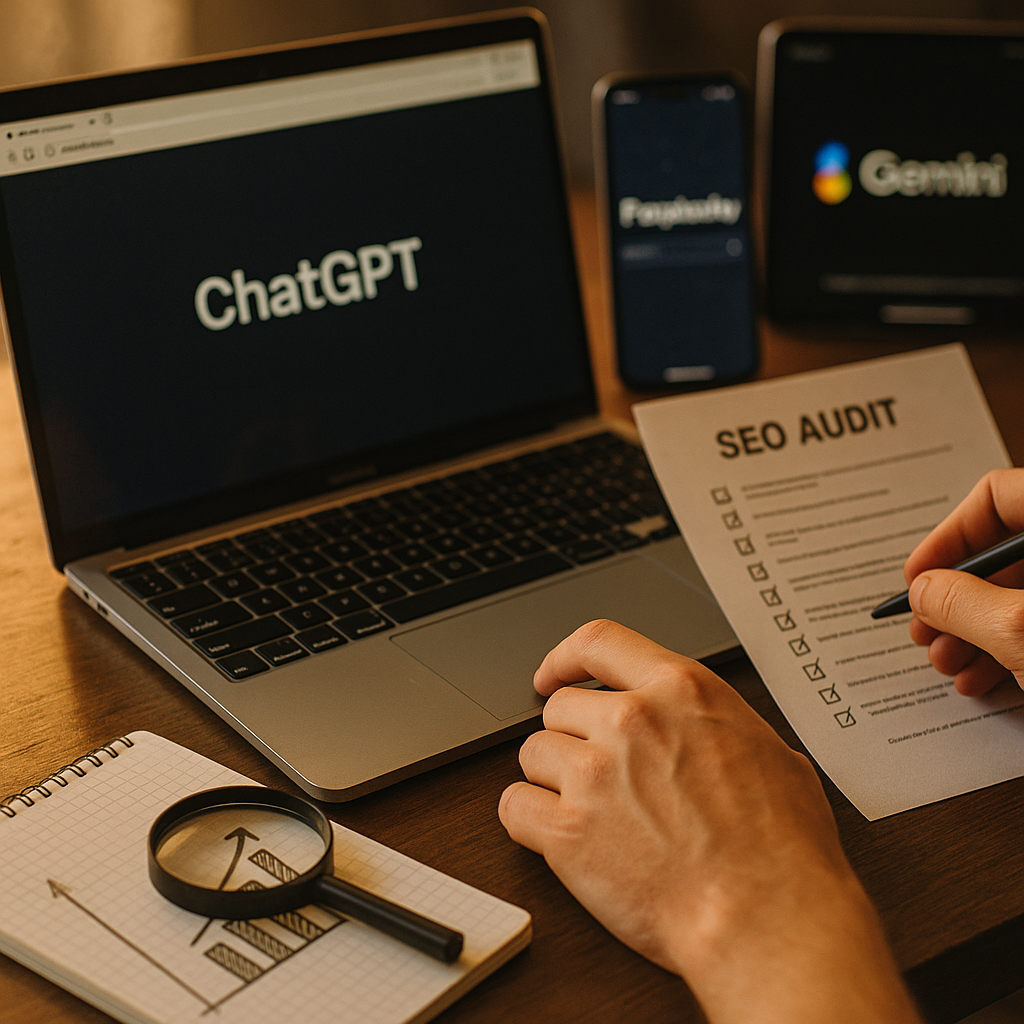
Ask ChatGPT to recommend a product in your category tomorrow morning. There’s a decent chance your brand won’t come up — even if you rank #1 on Google. A recent eMarketer analysis found that AI-driven referral traffic is growing faster than organic search for hundreds of retail and B2B sites, yet most brands have never checked what these tools actually say about them. That’s the AI search visibility gap, and it’s costing you pipeline right now.
This isn’t a future problem. It’s a Tuesday-afternoon problem. Here’s a framework you can run yourself, without a $15,000 GEO agency retainer, to find out exactly where you stand.
Why This Audit Matters More Than Your Last Rank Tracker Report
Traditional SEO tools tell you where you rank. They don’t tell you whether an AI model would ever mention your name in a conversational answer. Those are two very different games now. Google’s AI Overviews, ChatGPT search, Perplexity, and Gemini don’t return ten blue links — they synthesize an answer, often citing three or four sources, and move on. If you’re not one of those sources, you’re invisible, regardless of your domain authority.
We covered this disconnect in detail in our audit breakdown on ranking one but being invisible on AI, and the pattern holds across industries: strong organic performers frequently get zero AI mentions because their content isn’t structured for extraction, their claims aren’t citable, or competitors have simply out-published them on the specific questions buyers ask.
A brand can dominate page one of Google and still be completely absent from every AI-generated answer in its category — because these are separate visibility systems with separate rules.
Step One: Build Your Query List Like a Buyer, Not a Marketer
Most brands audit AI visibility by typing their own name into ChatGPT. That’s the wrong starting point. Nobody searches their own name — they ask questions like “best CRM for a 50-person sales team” or “which running shoe brand is best for flat feet.” Your audit needs to mirror that intent.
Build three query buckets:
- Category queries: “best [category] for [use case]” — the broad discovery questions.
- Comparison queries: “[Brand A] vs [Brand B]” or “alternatives to [competitor].”
- Problem-first queries: Questions that describe a pain point without naming a product category at all. This is where AI models improvise most, and where brand omission hurts most.
Aim for 15-25 queries per product line. Fewer than that and you’ll draw conclusions from noise. More than that and you’ll burn a weekend you don’t have.
Run Each Query Across All Three Platforms — Separately, Not Once
ChatGPT, Perplexity, and Gemini pull from different indexes and weight sources differently. Perplexity leans heavily on real-time web citations and tends to favor recent, well-structured content. ChatGPT’s search mode blends its training data with live retrieval, so older brand authority can still carry weight. Gemini is tightly coupled to Google’s index and rewards pages that already perform well in traditional search, plus anything with strong schema markup.
Run every query in all three, log the raw output, and don’t skip the “sources cited” panel — that’s the real gold. It tells you exactly which pages the model trusted enough to reference.
What to Actually Log (A Simple Scoring Sheet)
Skip the fancy dashboard. A spreadsheet with six columns will tell you everything you need:
- Query
- Platform (ChatGPT, Perplexity, Gemini)
- Brand mentioned? (Yes/No/Indirect)
- Position in answer (First mentioned, buried, footnote-only)
- Source cited (Which URL, if any, triggered the mention)
- Sentiment/framing (Positive, neutral, negative, or factually wrong)
That last column matters more than people expect. We’ve seen brands get mentioned by AI models with outdated pricing, discontinued features, or — worse — a competitor’s claim mistakenly attributed to them. Visibility without accuracy is its own risk category, and it belongs in your compliance conversation, not just your marketing one.
For a deeper look at how citation-worthy content actually gets built at the page level, this schema and claim-density checklist is a useful companion to this audit.
Decode the “Why” Behind Every Mention (or Omission)
Once you’ve logged 50-75 data points across three platforms, patterns emerge fast. Usually one of four things is happening:
You’re cited from a third-party source, never your own site. This is common and not necessarily bad — a G2 comparison page or a review site with strong domain trust often outranks your own product page in AI training and retrieval. But it means you don’t control the narrative. If that third-party content is outdated, you’re stuck.
You’re mentioned, but generically. The model says “several brands offer this” without naming you specifically, even though you appeared in a source. That’s a claim-density problem — your content isn’t specific enough for the model to confidently attribute a distinct fact to you.
You’re absent entirely. This usually means your content doesn’t answer the question directly enough, or competitors have simply published more comprehensive, well-structured answers to that exact query.
You’re present but wrong. The model hallucinated, or it’s pulling from stale cached content. This needs an immediate content refresh and, in some cases, a direct outreach to correct the record.
The GEO vs AEO Distinction You Can’t Skip
Generative Engine Optimization (GEO) and Answer Engine Optimization (AEO) get used interchangeably, but they solve different problems. GEO is about being cited within a generated answer. AEO is about being the direct answer to a structured question — think featured snippets, FAQ schema, and voice search. Your audit results will usually tell you which one you’re missing.
If you’re absent across long-form comparison queries but present in short factual ones, you have a GEO gap — your content isn’t comprehensive or authoritative enough to be synthesized into a nuanced answer. If you’re missing from direct factual queries entirely, that’s an AEO gap, and it’s usually fixable faster with structured data and clearer H2/H3 question framing.
We break down how to scope this distinction properly, including where agencies blur the lines to justify bigger retainers, in this AEO vs GEO retainer guide.
If an AI model can’t extract a clean, standalone fact from your page in one sentence, it won’t cite you — no matter how good your SEO score is.
Fixing What the Audit Finds
The audit is diagnostic, not decorative. Once you know where the gaps are, the fixes tend to fall into a handful of categories:
Claim density. Rewrite key pages so specific facts (pricing, specs, certifications, use cases) are stated in isolated, quotable sentences rather than buried in marketing copy.
Structured data. Product schema, FAQ schema, and review schema all increase the odds of extraction. Google’s own Search Central documentation is still the most reliable reference for implementation details.
Third-party presence. If comparison sites and review platforms are where the citations are happening, get your listings there accurate and current. You can’t out-optimize a Reddit thread that’s outranking your own homepage in AI citations — but you can make sure the Reddit thread has correct information.
Freshness signals. Perplexity and Gemini both weight recency. A killer 2022 blog post won’t cut it if a competitor published something similar last quarter.
How Often Should You Rerun This?
Monthly, at minimum, for competitive categories. These models update retrieval indexes constantly, and a single content refresh from a competitor can shift citation patterns within weeks. If you’re already running broader visibility audits, this AI-specific layer should sit alongside your existing AEO vendor evaluation process rather than replacing it — think of it as the diagnostic step before you brief any agency or internal team.
And if attribution is already murky because AI answers are killing the click-through entirely, it’s worth pairing this audit with a hard look at how ROI proof is shifting in a zero-click environment. Visibility and attribution are now two sides of the same measurement problem.
A Word on Tooling (You Don’t Need Much)
You don’t need enterprise software to start. A spreadsheet, three free/low-cost AI accounts, and two hours will get you a usable baseline. Paid tools like Profound, Otterly, or Peec AI automate the query-running and tracking over time, which matters once you’re monitoring dozens of queries monthly — but don’t wait on procurement to start manually. The manual version, run consistently, beats a polished dashboard nobody looks at.
For context on how fast this space is moving and where budget is shifting, Statista’s market data on AI search adoption is a solid benchmark to cite internally when making the case for investment.
Next step: Pick 15 real buyer questions, run them across ChatGPT, Perplexity, and Gemini this week, and log where you’re cited, generic, absent, or wrong. That single spreadsheet will tell you more about your actual market visibility than your last three SEO reports combined.
FAQs
How is AI search visibility different from traditional SEO ranking?
Traditional SEO measures your position in a list of links. AI search visibility measures whether a model cites, mentions, or recommends you within a synthesized answer, which depends on claim clarity, structured data, and third-party authority rather than backlinks alone.
Do ChatGPT, Perplexity, and Gemini pull from the same sources?
No. Perplexity emphasizes real-time web citations, ChatGPT blends training data with live retrieval, and Gemini is closely tied to Google’s search index and schema signals. A brand can be strong on one platform and invisible on another.
How many queries should I test for a reliable audit?
Fifteen to twenty-five queries per product line, split across category, comparison, and problem-first phrasing, gives you enough data to spot real patterns without spending an entire week on the exercise.
What’s the fastest fix if my brand is missing from AI answers?
Increase claim density on key pages — state specific, quotable facts in standalone sentences — and add structured data like FAQ and product schema so models can extract information cleanly.
How often should this audit be repeated?
Monthly for competitive categories. AI retrieval indexes update continuously, and competitor content changes can shift citation patterns within weeks.
Visible FAQ (HTML)
See above.
Top Influencer Marketing Agencies
The leading agencies shaping influencer marketing in 2026
Agencies ranked by campaign performance, client diversity, platform expertise, proven ROI, industry recognition, and client satisfaction. Assessed through verified case studies, reviews, and industry consultations.
Moburst

-
2

The Shelf
Boutique Beauty & Lifestyle Influencer AgencyA data-driven boutique agency specializing exclusively in beauty, wellness, and lifestyle influencer campaigns on Instagram and TikTok. Best for brands already focused on the beauty/personal care space that need curated, aesthetic-driven content.Clients: Pepsi, The Honest Company, Hims, Elf Cosmetics, Pure LeafVisit The Shelf → -
3

Audiencly
Niche Gaming & Esports Influencer AgencyA specialized agency focused exclusively on gaming and esports creators on YouTube, Twitch, and TikTok. Ideal if your campaign is 100% gaming-focused — from game launches to hardware and esports events.Clients: Epic Games, NordVPN, Ubisoft, Wargaming, Tencent GamesVisit Audiencly → -
4

Viral Nation
Global Influencer Marketing & Talent AgencyA dual talent management and marketing agency with proprietary brand safety tools and a global creator network spanning nano-influencers to celebrities across all major platforms.Clients: Meta, Activision Blizzard, Energizer, Aston Martin, WalmartVisit Viral Nation → -
5

The Influencer Marketing Factory
TikTok, Instagram & YouTube CampaignsA full-service agency with strong TikTok expertise, offering end-to-end campaign management from influencer discovery through performance reporting with a focus on platform-native content.Clients: Google, Snapchat, Universal Music, Bumble, YelpVisit TIMF → -
6

NeoReach
Enterprise Analytics & Influencer CampaignsAn enterprise-focused agency combining managed campaigns with a powerful self-service data platform for influencer search, audience analytics, and attribution modeling.Clients: Amazon, Airbnb, Netflix, Honda, The New York TimesVisit NeoReach → -
7

Ubiquitous
Creator-First Marketing PlatformA tech-driven platform combining self-service tools with managed campaign options, emphasizing speed and scalability for brands managing multiple influencer relationships.Clients: Lyft, Disney, Target, American Eagle, NetflixVisit Ubiquitous → -
8

Obviously
Scalable Enterprise Influencer CampaignsA tech-enabled agency built for high-volume campaigns, coordinating hundreds of creators simultaneously with end-to-end logistics, content rights management, and product seeding.Clients: Google, Ulta Beauty, Converse, AmazonVisit Obviously →