


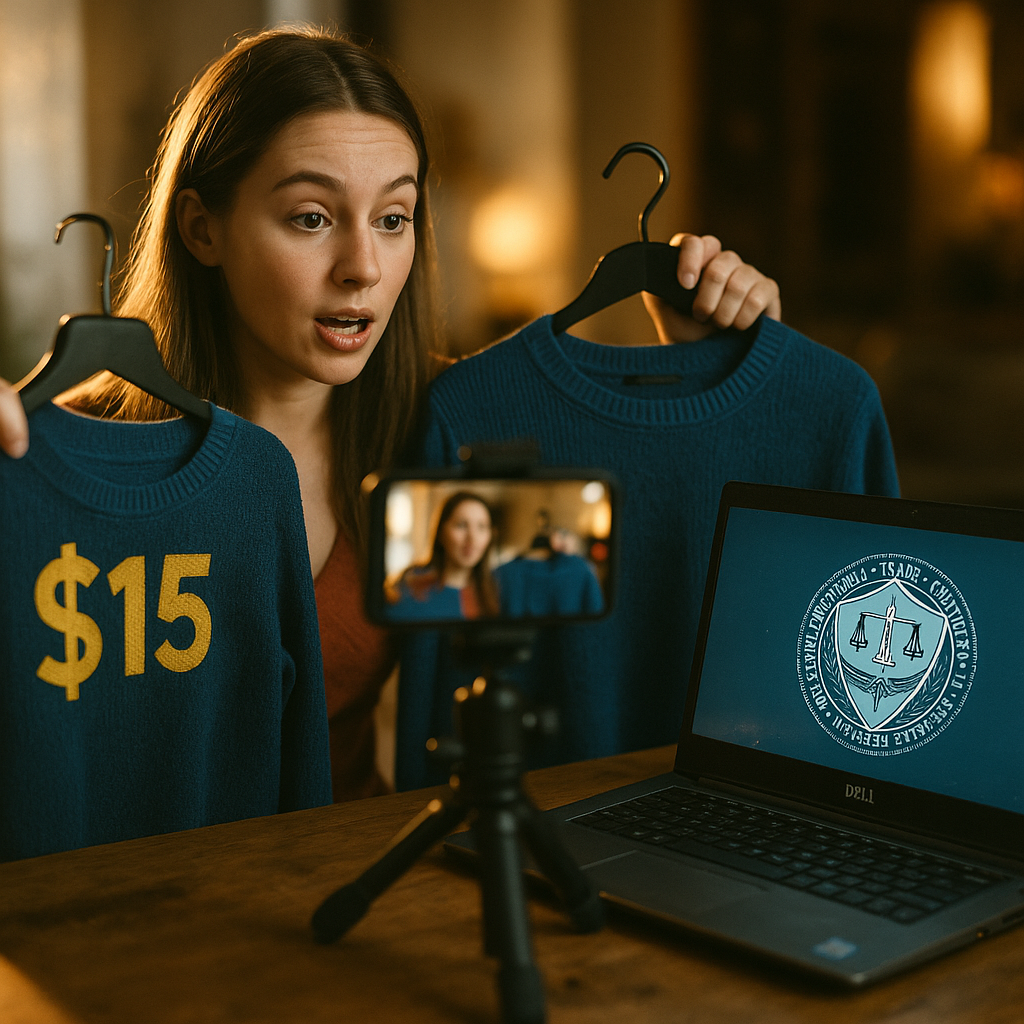
A “limited-time price” that resets every twelve minutes isn’t limited. It’s a script. The FTC now agrees, and its 2026 update to the Endorsement Guides puts livestream shopping’s price-claim theater squarely in the crosshairs. If your brand runs flash sales, countdown timers, or “today only” pricing through creator-hosted livestreams, the compliance ground just shifted under you.
This guide breaks down what changed, why livestream commerce triggered the update, and what your legal and marketing teams need to fix before the next big shopping event.
Why Livestream Shopping Forced the FTC’s Hand
Livestream shopping in the U.S. crossed an estimated $50 billion in transaction volume as TikTok Shop, Amazon Live, and Instagram’s shopping tools matured into serious retail channels. That growth came with a side effect regulators couldn’t ignore: real-time pricing claims made verbally, on camera, with no durable record and often no basis in fact.
Think about how a typical livestream event runs. A host says “this is the lowest price we’ve ever offered” or “only 40 left at this price.” No graphic. No disclosure card. No archived proof the claim was true when spoken. Multiply that across thousands of concurrent streams and you get a pricing claims problem that traditional advertising review never had to solve, because traditional ads don’t disappear the moment they’re uttered.
The FTC’s core concern isn’t influencer marketing itself. It’s that spoken, ephemeral price claims in livestreams are functionally unverifiable after the fact, which makes them a magnet for deceptive pricing enforcement.
The agency’s prior guidance leaned heavily on static disclosure norms: #ad tags, clear-and-conspicuous placement, proximity to the claim. Livestream commerce broke all three assumptions. There’s no fixed placement when a host is talking over a scrolling product carousel. There’s no proximity requirement that makes sense in a format where price mentions can happen dozens of times per hour.
What Actually Changed in the 2026 Update
The revised Endorsement Guides add three specific obligations for livestream shopping formats:
- Real-time price substantiation records. Brands and platforms must retain a timestamped log proving any comparative or urgency-based price claim (“lowest price,” “was $80, now $40,” “selling out”) was accurate at the moment it was spoken.
- Persistent on-screen disclosure during price claims. Verbal claims alone no longer satisfy disclosure requirements. A visible price-claim graphic must appear concurrently and remain on-screen for a minimum duration the FTC has signaled will be enforced similarly to its clear-and-conspicuous standard elsewhere.
- Creator-level accountability for pricing accuracy. Hosts making price claims share liability if they knew or should have known the claim was false, not just the brand backing the event.
That third point is the one keeping brand counsel up at night. It mirrors the direction the FTC already took on script approval liability. If you’ve read how script approval shifts liability to brands, this will feel familiar: the more control a brand exercises over what’s said, the more responsibility it inherits when the claim turns out to be false or unsubstantiated.
The “Was/Now” Problem Livestream Hosts Keep Creating
Here’s a scenario every retail marketer has lived through. A host on a livestream says, “This was $120, now it’s $60 for the next hour.” Except the product’s actual selling price for the prior 30 days was $65, not $120. That’s a classic reference-price violation the FTC has pursued in traditional retail for years. Livestream just makes it faster to commit and harder to catch.
The 2026 update explicitly extends the FTC’s existing reference pricing standards (the same logic behind its guidance on former price comparisons) into the livestream format, with the added wrinkle that hosts are often improvising. Scripts get loose. Enthusiasm inflates claims. A host trying to hit a sales target might round up the “original” price without checking it against actual sale history.
This is functionally the same failure mode covered in deceptive pricing disclosure standards for creator promo codes, just moved into a live, unscripted environment where there’s less opportunity for pre-approval review.
What Brands Need to Build Before the Next Livestream Event
Compliance here isn’t a policy memo. It’s an operational build. Here’s what needs to exist before your next livestream shopping event goes live:
- A live pricing dashboard synced to the stream. Whatever price a host states must match a backend system of record, updated in real time, with a timestamp log the platform can pull if the FTC or a state AG comes asking. Retailers using TikTok Shop or Amazon Live should confirm their commerce integration supports this kind of audit trail; if it doesn’t, that’s a vendor conversation to have now, not after an inquiry letter arrives.
- An on-screen disclosure template baked into the stream layout. Not a caption the host remembers to trigger. A persistent lower-third or overlay that updates automatically whenever a price claim is spoken, similar to how sports broadcasts show real-time odds. This needs design and engineering resources, not just a legal sign-off.
- A pre-stream script and claims briefing. Hosts need a locked list of approved price claims and the substantiation behind each one, distributed before broadcast. This is the livestream cousin of the script approval clause brands are already using to manage FTC liability in recorded content.
- Creator contract language addressing shared liability. Your creator agreements need explicit terms on who verifies pricing accuracy, who’s liable if a claim is later found false, and what recourse the brand has if a host goes off-script. If you’re already running a material connection audit for whitelisted content, extend that same rigor to livestream talent agreements.
- Post-event archival. The FTC’s update requires brands to retain full recordings of livestream shopping events, including chat logs and price overlays, for a minimum retention period. Treat this like ad substantiation files: boring, unglamorous, and exactly what saves you in an investigation.
If your livestream tech stack can’t produce a timestamped price-claim log on demand, you don’t have a compliance program. You have a hope.
Where Retail Media and Livestream Compliance Now Overlap
Retail media networks are increasingly the ones hosting or co-producing livestream shopping events, which raises a question brands haven’t fully answered: who owns the compliance risk when a retailer’s in-house creative team builds the livestream, but a brand’s creator delivers the pricing pitch? This is the same unresolved tension explored in retail media in-house creative services and who owns the risk. The 2026 update doesn’t fully resolve it, but it does make clear that “we didn’t control the script” is a weaker defense than it used to be, especially if the brand supplied pricing data or approved talking points in any form.
Instacart’s recent pricing scrutiny is instructive here too. Even outside the livestream context, regulators have shown they’ll dig into how CPG brands communicate pricing through any real-time or algorithmically updated channel. The same logic explored in why CPG creator briefs must change applies directly to livestream shopping events: pricing claims made through any dynamic, creator-fronted channel now get the same scrutiny as static ads, arguably more, because the ephemeral nature of live speech used to be seen as lower risk. Not anymore.
AI-Hosted Livestreams Add Another Layer
A growing number of brands use AI avatars or synthetic hosts to run livestream shopping segments overnight, when human creators are offline. The 2026 update doesn’t carve out an exception for this. If anything, it raises the bar, since an AI host reciting a stale price feed is arguably easier to catch making false urgency claims than a human improvising. Brands running AI-hosted commerce streams should cross-reference the FTC disclosure standard for AI shopping agents alongside this update, because the two frameworks now overlap directly whenever a synthetic host makes a real-time price claim.
There’s also a technical failure mode unique to AI hosts: model or feed lag. If the AI’s pricing data source updates on a delay, the host can state a claim that was true 90 seconds ago but isn’t true now. That’s not a hypothetical edge case, it’s a known integration risk, and it’s worth reading alongside AI model deprecation clauses when negotiating vendor contracts for any AI-hosted commerce tooling.
What Enforcement Will Likely Look Like
Early signals suggest the FTC will lean on complaint-driven investigations first, likely triggered by consumer reports of price claims that didn’t hold up post-purchase, before moving to proactive sweeps. That mirrors how the agency has handled other endorsement issues, escalating from informal warnings to formal consent orders only after patterns emerge. Brands should also watch how self-regulatory bodies respond; the NAD-to-FTC referral pathway gives competitors and watchdog groups a faster route to trigger federal scrutiny than waiting on the FTC to act unprompted.
Penalties for violations follow the same civil penalty framework the FTC uses elsewhere in the Endorsement Guides, calculated per violation, which in a high-volume livestream context can scale fast. A single event with a dozen unsubstantiated urgency claims isn’t one violation. It could be read as a dozen.
The Practical Next Step
Audit your next scheduled livestream shopping event this week: pull the script, check whether every price claim has a timestamped substantiation record, and confirm your on-screen disclosure template actually triggers when hosts go off-script. If you can’t produce that audit trail on demand, fix the gap before the event airs, not after a complaint lands on the FTC’s desk.
FAQs
Does the 2026 update apply to all livestream shopping platforms, or just certain ones?
The update applies to any platform hosting shoppable livestreams with real-time price claims, including TikTok Shop, Amazon Live, Instagram Live Shopping, and retailer-owned livestream tools. Platform ownership doesn’t create an exemption; the obligation follows the price claim, not the app it’s made on.
Who is liable if a creator misstates a price during a livestream?
Both the brand and the creator can share liability. Brands remain responsible for substantiation and disclosure infrastructure, while hosts can be held accountable if they knew or reasonably should have known a price claim was false.
What counts as an acceptable on-screen disclosure during a livestream price claim?
The FTC expects a persistent, clearly visible graphic that appears concurrently with the verbal claim and stays on-screen long enough for viewers to reasonably notice and read it. A verbal disclaimer alone, or a caption that flashes briefly, is unlikely to satisfy the standard.
How long do brands need to retain livestream recordings and price data?
The update requires retention of full event recordings, chat logs, and price-claim substantiation records for a defined minimum period following the event, mirroring existing ad substantiation retention practices used elsewhere in FTC enforcement.
Does this apply to AI-hosted or avatar-led livestream shopping events?
Yes. The update does not distinguish between human and synthetic hosts. If an AI avatar makes a real-time price claim, the same substantiation and disclosure requirements apply, and brands should also review AI-specific disclosure guidance for shopping agents.
Top Influencer Marketing Agencies
The leading agencies shaping influencer marketing in 2026
Agencies ranked by campaign performance, client diversity, platform expertise, proven ROI, industry recognition, and client satisfaction. Assessed through verified case studies, reviews, and industry consultations.
Moburst

-
2

The Shelf
Boutique Beauty & Lifestyle Influencer AgencyA data-driven boutique agency specializing exclusively in beauty, wellness, and lifestyle influencer campaigns on Instagram and TikTok. Best for brands already focused on the beauty/personal care space that need curated, aesthetic-driven content.Clients: Pepsi, The Honest Company, Hims, Elf Cosmetics, Pure LeafVisit The Shelf → -
3

Audiencly
Niche Gaming & Esports Influencer AgencyA specialized agency focused exclusively on gaming and esports creators on YouTube, Twitch, and TikTok. Ideal if your campaign is 100% gaming-focused — from game launches to hardware and esports events.Clients: Epic Games, NordVPN, Ubisoft, Wargaming, Tencent GamesVisit Audiencly → -
4

Viral Nation
Global Influencer Marketing & Talent AgencyA dual talent management and marketing agency with proprietary brand safety tools and a global creator network spanning nano-influencers to celebrities across all major platforms.Clients: Meta, Activision Blizzard, Energizer, Aston Martin, WalmartVisit Viral Nation → -
5

The Influencer Marketing Factory
TikTok, Instagram & YouTube CampaignsA full-service agency with strong TikTok expertise, offering end-to-end campaign management from influencer discovery through performance reporting with a focus on platform-native content.Clients: Google, Snapchat, Universal Music, Bumble, YelpVisit TIMF → -
6

NeoReach
Enterprise Analytics & Influencer CampaignsAn enterprise-focused agency combining managed campaigns with a powerful self-service data platform for influencer search, audience analytics, and attribution modeling.Clients: Amazon, Airbnb, Netflix, Honda, The New York TimesVisit NeoReach → -
7

Ubiquitous
Creator-First Marketing PlatformA tech-driven platform combining self-service tools with managed campaign options, emphasizing speed and scalability for brands managing multiple influencer relationships.Clients: Lyft, Disney, Target, American Eagle, NetflixVisit Ubiquitous → -
8

Obviously
Scalable Enterprise Influencer CampaignsA tech-enabled agency built for high-volume campaigns, coordinating hundreds of creators simultaneously with end-to-end logistics, content rights management, and product seeding.Clients: Google, Ulta Beauty, Converse, AmazonVisit Obviously →