


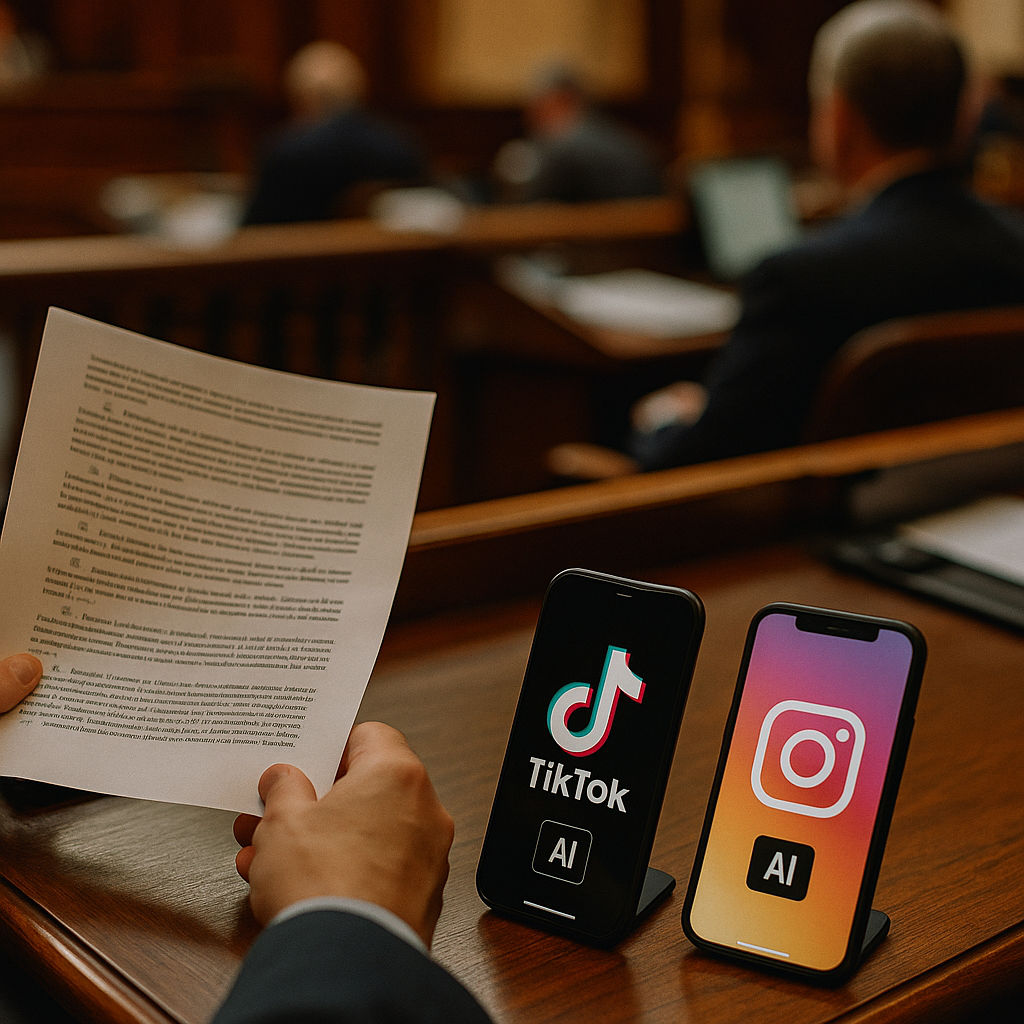
Nine states now have deepfake disclosure statutes on the books, and none of them accept “the platform auto-tagged it” as a legal defense. Yet most brand compliance teams still treat Meta’s “AI Info” tag and TikTok’s auto-labeling as if they’re doing the legal heavy lifting. They’re not. If you’re running synthetic or AI-augmented content across both platforms, relying on platform labels instead of state deepfake disclosure statutes is a gap waiting to become a headline.
Two Different Jobs Wearing the Same Costume
Platform AI labels and state disclosure laws look similar on the surface. Both slap a notice on content. Both exist because regulators and platforms got nervous about synthetic media. But they were built to solve different problems, for different audiences, with different enforcement teeth.
Meta’s AI content labels exist to protect platform integrity — to stop misinformation from spreading unchecked and to give Meta a defensible position with regulators and advertisers. TikTok’s Content Disclosure requirements work similarly: creators self-declare AI-generated or AI-edited content, and TikTok applies automated detection as a backstop. Both systems are designed around platform risk, not advertiser risk.
State deepfake statutes, by contrast, are written to protect consumers and, in election contexts, voters. California’s AB 602 and AB 730, Texas’s synthetic media law, and newer statutes in states like Minnesota and Washington impose disclosure obligations directly on the entity creating or distributing the content — meaning the brand, not just the platform. Some carry criminal penalties. Others create private rights of action. None of them care whether Meta already put a little “AI Info” badge in the corner of your ad.
A platform label satisfies the platform’s terms of service. It does not satisfy a state statute’s disclosure requirements — and treating them as interchangeable is the single most common compliance mistake brands make with synthetic content today.
Where the Gaps Actually Show Up
Let’s get specific, because “there’s a gap” isn’t actionable. Here’s where brands get exposed:
- Placement mismatch: Platform labels appear where the platform decides — often a small tag on the post itself. State statutes frequently require disclosure to be “clear and conspicuous” within the content or claim, sometimes with specific font-size or duration requirements for video.
- Trigger mismatch: TikTok’s auto-detection catches obvious synthetic voice or face swaps. It often misses AI-assisted b-roll, AI-upscaled footage, or voice cloning layered under real footage. State laws frequently define “deepfake” more broadly, capturing content platform algorithms never flag.
- Persistence mismatch: Labels can be stripped when content is downloaded, re-uploaded, or repurposed into paid media, email, or a landing page. The legal disclosure obligation doesn’t disappear just because the platform’s UI element did.
- Actor mismatch: Platform enforcement targets accounts and creators. State statutes often reach up the chain to the brand that commissioned the content, regardless of who technically posted it.
This is the same structural problem we’ve flagged in state-by-state synthetic performer rules versus FTC guidance: overlapping regimes with different triggers create compliance blind spots precisely where brands assume they’re covered.
A Quick Reality Check on Enforcement
Nobody’s been fined into oblivion yet for this specific gap — but that’s not comfort, it’s timing. State AGs are still building case inventories. The FTC has already signaled, through its endorsement guidance updates, that synthetic content disclosure is a live enforcement priority. When state and federal regulators start comparing notes, brands that leaned entirely on platform auto-labels will be the ones scrambling for a paper trail that doesn’t exist.
Building One Workflow Instead of Two Half-Measures
The fix isn’t running parallel compliance processes — one for platform rules, one for state law. That’s expensive, slow, and guaranteed to drift out of sync within two quarters. The fix is a single workflow where the strictest applicable standard becomes your default, and platform labels become a secondary confirmation layer, not the primary control.
Here’s what that looks like in practice.
Step 1: Classify Before You Create
Every piece of content touching AI generation, voice cloning, face-swapping, or synthetic performers gets tagged at the brief stage — not after the asset is delivered. Build a simple classification: fully synthetic, AI-augmented (real performer, AI-edited), and AI-assisted (real performer, AI tools used in production only, no synthetic likeness). This mirrors the audit logic in our AI content audit framework, and it matters because state statutes often only trigger on the first two categories, not the third.
Step 2: Map Jurisdiction to Requirement, Not to Platform
Determine where the content will run, not just where it will post. A TikTok video that gets boosted into paid media in Texas triggers Texas’s statute regardless of TikTok’s own labeling. Build a matrix — similar in structure to the under-16 compliance matrix approach — that maps content type against every state where paid distribution is planned, not just where the brand is headquartered.
Step 3: Apply the Strictest Disclosure as the Default
Instead of customizing disclosure language per state (a maintenance nightmare), identify the most stringent requirement across your active distribution states and apply it universally. If one state requires an on-screen disclosure visible for the full duration of the video, make that the house standard for all synthetic content, everywhere. It’s redundant in lighter-touch states. It’s compliant everywhere.
Standardizing on the strictest state requirement costs you a few extra seconds of screen time. Non-compliance in even one state can cost you a regulatory investigation and a very uncomfortable board conversation.
Step 4: Layer Platform Labels on Top, Never Instead Of
Let TikTok’s and Meta’s automatic labels do what they’re built for: platform-level transparency. Enable them by default in every campaign brief. But your legal disclosure — the state-compliant one — should exist independently in the content itself, not rely on the platform UI. If a creator downloads the video and a paid social manager re-uploads it as a dark post, the platform’s auto-label may not carry over. Your embedded disclosure will.
Step 5: Contractually Lock the Obligation Downstream
Creator contracts need explicit language requiring embedded disclosure regardless of platform auto-tagging, plus a warranty that the creator won’t strip or override disclosure elements during editing. This connects directly to the liability-shifting logic covered in script approval and FTC liability — the more control a brand exercises over final content, the more responsibility it inherits if disclosure fails. Building this into the same paperwork you use for deepfake endorsement risk clauses keeps the legal language centralized instead of scattered across a dozen one-off contracts.
Step 6: Audit Quarterly, Not Annually
State legislatures are moving fast on this. What was compliant last quarter may not be compliant next quarter. Build a recurring audit — quarterly at minimum — that checks your content library against updated state requirements, similar in cadence to the review process outlined in whitelisting agreement audits before renewal. Assign ownership. This can’t be a project that lives only in legal’s inbox; marketing ops needs a seat at the table because they control the content pipeline.
What This Means for Budget and Headcount
Compliance workflows cost money, and CFOs will ask for the ROI case. Here’s the honest framing: this isn’t a cost center, it’s insurance against a much larger cost. A single state investigation into undisclosed synthetic content can trigger discovery requests across your entire content library, not just the flagged asset. That’s agency hours, legal hours, and reputational exposure multiplying fast.
Compare that to the marginal cost of a standardized disclosure template, a classification step in your brief process, and a quarterly audit cycle. Most mid-size brands can build this with existing legal and marketing ops headcount, no new hires required — provided the workflow is centralized rather than distributed across regional teams improvising their own standards.
Tools matter less than you’d think here. Platforms like Meta Business Suite and TikTok Ads Manager give you the labeling controls, but the workflow discipline has to come from your side. According to eMarketer research on AI content adoption, synthetic and AI-assisted content in brand campaigns is scaling faster than most legal teams can review it manually — which is exactly why the process needs to be systematized now, not built ad hoc after the first enforcement letter arrives.
The Takeaway
Stop treating Meta’s and TikTok’s AI labels as compliance. They’re platform hygiene. Build one workflow that classifies content at the brief stage, applies your strictest state disclosure standard as the universal default, and locks the obligation into creator contracts — then let the platform labels ride along as a bonus, not a backstop.
Frequently Asked Questions
Does Meta’s AI content label satisfy state deepfake disclosure laws?
No. Meta’s AI Info label is a platform transparency feature governed by Meta’s own policies, not a legal disclosure mechanism. State deepfake statutes typically require disclosure language, placement, and duration standards that platform labels don’t guarantee, and the legal obligation falls on the brand or content creator, not the platform.
Which states currently have deepfake disclosure statutes affecting brand marketing?
California, Texas, Minnesota, and Washington are among the states with active synthetic media or deepfake disclosure requirements, with several others considering similar legislation. Requirements vary by trigger (political content, commercial endorsement, likeness use) so brands need a jurisdiction-specific matrix rather than a one-size-fits-all assumption.
What happens if a creator strips the AI disclosure when re-editing content?
Liability generally follows the brand that commissioned the content, especially if the brand exercised script or edit approval. This is why creator contracts should include explicit warranties against removing disclosure elements, paired with the same liability-shifting logic used in script approval clauses.
Do TikTok’s automatic AI detection tools catch everything that state law requires disclosing?
No. TikTok’s automated detection is tuned for obvious synthetic media like face swaps and cloned voices. It frequently misses AI-assisted editing, upscaling, or partial synthetic elements that some state statutes still classify as requiring disclosure. Brands should not treat “TikTok didn’t flag it” as confirmation of compliance.
Is it enough to apply one state’s strictest disclosure standard everywhere?
For most mid-size brands, yes — standardizing on the strictest applicable state requirement is more operationally efficient than customizing disclosure per jurisdiction, and it minimizes the risk of accidentally under-disclosing in a stricter state.
Top Influencer Marketing Agencies
The leading agencies shaping influencer marketing in 2026
Agencies ranked by campaign performance, client diversity, platform expertise, proven ROI, industry recognition, and client satisfaction. Assessed through verified case studies, reviews, and industry consultations.
Moburst

-
2

The Shelf
Boutique Beauty & Lifestyle Influencer AgencyA data-driven boutique agency specializing exclusively in beauty, wellness, and lifestyle influencer campaigns on Instagram and TikTok. Best for brands already focused on the beauty/personal care space that need curated, aesthetic-driven content.Clients: Pepsi, The Honest Company, Hims, Elf Cosmetics, Pure LeafVisit The Shelf → -
3

Audiencly
Niche Gaming & Esports Influencer AgencyA specialized agency focused exclusively on gaming and esports creators on YouTube, Twitch, and TikTok. Ideal if your campaign is 100% gaming-focused — from game launches to hardware and esports events.Clients: Epic Games, NordVPN, Ubisoft, Wargaming, Tencent GamesVisit Audiencly → -
4

Viral Nation
Global Influencer Marketing & Talent AgencyA dual talent management and marketing agency with proprietary brand safety tools and a global creator network spanning nano-influencers to celebrities across all major platforms.Clients: Meta, Activision Blizzard, Energizer, Aston Martin, WalmartVisit Viral Nation → -
5

The Influencer Marketing Factory
TikTok, Instagram & YouTube CampaignsA full-service agency with strong TikTok expertise, offering end-to-end campaign management from influencer discovery through performance reporting with a focus on platform-native content.Clients: Google, Snapchat, Universal Music, Bumble, YelpVisit TIMF → -
6

NeoReach
Enterprise Analytics & Influencer CampaignsAn enterprise-focused agency combining managed campaigns with a powerful self-service data platform for influencer search, audience analytics, and attribution modeling.Clients: Amazon, Airbnb, Netflix, Honda, The New York TimesVisit NeoReach → -
7

Ubiquitous
Creator-First Marketing PlatformA tech-driven platform combining self-service tools with managed campaign options, emphasizing speed and scalability for brands managing multiple influencer relationships.Clients: Lyft, Disney, Target, American Eagle, NetflixVisit Ubiquitous → -
8

Obviously
Scalable Enterprise Influencer CampaignsA tech-enabled agency built for high-volume campaigns, coordinating hundreds of creators simultaneously with end-to-end logistics, content rights management, and product seeding.Clients: Google, Ulta Beauty, Converse, AmazonVisit Obviously →