


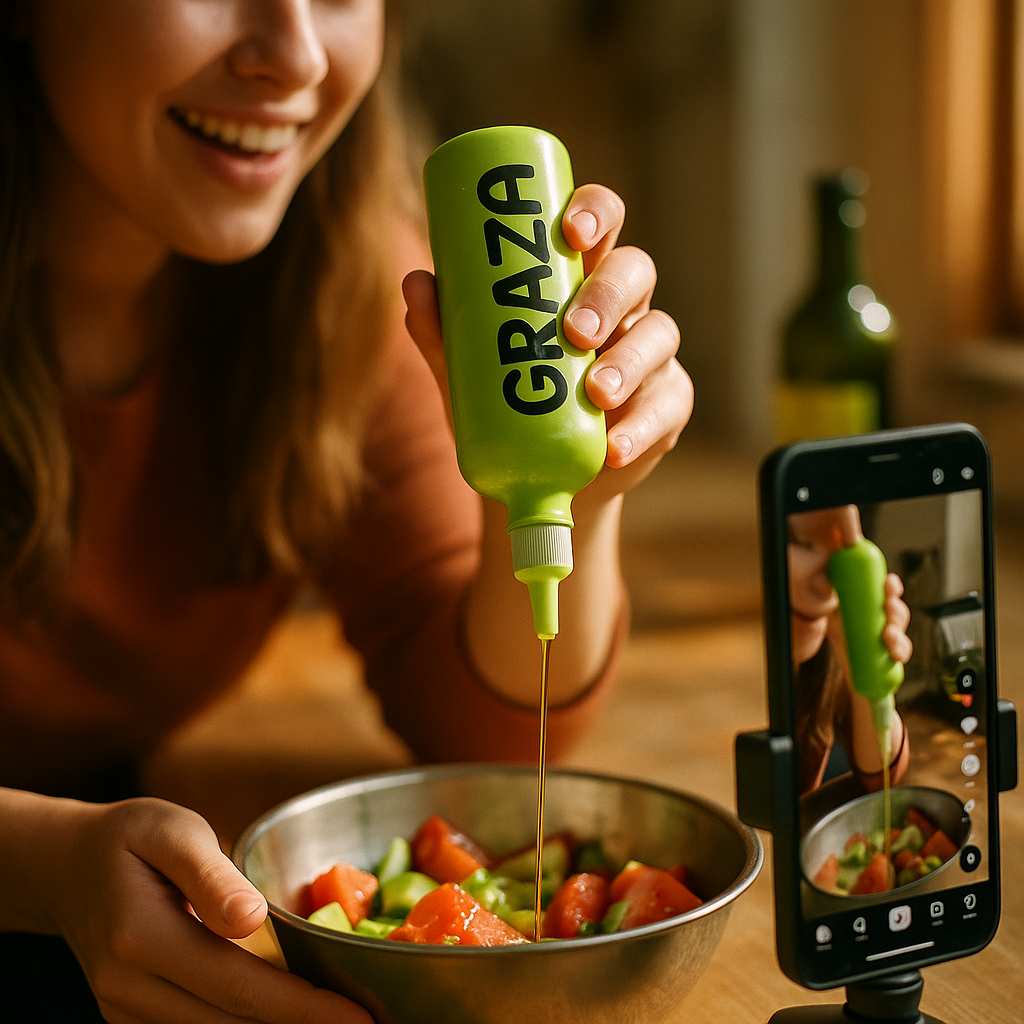
One SKU. One squeeze bottle. No celebrity endorsement, no six-figure media buy. Graza’s TikTok Shop strategy turned a $16 bottle of olive oil into one of the platform’s most-cited grocery success stories, reportedly moving over a million bottles through social commerce alone. If a condiment can pull that off, what’s your excuse?
This isn’t a story about virality. It’s a story about restraint, repetition, and a founder who understood that comedy is a distribution mechanic, not just a personality trait. Let’s break down what actually happened, and what a brand strategist can steal from it without a squeeze bottle of their own.
The Setup: A Condiment Brand That Refused to Act Like One
Graza launched in 2021 with a single product: extra virgin olive oil in a bright green squeeze bottle, positioned as “Drizzle” for finishing and “Sizzle” for cooking. Two SKUs, technically, but the content engine ran almost entirely on one hero product and one visual gag: squeezing oil like it’s ketchup.
That packaging decision did more strategic work than any ad campaign could. It gave every piece of content a built-in sight gag. Squeeze bottles are inherently funny in a kitchen context, they’re associated with diner condiments, not $200-a-liter finishing oils. Graza leaned into that dissonance instead of fighting it.
The packaging wasn’t just functional design, it was a content format. Every squeeze became a punchline, and every punchline became a reason to keep watching.
Comedy as Infrastructure, Not Decoration
Most CPG brands treat humor as a tone, something layered over a script late in production. Graza treated comedy as the actual content architecture. Their TikTok and Instagram output leaned into absurdist, low-fi sketches: a guy drizzling oil directly into his mouth, deadpan “olive oil sommelier” bits, rapid-fire recipe videos with exaggerated sound effects.
The founder, Andrew Benin, has talked publicly about hiring for comedic instinct over traditional food-content polish. That’s a deliberate operational choice. It means the brand didn’t need a big production budget, it needed people who understood timing, pacing, and the specific absurdist register that performs on TikTok.
For brand strategists evaluating creator partnerships, this is the transferable lesson: comedic fluency is a skill you can hire and brief for, just like copywriting or media buying. It’s not a happy accident.
- Low production value, high comedic precision. Graza’s videos rarely look expensive. They look fast, native, and specific to the platform.
- Repetition of visual motifs. The squeeze, the green bottle, the deadpan delivery, all repeated until they became recognizable shorthand.
- Product-forward jokes. The oil itself is almost always the punchline or the prop, never an afterthought bolted onto unrelated content.
Why TikTok Shop, Specifically, Mattered
Graza built organic affinity first, then layered TikTok Shop on top once the platform matured as a commerce channel. That sequencing matters. Brands that skip straight to shoppable tags without an existing content identity tend to see flat conversion, because there’s no context for the purchase decision.
TikTok Shop rewards content that already has watch-through and shares, the algorithm treats commerce content as content first, ad unit second. Graza’s comedic backlog gave the Shop tab something to surface that already had social proof attached.
According to eMarketer’s social commerce research, TikTok Shop has grown into one of the fastest-scaling commerce channels in the US, with grocery and specialty food emerging as unexpectedly strong categories. That’s counterintuitive on its face, who buys olive oil from a video app? But it tracks with broader social commerce behavior data showing that entertainment-first content drives higher purchase intent than product-first content, particularly among users under 35.
Brands chasing similar results should study the mechanics other CPG players have used to make commission-based and creator-driven models work at scale. The Chipotle TikTok Go commission data is instructive here: platforms increasingly reward brands that align creator incentives with actual sales, not just impressions.
Nano and Micro-Creators Did the Heavy Lifting
Graza didn’t rely exclusively on branded content. A meaningful share of the volume came from nano and micro-creators who filmed their own reaction and recipe content unprompted, then got amplified through whitelisting and light-touch gifting. This mirrors a pattern documented across the category: Olipop’s creator whitelisting strategy shows how a beverage brand scaled a category almost entirely through unpaid or lightly-compensated micro-creator content, amplified with paid spend behind the best-performing organic posts.
Graza’s team reportedly monitored UGC closely and reposted or boosted the strongest performers rather than commissioning everything from scratch. That’s a resourcing decision more brands should copy: let the algorithm and the audience tell you which creator content deserves budget behind it.
This approach also reduces risk. You’re not betting the quarter’s budget on one influencer’s judgment. You’re distributing bets across dozens of smaller creators and doubling down only on what’s already proven to convert. It’s the same logic behind nano-creator strategies beating paid search CPA in other CPG verticals.
The Numbers Marketers Actually Care About
Graza doesn’t publish granular TikTok Shop revenue breakdowns, but public statements and trade coverage point to several directionally reliable signals:
- Graza has cited retail distribution growth into thousands of doors, including major grocery chains, largely credited to social-first demand generation rather than traditional trade marketing.
- The brand’s TikTok following and engagement rate consistently outperform category norms for a single-SKU food brand, per third-party social listening estimates.
- Multiple trade reports have named Graza among the top-performing TikTok Shop grocery accounts by unit velocity, a category where most CPG brands still struggle to gain traction.
The honest caveat: Graza is privately held and doesn’t disclose full-funnel attribution. Marketers should treat the “bestseller” narrative as directionally true and well-supported by public performance signals, not as an audited financial claim. That’s a normal limitation in creator economy case studies, and it’s worth building into how you report these stories internally too.
What This Means for Your Budget Conversation
If you’re pitching leadership on a TikTok Shop investment, Graza’s arc gives you a defensible sequencing argument: build comedic or entertainment-first content identity before layering on shoppable commerce. Skipping straight to performance creative on a platform your audience associates with entertainment tends to underperform, because it breaks the implicit contract users have with the format.
This mirrors findings across other verticals too. Warby Parker’s nano-creator try-on videos beat paid search on CAC precisely because the content felt native to the platform first, commercial second.
Entertainment-first content isn’t the opposite of performance marketing, it’s the precondition for it on platforms like TikTok Shop.
Practically, that means restructuring how you brief creators and internal teams. Instead of “make a video that sells the product,” the brief becomes “make a video someone would send to a friend, that happens to feature the product.” Graza’s team clearly operated from the second brief, not the first.
Risk Considerations Brands Shouldn’t Skip
Comedy carries brand safety exposure that straightforward product demos don’t. A joke that lands with one audience segment can alienate another, and absurdist humor ages faster than straightforward testimonial content. Brands adopting this playbook should build in a review layer for tone consistency, not just legal and disclosure compliance.
On the compliance side, any creator content tied to TikTok Shop commerce still needs to meet FTC endorsement guidelines, including clear disclosure when creators are compensated or gifted product. This applies whether the content is scripted comedy or an off-the-cuff recipe video. Treating disclosure as a creative constraint rather than a legal afterthought tends to produce better content anyway, the best creators build the disclosure into the joke.
Brands should also revisit how they structure creator payment. The shift toward commission-linked or performance-based compensation, documented in TikTok Go’s hybrid payout model data, gives finance teams a cleaner way to justify spend against a single-SKU strategy like Graza’s, since cost scales with proven sales rather than upfront production fees.
Applying the Playbook Beyond Olive Oil
Graza’s model isn’t exclusive to food. The underlying mechanics, one hero product, a repeatable visual gag, hiring for comedic fluency, letting organic UGC guide paid amplification, apply to any category where the product has a demonstrable, visual use case. Beauty, home goods, and even fintech apps with a strong visual interface have run adjacent playbooks with comedy or personality-led content.
The common thread across every successful case, including Poppi’s micro-creator seeding strategy, is discipline. Pick one format. Repeat it until it’s recognizable. Resist the urge to diversify content style before the format has actually saturated.
For a marketing team evaluating whether this fits their category, ask: does our product have an inherent visual or physical quirk that supports a repeatable joke? If the answer is no, comedy-led content will feel forced, and audiences notice forced humor faster than almost any other content failure mode.
Next step: before greenlighting a TikTok Shop content plan, audit your product for one repeatable, camera-friendly quirk, then brief creators to build jokes around it rather than testimonials. Graza didn’t sell olive oil. It sold a bit, and let the bottle do the converting.
FAQs
What made Graza’s TikTok Shop strategy different from typical CPG social content?
Graza treated comedy as core content architecture rather than a stylistic layer, hiring for comedic timing and building content around the squeeze bottle’s inherent visual gag instead of standard product demos or testimonials.
Did Graza rely mostly on paid influencer partnerships?
No. A significant share of Graza’s visibility came from unprompted micro and nano-creator content, which the brand monitored and amplified through whitelisting and boosted spend behind top-performing organic posts, rather than commissioning everything from scratch.
Can a single-SKU brand realistically build a TikTok Shop presence without a big budget?
Yes, but it requires sequencing: build entertainment-first content identity and organic engagement before layering on shoppable commerce features, since TikTok’s algorithm and audience both reward content that feels native to the platform first.
What compliance issues should brands watch for when running comedy-led creator content?
FTC endorsement disclosure rules still apply regardless of tone, creators must clearly disclose gifted or paid partnerships. Brands should also add a tone-review layer, since comedic content carries different brand safety risks than straightforward demos.
Is Graza’s “bestseller” status independently verified?
Graza is privately held and hasn’t published audited TikTok Shop revenue figures. Trade coverage and third-party social listening estimates support the bestseller narrative directionally, but marketers should treat exact figures as unconfirmed.
Top Influencer Marketing Agencies
The leading agencies shaping influencer marketing in 2026
Agencies ranked by campaign performance, client diversity, platform expertise, proven ROI, industry recognition, and client satisfaction. Assessed through verified case studies, reviews, and industry consultations.
Moburst

-
2

The Shelf
Boutique Beauty & Lifestyle Influencer AgencyA data-driven boutique agency specializing exclusively in beauty, wellness, and lifestyle influencer campaigns on Instagram and TikTok. Best for brands already focused on the beauty/personal care space that need curated, aesthetic-driven content.Clients: Pepsi, The Honest Company, Hims, Elf Cosmetics, Pure LeafVisit The Shelf → -
3

Audiencly
Niche Gaming & Esports Influencer AgencyA specialized agency focused exclusively on gaming and esports creators on YouTube, Twitch, and TikTok. Ideal if your campaign is 100% gaming-focused — from game launches to hardware and esports events.Clients: Epic Games, NordVPN, Ubisoft, Wargaming, Tencent GamesVisit Audiencly → -
4

Viral Nation
Global Influencer Marketing & Talent AgencyA dual talent management and marketing agency with proprietary brand safety tools and a global creator network spanning nano-influencers to celebrities across all major platforms.Clients: Meta, Activision Blizzard, Energizer, Aston Martin, WalmartVisit Viral Nation → -
5

The Influencer Marketing Factory
TikTok, Instagram & YouTube CampaignsA full-service agency with strong TikTok expertise, offering end-to-end campaign management from influencer discovery through performance reporting with a focus on platform-native content.Clients: Google, Snapchat, Universal Music, Bumble, YelpVisit TIMF → -
6

NeoReach
Enterprise Analytics & Influencer CampaignsAn enterprise-focused agency combining managed campaigns with a powerful self-service data platform for influencer search, audience analytics, and attribution modeling.Clients: Amazon, Airbnb, Netflix, Honda, The New York TimesVisit NeoReach → -
7

Ubiquitous
Creator-First Marketing PlatformA tech-driven platform combining self-service tools with managed campaign options, emphasizing speed and scalability for brands managing multiple influencer relationships.Clients: Lyft, Disney, Target, American Eagle, NetflixVisit Ubiquitous → -
8

Obviously
Scalable Enterprise Influencer CampaignsA tech-enabled agency built for high-volume campaigns, coordinating hundreds of creators simultaneously with end-to-end logistics, content rights management, and product seeding.Clients: Google, Ulta Beauty, Converse, AmazonVisit Obviously →