


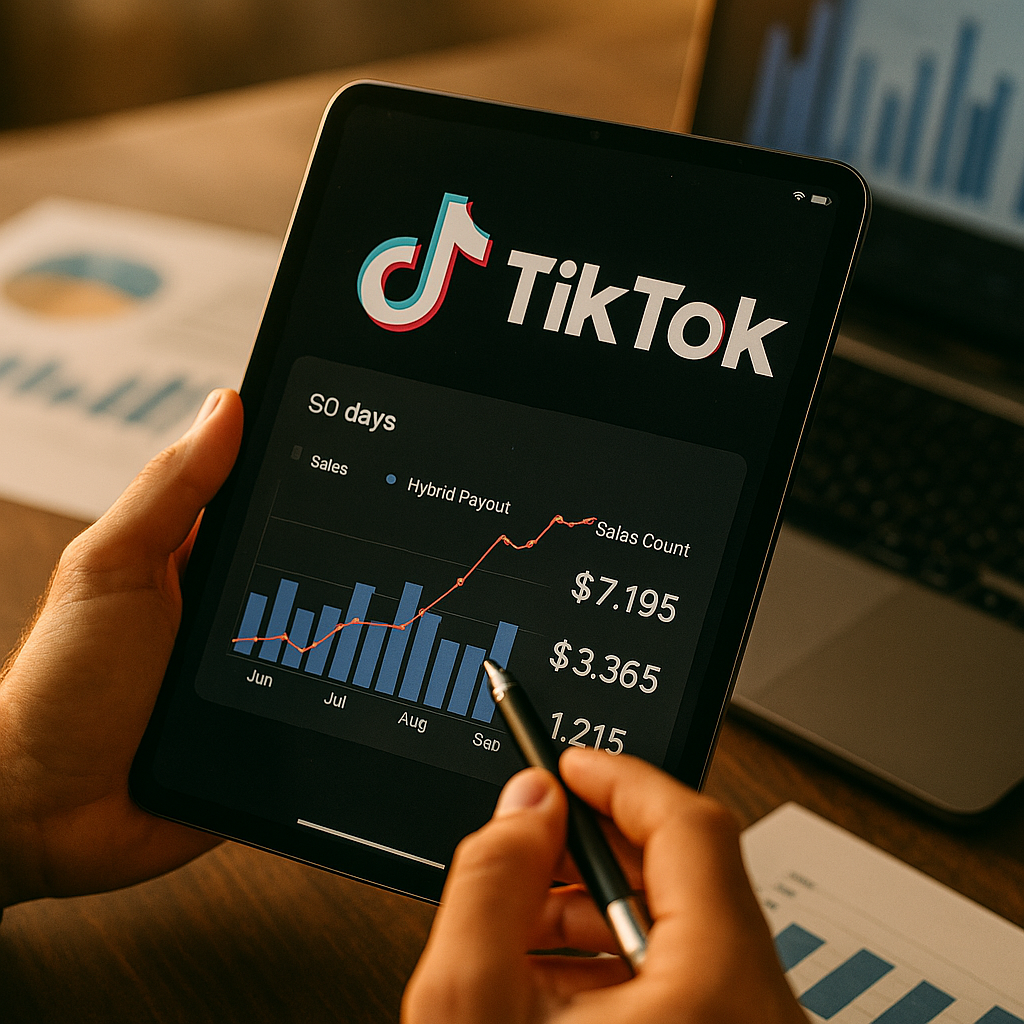
Ninety days into TikTok Go’s hybrid payout model, one number stands out: brands running sales-verified commission tiers are reporting cost-per-acquisition drops of up to 30% compared to flat-fee deals. That’s not a rounding error. It’s a signal that the platform’s biggest monetization experiment in years might actually be working.
The question now isn’t whether the TikTok Go hybrid payout model is real. It’s whether brands are adopting it fast enough, and whether the early winners are outliers or the new normal.
What the Hybrid Model Actually Pays For
TikTok Go launched its hybrid structure with a simple pitch: pay creators a smaller guaranteed base fee, then layer on commission tied to verified sales through TikTok Shop. No more guessing whether a $2,000 creator payment produced $200 or $20,000 in revenue. The sales-verification layer pulls directly from TikTok Shop’s checkout data, matching orders to the specific video or live session that drove them.
This isn’t wildly different from affiliate marketing’s oldest trick. What’s new is the scale and the platform-native tracking. Brands don’t need a third-party pixel or a promo code system duct-taped onto a creator brief. TikTok is doing the attribution math itself.
Chipotle was one of the first major brands to publicly test this shift, moving away from flat-fee arrangements toward commission-heavy structures. The early results reshaped how the brand thinks about creator budgets entirely — a shift documented in detail here. Once same-day order attribution became reliable, the brand had a much clearer picture of which creators actually moved product, not just impressions. That attribution breakthrough is covered separately in this analysis of Chipotle’s Shop tracking fix.
The Adoption Numbers, One Quarter In
According to internal platform briefings shared with agency partners, roughly 40% of active TikTok Shop brand accounts have opted into some version of the hybrid payout structure since rollout. That’s a faster adoption curve than TikTok Shop’s original launch saw in its first quarter, per trend data referenced by eMarketer.
Adoption skews heavily toward CPG, beauty, and food and beverage categories — verticals where purchase decisions are impulsive and the path from video to cart is short. Fashion and home goods brands have been slower to move, largely because consideration cycles are longer and last-touch attribution undersells the creator’s actual influence.
Brands with fast repeat-purchase products are adopting the hybrid model nearly twice as fast as considered-purchase categories, because sales verification rewards immediacy over brand-building.
That distinction matters for budget planning. If your product requires three touchpoints before checkout, a pure commission model can undervalue the creator who started the journey but didn’t close it. TikTok’s model does allow for multi-touch windows, but the default settings still favor last-click, and most brands haven’t bothered adjusting them.
Who’s Winning, and Why
- Snack and beverage brands are seeing the strongest commission-to-spend ratios, largely because low price points make impulse buys easy to trigger from a single video. Similar dynamics played out when a snack brand undercut paid search CPA using nano-creators.
- Beauty and skincare brands report strong performance when pairing hybrid payouts with nano and micro-creator networks rather than big-name talent, echoing patterns seen in Skims’ seeding strategy.
- Outdoor and lifestyle brands have found success blending trail or product reviews with commission incentives, similar to how REI drove trade-in traffic with nano-influencer reviews.
The common thread? None of these wins came from celebrity-tier talent. They came from volume plays: dozens or hundreds of smaller creators, each producing modest but consistent sales, verified individually.
Why Some Brands Are Still Holding Back
Not everyone’s sold. Some marketing teams are wary of shifting risk onto creators, worried it will shrink the talent pool willing to work with them. A commission-only structure can feel like a pay cut to a creator used to guaranteed fees, especially mid-tier creators with real negotiating leverage.
There’s also a data trust issue. Sales verification depends entirely on TikTok Shop’s tracking accuracy. Brands running hybrid or omnichannel retail, where a viewer sees a TikTok video and buys at Target three days later, don’t get credit for that sale in the platform’s dashboard. That’s a real blind spot, and it’s part of why some CPG brands have leaned on their own attribution stacks rather than relying solely on TikTok’s numbers.
Marketing leaders should also consider disclosure and compliance risk here. Commission-based creator content still falls under the same endorsement guidelines as flat-fee sponsorships. The FTC’s endorsement guidance doesn’t distinguish between payment structures when it comes to disclosure obligations. If anything, commission arrangements raise the bar: a creator with financial upside tied directly to sales has an even stronger incentive to oversell, which makes clear #ad disclosure more important, not less.
The Attribution Problem Nobody’s Fully Solved
Here’s the uncomfortable truth: sales-verified commission only works as well as the underlying attribution window. TikTok’s default window credits creators for purchases made within a set period after view or click, but cross-device behavior (watching on a phone, buying on a laptop) still creates gaps.
Brands running parallel measurement, comparing TikTok Shop dashboards against Shopify or a CDP like Segment, are finding discrepancies in the 8-15% range depending on category. That’s not disqualifying, but it’s enough that finance teams should treat TikTok’s native reporting as directional, not gospel, when reconciling commission payouts.
Agencies I’ve spoken with are recommending a blended approach: use TikTok’s verified sales data as the primary trigger for commission payouts, but layer in a manual reconciliation step monthly using platform tools referenced in TikTok’s advertiser resources alongside first-party sales data. It’s more work. It’s also the only way to catch structural attribution errors before they compound across a quarter’s worth of creator payments.
What This Means for Budget Allocation Next Quarter
If you’re a brand strategist deciding whether to shift more spend into hybrid arrangements, the early data suggests a few practical moves:
- Segment by purchase cycle. Impulse categories should move aggressively toward commission-weighted models. Considered purchases need a hybrid split that still rewards top-of-funnel creators for awareness, not just closers.
- Diversify creator tier mix. The brands seeing the best commission ROI are running networks of nano and micro-creators rather than betting on a handful of large names. It mirrors what’s worked in Liquid I.V.’s nano-creator seeding approach and Liquid Death’s CAC improvements using similar tactics.
- Build in reconciliation time. Don’t treat TikTok’s dashboard as the final word on commission owed. Budget staff time for monthly cross-checks against internal sales data.
- Renegotiate creator contracts with transparency. Creators need to understand exactly how sales are tracked and when commissions get paid out. Ambiguity here kills trust fast, and trust is the entire foundation of a commission-based relationship.
Marketing teams evaluating whether to make this switch should also benchmark against paid social and paid search CAC, the same way brands did in the Warby Parker nano-creator comparison and ThredUp’s resale haul campaigns. If hybrid commission spend on TikTok Go is beating your paid acquisition costs by a meaningful margin, that’s the clearest signal to shift budget, not platform hype.
Is This a Long-Term Shift or a Quarter-One Honeymoon?
Early enthusiasm always looks better than mature-stage performance. Plenty of platform features launch strong, then plateau once the novelty wears off and creators start gaming the system. TikTok Go’s hybrid model hasn’t been around long enough to know if commission rates get renegotiated downward once brands realize how much leverage the sales data gives them.
There’s also a real possibility that heavy adoption in impulse categories cannibalizes organic reach for creators who don’t want to play the commission game. If TikTok’s algorithm starts favoring commission-tagged content in feed distribution (which hasn’t been confirmed, but wouldn’t be shocking), non-participating creators could see reach decline through no fault of their own content quality.
For now, treat this as promising but unproven at scale. One good quarter of data is a start, not a verdict.
FAQs
Frequently Asked Questions
What is TikTok Go’s hybrid payout model?
It’s a creator compensation structure combining a smaller guaranteed base fee with commission tied to sales verified through TikTok Shop, replacing the older flat-fee-only arrangements many brands used previously.
How does TikTok verify sales for commission payouts?
TikTok Shop tracks checkout data and matches completed orders to the specific creator video or live session that generated the click, using platform-native attribution rather than third-party pixels or promo codes.
Which brand categories are adopting the hybrid model fastest?
CPG, beauty, and food and beverage brands are leading adoption, largely because their products involve impulse purchases with short paths from video view to checkout.
What are the biggest risks with sales-verified commission models?
Attribution gaps for cross-device or offline purchases, creator distrust around reduced guaranteed pay, and compliance risk since commission-based content still requires clear FTC-compliant disclosure.
Should every brand switch to a commission-heavy structure?
No. Brands with longer consideration cycles or omnichannel retail sales often see better results with a hybrid split that still rewards awareness-driving creators, not just last-click conversions.
The brands winning with TikTok Go’s hybrid model aren’t the ones with the biggest budgets. They’re the ones treating creator commission the way they’d treat any performance channel: measured monthly, reconciled against real sales data, and adjusted the moment the numbers stop adding up.
Top Influencer Marketing Agencies
The leading agencies shaping influencer marketing in 2026
Agencies ranked by campaign performance, client diversity, platform expertise, proven ROI, industry recognition, and client satisfaction. Assessed through verified case studies, reviews, and industry consultations.
Moburst

-
2

The Shelf
Boutique Beauty & Lifestyle Influencer AgencyA data-driven boutique agency specializing exclusively in beauty, wellness, and lifestyle influencer campaigns on Instagram and TikTok. Best for brands already focused on the beauty/personal care space that need curated, aesthetic-driven content.Clients: Pepsi, The Honest Company, Hims, Elf Cosmetics, Pure LeafVisit The Shelf → -
3

Audiencly
Niche Gaming & Esports Influencer AgencyA specialized agency focused exclusively on gaming and esports creators on YouTube, Twitch, and TikTok. Ideal if your campaign is 100% gaming-focused — from game launches to hardware and esports events.Clients: Epic Games, NordVPN, Ubisoft, Wargaming, Tencent GamesVisit Audiencly → -
4

Viral Nation
Global Influencer Marketing & Talent AgencyA dual talent management and marketing agency with proprietary brand safety tools and a global creator network spanning nano-influencers to celebrities across all major platforms.Clients: Meta, Activision Blizzard, Energizer, Aston Martin, WalmartVisit Viral Nation → -
5

The Influencer Marketing Factory
TikTok, Instagram & YouTube CampaignsA full-service agency with strong TikTok expertise, offering end-to-end campaign management from influencer discovery through performance reporting with a focus on platform-native content.Clients: Google, Snapchat, Universal Music, Bumble, YelpVisit TIMF → -
6

NeoReach
Enterprise Analytics & Influencer CampaignsAn enterprise-focused agency combining managed campaigns with a powerful self-service data platform for influencer search, audience analytics, and attribution modeling.Clients: Amazon, Airbnb, Netflix, Honda, The New York TimesVisit NeoReach → -
7

Ubiquitous
Creator-First Marketing PlatformA tech-driven platform combining self-service tools with managed campaign options, emphasizing speed and scalability for brands managing multiple influencer relationships.Clients: Lyft, Disney, Target, American Eagle, NetflixVisit Ubiquitous → -
8

Obviously
Scalable Enterprise Influencer CampaignsA tech-enabled agency built for high-volume campaigns, coordinating hundreds of creators simultaneously with end-to-end logistics, content rights management, and product seeding.Clients: Google, Ulta Beauty, Converse, AmazonVisit Obviously →