


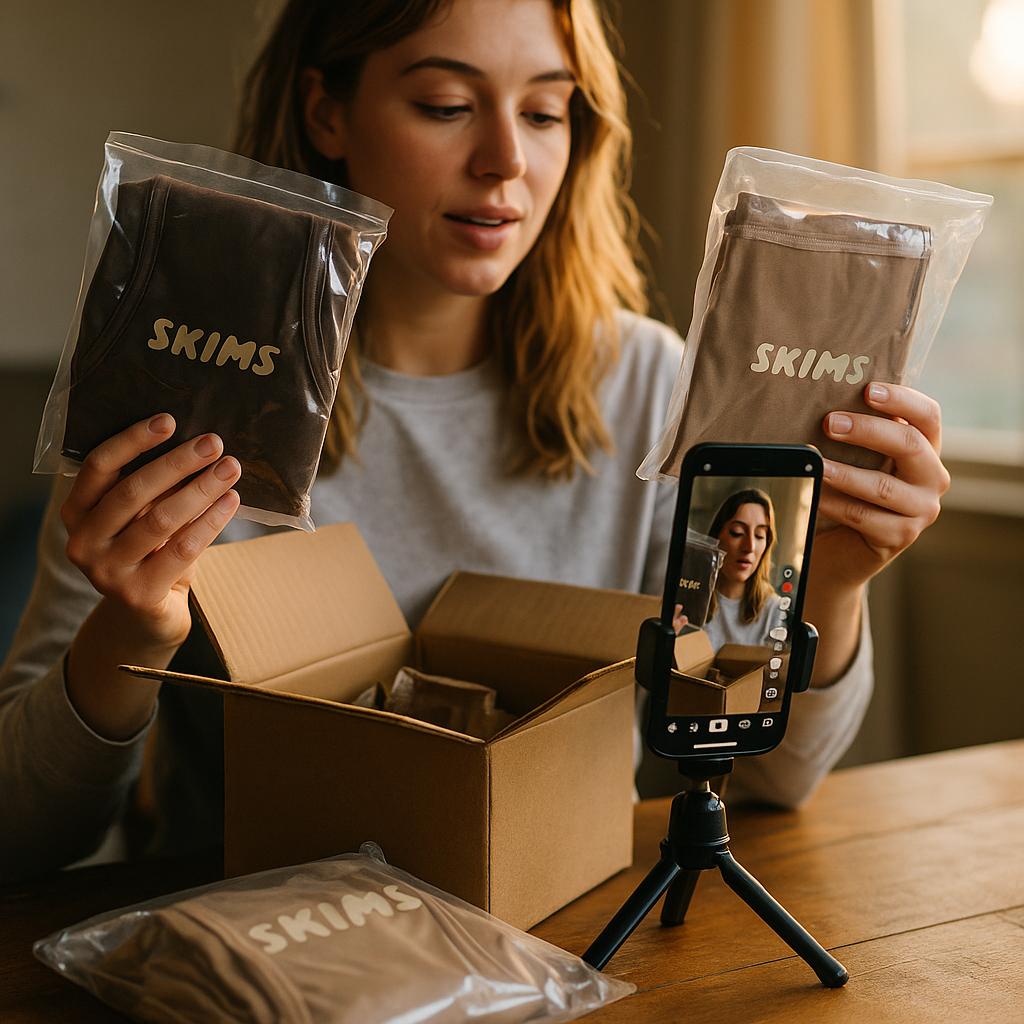
Skims doesn’t run a single paid TikTok ad before a major drop. And yet its restocks and collaborations routinely sell out in under 10 minutes, sometimes crashing the site in the process. No boosted posts. No influencer contracts with guaranteed views. Just seeding, timing, and a distribution model most brands still haven’t figured out. This is the TikTok seeding strategy playbook worth stealing.
The Numbers Behind the Hype
Skims doesn’t publish granular sell-through data, but the pattern is consistent enough to study. Drops with names like the Kim Kardashian holiday collection or the men’s underwear launch with Snoop Dogg have sold out sitewide within minutes of going live, according to widespread creator and press coverage. Search interest spikes on TikTok in the 48 hours before launch, then site traffic surges the moment the countdown hits zero.
None of that traffic comes from a media buy. Skims spends its dollars on seeding: sending product to creators, celebrities, and micro-influencers ahead of launch, with zero requirement that they post a certain way, tag a certain link, or hit a certain view count. The content that results looks native because it is native. Nobody’s watching a sponsored placement. They’re watching someone’s genuine unboxing reaction.
Skims treats seeding as a distribution system, not a gifting program. The product itself is the media buy.
What “Zero-Paid-Media” Actually Means in Practice
Let’s be precise about the claim, because “zero paid media” gets thrown around loosely in marketing circles. Skims isn’t avoiding paid channels entirely; the brand does run performance marketing for evergreen SKUs and uses email and SMS aggressively. But for the drop mechanic specifically, the mechanic that generates the sellout headlines, the pre-launch buzz is built almost entirely on organic and gifted content.
The strategy breaks down into three layers:
- Celebrity and mega-creator seeding. Kim Kardashian’s own following does heavy lifting, but the brand also seeds product to adjacent celebrities and creators who have no formal brand deal, just a relationship built over multiple drops.
- Mid-tier fashion and body-positive creators. This tier produces try-on hauls, size comparisons, and “is it worth the hype” videos that rank well in TikTok search and get cross-posted to Instagram Reels.
- Nano and micro creators seeded in bulk. Lower cost per unit, higher volume, and crucially, these creators post the unscripted, low-production content that performs best in TikTok’s For You feed algorithm.
The layering matters. Celebrity seeding creates the initial spike of awareness. Mid-tier creators translate that into product education, answering the questions a shopper actually has (does it run small, does it hold up after washing, is it worth $68). Nano-creators create volume and social proof, the “everyone’s talking about this” effect that drives urgency.
Why This Works Better Than a Media Buy
A paid TikTok campaign has a ceiling. You can throw six figures at a boosted post and still get flagged as an ad, skipped, or scrolled past. TikTok users have gotten remarkably good at pattern-matching sponsored content within the first second of a video. Seeded, unpaid content doesn’t trigger that same skepticism because there’s no “Sponsored” label to spot.
There’s also a compounding effect that paid media doesn’t replicate. Seeded content generates duets, stitches, and comment threads that extend the content’s life well past the original post. A single try-on video from a mid-tier creator can spawn dozens of reaction videos, none of which cost Skims anything, all of which point back to the same product drop.
This isn’t a new insight for brands paying attention to the creator economy. Liquid Death’s nano-creator seeding strategy runs on a similar logic: product in hands beats ad dollars in an auction. Same with Vessi’s single viral TikTok that turned into a lasting referral engine without a media plan behind it. What differs with Skims is speed and scale: they’re compressing the entire demand curve into a 10-minute window, on purpose.
Scarcity Is the Real Growth Lever
Seeding creates the content. Scarcity creates the urgency. Skims almost never restocks a specific colorway or print at the same volume twice, and drops are announced with tight lead times, sometimes just days out. That combination trains the audience to act fast or miss out entirely.
Compare that to the standard DTC playbook, where brands over-produce, discount aggressively within weeks of launch, and train customers to wait for a sale. Skims does the opposite. Scarcity isn’t a marketing gimmick bolted onto the launch; it’s baked into the production planning itself.
When you combine authentic, unpaid content with genuine product scarcity, urgency becomes self-reinforcing. Shoppers aren’t responding to an ad. They’re responding to social proof plus a countdown clock.
Marketers should note the risk here too. Chronic under-stocking frustrates loyal customers and can create secondary-market reselling at inflated prices, which introduces brand safety and pricing control issues. Skims manages this by communicating restock timing through its own channels and by leaning on Kardashian-family reach to reset expectations quickly. Smaller brands without that built-in amplification need a different backstop, usually a waitlist or SMS list that substitutes for celebrity reach.
The Compliance Question Nobody’s Asking
Here’s where brand and legal teams should pay closer attention. Unpaid seeding still falls under FTC disclosure rules if there’s a material connection between brand and creator, and “we sent free product” counts as material. The FTC’s endorsement guidelines require disclosure regardless of whether money changed hands. Skims’ creators overwhelmingly use #gifted or #skims tags, but enforcement across thousands of nano and micro creators is inconsistent, and it’s a compliance gap larger brands running seeding programs at scale need to actively manage, not assume will self-correct.
This is also where seeding differs meaningfully from affiliate or commission models. Programs like Chipotle’s shift to commission-based creator payouts create a paper trail through the platform itself. Pure product seeding doesn’t, which means disclosure compliance rests almost entirely on creator behavior and spot-checking by the brand’s legal or comms team.
Can Smaller Brands Actually Replicate This?
The honest answer: partially. Skims has three unfair advantages most brands don’t: a founder with 300+ million combined social followers, a fashion category with strong visual and try-on appeal, and a customer base primed for scarcity marketing because of years of hype-driven drop culture in adjacent categories like sneakers and streetwear.
That said, the underlying mechanics scale down. Brands without a celebrity founder can still build a tiered seeding program:
- Identify creators already talking about your category, not just your brand, and seed product before they ask.
- Prioritize nano and micro creators for volume, the same way Aldi’s grocery haul seeding or ThredUp’s resale hauls generated cost-efficient reach without a media budget.
- Build real scarcity into launch calendars, not fake countdown timers, actual limited production runs.
- Track content performance manually if you lack enterprise tooling, since seeding programs without paid media don’t generate the same attribution data a paid campaign would.
That last point trips up a lot of mid-market brands. Without ad spend, there’s no campaign dashboard showing impressions and click-through. Measurement has to shift toward share of voice, branded search lift, and direct traffic spikes correlated with seeding waves, metrics that require more manual stitching but are entirely trackable with tools like Sprout Social or native TikTok Creative Center data.
What the Data Says About Organic Reach Right Now
Industry benchmarks back up why brands are leaning harder into seeding. eMarketer has repeatedly flagged rising CPMs across social platforms, squeezing ROI on paid social campaigns, while organic engagement on creator content continues to outperform branded posts on trust metrics. HubSpot’s creator marketing research has found consumers consistently rate creator recommendations as more trustworthy than brand advertising, particularly among Gen Z shoppers, the exact demographic driving Skims’ drop culture.
That trust gap is the entire reason seeding outperforms paid media for launch moments. It’s not that paid ads don’t work. It’s that they can’t manufacture the specific kind of social proof a sellout requires: the appearance that real people, unprompted, are excited about a product before you even ask them to be.
Where This Goes Next
Expect more fashion and beauty brands to copy the Skims model in the next 12 months, layering celebrity seeding with structured nano-creator waves ahead of every drop. The brands that get it right will treat seeding as a repeatable operational system with clear tiers, timing, and compliance checks, not a one-off PR stunt. The brands that get it wrong will send free product to whoever has the biggest following and wonder why nothing sells out.
Frequently Asked Questions
What is a TikTok seeding strategy?
A TikTok seeding strategy involves sending free product to creators and influencers without paid contracts or guaranteed posting requirements, relying on genuine reactions to generate organic reach and social proof rather than paid ad placements.
Does Skims pay influencers for TikTok content?
Skims runs some paid partnerships for evergreen products, but its signature drop launches rely primarily on unpaid product seeding to celebrities, mid-tier creators, and nano-influencers, which is what generates the viral sellout effect.
Is unpaid product seeding still subject to FTC disclosure rules?
Yes. The FTC considers free product a material connection between brand and creator, meaning disclosure (such as #gifted) is required regardless of whether cash payment occurred.
Can smaller brands without celebrity founders replicate this model?
Partially. Smaller brands can build tiered nano and micro-creator seeding programs, create genuine product scarcity, and track branded search and direct traffic lift, but they’ll lack the instant amplification a celebrity founder provides.
How do brands measure ROI on a seeding-only strategy?
Without paid media, brands typically track branded search volume, share of voice, direct traffic spikes correlated with seeding waves, and sell-through rate rather than traditional paid campaign metrics like impressions and CTR.
Next step: Audit your last product launch and ask whether your creator budget went toward paid placements or genuine product seeding. If it’s mostly the former, start shifting 20% of that spend into a structured, tiered gifting program and measure branded search lift before your next drop.
Top Influencer Marketing Agencies
The leading agencies shaping influencer marketing in 2026
Agencies ranked by campaign performance, client diversity, platform expertise, proven ROI, industry recognition, and client satisfaction. Assessed through verified case studies, reviews, and industry consultations.
Moburst

-
2

The Shelf
Boutique Beauty & Lifestyle Influencer AgencyA data-driven boutique agency specializing exclusively in beauty, wellness, and lifestyle influencer campaigns on Instagram and TikTok. Best for brands already focused on the beauty/personal care space that need curated, aesthetic-driven content.Clients: Pepsi, The Honest Company, Hims, Elf Cosmetics, Pure LeafVisit The Shelf → -
3

Audiencly
Niche Gaming & Esports Influencer AgencyA specialized agency focused exclusively on gaming and esports creators on YouTube, Twitch, and TikTok. Ideal if your campaign is 100% gaming-focused — from game launches to hardware and esports events.Clients: Epic Games, NordVPN, Ubisoft, Wargaming, Tencent GamesVisit Audiencly → -
4

Viral Nation
Global Influencer Marketing & Talent AgencyA dual talent management and marketing agency with proprietary brand safety tools and a global creator network spanning nano-influencers to celebrities across all major platforms.Clients: Meta, Activision Blizzard, Energizer, Aston Martin, WalmartVisit Viral Nation → -
5

The Influencer Marketing Factory
TikTok, Instagram & YouTube CampaignsA full-service agency with strong TikTok expertise, offering end-to-end campaign management from influencer discovery through performance reporting with a focus on platform-native content.Clients: Google, Snapchat, Universal Music, Bumble, YelpVisit TIMF → -
6

NeoReach
Enterprise Analytics & Influencer CampaignsAn enterprise-focused agency combining managed campaigns with a powerful self-service data platform for influencer search, audience analytics, and attribution modeling.Clients: Amazon, Airbnb, Netflix, Honda, The New York TimesVisit NeoReach → -
7

Ubiquitous
Creator-First Marketing PlatformA tech-driven platform combining self-service tools with managed campaign options, emphasizing speed and scalability for brands managing multiple influencer relationships.Clients: Lyft, Disney, Target, American Eagle, NetflixVisit Ubiquitous → -
8

Obviously
Scalable Enterprise Influencer CampaignsA tech-enabled agency built for high-volume campaigns, coordinating hundreds of creators simultaneously with end-to-end logistics, content rights management, and product seeding.Clients: Google, Ulta Beauty, Converse, AmazonVisit Obviously →