


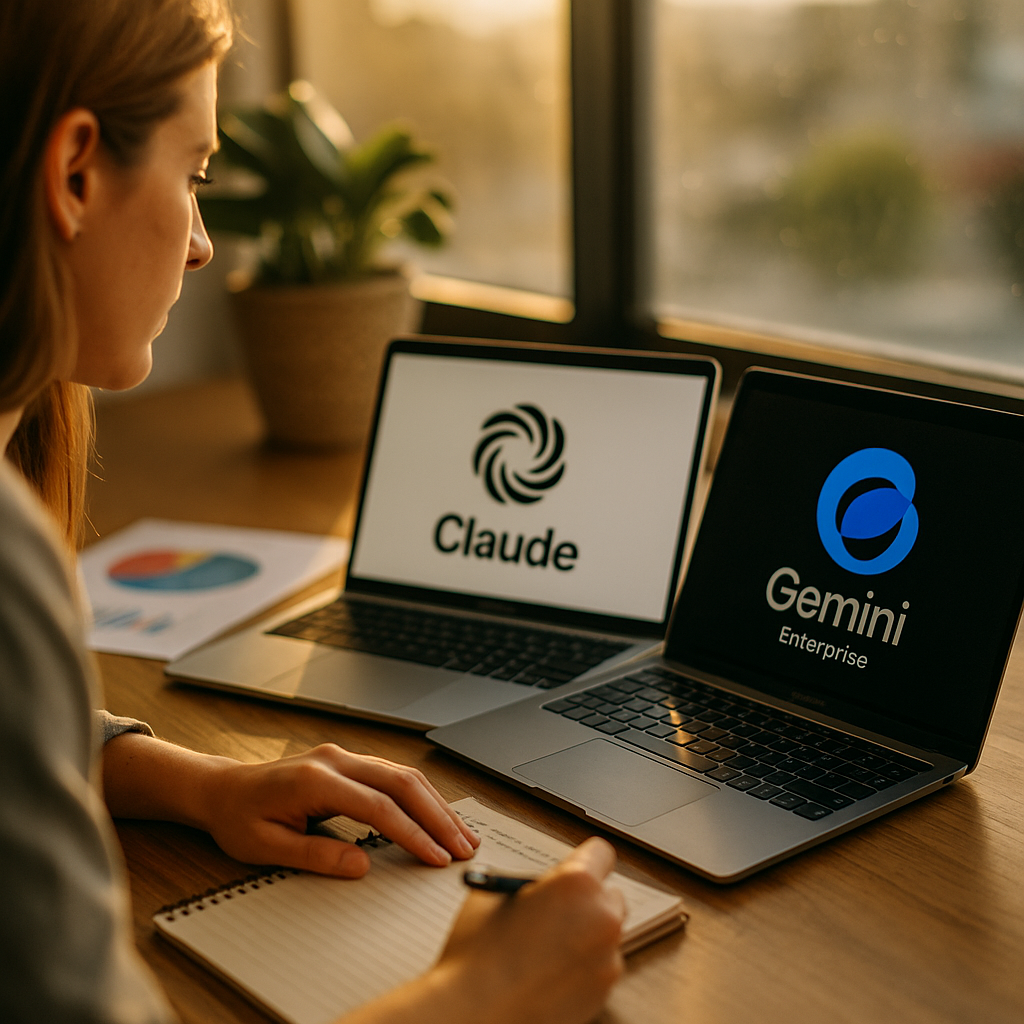
Two-thirds of enterprise marketing teams say they’ll consolidate to a single primary AI vendor within the next 12 months, according to recent eMarketer survey data. That’s a big bet to make on one partner. So which one deserves your brand’s budget, workflows, and legal team’s blessing: Claude for Enterprise or Google Gemini Enterprise? The honest answer depends less on benchmark scores and more on how each platform handles the messy realities of brand marketing operations.
This isn’t an academic comparison. If you’re a CMO or head of marketing ops evaluating a primary AI platform partner, you need answers on compliance posture, integration cost, and what happens when a campaign goes sideways because a model hallucinated a claim about your product. Let’s get into it.
Why This Decision Is Different From a Typical Tool Purchase
Choosing a primary AI platform isn’t like picking a social listening tool or a new CRM plug-in. It touches legal review, brand voice consistency, creative production, media planning, and customer-facing copy all at once. Get it wrong and you’re not just out a subscription fee. You’re re-training hundreds of marketers, migrating prompt libraries, and possibly explaining to legal why a chatbot cited a competitor’s pricing.
That’s why this evaluation matters more than most vendor comparisons Influencers Time covers. The stakes are operational, not cosmetic.
The real cost of an AI platform isn’t the license fee. It’s the hours your team spends re-prompting, fact-checking, and escalating outputs that should have been correct the first time.
Claude for Enterprise: The Compliance-First Choice
Anthropic has built its enterprise pitch almost entirely around trust and safety. Claude for Enterprise ships with constitutional AI guardrails, granular data retention controls, and what Anthropic calls “steerability” for tone and brand voice. For marketing teams in regulated categories (finance, healthcare, CPG with FTC-sensitive claims), this matters enormously.
If you’ve read our breakdown of Claude’s enterprise suite for financial services, you already know Anthropic leans hard into audit trails and refusal transparency. That same DNA carries into the general enterprise product. Claude tends to decline ambiguous or risky brand claims rather than guess, which sounds conservative until you remember the FTC’s increasing scrutiny of AI-generated advertising claims.
Where Claude falls short: native integration with ad platforms and media buying stacks. Anthropic isn’t a media company. It doesn’t own a DSP, a search engine, or a video platform. So if your workflow depends on tight loops between content generation and campaign execution, you’ll be stitching together third-party connectors.
Where Claude Genuinely Wins
- Long-context document review for brand guidelines, legal redlines, and campaign briefs (Claude’s context window handles full campaign playbooks without truncation).
- Lower hallucination rates on factual brand claims, based on internal QA testing many agencies now run before every model swap.
- Cleaner data governance controls, which speeds up procurement and legal sign-off, similar to the friction we’ve documented in AI budget approval workflows.
Gemini Enterprise: The Ecosystem Play
Google’s pitch is fundamentally different. Gemini Enterprise isn’t just a chatbot with an API key, it’s the connective tissue across Google Workspace, Google Ads, YouTube, and increasingly, Google’s Vertex AI stack for custom model tuning. If your media budget already lives in Google Ads and your creative assets sit in Drive, the operational friction of adopting Gemini is close to zero.
That’s not a small thing. Our piece on AI format prediction tools for CTV, social, and display found that platform-native tools consistently beat standalone point solutions on speed to activation, simply because there’s no data hand-off delay.
Gemini also benefits from Google’s multimodal head start. Video, image, and text generation live under one roof, which matters if you’re producing creative variants at scale. We’ve seen brands compare this directly against dedicated video generation tools in our Sora vs Veo 3 vs Runway Gen-4 cost comparison, and Gemini’s tie-in with Veo gives Google a real production advantage that Anthropic simply doesn’t have.
The tradeoff? Governance transparency. Google’s enterprise terms have improved, but marketing compliance teams still report more friction getting clear answers on training data usage and output attribution compared to Anthropic’s more legible policies. If your legal team already has concerns about walled-garden platforms shaping ad measurement (see our coverage of governance gaps in platform-native ad tools), expect similar questions here.
Head-to-Head: What Actually Matters for Brand Teams
Brand voice consistency. Claude edges ahead here. Its steerability settings let you lock tone parameters more precisely, which reduces the “sounds almost right but not quite us” problem that plagues generic LLM outputs. Gemini has improved with custom instructions, but marketers running multi-brand portfolios report more drift across sessions.
Media integration and activation speed. Gemini wins decisively. Native connections to Google Ads, Performance Max, and YouTube mean less manual export-import work. If your team is already stretched thin, this operational efficiency alone might tip the decision.
Compliance and risk mitigation. Claude wins, particularly for regulated industries or any brand that’s been burned by an AI-generated claim triggering a legal review. Anthropic’s refusal-first design philosophy costs you some creative flexibility but buys you fewer 2 a.m. calls from legal.
Cost at scale. This is close, and pricing structures shift often enough that any specific number here would be stale within a quarter. What’s consistent: Gemini Enterprise pricing tends to bundle more tightly with existing Google Cloud and Workspace spend, which can look cheaper on paper but obscures true cost if you’re not already deep in the Google ecosystem. Claude’s standalone pricing is more transparent but doesn’t get you volume discounts tied to other software spend.
If more than 60% of your media budget already runs through Google Ads, the switching cost of choosing Claude as your primary platform may outweigh its compliance advantages. Run the math before you run the pilot.
A Quick Gut Check for Procurement Teams
Ask these three questions before you sign anything:
- Does our current martech stack already lean Google (Analytics, Ads, Workspace)? If yes, switching costs favor Gemini.
- Are we in a regulated category where AI-generated claims carry legal exposure? If yes, Claude’s guardrails are worth the integration friction.
- Do we have internal engineering resources to build custom connectors? If no, Gemini’s native integrations save real headcount.
None of this is revolutionary logic. It’s the same framework we’ve applied when comparing other platform-native versus best-of-breed decisions, like in our TikTok Symphony vs Meta Advantage+ governance guide. The pattern holds: ecosystem lock-in trades flexibility for speed, every single time.
The Hybrid Option Nobody Talks About
Here’s the thing vendors won’t tell you: plenty of sophisticated marketing orgs are running both. Claude for high-stakes copy review, legal-adjacent content, and brand voice governance. Gemini for high-volume creative production and media activation where speed matters more than precision.
Is this more complex to manage? Sure. But if you’ve already built out a vendor evaluation muscle, similar to what we outlined in our guide to evaluating AI ad format prediction tools before you buy, a dual-platform approach might actually reduce risk rather than add it. You’re not putting all your operational eggs in one API basket.
The downside is obvious: two contracts, two sets of training requirements, two vendor relationships to manage. For lean marketing teams, that overhead might not be worth the flexibility.
So, Which One Should You Actually Pick?
If your organization prioritizes risk mitigation, operates in a regulated category, or has been burned by AI-generated claims before, Claude for Enterprise is the safer primary bet. If your marketing operation is deeply embedded in Google’s ecosystem and speed-to-activation is your biggest constraint, Gemini Enterprise will feel like the path of least resistance.
There’s no universal right answer here. There’s only the right answer for your specific stack, risk tolerance, and team capacity. Run a 90-day pilot with clear KPIs (not vague “efficiency gains”) before committing to a multi-year enterprise agreement. Test both on the same brief. See which one your legal team stops flagging first.
Frequently Asked Questions
Is Claude for Enterprise or Gemini Enterprise better for regulated industries?
Claude for Enterprise generally offers stronger compliance guardrails and more transparent refusal behavior, making it the safer default for finance, healthcare, and other heavily regulated marketing categories.
Does Gemini Enterprise integrate directly with Google Ads and YouTube?
Yes. Gemini Enterprise has native connections across Google Workspace, Google Ads, and YouTube, which significantly reduces activation time for teams already using those platforms.
Can brand marketing teams use both platforms at once?
Some organizations run a hybrid model, using Claude for compliance-sensitive content review and Gemini for high-volume creative production and media activation. It adds vendor management overhead but can reduce concentration risk.
Which platform has lower total cost of ownership?
It depends on your existing stack. Gemini Enterprise often bundles more affordably if you already spend heavily on Google Cloud or Workspace. Claude’s standalone pricing is more transparent but won’t benefit from cross-product discounts.
How long should a pilot period last before committing to one platform?
A 90-day pilot with defined KPIs, tested against the same creative briefs and compliance scenarios, gives most marketing teams enough signal to make a confident enterprise-wide decision.
Bottom line: don’t pick a primary AI platform based on demo-day polish. Run both through your worst-case compliance scenario and your highest-volume production week, then let the friction points make the decision for you.
Top Influencer Marketing Agencies
The leading agencies shaping influencer marketing in 2026
Agencies ranked by campaign performance, client diversity, platform expertise, proven ROI, industry recognition, and client satisfaction. Assessed through verified case studies, reviews, and industry consultations.
Moburst

-
2

The Shelf
Boutique Beauty & Lifestyle Influencer AgencyA data-driven boutique agency specializing exclusively in beauty, wellness, and lifestyle influencer campaigns on Instagram and TikTok. Best for brands already focused on the beauty/personal care space that need curated, aesthetic-driven content.Clients: Pepsi, The Honest Company, Hims, Elf Cosmetics, Pure LeafVisit The Shelf → -
3

Audiencly
Niche Gaming & Esports Influencer AgencyA specialized agency focused exclusively on gaming and esports creators on YouTube, Twitch, and TikTok. Ideal if your campaign is 100% gaming-focused — from game launches to hardware and esports events.Clients: Epic Games, NordVPN, Ubisoft, Wargaming, Tencent GamesVisit Audiencly → -
4

Viral Nation
Global Influencer Marketing & Talent AgencyA dual talent management and marketing agency with proprietary brand safety tools and a global creator network spanning nano-influencers to celebrities across all major platforms.Clients: Meta, Activision Blizzard, Energizer, Aston Martin, WalmartVisit Viral Nation → -
5

The Influencer Marketing Factory
TikTok, Instagram & YouTube CampaignsA full-service agency with strong TikTok expertise, offering end-to-end campaign management from influencer discovery through performance reporting with a focus on platform-native content.Clients: Google, Snapchat, Universal Music, Bumble, YelpVisit TIMF → -
6

NeoReach
Enterprise Analytics & Influencer CampaignsAn enterprise-focused agency combining managed campaigns with a powerful self-service data platform for influencer search, audience analytics, and attribution modeling.Clients: Amazon, Airbnb, Netflix, Honda, The New York TimesVisit NeoReach → -
7

Ubiquitous
Creator-First Marketing PlatformA tech-driven platform combining self-service tools with managed campaign options, emphasizing speed and scalability for brands managing multiple influencer relationships.Clients: Lyft, Disney, Target, American Eagle, NetflixVisit Ubiquitous → -
8

Obviously
Scalable Enterprise Influencer CampaignsA tech-enabled agency built for high-volume campaigns, coordinating hundreds of creators simultaneously with end-to-end logistics, content rights management, and product seeding.Clients: Google, Ulta Beauty, Converse, AmazonVisit Obviously →