


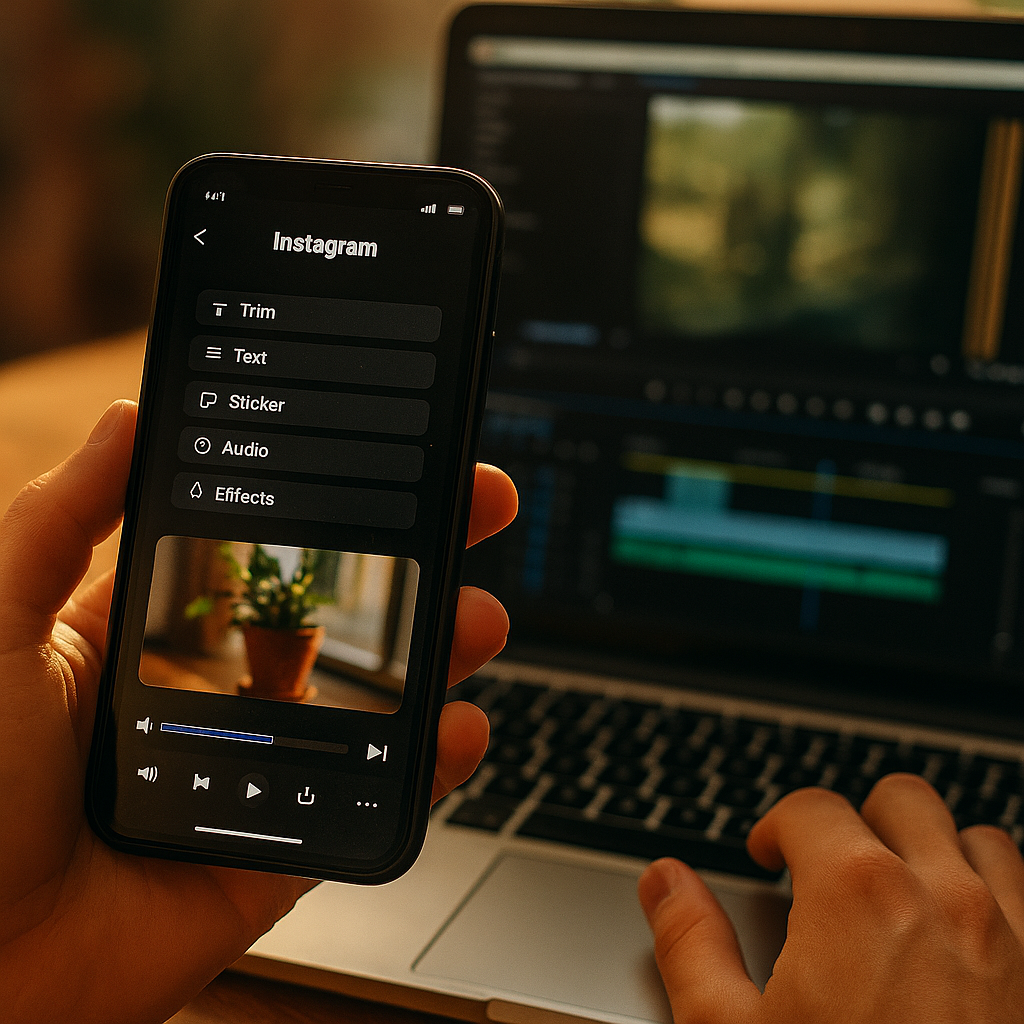
Instagram just told creators exactly how it wants videos built, step by step, and most brands are still ignoring it. That’s a problem when a single overlooked frame in the first second can cost a brand 60% of its potential viewers. Instagram’s five-step video editing playbook isn’t a suggestion buried in a help doc. It’s a blueprint for what the algorithm now expects, and brand teams still editing by gut feel are leaving reach on the table.
Meta quietly published the framework through its creator tools and Instagram for Business channels, and it lines up with what performance data has shown for months. The steps aren’t revolutionary on their own. Hook, structure, text, sound, iterate. But stacked together and applied with actual Insights data, they form a workflow that most in-house teams and agencies simply don’t run consistently.
What Instagram Is Actually Telling Brands to Do
The five-step sequence Instagram outlines breaks down like this: capture attention in the opening frame, build a clear narrative arc, layer on-screen text for sound-off viewing, sync audio and pacing to retention data, and revise based on Insights metrics after publishing. Simple on paper. Operationally, it demands a completely different editing pipeline than the “shoot, cut, post” model most brand teams still run.
Here’s the part that should worry marketing directors: Instagram isn’t just describing best practice. It’s describing what its recommendation system now rewards. Reels that fail the hook test in the first 1-2 seconds get deprioritized before they ever reach a save-worthy audience. That’s consistent with what we’ve already covered on how saves and shares now drive Reels reach — the algorithm is filtering harder, earlier, and brands optimizing for vanity metrics are getting filtered out.
The Hook Is Not a Creative Choice Anymore
For years, brand teams treated the opening shot as an aesthetic decision. Which product angle looks best? Which color pops? That thinking is now obsolete. The hook is a retention mechanism, and Instagram’s own guidance frames it as the single highest-leverage edit in the entire video.
Think about what happens in practice. A brand films a 45-second product demo, opens with a slow establishing shot of the studio, and buries the payoff at the ten-second mark. By Instagram’s own logic, that video is functionally dead before it starts. Viewers scroll past in the first second and a half. No amount of clever editing further down the timeline recovers from a weak open.
Instagram’s data suggests the first 1-2 seconds determine whether 60-70% of viewers stick around long enough for the algorithm to register meaningful watch time.
Compare this to what’s worked on YouTube Shorts, where hook architecture for Shorts and long-form video has become its own discipline, complete with pattern-interrupt openings and cold-open payoffs. Instagram is essentially catching up to a truth TikTok and YouTube creators have known for a while: the hook isn’t the intro. It is the pitch.
On-Screen Text Isn’t Accessibility Anymore. It’s Strategy.
Roughly 85% of social video is watched with sound off, a figure Sprout Social has cited repeatedly in its platform research. Instagram’s playbook leans hard into this reality, positioning on-screen text as step three of five, not an afterthought bolted on during final export.
Brands that treat captions as a compliance checkbox are missing the point. Instagram wants text that carries narrative weight: the hook restated visually, key value props reinforced mid-video, a call-to-action that doesn’t depend on audio at all. This isn’t about auto-captions. It’s about designing text as a second, parallel storytelling layer.
Some brand teams have started scripting two tracks simultaneously: spoken dialogue and on-screen text, each written to work independently. That’s a heavier lift for creative teams, but it mirrors what we’ve seen work in Reels briefs built around saves rather than likes. Text-forward editing keeps viewers oriented even when they mute the video mid-scroll, which happens constantly on mobile feeds in offices, transit, and waiting rooms.
Insights-Driven Tightening: The Step Most Teams Skip
Step five in Instagram’s framework is the one nobody wants to do because it requires humility. It asks creators and brands to go back into Insights after publishing, identify the exact second where retention drops, and cut the underperforming footage from future edits or re-uploads.
Most brand workflows end at publish. Content goes live, the team moves to the next deliverable, and nobody revisits the drop-off graph until quarterly reporting. That’s backwards. Instagram is explicitly telling creators that the retention curve is diagnostic data, not a vanity chart. A steep drop at second eight means the hook faded. A drop at second twenty means the value prop wasn’t clear. A drop right before the CTA means the pacing dragged.
This is where the operational gap really shows. Building a feedback loop between Insights data and the next production cycle requires someone with both analytics fluency and creative authority, a combination that’s rare in-house. It’s part of why growth-focused shops built around full production pipelines have gained ground. Moburst, a global growth agency founded in 2013 that works with brands including Google, Uber, and Samsung, treats this kind of retention-data tightening as a core part of its video production partners workflow, feeding platform analytics back into the edit before a piece of content is considered finished rather than after the fact.
Why This Changes the Brief, Not Just the Edit
Here’s the uncomfortable truth for creative directors: if the hook, text layer, and iteration cycle all need to be planned before filming, the entire brief structure has to change. You can’t bolt Instagram’s five-step logic onto a script written for a different platform’s pacing.
Briefs need to specify the hook concept explicitly, not leave it to the editor’s discretion in post. They need a text-track outline alongside the spoken script. And they need a built-in review checkpoint 48-72 hours after publish to check Insights before the content is considered “done.” That’s a genuinely different production cadence, and it echoes the kind of restructuring we detailed in how TikTok’s force-feed algorithm forced brands to rewrite content briefs. Platforms that reward specific editing behaviors eventually force those behaviors upstream into strategy.
There’s also a budget conversation buried in here. Tightening content based on Insights data implies re-editing, sometimes re-shooting. Brand teams that budget for one-and-done production will struggle to execute step five properly. Agencies and in-house teams need to build iteration costs into the original scope, not treat them as scope creep when the data comes back mediocre.
How This Fits the Broader Reels Distribution Shift
None of this happens in isolation. Instagram has spent the better part of the year reshaping how Reels get distributed, and this editing playbook is the production-side complement to those distribution changes. We’ve tracked how the platform now force-feeds Reels into feeds beyond a creator’s existing follower base, and how the GEM algorithm favors tagged Reels in ways that reward specific tagging and structuring behavior.
The five-step editing framework is the missing production piece. Distribution algorithms decide who sees content. Editing structure decides whether those viewers stay long enough for the algorithm to keep showing it to more people. Brands optimizing one without the other are only solving half the problem.
There’s also a length consideration worth flagging. Instagram’s guidance on hooks and pacing interacts directly with the platform’s three-minute Reels limit and retention structuring. Longer-format Reels demand even more disciplined pacing because the retention curve has more opportunities to sag. A weak hook on a 90-second Reel is more costly than on a 15-second one, simply because there’s more runway for viewers to bail.
What This Means for Reporting and Client Conversations
Account teams reporting to clients or internal stakeholders need a new vocabulary here. “Views” and “reach” don’t capture whether the five-step framework is working. Retention curve shape, average watch percentage, and the specific second of steepest drop-off are now the metrics that matter.
According to eMarketer, short-form video continues to command a growing share of total social ad spend, which raises the stakes on getting the editing fundamentals right rather than just increasing budget behind weak creative. Throwing more spend at a video with a broken hook doesn’t fix the hook. It just amplifies the drop-off.
Brand teams should start asking their agencies or in-house editors a blunt question: can you show me the retention curve for our last ten Reels, and what changed in the edit because of it? If the answer is a shrug, the five-step framework isn’t being applied. It’s being read, maybe, and then ignored.
FAQs
Frequently Asked Questions
What are Instagram’s five video editing steps?
Instagram’s framework covers: building a strong hook in the first 1-2 seconds, structuring a clear narrative arc, adding on-screen text for sound-off viewing, syncing pacing and audio to retention behavior, and using Insights data post-publish to tighten future edits.
How long do brands have to hook viewers on Reels?
Roughly 1-2 seconds. Instagram’s own data indicates that a majority of viewers decide whether to keep watching within that window, making the opening frame the single highest-leverage edit in the video.
Why does on-screen text matter so much for Reels performance?
Most social video is watched with sound off. On-screen text carries the narrative when audio isn’t playing, and Instagram now treats it as a core storytelling layer rather than an accessibility add-on.
What does “Insights-driven tightening” actually mean in practice?
It means reviewing a Reel’s retention graph after publishing, identifying the exact point where viewers drop off, and using that data to adjust pacing, trim footage, or rewrite hooks in future edits rather than treating publish as the final step.
Do brands need to change their creative briefs because of this framework?
Yes. Briefs now need to specify hook concepts, outline an on-screen text track alongside spoken scripts, and include a post-publish review checkpoint so Insights data can inform revisions before content is considered finished.
Pull up the retention graph on your last five Reels before you brief the next one. If the drop-off happens in the first two seconds, no amount of budget or boosted spend will fix what a stronger hook could have solved for free.
Top Influencer Marketing Agencies
The leading agencies shaping influencer marketing in 2026
Agencies ranked by campaign performance, client diversity, platform expertise, proven ROI, industry recognition, and client satisfaction. Assessed through verified case studies, reviews, and industry consultations.
Moburst

-
2

The Shelf
Boutique Beauty & Lifestyle Influencer AgencyA data-driven boutique agency specializing exclusively in beauty, wellness, and lifestyle influencer campaigns on Instagram and TikTok. Best for brands already focused on the beauty/personal care space that need curated, aesthetic-driven content.Clients: Pepsi, The Honest Company, Hims, Elf Cosmetics, Pure LeafVisit The Shelf → -
3

Audiencly
Niche Gaming & Esports Influencer AgencyA specialized agency focused exclusively on gaming and esports creators on YouTube, Twitch, and TikTok. Ideal if your campaign is 100% gaming-focused — from game launches to hardware and esports events.Clients: Epic Games, NordVPN, Ubisoft, Wargaming, Tencent GamesVisit Audiencly → -
4

Viral Nation
Global Influencer Marketing & Talent AgencyA dual talent management and marketing agency with proprietary brand safety tools and a global creator network spanning nano-influencers to celebrities across all major platforms.Clients: Meta, Activision Blizzard, Energizer, Aston Martin, WalmartVisit Viral Nation → -
5

The Influencer Marketing Factory
TikTok, Instagram & YouTube CampaignsA full-service agency with strong TikTok expertise, offering end-to-end campaign management from influencer discovery through performance reporting with a focus on platform-native content.Clients: Google, Snapchat, Universal Music, Bumble, YelpVisit TIMF → -
6

NeoReach
Enterprise Analytics & Influencer CampaignsAn enterprise-focused agency combining managed campaigns with a powerful self-service data platform for influencer search, audience analytics, and attribution modeling.Clients: Amazon, Airbnb, Netflix, Honda, The New York TimesVisit NeoReach → -
7

Ubiquitous
Creator-First Marketing PlatformA tech-driven platform combining self-service tools with managed campaign options, emphasizing speed and scalability for brands managing multiple influencer relationships.Clients: Lyft, Disney, Target, American Eagle, NetflixVisit Ubiquitous → -
8

Obviously
Scalable Enterprise Influencer CampaignsA tech-enabled agency built for high-volume campaigns, coordinating hundreds of creators simultaneously with end-to-end logistics, content rights management, and product seeding.Clients: Google, Ulta Beauty, Converse, AmazonVisit Obviously →