


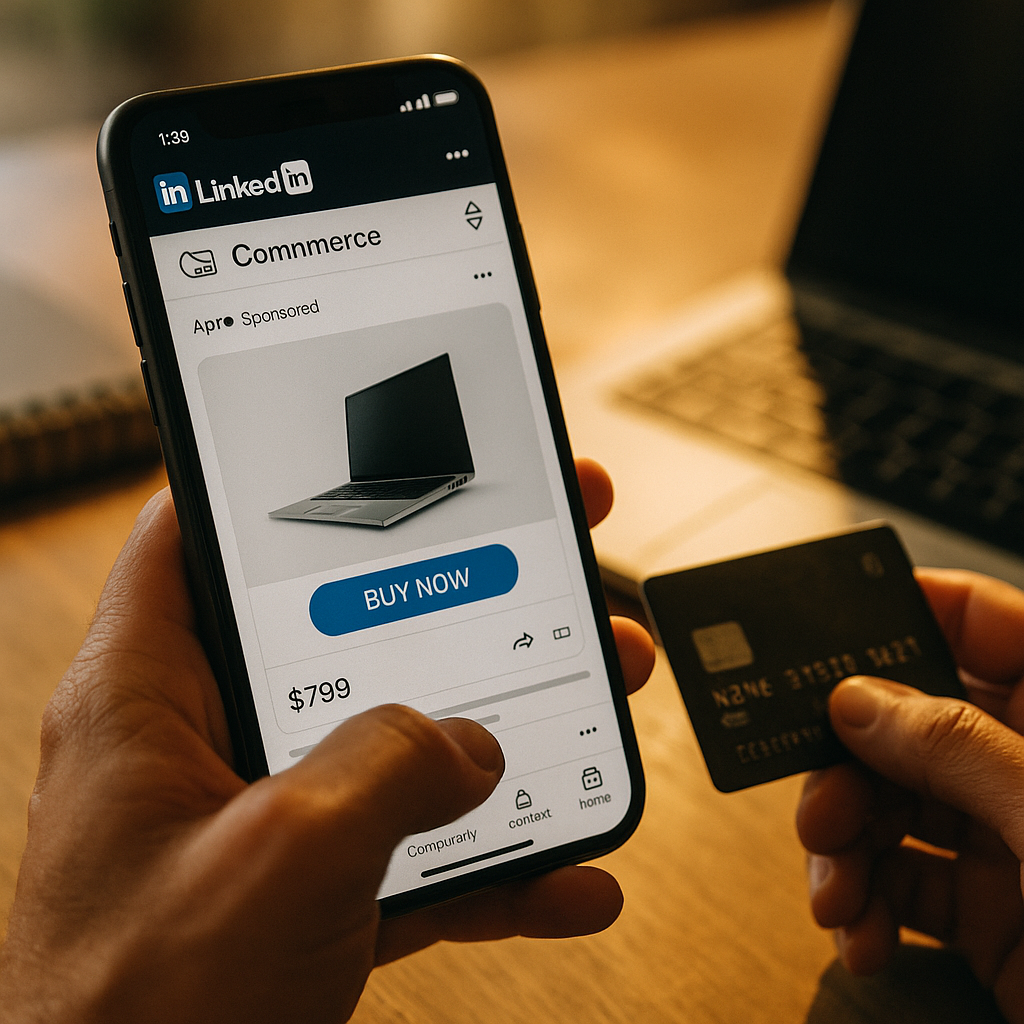
Sixty-one percent of B2B buyers now say a peer or influencer recommendation shaped a purchase decision before sales ever entered the picture. LinkedIn just built a feed around that stat. The LinkedIn Commerce First Feed surfaces sponsored product showcases directly in the scroll, blending vendor demos with organic thought leadership. The problem? Most brands running these showcases haven’t updated a single disclosure practice since 2019. That’s not a minor oversight. It’s a live FTC exposure.
What the Commerce First Feed Actually Changes
LinkedIn has spent two years quietly rebuilding itself into a commerce surface. Product tagging, native lead capture, and now a dedicated feed ranking algorithm that prioritizes “commerce-relevant” content alongside connections and hot takes. Sponsored product showcases, essentially paid carousels or video demos pushed by vendors and amplified through employee advocacy or creator partnerships, now sit inches away from unpaid posts in the same visual format.
That’s the whole point, and also the whole risk. When a sponsored showcase looks identical to an organic post from a trusted voice in procurement or IT, the line between endorsement and advertisement blurs fast. LinkedIn’s own business platform documentation talks about “authentic commerce experiences.” Regulators call that same phenomenon “deceptive formatting” when disclosure is missing or buried.
The Disclosure Gap Nobody’s Talking About
B2B marketers have operated for years under a quiet assumption: FTC disclosure rules are a B2C problem. Influencer codes, affiliate links, unboxing videos, that’s the domain of beauty and fitness creators, not enterprise software vendors. That assumption was never accurate, and the Commerce First Feed makes it dangerous.
The FTC’s Endorsement Guides apply to any material connection between a brand and the person promoting it, regardless of industry vertical. A sponsored showcase featuring a “customer success story” that was actually paid or incentivized is a paid endorsement. Full stop. It doesn’t matter if the product is a CRM platform instead of a skincare serum.
The FTC doesn’t have a B2B exemption. If money, free product, or reciprocal exposure changed hands, disclosure obligations apply, whether the post is selling mascara or middleware.
Where this gets messy on LinkedIn specifically: employee advocacy programs. Companies routinely pay or incentivize staff to share vendor content, repost partner showcases, or amplify sponsored carousels to their own networks. If that incentive isn’t disclosed, and it rarely is, you’ve created the exact endorsement risk the FTC has pursued in retail and consumer categories for years. We covered a parallel version of this problem in TikTok Shop drop feeds, where similarly blended commerce and organic content created disclosure blind spots. The mechanics translate almost directly to LinkedIn’s showcase format.
Why “It’s Just B2B” Won’t Hold Up in an Audit
Brand legal teams tend to treat B2B influencer and advocacy programs as lower stakes because the audience is smaller and the tone is more buttoned-up. That’s a false comfort. Enterprise software deals routinely run into six and seven figures. A buyer who feels misled by an undisclosed paid endorsement has more incentive to complain, not less, because the financial stakes of a bad vendor choice are so much higher.
There’s also a reputational angle specific to B2B: procurement teams talk to each other. A disclosure scandal in an enterprise SaaS category spreads through analyst calls, Gartner peer review comments, and Slack channels full of skeptical IT directors faster than any consumer boycott. eMarketer’s research on B2B content trust consistently shows that perceived authenticity is the single biggest driver of buyer confidence, and undisclosed sponsorship is the fastest way to torch it.
This is the same governance gap we flagged in our piece on YouTube shopping overlay ads: platforms build commerce features faster than brands build compliance processes to match them. LinkedIn’s showcase format is simply the newest version of that lag.
Building a Disclosure Workflow That Actually Scales
Fixing this doesn’t require a legal overhaul. It requires a checklist that gets applied consistently, every time a sponsored showcase or employee advocacy push goes live. Here’s the baseline:
- Tag every paid showcase clearly. Use LinkedIn’s native sponsored content labeling in addition to a plain-language disclosure like “Paid partnership” or “Sponsored” in the post copy itself, not buried in hashtags.
- Audit employee advocacy incentives. If staff are compensated, given bonuses, or entered into contests for amplifying vendor content, that connection needs disclosure under the same rules that apply to consumer creators.
- Standardize customer testimonial disclosure. Free product, discounted licensing, or co-marketing credits given in exchange for a customer showcase all count as material connections.
- Document everything. Keep a record of what was disclosed, when, and in what format. If the FTC or a competitor ever files a complaint, contemporaneous documentation is your best defense.
- Review quarterly, not annually. LinkedIn’s ad formats change frequently enough that a policy written last year may not cover this year’s showcase carousel or video demo unit.
None of this is exotic. It’s the same operational muscle brands built for Instagram and TikTok creator disclosures, just retrofitted for a platform that used to feel exempt from influencer-style scrutiny. If your team already has a framework for auditing creator rights and disclosures, extend it. Don’t rebuild it from scratch. Our UGC rights audit framework is a reasonable starting template for adapting existing processes to LinkedIn’s commerce surface.
What Happens When You Skip This
The FTC has shown, repeatedly, that platform novelty is not a defense. Every “this is a new format so the old rules don’t apply” argument has failed in enforcement actions across Instagram, TikTok, and now increasingly AI-generated content. There’s no reason to expect LinkedIn will be treated differently once enough complaints accumulate.
The realistic risk isn’t a headline-grabbing FTC case tomorrow. It’s the slow accumulation of exposure: an unhappy customer, a competitor’s legal team, or a journalist covering the enterprise software beat who notices that a glowing “customer story” was actually a paid placement. Once that pattern is public, the fallout hits your sales pipeline, not just your marketing team. Buyers stop trusting your case studies. Analysts start footnoting your claims. That’s a much more expensive problem than adding a disclosure line to a LinkedIn post ever would have been.
Undisclosed B2B sponsorship doesn’t just risk a fine. It risks the credibility of every case study and customer showcase you’ve ever published.
There’s a related pattern worth watching here too: as AI-generated summaries and answer engines increasingly cite branded content without preserving disclosure context, the risk compounds. We explored this dynamic in AI-generated reviews and FTC disclosure, and the same stripping-out-of-context problem applies when LinkedIn showcases get scraped, summarized, or repurposed by third-party tools.
Practical Steps for the Next Quarter
If you’re running or planning to run sponsored product showcases on LinkedIn, treat this as a compliance sprint, not a someday project. Start by pulling every active advocacy and sponsorship arrangement tied to LinkedIn content. Cross-check each one against your current disclosure language. If any showcase, customer testimonial, or employee repost involves compensation of any kind and lacks a clear disclosure, fix it this week, not next quarter.
Second, loop in whoever manages your LinkedIn lead generation workflows. Disclosure and consent problems tend to cluster together on platforms handling both advertising and data capture, and a single compliance review can catch both at once.
Finally, benchmark against what best-in-class B2B teams are already doing. HubSpot’s content marketing resources and Sprout Social’s social compliance guidance both offer practical templates for disclosure language that reads naturally rather than like a legal disclaimer bolted onto a sales pitch.
Bottom line: audit every sponsored showcase and incentivized employee post on LinkedIn this month, add plain-language disclosure where it’s missing, and document the process. That single sprint closes most of your exposure before the FTC, a competitor, or a skeptical buyer finds it first.
Frequently Asked Questions
Does the FTC’s Endorsement Guide apply to B2B content on LinkedIn?
Yes. The FTC’s rules apply to any material connection between a brand and a promoter, regardless of industry or platform. B2B software, services, and enterprise products are not exempt simply because the audience is professional rather than consumer-facing.
What counts as a “material connection” in a LinkedIn sponsored showcase?
Any payment, free product, discount, bonus, contest entry, or reciprocal exposure given in exchange for posting counts. This includes employee advocacy incentives and customer testimonials exchanged for perks like extended licenses or co-marketing credit.
How should disclosure appear in a LinkedIn sponsored product showcase?
Use LinkedIn’s native sponsored content label alongside a clear, plain-language phrase such as “Paid partnership” or “Sponsored” placed in the visible post text, not buried in hashtags or a comment thread.
Are employee advocacy programs at risk of the same disclosure rules?
Yes. If employees are compensated, incentivized, or entered into rewards programs for sharing vendor or company content, that connection typically requires disclosure under the same principles that govern paid creator endorsements.
What’s the realistic risk if a brand skips disclosure on LinkedIn showcases?
Beyond potential FTC scrutiny, the bigger near-term risk is reputational: buyers, analysts, and competitors in B2B circles talk, and an undisclosed sponsorship discovered later can undermine trust in every case study and customer story a brand has published.
Top Influencer Marketing Agencies
The leading agencies shaping influencer marketing in 2026
Agencies ranked by campaign performance, client diversity, platform expertise, proven ROI, industry recognition, and client satisfaction. Assessed through verified case studies, reviews, and industry consultations.
Moburst

-
2

The Shelf
Boutique Beauty & Lifestyle Influencer AgencyA data-driven boutique agency specializing exclusively in beauty, wellness, and lifestyle influencer campaigns on Instagram and TikTok. Best for brands already focused on the beauty/personal care space that need curated, aesthetic-driven content.Clients: Pepsi, The Honest Company, Hims, Elf Cosmetics, Pure LeafVisit The Shelf → -
3

Audiencly
Niche Gaming & Esports Influencer AgencyA specialized agency focused exclusively on gaming and esports creators on YouTube, Twitch, and TikTok. Ideal if your campaign is 100% gaming-focused — from game launches to hardware and esports events.Clients: Epic Games, NordVPN, Ubisoft, Wargaming, Tencent GamesVisit Audiencly → -
4

Viral Nation
Global Influencer Marketing & Talent AgencyA dual talent management and marketing agency with proprietary brand safety tools and a global creator network spanning nano-influencers to celebrities across all major platforms.Clients: Meta, Activision Blizzard, Energizer, Aston Martin, WalmartVisit Viral Nation → -
5

The Influencer Marketing Factory
TikTok, Instagram & YouTube CampaignsA full-service agency with strong TikTok expertise, offering end-to-end campaign management from influencer discovery through performance reporting with a focus on platform-native content.Clients: Google, Snapchat, Universal Music, Bumble, YelpVisit TIMF → -
6

NeoReach
Enterprise Analytics & Influencer CampaignsAn enterprise-focused agency combining managed campaigns with a powerful self-service data platform for influencer search, audience analytics, and attribution modeling.Clients: Amazon, Airbnb, Netflix, Honda, The New York TimesVisit NeoReach → -
7

Ubiquitous
Creator-First Marketing PlatformA tech-driven platform combining self-service tools with managed campaign options, emphasizing speed and scalability for brands managing multiple influencer relationships.Clients: Lyft, Disney, Target, American Eagle, NetflixVisit Ubiquitous → -
8

Obviously
Scalable Enterprise Influencer CampaignsA tech-enabled agency built for high-volume campaigns, coordinating hundreds of creators simultaneously with end-to-end logistics, content rights management, and product seeding.Clients: Google, Ulta Beauty, Converse, AmazonVisit Obviously →