


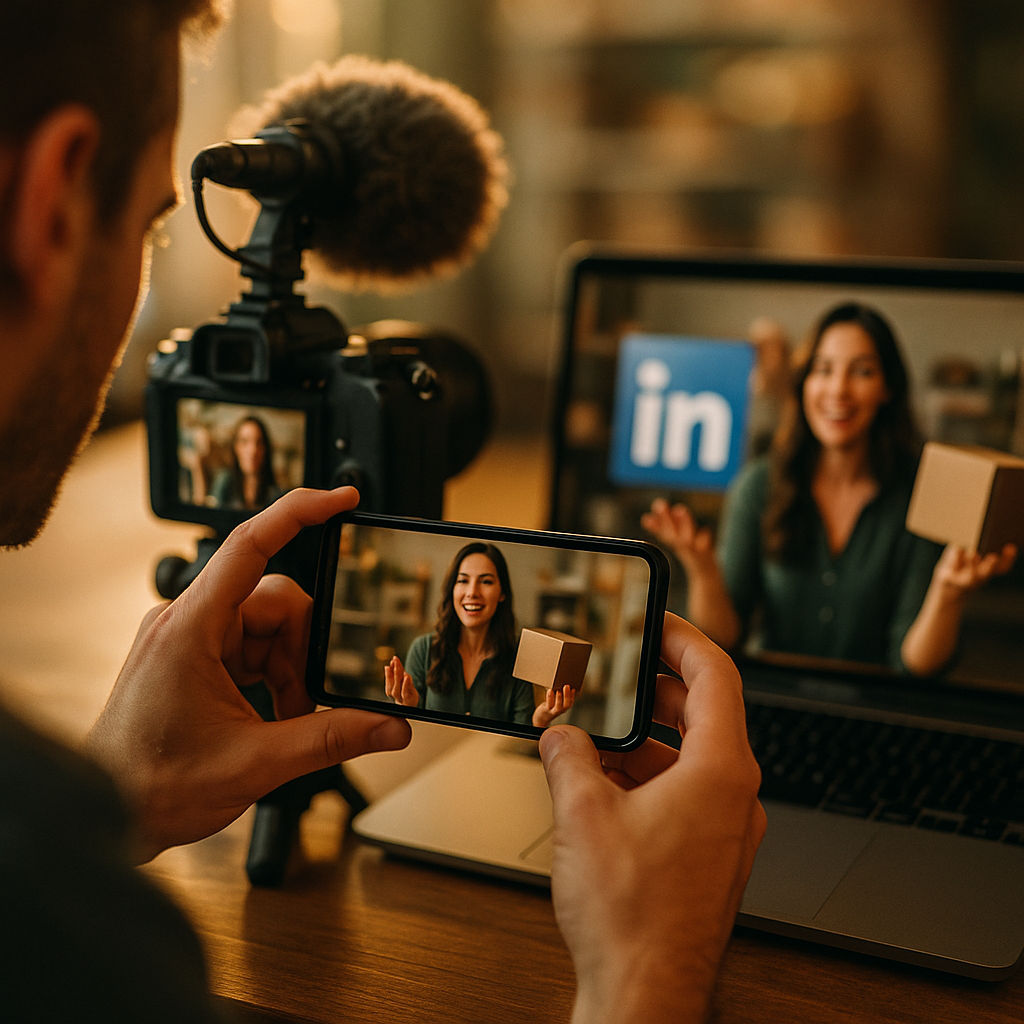
LinkedIn video watch time has grown over 36% year-over-year, yet most B2B brands are still briefing creators like it’s a static thought-leadership post. That disconnect is costing pipeline. LinkedIn video commerce for B2B creator campaigns is now a legitimate demand-generation channel, and the brands winning are the ones who’ve figured out how to brief for it properly.
Why LinkedIn Video Is a Different Beast Than Other Platforms
The instinct to repurpose TikTok or Instagram Reels content for LinkedIn is understandable. It’s cheaper. Faster. But it’s wrong. LinkedIn’s feed algorithm rewards dwell time and professional engagement signals — saves, reposts to newsletters, comments from credentialed users — not just raw views. A 60-second product walkthrough that generates 200 comments from VPs of Operations is worth ten times a viral clip that attracts zero commercial intent.
LinkedIn has also been steadily expanding its native video capabilities: full-screen vertical video feeds, clickable CTAs inside video posts, and tighter integration with Lead Gen Forms. Combined with LinkedIn’s unmatched first-party professional data (job title, seniority, company size, industry), video content now has a direct path from creator impression to qualified lead capture. That’s a pipeline machine, if you know how to operate it.
LinkedIn’s professional audience targeting means a single well-structured creator video can reach 500 CFOs or 1,200 mid-market IT directors with precision that Google and Meta simply cannot replicate for B2B categories.
Structuring the Creator Brief: What B2B Teams Get Wrong
Most B2B creator briefs fail at the premise. They ask creators to “talk about” a product. They provide a wall of brand messaging. They measure success by impressions. For LinkedIn video commerce, the brief needs to be engineered around a specific funnel outcome: MQL generation or pipeline acceleration, not brand awareness vanity metrics.
Start by defining the exact professional audience segment the video should convert. Not “marketing professionals.” Try “VPs of Demand Generation at SaaS companies with 200-1,000 employees who are currently evaluating ABM platforms.” That specificity shapes everything: the creator’s hook, the language they use, the pain point they lead with, and the CTA they drive toward.
Here’s what a high-converting LinkedIn video creator brief should contain:
- Audience persona with job title and pain point: Give the creator the language their audience uses in Slack messages and board decks, not marketing speak.
- A single conversion action: One CTA per video. Download the benchmark report. Book a 15-minute demo. Join the waitlist. Multiple CTAs kill conversion rates.
- Hook mandate (first 3 seconds): LinkedIn autoplay is silent by default. The visual hook must communicate value before audio kicks in. Brief creators on this explicitly.
- Proof-point requirement: B2B buyers need credibility signals. Instruct the creator to reference a specific data point, customer outcome, or verifiable claim in the first 20 seconds.
- CTA placement in the video body, not just the caption: LinkedIn’s native video CTA overlay should match what the creator says verbally. Brief this alignment explicitly.
- Lead Gen Form integration instructions: If you’re using LinkedIn’s native Lead Gen Forms attached to the video post, the creator needs to know the offer value proposition cold — because their verbal pitch is the pre-sell.
The brief should also specify video length based on funnel stage. Mid-funnel MQL plays typically perform best at 90 seconds to 3 minutes. Bottom-funnel pipeline acceleration content, where you’re re-engaging warm accounts, can run longer, especially for technical categories like enterprise software, cybersecurity, or financial infrastructure.
Creator Selection: Authority Signals Over Follower Count
On LinkedIn, a creator with 8,000 followers who is a recognized practitioner in supply chain management will outperform a 200,000-follower generalist every time, assuming your ICP lives in that supply chain world. This is the core selection principle B2B teams consistently misapply.
Look for creators whose comment sections are populated by your actual buyers. Use LinkedIn’s own analytics to validate audience composition before signing agreements. Ask creators for a screenshot of their follower demographics filtered by job title and seniority. Any serious LinkedIn creator will have this data ready. If they don’t, that’s a risk signal.
Also consider whether the creator has existing relationships with your target accounts. A creator who is regularly tagged by procurement leaders at Fortune 500 companies brings relationship capital that no paid amplification budget can replicate. This is especially relevant for enterprise sales cycles where familiarity and trust compress deal timelines.
For niche creator amplification strategy comparisons across platforms, the underlying principle holds: smaller, context-relevant audiences outperform broad reach when conversion is the goal.
Attribution and Pipeline Tracking
This is where B2B LinkedIn video campaigns succeed or collapse. Impression-level measurement is not a business outcome. You need a closed-loop attribution model that connects creator video views to CRM pipeline events.
The practical stack for this in most enterprise marketing environments looks like: LinkedIn Campaign Manager for video view data, UTM parameters on all CTA links, HubSpot or Salesforce for MQL and opportunity tracking, and ideally a tool like LinkedIn’s Revenue Attribution Report to tie member engagement back to pipeline influence. For teams running ABM programs, overlay this with tools like Demandbase or 6sense to see whether creator-exposed accounts are showing increased intent signals post-campaign.
One critical note: LinkedIn’s native Lead Gen Forms collect first-party data without sending the user off-platform, which typically boosts conversion rates by 2-3x compared to external landing pages. But those leads need to flow directly into your MAP and CRM via native integration or Zapier. If that data sits in LinkedIn Campaign Manager and never gets actioned by sales, the campaign’s pipeline contribution will be invisible.
For comparison on how attribution complexity plays out on other platforms, the challenges around Instagram Reels attribution are instructive, especially for teams managing multi-platform creator programs.
Brands that integrate LinkedIn Lead Gen Form data directly into Salesforce with a 4-hour SLA for sales follow-up report significantly higher MQL-to-opportunity conversion rates than those routing leads through weekly batch exports.
Paid Amplification of Organic Creator Content
Organic LinkedIn reach for creator content has a ceiling. The strategic move is to identify which creator videos perform organically in the first 48 hours, then amplify those posts through LinkedIn’s Thought Leader Ads format. This lets you run the creator’s authentic post as a paid ad, targeting your exact ICP by company, seniority, and function, without it looking like a sponsored brand asset.
Budget allocation: A reasonable starting model is 60% organic creator fee, 40% paid amplification budget. As you identify winning creative, shift budget toward top performers and kill underperformers fast. LinkedIn CPMs for B2B audiences run higher than other platforms, often $60-$120 for senior decision-maker segments, so creative efficiency matters more, not less.
This model also applies when briefing creators on content designed for LinkedIn’s video feed specifically. Creators should understand upfront that strong-performing content will be whitelisted for paid promotion, so the brief should include brand safety guidelines and disclosure requirements aligned with FTC endorsement rules. Disclosure on sponsored LinkedIn posts must be clear, and “Paid partnership” labeling should appear in both the post caption and the creator’s verbal mention.
Category-Specific Brief Adjustments
Not all B2B categories operate the same way on LinkedIn video. A few category-specific brief adjustments worth building into your templates:
Enterprise SaaS: Brief creators to lead with an operational problem, not a feature. Decision-makers respond to workflow pain far faster than capability lists. Use the CTA to offer a benchmark report or ROI calculator, not a demo request. Cold traffic rarely converts to demo on first touch.
Financial Services and Fintech: Compliance review timelines must be factored into the production schedule. Brief creators on approved language parameters early, and build in a compliance review stage before the video goes live. Reference the relevant disclosure requirements and any sector-specific regulatory constraints in the brief itself.
HR Tech and Workforce Solutions: CHROs and People Operations leaders respond to data-backed narratives about employee experience and retention. Brief creators to anchor their content in workforce research, not vendor claims. Tools like HubSpot’s State of Marketing report or LinkedIn’s own Workforce Insights data make credible reference points.
Cybersecurity: Fear-based messaging tends to backfire with technical buyers. Brief creators to take a peer-practitioner tone, sharing how they would evaluate a solution, rather than advocating for one. Practitioners trust practitioners. The creator’s credentials in this category matter more than their audience size.
For teams managing creator briefs across multiple platforms simultaneously, the structural principles from consideration-phase creator briefs offer useful parallels, particularly around CTA specificity and proof-point requirements.
One more variable to track: LinkedIn’s algorithm currently favors content that generates “meaningful engagement” from first-degree connections. Brief creators to seed early comments from colleagues or partners in the first hour after posting. This is not inauthentic; it’s standard community management applied to creator content strategy. Verified practitioners from the brand’s own network commenting substantively on a creator’s video sends a strong relevance signal to LinkedIn’s distribution engine.
Also worth reviewing: how B2B creator matching tools on competing platforms are handling audience validation, since LinkedIn’s own creator discovery tools are still maturing and many teams supplement them with third-party vetting platforms like Modash or Traackr.
For teams evaluating spend allocation across creator platforms, Sprout Social’s B2B benchmarks provide useful context on LinkedIn engagement rates versus other channels, helping justify budget reallocation toward LinkedIn video when pitching internally.
Start by auditing your last three creator briefs against the framework above. If none of them specified a CTA integration with Lead Gen Forms, a proof-point requirement, or a pipeline tracking methodology, you now know exactly where the MQL leak is.
Frequently Asked Questions
What makes a LinkedIn creator brief different from a brief for other platforms?
A LinkedIn creator brief must be engineered around professional audience segments and specific funnel outcomes like MQL generation or pipeline acceleration. Unlike consumer platforms, LinkedIn video performance is measured by commercial engagement quality — saves, comments from target-title professionals, and lead form completions — not by raw views or shares. The brief should specify job title targeting, a single conversion action, proof-point requirements, and Lead Gen Form integration instructions.
How do I measure ROI from LinkedIn creator video campaigns?
ROI measurement requires a closed-loop attribution stack connecting LinkedIn Campaign Manager video data, UTM-tagged CTA links, and your CRM or MAP. LinkedIn’s Revenue Attribution Report can tie member engagement to pipeline influence. For ABM programs, overlay intent data tools like Demandbase or 6sense to track whether creator-exposed accounts show increased buying signals. Define MQL-to-opportunity conversion rate as your primary success metric, not impressions.
What video length performs best for B2B LinkedIn creator content?
It depends on funnel stage. Mid-funnel MQL generation content typically performs best at 90 seconds to 3 minutes. Bottom-funnel pipeline acceleration content, targeting warm or re-engaged accounts, can run longer, particularly in technical categories like enterprise SaaS, cybersecurity, or financial infrastructure where buyers expect depth and detail before converting.
How should I select creators for a LinkedIn B2B campaign?
Prioritize practitioners with verified audience composition over follower volume. Request a screenshot of the creator’s follower demographics by job title and seniority. Look for creators whose comment sections are populated by your actual ICP. Creators with existing relationships at target accounts add relationship capital that paid amplification cannot replicate. Authority and trust signals matter more on LinkedIn than platform-wide reach.
Can LinkedIn creator content be amplified with paid media?
Yes. LinkedIn’s Thought Leader Ads format allows you to amplify a creator’s organic post as a paid ad, targeting your ICP by company, seniority, and function. A common budget model is 60% allocated to creator fees and 40% to paid amplification, with spend shifted toward top-performing creative after the first 48-hour organic performance window. All amplified sponsored content must include clear FTC-compliant disclosure in both the caption and verbal mention.
Top Influencer Marketing Agencies
The leading agencies shaping influencer marketing in 2026
Agencies ranked by campaign performance, client diversity, platform expertise, proven ROI, industry recognition, and client satisfaction. Assessed through verified case studies, reviews, and industry consultations.
Moburst

-
2

The Shelf
Boutique Beauty & Lifestyle Influencer AgencyA data-driven boutique agency specializing exclusively in beauty, wellness, and lifestyle influencer campaigns on Instagram and TikTok. Best for brands already focused on the beauty/personal care space that need curated, aesthetic-driven content.Clients: Pepsi, The Honest Company, Hims, Elf Cosmetics, Pure LeafVisit The Shelf → -
3

Audiencly
Niche Gaming & Esports Influencer AgencyA specialized agency focused exclusively on gaming and esports creators on YouTube, Twitch, and TikTok. Ideal if your campaign is 100% gaming-focused — from game launches to hardware and esports events.Clients: Epic Games, NordVPN, Ubisoft, Wargaming, Tencent GamesVisit Audiencly → -
4

Viral Nation
Global Influencer Marketing & Talent AgencyA dual talent management and marketing agency with proprietary brand safety tools and a global creator network spanning nano-influencers to celebrities across all major platforms.Clients: Meta, Activision Blizzard, Energizer, Aston Martin, WalmartVisit Viral Nation → -
5

The Influencer Marketing Factory
TikTok, Instagram & YouTube CampaignsA full-service agency with strong TikTok expertise, offering end-to-end campaign management from influencer discovery through performance reporting with a focus on platform-native content.Clients: Google, Snapchat, Universal Music, Bumble, YelpVisit TIMF → -
6

NeoReach
Enterprise Analytics & Influencer CampaignsAn enterprise-focused agency combining managed campaigns with a powerful self-service data platform for influencer search, audience analytics, and attribution modeling.Clients: Amazon, Airbnb, Netflix, Honda, The New York TimesVisit NeoReach → -
7

Ubiquitous
Creator-First Marketing PlatformA tech-driven platform combining self-service tools with managed campaign options, emphasizing speed and scalability for brands managing multiple influencer relationships.Clients: Lyft, Disney, Target, American Eagle, NetflixVisit Ubiquitous → -
8

Obviously
Scalable Enterprise Influencer CampaignsA tech-enabled agency built for high-volume campaigns, coordinating hundreds of creators simultaneously with end-to-end logistics, content rights management, and product seeding.Clients: Google, Ulta Beauty, Converse, AmazonVisit Obviously →