


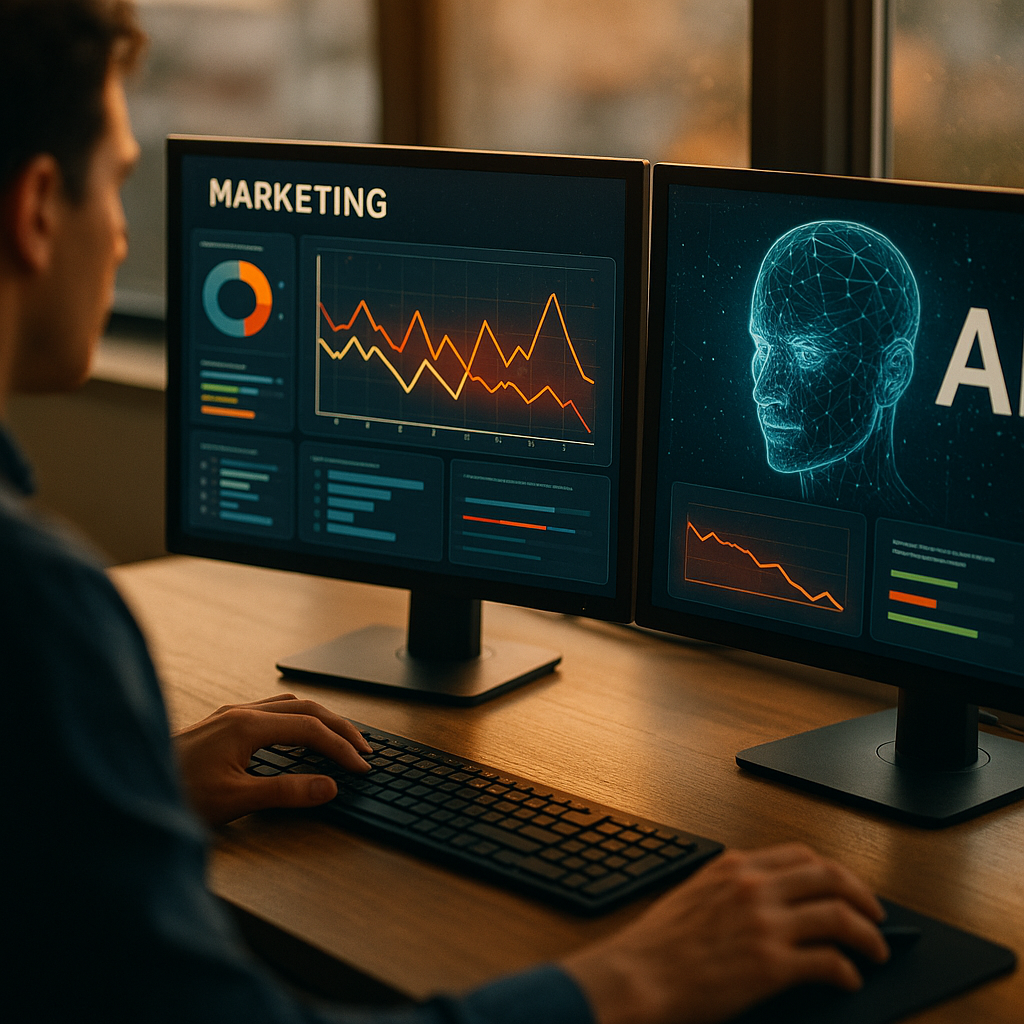
Some 78% of marketing teams now run at least one AI agent in production, generating copy, bidding on media, or replying to customers. Almost none of them can tell you, in real time, when that agent goes off script. Marketing observability is the emerging fix — and it’s about to become as non-negotiable as web analytics.
Here’s the uncomfortable question nobody wants to answer at the quarterly review: what did your AI agent say to a customer at 2 a.m. last Tuesday? If you can’t produce a log, a confidence score, and a brand-safety verdict in under thirty seconds, you don’t have an AI program. You have a liability generator with a nice dashboard.
Why “Set It and Forget It” AI Doesn’t Work Anymore
Marketing teams adopted AI agents fast. Governance adoption lagged behind by, generously, eighteen months. That gap is where things go wrong.
An AI agent that writes product descriptions doesn’t stay static. Its outputs shift as the underlying model gets updated, as retrieval sources change, as prompts get tweaked by three different people across two agencies. This is model drift, and in a marketing context it’s not an academic concern — it’s the difference between an on-brand tagline and a sentence that gets you a call from legal.
Drift in lead scoring is one flavor. Drift in generative outputs — the copy, images, and video your agents ship to production — is another, and it’s harder to catch because there’s no single numeric score to watch. You’re monitoring tone, factual accuracy, claims compliance, and visual brand consistency all at once.
The core problem: traditional QA was built for humans checking humans. AI agents produce content at a volume and velocity that makes manual review mathematically impossible past a handful of outputs per day.
That’s the gap marketing observability platforms are built to close.
What Is a Marketing Observability Platform, Exactly?
Borrow the term from software engineering and you’re close. In DevOps, “observability” means instrumenting systems so you can see, in real time, what’s happening inside them — not just whether the app is up, but why it’s slow, where it’s erroring, and what changed right before it broke.
Apply that to marketing AI and you get platforms that sit between your AI agents and the outputs they push live. They intercept generated content, ad copy, chatbot replies, personalized emails, dynamic creative, before or immediately after publication, and score it against a rulebook you define: brand voice guidelines, regulatory claims restrictions, tone thresholds, competitor mention policies, factual grounding checks.
Think of it as a compliance layer with a dashboard, not a replacement for your creative or media teams.
- Drift detection: flags when agent outputs statistically diverge from a baseline (e.g., tone score moving from “conversational” to “aggressive” over two weeks).
- Hallucination and factual error catching: cross-references claims against approved product data.
- Brand safety scoring: checks generated content against banned topics, competitor names, and sensitive categories before it ships.
- Audit trails: timestamped logs of every agent decision, useful for legal, for the FTC, and for your own sanity when something goes sideways.
The Real-Time Piece Is the Whole Point
Batch review, checking outputs once a week, was tolerable when a human wrote the copy and a single campaign ran for a month. It’s useless when an agentic system is generating and publishing hundreds of ad variants an hour across paid social.
By the time a weekly audit catches a brand safety violation, it’s already been live for six days. It’s been screenshotted. It’s on a marketing Twitter account with 40,000 followers, captioned “lol what is this brand doing.” Real-time observability catches the violation at generation or at the publish gate, before it’s a screenshot problem.
This matters more as agent autonomy increases. Teams evaluating no-code AI agent builders are giving those agents more direct publishing rights, not less. Fewer humans in the approval loop means the automated safety net has to be tighter, not looser.
A Quick Gut Check
Ask your team these three questions. If you can’t answer all three confidently, you have an observability gap:
- Can we see, right now, every piece of content our AI agents published in the last 24 hours?
- Do we have an automatic alert if output tone or claims drift outside approved thresholds?
- If a regulator or journalist asked “why did your AI say that,” could we answer in an hour, not a week?
What’s Actually Driving the Adoption Curve
Three forces are pushing marketing observability from “nice to have” to budget-line item.
Regulatory pressure is real and growing. The FTC has made clear that AI-generated marketing claims are subject to the same truth-in-advertising standards as human-written ones — the tool doesn’t excuse the outcome. The ICO in the UK has taken a similarly firm line on automated decision-making transparency. Platforms like TikTok are also formalizing disclosure requirements around synthetic and AI-assisted content, as covered in our breakdown of TikTok’s C2PA labeling rules. Regulators are done treating “the AI did it” as a defense.
Scale has outpaced human review capacity. According to eMarketer research on generative AI adoption in marketing, the majority of large brands now use AI tools somewhere in their content pipeline. Multiply that across creative, paid media, email, and customer service agents, and you get an output volume no compliance team can eyeball manually.
Board-level risk appetite has shrunk. After a string of visible AI marketing mishaps across the industry, CMOs are getting direct questions from boards about AI governance. “What’s our exposure” is now a standing agenda item, not a once-a-year footnote.
If your AI governance conversation only happens after an incident, you’ve already priced in the incident. Observability platforms exist to move that conversation upstream, before publication, not after the apology tweet.
Where This Overlaps With Your Existing Stack
Marketing observability doesn’t replace your martech stack, it instruments it. A few connection points worth mapping before you buy anything:
Your CDP or identity layer. If you’ve moved toward warehouse-native identity unification, observability tools need read access to understand which customer segments received which AI-generated messages, so drift can be traced to specific audiences, not just aggregate output.
Your ad verification tools. Brand safety monitoring for AI outputs overlaps meaningfully with the placement-level safety work done by vendors compared in our piece on HUMAN, DoubleVerify, and Pixalate. The difference: those tools check where your ad ran. Observability platforms check what your ad (or agent) actually said before it ran anywhere.
Your AI agent governance framework. If you’ve already built a governance checklist for AI agent platforms, observability is the enforcement mechanism. A checklist tells you what good looks like. An observability platform tells you, continuously, whether you’re still meeting it.
Your attribution and analytics. Vendors doing B2B attribution work increasingly want clean data on which content was AI-generated versus human-written, since performance patterns often diverge and finance wants to know why.
What to Actually Look for in a Vendor
The category is young enough that there’s no clear market leader yet, so evaluate on capability, not brand recognition. Consider:
- Latency: is the check happening pre-publish (a gate) or post-publish (a fire alarm)? Pre-publish is strictly better for high-stakes channels.
- Customization depth: can you define your own brand voice thresholds, or are you stuck with generic toxicity scoring built for content moderation, not marketing tone?
- Integration reach: does it plug into your existing agent orchestration layer, or does it require a rip-and-replace?
- Explainability: when it flags something, does it tell you why, with enough specificity to fix the prompt or retrain the agent?
- Audit-readiness: can legal pull a clean, timestamped export in the format a regulator or litigator would actually accept?
Run the same rigor you’d apply to any martech purchase. Our vendor evaluation framework for AI agent platforms is a reasonable starting template, adapted for observability’s specific requirements around real-time alerting and audit trails.
The Cost of Skipping This
Nobody budgets for observability until after the incident. That’s backwards, and expensive backwards. A single viral brand-safety miss can cost more in reputational cleanup than three years of an observability subscription.
Compare that to the operational cost of building this in from the start: a monitoring layer, a defined escalation path, and a human who actually reviews the flagged edge cases each morning. It’s a fraction of the crisis-comms budget you’d otherwise burn.
The teams getting this right treat observability the way they treat web uptime monitoring, boring, always-on infrastructure nobody notices until it saves them. That’s the correct posture. AI agent outputs are production systems now. Monitor them like one.
Next Steps
Audit which AI agents currently publish without a real-time human or automated checkpoint, that list is your risk register. Prioritize observability tooling for the highest-volume, highest-autonomy agents first, then expand coverage from there.
Frequently Asked Questions
What is marketing observability, in simple terms?
It’s real-time monitoring of what your AI marketing agents actually produce and publish, checking for brand voice drift, factual errors, and compliance violations before or immediately after content goes live.
How is this different from regular AI content moderation?
Content moderation tools typically check for toxicity, hate speech, or policy violations in a generic sense. Marketing observability platforms check for brand-specific standards: your tone guidelines, your regulatory claims restrictions, your competitor mention policies, and your factual accuracy against your own product data.
Do we need this if our AI agents already go through human approval?
If a human reviews every single output before publication, the risk is lower but not zero, humans miss drift patterns that only show up in aggregate over weeks. If any agent publishes autonomously or at high volume, observability isn’t optional.
What counts as “drift” in an AI marketing agent?
Drift is a gradual, often unnoticed shift in an agent’s output patterns, tone becoming more aggressive, claims becoming less accurate, or brand voice diverging from approved guidelines. It typically happens after model updates, prompt changes, or shifts in retrieval data, and it’s hard to catch without continuous baseline comparison.
How quickly can a marketing observability platform be implemented?
Timelines vary by integration complexity, but most brands can get basic post-publish monitoring running within a few weeks. Pre-publish gating, which requires deeper integration with your agent orchestration layer, typically takes longer and should be scoped as a distinct phase.
Who should own this inside a marketing organization?
Ownership varies, but it typically sits at the intersection of marketing operations, legal/compliance, and whoever manages the AI agent stack. The key is a named owner with authority to pause an agent, not a shared responsibility that nobody actually acts on.
Top Influencer Marketing Agencies
The leading agencies shaping influencer marketing in 2026
Agencies ranked by campaign performance, client diversity, platform expertise, proven ROI, industry recognition, and client satisfaction. Assessed through verified case studies, reviews, and industry consultations.
Moburst

-
2

The Shelf
Boutique Beauty & Lifestyle Influencer AgencyA data-driven boutique agency specializing exclusively in beauty, wellness, and lifestyle influencer campaigns on Instagram and TikTok. Best for brands already focused on the beauty/personal care space that need curated, aesthetic-driven content.Clients: Pepsi, The Honest Company, Hims, Elf Cosmetics, Pure LeafVisit The Shelf → -
3

Audiencly
Niche Gaming & Esports Influencer AgencyA specialized agency focused exclusively on gaming and esports creators on YouTube, Twitch, and TikTok. Ideal if your campaign is 100% gaming-focused — from game launches to hardware and esports events.Clients: Epic Games, NordVPN, Ubisoft, Wargaming, Tencent GamesVisit Audiencly → -
4

Viral Nation
Global Influencer Marketing & Talent AgencyA dual talent management and marketing agency with proprietary brand safety tools and a global creator network spanning nano-influencers to celebrities across all major platforms.Clients: Meta, Activision Blizzard, Energizer, Aston Martin, WalmartVisit Viral Nation → -
5

The Influencer Marketing Factory
TikTok, Instagram & YouTube CampaignsA full-service agency with strong TikTok expertise, offering end-to-end campaign management from influencer discovery through performance reporting with a focus on platform-native content.Clients: Google, Snapchat, Universal Music, Bumble, YelpVisit TIMF → -
6

NeoReach
Enterprise Analytics & Influencer CampaignsAn enterprise-focused agency combining managed campaigns with a powerful self-service data platform for influencer search, audience analytics, and attribution modeling.Clients: Amazon, Airbnb, Netflix, Honda, The New York TimesVisit NeoReach → -
7

Ubiquitous
Creator-First Marketing PlatformA tech-driven platform combining self-service tools with managed campaign options, emphasizing speed and scalability for brands managing multiple influencer relationships.Clients: Lyft, Disney, Target, American Eagle, NetflixVisit Ubiquitous → -
8

Obviously
Scalable Enterprise Influencer CampaignsA tech-enabled agency built for high-volume campaigns, coordinating hundreds of creators simultaneously with end-to-end logistics, content rights management, and product seeding.Clients: Google, Ulta Beauty, Converse, AmazonVisit Obviously →