


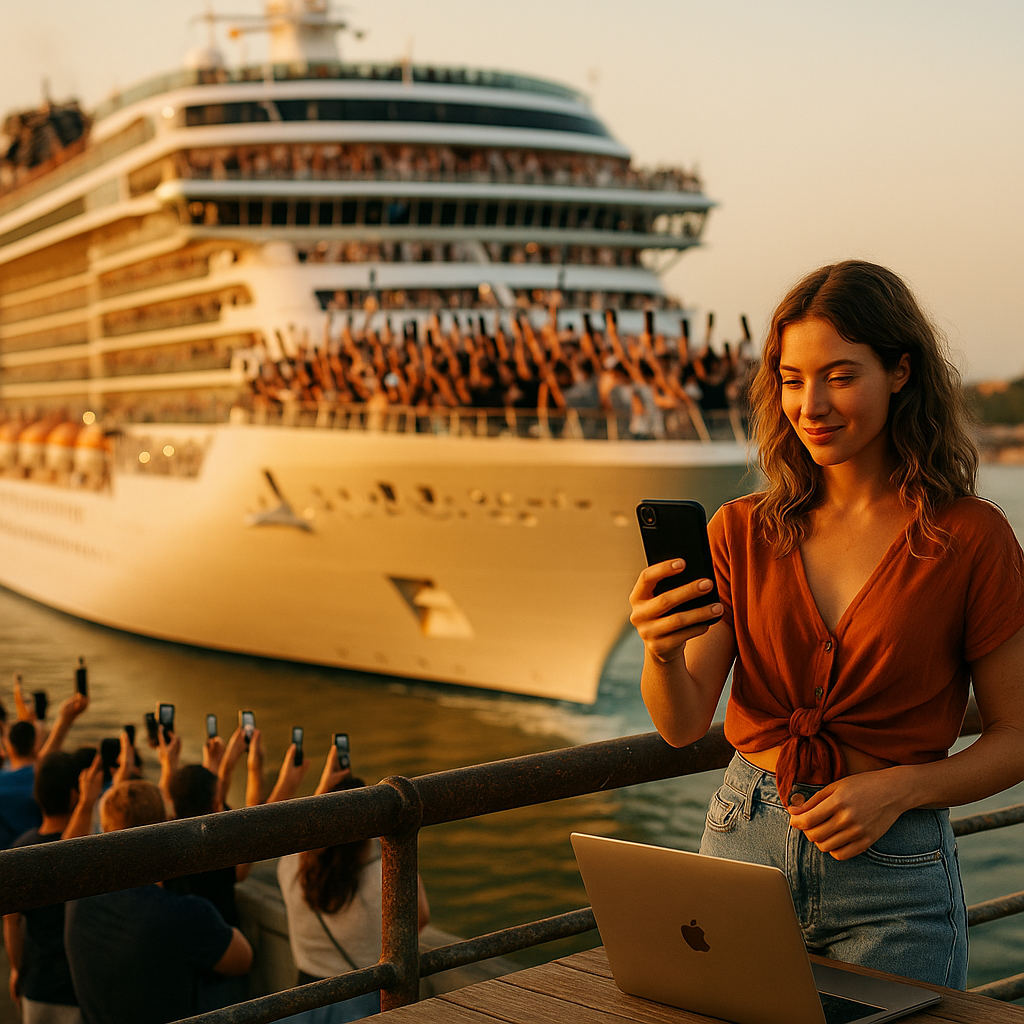
What Happens When a Brand Invites 300 Creators on a Cruise and Lets Go of the Brief?
Virgin Voyages reportedly hosted over 300 creators across multiple sailings in a single quarter, generating north of 18,000 pieces of organic content. No rigid shot lists. No scripted talking points. Minimal brand-police oversight. And the campaign — by nearly every earned media metric — outperformed the surgical micro-influencer programs that most hospitality brands still cling to. The high-volume creator cruise model forces a question brand strategists need to answer honestly: when does scale-over-control actually win?
The Logic Behind Mass Creator Activation
The instinct to control messaging is rational. Decades of brand management taught us that consistency equals equity. But experiential categories — travel, food, entertainment, events — operate under different physics. The product is the experience, and no single creator’s lens captures it fully. Volume becomes the strategy.
Virgin Voyages understood something that many brand teams still resist: when your product is visually rich and emotionally sticky, the marginal cost of one more creator drops while the marginal return on content diversity stays high. A fitness creator films the gym at sunrise. A foodie shoots the Korean BBQ restaurant. A fashion creator captures the pool deck outfit culture. Together, they build a 360-degree demand engine no single creator or agency shoot could replicate.
In experiential categories, the most dangerous creative decision is trying to reduce a multisensory product to one controlled narrative. Mass activation lets the product speak in every voice at once.
This isn’t recklessness. It’s a calculated bet that high-volume creator campaigns can generate asymmetric returns when the underlying category conditions are right.
When Does Tightly Controlled Micro-Influencer Work Actually Win?
Not every category should follow the cruise ship playbook. The conditions that favor controlled programs are well-documented:
- Regulated industries. Pharma, financial services, and alcohol brands operate under disclosure and claims requirements that make open-ended briefs legally dangerous. The FTC’s endorsement guidelines already put the onus on brands for creator compliance.
- Complex consideration products. Enterprise SaaS, high-end B2B services, and luxury goods often require nuanced messaging. A $40,000 watch doesn’t benefit from 300 unvetted unboxing videos.
- Narrow TAM categories. When your total addressable market is 50,000 procurement officers, mass activation is waste. Precision matters more than volume.
- Brand reputation rebuilds. If you’re managing a crisis or repositioning, every piece of content needs oversight. One off-brand post can undo months of narrative repair.
Research from eMarketer consistently shows that micro-influencer engagement rates outperform macro and mega tiers in categories where trust and expertise drive purchase decisions. That finding is real — but it gets misapplied when brands in experiential categories use it to justify limiting creator volume.
The nuance matters: micro-creators beat larger influencers on trust in specific contexts. That doesn’t make them universally superior.
Five Category Conditions That Favor the Mass Activation Model
After studying Virgin Voyages, Marriott Bonvoy’s creator residencies, and several DTC beauty brands running 200+ creator activations per quarter, a pattern emerges. Mass activation generates superior ROI when these conditions overlap:
- The product is photogenic and self-evident. If creators need a paragraph of explanation to make the product interesting, scale won’t save you. If the product creates its own content moment — a sunset from a cruise balcony, a color-shifting lipstick, a theme park ride — volume amplifies naturally.
- The purchase is emotionally driven with a short consideration window. Cruises, concerts, beauty products, fast-casual dining. When the gap between “that looks amazing” and “I’m booking” is measured in hours rather than months, flooding feeds works.
- Audience diversity is a strategic advantage. Virgin Voyages doesn’t sell to one demographic. They need to reach millennials, Gen X couples, friend groups, solo travelers, and the LGBTQ+ community simultaneously. One creator can’t do that. Three hundred can.
- Content has a long organic shelf life. Travel content gets resurfaced by algorithms for months. A TikTok of a cruise cabin tour from Q1 still drives search interest in Q3. High volume creates an evergreen content moat. Brands dealing with declining sponsored content visibility especially benefit from this volume-based hedge.
- The cost of a single off-brand post is low relative to total output. If one creator out of 300 posts something cringe, it disappears in the noise. The reputational risk per unit of content approaches zero. Compare that to a five-creator luxury program where one misstep dominates the conversation.
The Operational Reality Most Brands Underestimate
Here’s where the Virgin Voyages model gets hard to replicate: logistics.
Running 300 creators through any experience requires infrastructure that most marketing teams aren’t built for. Creator onboarding, travel coordination, content rights management, payment processing at scale, and real-time community monitoring during the activation — these aren’t nice-to-haves. They’re prerequisites. Our deep dive into ops staffing and tech for mass creator programs lays out the minimum viable tech stack, but the short version: you need a creator management platform (Grin, CreatorIQ, or SARAL at minimum), a dedicated ops coordinator per 50-75 creators, and pre-negotiated content licensing terms.
The brands that fail at mass activation almost always fail at operations, not strategy. They green-light the volume, then try to manage it with the same two-person influencer team that ran their 15-creator micro program. That’s how you get missed payments, creator resentment, and a wave of negative creator-community word-of-mouth that tanks future recruitment.
Mass activation isn’t a creative philosophy. It’s an operational capability. The strategy is only as good as the logistics underneath it.
Measuring ROI Across Both Models
The attribution challenge differs between approaches. Controlled micro-influencer programs lend themselves to trackable links, promo codes, and direct-response measurement. Mass activation generates value that shows up in different places: branded search volume, social share of voice, cost-per-impression efficiency, and downstream organic traffic.
Smart brands measure both models using a blended framework:
- For controlled programs: Cost per acquisition, conversion rate by creator, customer lifetime value of referred customers.
- For mass activation: Earned media value (yes, with all its flaws), branded search lift during and after activation windows, content library value (what would this volume of studio-quality content cost to produce?), and social sentiment shift.
The creator attribution gap remains real, especially for mid-market brands without enterprise-grade measurement stacks. But ignoring upper-funnel value because it’s harder to measure is how brands end up over-indexed on performance creators and under-invested in demand generation.
Data from Statista pegs influencer marketing spend growth at 15-20% annually, yet most of that budget still flows toward controlled programs because they’re easier to justify in a spreadsheet. The brands gaining share are the ones willing to allocate 20-30% of their creator budget toward high-volume bets — then measure them on the right KPIs.
The Decision Framework: Which Model Fits Your Brand?
Stop treating this as ideology. It’s a category-fit question. Ask these five things:
- Is my product inherently visual and self-explanatory?
- Does my brand benefit from audience diversity or audience precision?
- What’s the reputational cost of a single off-brand creator post?
- Do I have (or can I build) the operational infrastructure for 100+ creators?
- Is my purchase cycle short enough that awareness-to-conversion happens within a content cycle?
If you answered yes to four or five, the mass activation model deserves serious budget allocation. Two or fewer? Stay with controlled programs and invest your energy in better creator discovery and scoring. Three is the gray zone — consider hybrid campaigns where a controlled core of 10-15 premium creators is surrounded by a broader activation ring of 50-100 lighter-touch partners.
Hybrid is also where Meta’s paid amplification tools become critical. Use controlled creators for whitelisted ad content and mass activation creators for organic reach and content library depth.
Your Next Move
Audit your current influencer program against the five category conditions above. If you’re in an experiential category still running a 20-creator controlled roster, you’re likely leaving significant earned media value on the table. Build the ops capability first, then scale the creator volume — not the other way around.
Frequently Asked Questions
What is the high-volume creator cruise model?
The high-volume creator cruise model is a mass activation strategy — pioneered most visibly by Virgin Voyages — where brands invite hundreds of creators to experience a product simultaneously, prioritizing volume and content diversity over tight messaging control. The approach generates thousands of organic content pieces across multiple audience segments and platforms.
When does mass creator activation outperform micro-influencer programs?
Mass creator activation tends to outperform controlled micro-influencer programs when the product is visually compelling and self-explanatory, the purchase decision is emotionally driven with a short consideration cycle, the brand benefits from audience diversity, content has a long organic shelf life, and the reputational risk per individual post is low. Experiential categories like travel, hospitality, beauty, and entertainment most commonly meet these conditions.
What are the biggest operational challenges of running a 300-creator campaign?
The primary challenges are logistics and infrastructure: creator onboarding at scale, travel and experience coordination, content rights and licensing management, timely payment processing, and real-time monitoring during the activation. Brands need a dedicated creator management platform, at least one ops coordinator per 50-75 creators, and pre-negotiated content licensing agreements to avoid costly missteps.
How do you measure ROI for mass creator activations versus controlled influencer programs?
Controlled programs are best measured through direct-response metrics like cost per acquisition, conversion rate by creator, and customer lifetime value. Mass activations require upper-funnel KPIs: earned media value, branded search lift, social share of voice, content library replacement value, and sentiment shift. A blended measurement framework that evaluates both models on their appropriate KPIs gives the most accurate picture of total ROI.
Can brands combine mass activation and controlled micro-influencer strategies?
Yes. A hybrid approach uses a controlled core of 10-15 premium creators for whitelisted ad content and precise messaging, surrounded by a broader activation ring of 50-100+ lighter-touch creators for organic reach and content diversity. This model works well for brands that meet some but not all of the category conditions favoring pure mass activation.
Top Influencer Marketing Agencies
The leading agencies shaping influencer marketing in 2026
Agencies ranked by campaign performance, client diversity, platform expertise, proven ROI, industry recognition, and client satisfaction. Assessed through verified case studies, reviews, and industry consultations.
Moburst

-
2

The Shelf
Boutique Beauty & Lifestyle Influencer AgencyA data-driven boutique agency specializing exclusively in beauty, wellness, and lifestyle influencer campaigns on Instagram and TikTok. Best for brands already focused on the beauty/personal care space that need curated, aesthetic-driven content.Clients: Pepsi, The Honest Company, Hims, Elf Cosmetics, Pure LeafVisit The Shelf → -
3

Audiencly
Niche Gaming & Esports Influencer AgencyA specialized agency focused exclusively on gaming and esports creators on YouTube, Twitch, and TikTok. Ideal if your campaign is 100% gaming-focused — from game launches to hardware and esports events.Clients: Epic Games, NordVPN, Ubisoft, Wargaming, Tencent GamesVisit Audiencly → -
4

Viral Nation
Global Influencer Marketing & Talent AgencyA dual talent management and marketing agency with proprietary brand safety tools and a global creator network spanning nano-influencers to celebrities across all major platforms.Clients: Meta, Activision Blizzard, Energizer, Aston Martin, WalmartVisit Viral Nation → -
5

The Influencer Marketing Factory
TikTok, Instagram & YouTube CampaignsA full-service agency with strong TikTok expertise, offering end-to-end campaign management from influencer discovery through performance reporting with a focus on platform-native content.Clients: Google, Snapchat, Universal Music, Bumble, YelpVisit TIMF → -
6

NeoReach
Enterprise Analytics & Influencer CampaignsAn enterprise-focused agency combining managed campaigns with a powerful self-service data platform for influencer search, audience analytics, and attribution modeling.Clients: Amazon, Airbnb, Netflix, Honda, The New York TimesVisit NeoReach → -
7

Ubiquitous
Creator-First Marketing PlatformA tech-driven platform combining self-service tools with managed campaign options, emphasizing speed and scalability for brands managing multiple influencer relationships.Clients: Lyft, Disney, Target, American Eagle, NetflixVisit Ubiquitous → -
8

Obviously
Scalable Enterprise Influencer CampaignsA tech-enabled agency built for high-volume campaigns, coordinating hundreds of creators simultaneously with end-to-end logistics, content rights management, and product seeding.Clients: Google, Ulta Beauty, Converse, AmazonVisit Obviously →