


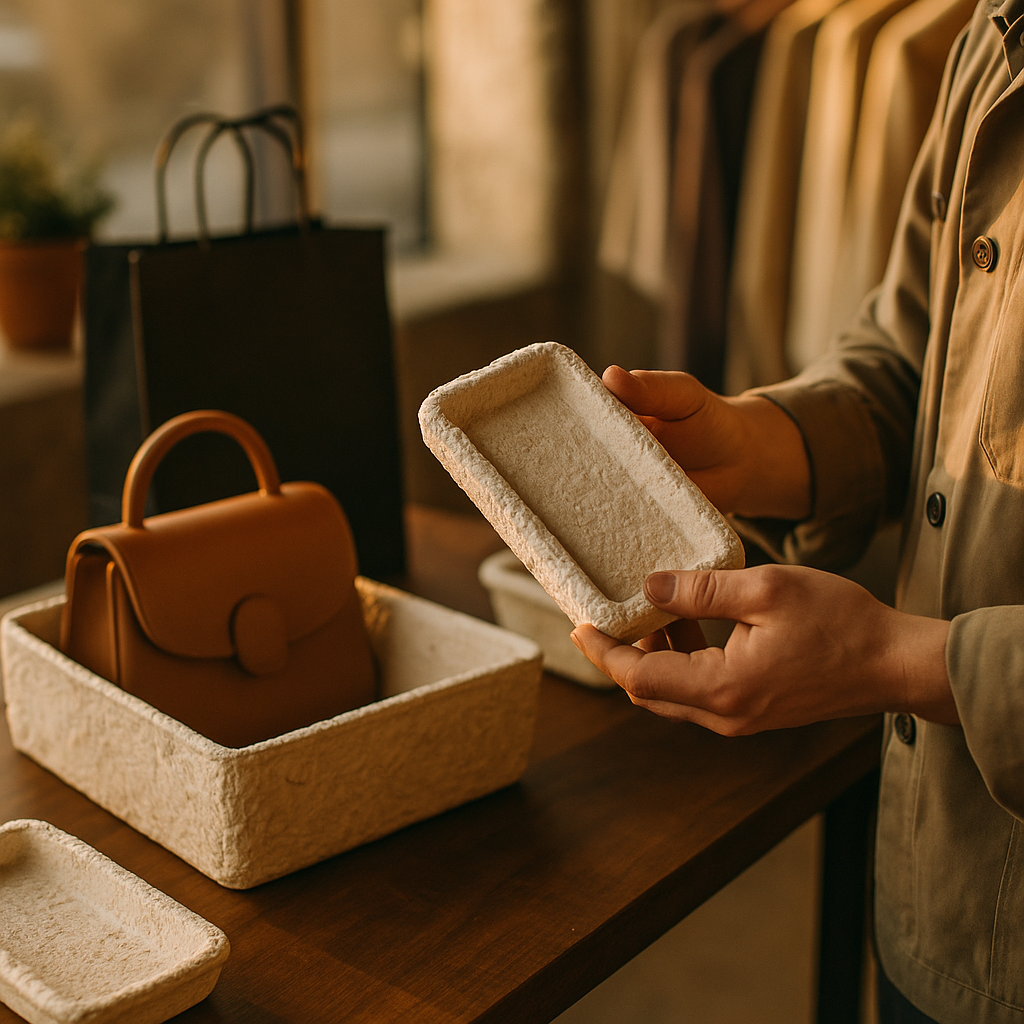
Mycelium packaging has moved from experimental material to strategic brand asset, and Ecovative stands as the clearest proof. By turning agricultural waste and mushroom roots into premium protective packaging, the company solved a problem luxury brands could no longer ignore: how to deliver exceptional unboxing without the waste, plastic, or image risk. The real story is how that shift won discerning clients.
Ecovative case study: why luxury brands paid attention
Ecovative entered the market with a proposition that sounded unconventional but addressed a very modern concern. Luxury companies needed packaging that looked refined, protected fragile goods, and aligned with rising consumer expectations around environmental responsibility. Traditional foams and molded plastics performed well in transit, but they increasingly undermined premium brand narratives.
Ecovative’s solution used mycelium, the root-like network of fungi, grown around agricultural byproducts inside custom molds. The result was a protective packaging form that could be composted and produced with a far lower environmental burden than petroleum-based alternatives. For luxury buyers, that mattered for two reasons: it reduced waste and signaled innovation.
What makes this a useful case study in 2026 is not just the material itself, but the commercial pattern behind its adoption. High-end brands tend to be conservative when packaging affects product safety and presentation. They do not switch materials because of novelty alone. They switch when a supplier can prove three things:
- Performance: the packaging protects high-value products in transit.
- Brand fit: the experience feels premium, intentional, and visually consistent.
- Credibility: the supplier can scale, document processes, and support procurement teams.
Ecovative gained traction because it addressed all three. Its mycelium packaging was not marketed as a rough, earthy compromise. It was positioned as engineered, custom-formed, and aligned with a sophisticated sustainability story. That distinction helped luxury clients see it as an upgrade, not a sacrifice.
Luxury sustainable packaging: the market problem Ecovative solved
Luxury brands face a packaging paradox. Their customers expect immaculate presentation, but they are also more likely to scrutinize wasteful choices. Oversized boxes, foam inserts, laminated finishes, and mixed-material packs may create a dramatic reveal, yet they increasingly create friction with environmentally conscious buyers.
That tension became sharper as luxury commerce expanded across direct-to-consumer channels. Products once handed over in-store now needed to survive parcel shipping. Protective packaging became more important, but so did the optics of what customers found inside the box. A premium product cushioned in hard-to-recycle foam could instantly weaken the brand message.
Ecovative solved this problem by reframing protective packaging as part of the product story. Instead of hiding the insert, brands could explain it. Instead of apologizing for shipping materials, they could highlight them as evidence of better design. That shift matters in luxury, where every touchpoint influences perceived value.
Several practical advantages made the offering attractive:
- Custom molding: inserts could be shaped to match bottles, cosmetics jars, electronics, home fragrance items, and gift sets.
- Material narrative: mycelium grown from natural feedstocks gave brands a memorable, credible sustainability talking point.
- End-of-life simplicity: compostability reduced the confusion associated with multi-material premium packs.
- Distinctive texture: the material looked intentional and artisanal when paired with the right brand design system.
For procurement teams, the appeal went beyond marketing. Switching to luxury sustainable packaging can help reduce exposure to future packaging regulations, retailer pressure, and reputational risk. For brand teams, it offered something rare: a sustainability move customers could actually see and feel.
Mycelium packaging benefits that helped Ecovative win premium accounts
Ecovative’s success with premium brands rested on a disciplined value proposition. Luxury companies do not buy “green” materials in the abstract. They buy business outcomes. The company’s mycelium packaging benefits translated directly into outcomes luxury decision-makers cared about.
1. Strong product protection
The first question from any luxury brand is simple: will this protect the item? Ecovative’s molded packaging offered shock absorption and structural support suitable for fragile and high-value goods. That made it viable for categories where breakage, leaks, or dents would be costly and brand-damaging.
2. Premium differentiation
Luxury clients compete on detail. Standard foam inserts are functional but forgettable. Mycelium packaging created a tactile, unexpected experience that stood out immediately. In a market where differentiation often depends on subtle cues, this gave brands a new sensory layer.
3. Sustainability with proof points
Claims matter less than evidence. Ecovative benefited from being associated with a material platform rooted in biofabrication and renewable inputs. For luxury brands under pressure to back sustainability claims with substance, that offered more credibility than superficial packaging tweaks.
4. Better story for PR and customer communication
Packaging rarely generates earned media unless it solves a visible problem. Mycelium packaging was inherently newsworthy because it combined science, design, and sustainability. Luxury companies could use it in campaigns, product launches, gifting programs, and retail storytelling.
5. Alignment with premium values
The best luxury brands do not merely sell products; they sell taste, discernment, and future-facing values. A packaging partner that embodied material innovation helped reinforce those values. Ecovative became attractive not only as a vendor but as a signal that the brand was ahead of the curve.
These benefits answer a likely follow-up question: why not simply use recycled paper pulp? In some categories, molded fiber works well. But Ecovative offered a more distinctive combination of cushioning performance, sculpted fit, and story value. For luxury brands, uniqueness can justify operational change.
Sustainable packaging for luxury brands: how Ecovative built trust
Winning luxury clients requires more than a compelling prototype. It requires confidence across design, supply chain, compliance, and executive leadership. Ecovative’s commercial lesson is that sustainable packaging for luxury brands must be sold through trust-building, not just material innovation.
First, the company made the unfamiliar feel engineered. Mycelium can sound experimental to buyers who are used to foam specifications and established packaging standards. Ecovative reduced perceived risk by presenting the material as a controlled manufacturing process rather than an organic novelty. That distinction is critical in high-value sectors.
Second, it focused on customization. Luxury brands rarely want a generic insert. They need packaging that fits exact dimensions, supports product geometry, and works within a larger brand presentation system. Ecovative’s mold-based growth process allowed packaging to be tailored to product lines and gifting formats, making adoption easier.
Third, the company benefited from mission consistency. Premium brands often evaluate suppliers on more than price and output. They assess whether a partner’s values and operational story support their own positioning. Ecovative’s identity as a biomaterials innovator strengthened that fit.
Fourth, it addressed the internal stakeholders behind luxury purchasing decisions:
- Packaging engineers needed confidence in protection and consistency.
- Sustainability teams needed a stronger material story and better end-of-life profile.
- Brand marketers needed visual and narrative differentiation.
- Executives needed reputational upside without operational disruption.
That multi-stakeholder approach reflects an EEAT-friendly business reality. Expertise alone is not enough. Experience with product packaging, operational authority, and transparent communication all shape purchasing decisions. Ecovative’s path suggests that successful sustainable packaging companies must educate clients as much as they sell to them.
Eco-friendly protective packaging: lessons from Ecovative’s sales strategy
If there is one reason this case study matters beyond Ecovative itself, it is that the company showed how eco-friendly protective packaging can move from niche interest to premium mainstream. The sales strategy offers several repeatable lessons.
Lead with a costly customer problem, not a moral appeal. Luxury brands lose money when products arrive damaged and lose trust when packaging feels wasteful. Ecovative addressed both. That made the pitch commercially relevant from the start.
Turn sustainability into visible value. Many packaging improvements remain invisible to the end user. Mycelium packaging did the opposite. It let brands showcase a smarter material choice at the exact moment customers were judging the product experience.
Use design to overcome material skepticism. New materials often fail because they look inferior or unfamiliar. Ecovative used shape, fit, and product-specific form to make the packaging feel deliberate. The more intentional the presentation, the less likely buyers were to see it as a compromise.
Target premium early adopters. Luxury clients are demanding, but they are also motivated by differentiation. That made them a strong fit for an innovative packaging material. Once premium brands validated the concept, Ecovative gained social proof that could support broader market adoption.
Make disposal simple. One of the biggest barriers to sustainable packaging is consumer confusion. If buyers are unsure whether something is recyclable, compostable, or landfill-bound, the sustainability benefit gets diluted. Clear end-of-life messaging helped strengthen Ecovative’s value proposition.
Another likely question is whether cost blocked adoption. In many cases, innovative materials do carry pricing pressure versus conventional foam. But luxury economics are different. When the product itself commands a premium, packaging costs are judged in the context of damage prevention, customer perception, PR value, and brand equity. Ecovative appears to have won where total value outweighed unit-cost comparison.
Brand packaging innovation: what businesses can learn in 2026
Ecovative’s story offers a wider lesson for any company considering brand packaging innovation in 2026. Sustainable materials alone do not win premium clients. What wins is the ability to connect material science to customer experience, risk reduction, and strategic positioning.
Businesses looking to replicate this success should start with a practical framework:
- Audit where current packaging creates brand friction. Look for customer complaints, excess material use, poor recyclability, and weak unboxing experiences.
- Test material performance before storytelling. Premium packaging must survive shipping, storage, humidity, and handling.
- Design for the product, not for sustainability optics alone. Fit, stability, and aesthetics remain non-negotiable.
- Equip customer-facing teams with simple claims. If sales staff and support teams cannot explain the packaging clearly, adoption loses momentum.
- Measure outcomes beyond cost. Include breakage rates, customer sentiment, social sharing, press interest, and repeat purchase signals.
There is also a strategic insight here for founders and packaging suppliers. The fastest path to credibility often comes from clients with the highest standards. By proving mycelium packaging could satisfy luxury expectations, Ecovative strengthened its authority across the broader packaging market.
For brands, the takeaway is equally direct. Customers increasingly judge packaging as part of the product itself. Materials now communicate quality, values, and innovation. Ecovative recognized that early and turned a biological material into a commercial advantage.
FAQs about mycelium packaging and Ecovative
What is mycelium packaging?
Mycelium packaging is protective packaging made by growing fungal mycelium around agricultural waste inside molds. The material forms into rigid or semi-rigid shapes suitable for cushioning products during shipping and can often be composted at end of life.
Why did luxury brands choose Ecovative?
Luxury brands chose Ecovative because it combined premium presentation, custom protective performance, and a credible sustainability story. It helped them reduce reliance on plastic foams while strengthening brand perception during the unboxing experience.
Is mycelium packaging strong enough for fragile products?
It can be, depending on the product, packaging geometry, and transit requirements. Brands typically validate performance through packaging tests before rollout. Ecovative’s appeal came partly from showing that mycelium-based inserts could protect delicate, high-value goods effectively.
How is mycelium packaging different from molded pulp?
Molded pulp is paper-based and widely used for trays and inserts. Mycelium packaging offers a different texture, cushioning profile, and innovation story. For luxury brands, that distinction can create stronger differentiation and a more memorable unboxing moment.
Is mycelium packaging more expensive than traditional foam?
It may be more expensive on a unit basis in some use cases, but luxury brands often assess total value rather than raw material cost. Reduced brand risk, stronger customer perception, and sustainability benefits can justify the investment.
Can smaller brands learn from Ecovative’s approach?
Yes. Smaller brands can apply the same principles by choosing packaging that solves a visible customer problem, fits the product precisely, and supports a clear sustainability message. The material may differ, but the strategy remains relevant.
What is the biggest lesson from this case study?
The biggest lesson is that sustainable packaging wins premium business when it performs as well as conventional options and improves the brand experience. Innovation becomes commercially powerful when customers can feel the difference immediately.
Ecovative showed that mycelium packaging could do more than replace foam. It could help luxury brands protect products, sharpen differentiation, and make sustainability visible at the moment of unboxing. The clearest takeaway for 2026 is simple: when a new material improves both performance and perception, premium clients are willing to follow. That is how packaging becomes a growth lever, not just a shipping necessity.
Top Influencer Marketing Agencies
The leading agencies shaping influencer marketing in 2026
Agencies ranked by campaign performance, client diversity, platform expertise, proven ROI, industry recognition, and client satisfaction. Assessed through verified case studies, reviews, and industry consultations.
Moburst

-
2

The Shelf
Boutique Beauty & Lifestyle Influencer AgencyA data-driven boutique agency specializing exclusively in beauty, wellness, and lifestyle influencer campaigns on Instagram and TikTok. Best for brands already focused on the beauty/personal care space that need curated, aesthetic-driven content.Clients: Pepsi, The Honest Company, Hims, Elf Cosmetics, Pure LeafVisit The Shelf → -
3

Audiencly
Niche Gaming & Esports Influencer AgencyA specialized agency focused exclusively on gaming and esports creators on YouTube, Twitch, and TikTok. Ideal if your campaign is 100% gaming-focused — from game launches to hardware and esports events.Clients: Epic Games, NordVPN, Ubisoft, Wargaming, Tencent GamesVisit Audiencly → -
4

Viral Nation
Global Influencer Marketing & Talent AgencyA dual talent management and marketing agency with proprietary brand safety tools and a global creator network spanning nano-influencers to celebrities across all major platforms.Clients: Meta, Activision Blizzard, Energizer, Aston Martin, WalmartVisit Viral Nation → -
5

The Influencer Marketing Factory
TikTok, Instagram & YouTube CampaignsA full-service agency with strong TikTok expertise, offering end-to-end campaign management from influencer discovery through performance reporting with a focus on platform-native content.Clients: Google, Snapchat, Universal Music, Bumble, YelpVisit TIMF → -
6

NeoReach
Enterprise Analytics & Influencer CampaignsAn enterprise-focused agency combining managed campaigns with a powerful self-service data platform for influencer search, audience analytics, and attribution modeling.Clients: Amazon, Airbnb, Netflix, Honda, The New York TimesVisit NeoReach → -
7

Ubiquitous
Creator-First Marketing PlatformA tech-driven platform combining self-service tools with managed campaign options, emphasizing speed and scalability for brands managing multiple influencer relationships.Clients: Lyft, Disney, Target, American Eagle, NetflixVisit Ubiquitous → -
8

Obviously
Scalable Enterprise Influencer CampaignsA tech-enabled agency built for high-volume campaigns, coordinating hundreds of creators simultaneously with end-to-end logistics, content rights management, and product seeding.Clients: Google, Ulta Beauty, Converse, AmazonVisit Obviously →