


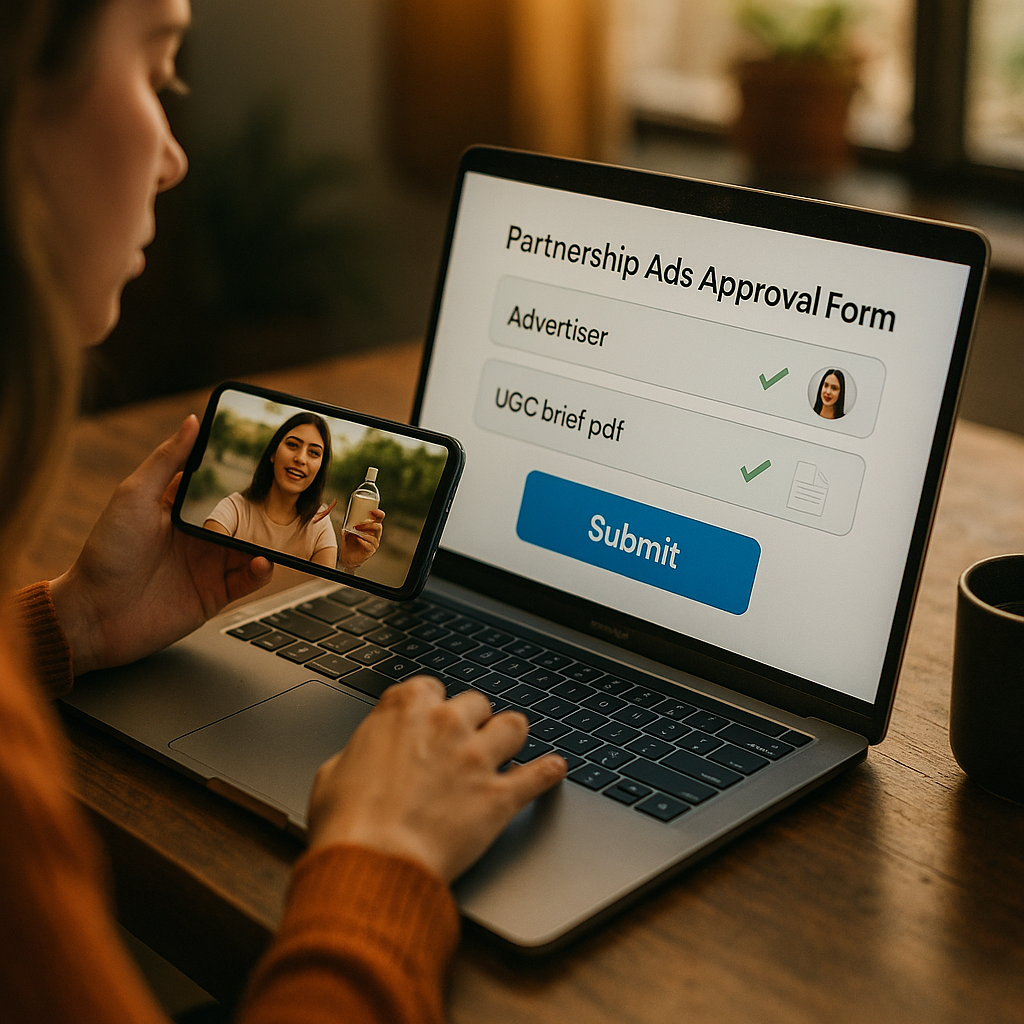
Roughly one in four branded content submissions gets bounced back on first review, and most teams never find out why. They just resubmit, tweak a caption, and hope. If you’re running short-form commerce reels through Meta Partnership Ads, guessing isn’t a strategy. It’s a budget leak. This guide breaks down how to structure UGC so it passes approval on the first pass, not the third.
Why Meta Keeps Rejecting Your UGC
Partnership Ads (the format formerly known as Branded Content Ads) let brands run creator content directly from their own ad account, with the creator’s handle still attached. It’s a smart mechanic. It preserves social proof while giving the brand full targeting and optimization control. But the approval layer sits on top of Meta’s standard ad review, plus a branded content tagging requirement, plus whatever category-specific restrictions apply to your vertical.
That’s three separate compliance checks happening at once. Most rejections come from teams treating it like a single hurdle.
The most common failure points, in order of frequency:
- Missing or improperly applied branded content tags on the creator’s original post
- No visible disclosure (no “#ad,” “Paid partnership,” or on-screen text) within the first few seconds
- Claims language that trips automated review, especially in beauty, supplements, and finance
- Rights window mismatches, where the ad flight extends beyond the usage terms in the creator agreement
- Music or third-party audio without cleared licensing
A rejected ad doesn’t just cost you a day of review time. It costs you the flight window you already negotiated with the creator and the media plan you already built around it.
None of this is exotic. It’s operational hygiene that most teams skip because the creative brief and the media buying brief are written by two different people who never compare notes.
The Partnership Ads Approval Checklist Nobody Publishes
Meta doesn’t hand you a punch list. You build one from pattern recognition after enough rejections. Here’s the condensed version, tested across multiple commerce verticals.
- Confirm business partner access before shooting. The creator needs to grant your ad account partnership permissions in Meta Business Suite before content goes live. Do this at contract signing, not the week you plan to launch.
- Bake disclosure into the video, not just the caption. Captions get truncated or hidden behind “see more.” A burned-in “Paid partnership with [Brand]” graphic in the first three seconds survives every placement.
- Match your usage rights window to your ad flight, plus buffer. If the campaign might run 45 days, negotiate 60. Renewing mid-flight is where most teams get caught.
- Run claims through legal or compliance before the creator ever presses record. “Clinically proven,” “cures,” “guaranteed results,” these words trigger manual review almost every time.
- Clear your audio. Use licensed tracks from Meta’s sound collection or original audio. Anything else invites a copyright flag that stalls the whole ad.
Teams that build this into the brief upfront see meaningfully faster approval turnaround, often same-day instead of the standard 24 to 48 hour window Meta’s ad review process typically takes.
Structuring the Creator Brief for First Pass Approval
Your brief is the control document. If it’s vague, the creator improvises, and improvisation is where compliance risk sneaks in. A tight brief for commerce reels destined for Partnership Ads should specify:
- Exact disclosure language and placement, timed to the second
- A pre-approved claims list (what they can say about the product, what they cannot)
- Aspect ratio and safe zones, since Meta’s UI elements cover roughly the bottom 15 percent and top 10 percent of a 9:16 frame
- Text overlay guidance, since visually cluttered creative tends to get flagged more often in automated review and performs worse regardless
- A note on third-party logos, packaging from other brands, or competitor mentions, all of which can trigger rejection
This is where a lot of commerce teams underinvest. They treat the creator brief as a vibe document (“keep it authentic, keep it casual”) instead of a production spec with legal guardrails built in. Both things can be true at once. Authentic doesn’t mean unstructured. For more on building briefs that protect brand voice without stripping out the trust factor, see our breakdown of founder video diaries and how legal risk gets managed without killing the format’s authenticity.
Disclosure Isn’t Optional: FTC and Meta Both Watch
Two separate authorities care about disclosure, and they don’t always agree on the exact wording, but the intent overlaps almost completely. The FTC’s endorsement guidelines require clear and conspicuous disclosure of any material connection between a creator and a brand. Meta’s branded content policy requires the tag itself, plus visible acknowledgment in the content.
Skip either one and you’re not just risking ad rejection. You’re risking a regulatory inquiry, which is a far more expensive problem than a stalled campaign.
Disclosure isn’t a compliance tax you pay reluctantly. Data from Sprout Social’s consumer trust research consistently shows that transparent sponsorship labeling doesn’t hurt engagement the way brands fear. Audiences already assume the partnership exists. Hiding it just makes you look evasive.
Practical rule: disclose early, disclose visibly, disclose in a way that survives autoplay with sound off. That means on-screen text, not just spoken acknowledgment. If you’re already building for silent consumption, this pairs naturally with the subtitle and caption discipline covered in our silent-first editing guide.
What Happens After Approval? Scaling Without Re Review
Getting one asset approved is the easy part. The real operational challenge is scaling a format across dozens of creators without triggering re-review on every single variant.
A few things help:
- Standardize the disclosure graphic as a template asset that every creator drops into their edit, rather than each person handwriting their own version. Consistency reduces both legal risk and review friction.
- Batch-submit similar creative under a documented naming convention so your media buying team can track which assets cleared review and which are pending, instead of chasing status in Slack threads.
- Build a rejection log. Every time an ad bounces, note the reason. After a few campaigns, you’ll have an internal pattern library that’s more accurate than any public documentation, because it reflects how review actually behaves for your specific vertical.
- Refresh usage rights proactively before they lapse, especially for evergreen commerce reels that outperform their original flight and get extended.
If you’re running multi-angle product demos or unboxing content through the same pipeline, the structural discipline is nearly identical. Our guide on multi-angle demo reels covers shot-list planning that also happens to reduce claims risk, since tighter shot lists mean less improvised commentary that could trip compliance review. And if your commerce strategy leans on before-and-after formats, pair this approval process with the beat structure in our transformation reel brief guide, since “results” claims are exactly where automated review gets strict.
One more thing worth tracking: category-specific ad spend growth. eMarketer’s creator economy data shows commerce-driven short-form ad spend continuing to climb, which means review queues are getting busier too. Slower turnaround during peak commerce windows (holiday, back-to-school) is now the norm, not the exception. Plan submission timing accordingly.
Frequently Asked Questions
What is Meta Partnership Ads and how is it different from boosting a creator’s post?
Partnership Ads let brands run a creator’s content directly from their own ad account with full targeting and optimization tools, while the creator’s handle remains visible on the post. Boosting simply extends reach on the original post without giving the brand advertiser-level control over budget, audience, or placement.
Why does Meta reject UGC even when the product claims are accurate?
Rejections often come from formatting issues rather than the claims themselves. Missing branded content tags, absent visual disclosure, unclear third-party audio licensing, or expired usage rights can all trigger a rejection independent of whether the product claim is true.
How long should creator usage rights last for Partnership Ads campaigns?
Build in a buffer beyond your planned flight dates. If a campaign might run six weeks, negotiate rights for eight. Renewing mid-flight risks a gap in usage rights that can pull an approved ad down mid-campaign.
Does disclosure language hurt engagement on commerce reels?
Generally, no. Research on consumer trust consistently shows audiences respond to transparency, not against it. Hiding a sponsorship tends to damage trust more than a clearly labeled paid partnership.
Can I reuse the same UGC asset across multiple ad accounts?
Only if the creator’s branded content permissions are granted to each specific ad account and the usage rights terms explicitly allow multi-account use. Check permissions per account rather than assuming approval carries over.
Next step: Audit your last five rejected Partnership Ads submissions, tag each rejection reason, and build that pattern into your next creator brief template. That single habit will cut your review turnaround time faster than any policy update Meta ships.
FAQs
What is Meta Partnership Ads and how is it different from boosting a creator’s post?
Partnership Ads let brands run a creator’s content directly from their own ad account with full targeting and optimization tools, while the creator’s handle remains visible on the post. Boosting simply extends reach on the original post without giving the brand advertiser-level control over budget, audience, or placement.
Why does Meta reject UGC even when the product claims are accurate?
Rejections often come from formatting issues rather than the claims themselves. Missing branded content tags, absent visual disclosure, unclear third-party audio licensing, or expired usage rights can all trigger a rejection independent of whether the product claim is true.
How long should creator usage rights last for Partnership Ads campaigns?
Build in a buffer beyond your planned flight dates. If a campaign might run six weeks, negotiate rights for eight. Renewing mid-flight risks a gap in usage rights that can pull an approved ad down mid-campaign.
Does disclosure language hurt engagement on commerce reels?
Generally, no. Research on consumer trust consistently shows audiences respond to transparency, not against it. Hiding a sponsorship tends to damage trust more than a clearly labeled paid partnership.
Can I reuse the same UGC asset across multiple ad accounts?
Only if the creator’s branded content permissions are granted to each specific ad account and the usage rights terms explicitly allow multi-account use. Check permissions per account rather than assuming approval carries over.
Top Influencer Marketing Agencies
The leading agencies shaping influencer marketing in 2026
Agencies ranked by campaign performance, client diversity, platform expertise, proven ROI, industry recognition, and client satisfaction. Assessed through verified case studies, reviews, and industry consultations.
Moburst

-
2

The Shelf
Boutique Beauty & Lifestyle Influencer AgencyA data-driven boutique agency specializing exclusively in beauty, wellness, and lifestyle influencer campaigns on Instagram and TikTok. Best for brands already focused on the beauty/personal care space that need curated, aesthetic-driven content.Clients: Pepsi, The Honest Company, Hims, Elf Cosmetics, Pure LeafVisit The Shelf → -
3

Audiencly
Niche Gaming & Esports Influencer AgencyA specialized agency focused exclusively on gaming and esports creators on YouTube, Twitch, and TikTok. Ideal if your campaign is 100% gaming-focused — from game launches to hardware and esports events.Clients: Epic Games, NordVPN, Ubisoft, Wargaming, Tencent GamesVisit Audiencly → -
4

Viral Nation
Global Influencer Marketing & Talent AgencyA dual talent management and marketing agency with proprietary brand safety tools and a global creator network spanning nano-influencers to celebrities across all major platforms.Clients: Meta, Activision Blizzard, Energizer, Aston Martin, WalmartVisit Viral Nation → -
5

The Influencer Marketing Factory
TikTok, Instagram & YouTube CampaignsA full-service agency with strong TikTok expertise, offering end-to-end campaign management from influencer discovery through performance reporting with a focus on platform-native content.Clients: Google, Snapchat, Universal Music, Bumble, YelpVisit TIMF → -
6

NeoReach
Enterprise Analytics & Influencer CampaignsAn enterprise-focused agency combining managed campaigns with a powerful self-service data platform for influencer search, audience analytics, and attribution modeling.Clients: Amazon, Airbnb, Netflix, Honda, The New York TimesVisit NeoReach → -
7

Ubiquitous
Creator-First Marketing PlatformA tech-driven platform combining self-service tools with managed campaign options, emphasizing speed and scalability for brands managing multiple influencer relationships.Clients: Lyft, Disney, Target, American Eagle, NetflixVisit Ubiquitous → -
8

Obviously
Scalable Enterprise Influencer CampaignsA tech-enabled agency built for high-volume campaigns, coordinating hundreds of creators simultaneously with end-to-end logistics, content rights management, and product seeding.Clients: Google, Ulta Beauty, Converse, AmazonVisit Obviously →