


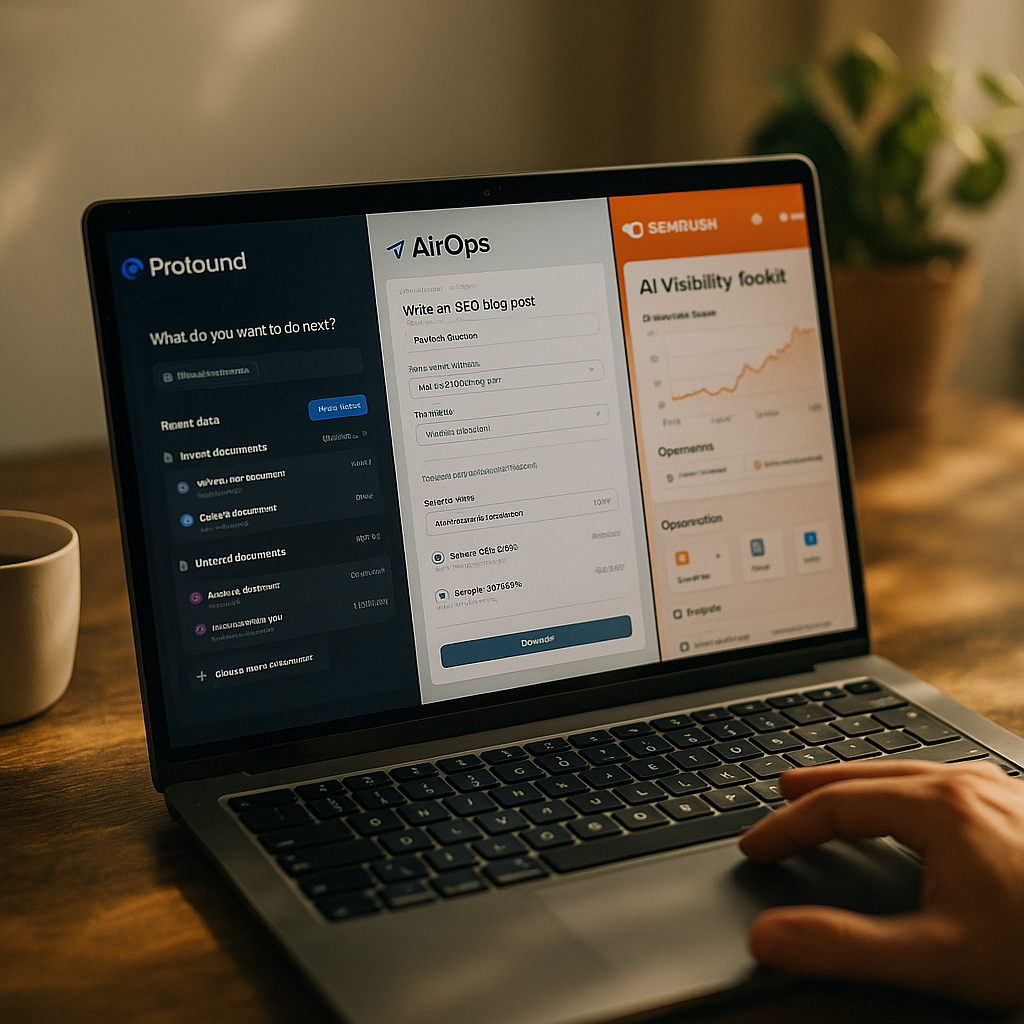
Roughly 60% of Google searches now end without a click, and a growing share of B2B research starts inside ChatGPT, Perplexity, or Gemini instead of a search bar. If your brand isn’t showing up in those answers, you’re invisible to buyers who never see a SERP at all. That’s the pitch behind generative engine optimization tooling, and three vendors — Profound, AirOps, and Semrush’s AI Visibility Toolkit — are racing to own the category.
I put all three through the same test: track brand citations, competitor mentions, and sentiment across the major LLMs for a mid-market SaaS client over a six-week period. Here’s what actually held up.
Why This Category Exists Now
Marketers spent two decades optimizing for ten blue links. Now the answer engine reads a hundred sources, synthesizes them, and hands the user a paragraph. Your brand either gets cited in that paragraph or it doesn’t exist in that moment. There’s no page two.
Profound, AirOps, and Semrush all built products to answer one deceptively simple question: when someone asks an LLM about my category, does my brand show up, and how? The mechanics differ wildly, and so does the reliability of what they report back.
Citation tracking across LLMs isn’t a solved science yet — it’s closer to rank tracking in 2004, when everyone had a slightly different definition of “position one.”
Profound: Built for Enterprise Answer-Engine Monitoring
Profound was arguably first to market with serious enterprise positioning, and it shows. The platform runs thousands of simulated prompts across ChatGPT, Perplexity, Google AI Overviews, and Gemini, then maps which domains get cited, how often, and in what context (favorable, neutral, or negative).
What impressed me most: Profound’s “Answer Engine Insights” module breaks citations down by prompt intent — commercial, informational, comparison — so you can see exactly where you’re winning and where a competitor is eating your lunch. For a brand strategist trying to justify GEO spend to a CFO, that granularity matters. You can tie citation share to specific buyer-journey stages instead of reporting a vague “visibility score.”
The tradeoff is cost and complexity. Profound is priced for enterprise budgets, and onboarding takes real effort. Smaller teams may find the reporting depth more than they need, and the learning curve isn’t trivial for a marketer used to Google Search Console.
- Best for: enterprise brands with dedicated SEO/GEO headcount and multi-market visibility needs
- Standout feature: intent-segmented citation tracking across four+ LLMs
- Watch out for: price point and implementation time
AirOps: The Content-Ops Angle
AirOps takes a different route. Instead of positioning itself purely as a monitoring dashboard, it’s built as a content operations platform with GEO tracking bolted on as a feedback loop. The idea: track citations, then use that data to automatically brief and generate content optimized to close the gap.
That’s a genuinely useful workflow if your team is already producing content at volume. AirOps lets you see which pages or topics are getting cited by AI engines, then routes underperforming topics straight into a content brief with suggested structure and entities to include. It closes the loop between insight and action faster than the other two tools.
Where AirOps falls short is depth of LLM coverage. It tracks the major players but doesn’t go as deep on prompt-intent segmentation as Profound, and its citation attribution can lag by a few days compared to real-time competitors. If your primary goal is pure measurement and executive reporting, AirOps feels more like a content engine that happens to track citations than a dedicated visibility platform.
Teams already wrestling with content-ops sprawl should read our martech stack audit framework before adding another platform — GEO tools work best when they replace a manual process, not stack on top of one.
Semrush’s AI Visibility Toolkit: The Familiar Interface Play
Semrush had the easiest on-ramp of the three, mostly because so many teams already live inside Semrush for traditional SEO. The AI Visibility Toolkit sits alongside existing position-tracking tools, so brand citation data shows up in a dashboard your team already knows how to read.
That familiarity is the whole value proposition. Semrush pulls citation and mention data across ChatGPT and AI Overviews, layers it against your existing keyword and competitor data, and shows overlap between “who ranks organically” and “who gets cited by AI.” For teams that want GEO folded into an existing workflow rather than standing up a new tool, that’s a real efficiency win.
The limitation is coverage breadth. Semrush’s LLM tracking currently lags Profound on model diversity, and the citation-context analysis (is the mention positive, neutral, negative?) is less mature. It’s a strong starting point, not yet a definitive source of truth. We covered a closely related matchup in our Semrush vs Profound vs Peec AI comparison, and the pattern holds here too: Semrush wins on integration, loses on raw depth.
Head-to-Head: What Actually Matters for Brand Teams
Strip away the marketing decks and three variables decide which tool earns budget: coverage (how many LLMs and how often you’re checked), attribution clarity (can you tell why you were or weren’t cited), and actionability (does the data turn into a task your team can execute this week).
- Coverage: Profound wins outright. AirOps and Semrush cover the big three (ChatGPT, Perplexity or AI Overviews, Gemini) but with less frequency and shallower historical data.
- Attribution clarity: Profound again, thanks to intent segmentation. Semrush is improving here by tying citations to known ranking factors. AirOps is weakest on this axis.
- Actionability: AirOps wins clean. The content-brief loop is the fastest path from “we’re not cited” to “here’s a draft to fix it.”
None of the three is a complete package yet. That’s not a knock — it’s an accurate description of a category that’s maybe eighteen months old. Compare that to the maturity curve of AI format-prediction tools and budget authority, where vendor consolidation is already well underway. GEO tracking is still in its land-grab phase.
If you can only budget for one GEO tool this year, buy based on which gap costs your team the most: measurement blindness (choose Profound), content velocity (choose AirOps), or workflow friction (choose Semrush).
The Governance Question Nobody’s Asking
Here’s the part vendors don’t put in the sales deck: none of these tools give you control over LLM outputs. You can measure citations, but you can’t force ChatGPT to cite you, and you definitely can’t stop it from citing a competitor’s outdated stat as fact. That’s a fundamentally different risk profile than SEO, where you at least control your own site.
Brands running any kind of automated content generation to chase GEO visibility should treat it the same way they’d treat any other AI agent in the stack — with clear governance, human review, and audit trails. Our governance checklist for AI agent platforms is a useful starting point if AirOps or a similar tool becomes part of your content pipeline. The same discipline that applies to no-code AI agent builders generally applies here: someone needs sign-off before AI-generated content ships, no matter how good the citation data looks.
There’s also a data-quality wrinkle worth flagging: LLM outputs are non-deterministic. Ask the same prompt twice and you can get different citations. That means every one of these tools is sampling a moving target, and month-over-month comparisons need wider error bars than a marketer used to stable SERP rankings might expect. Treat directional trends as signal; treat single-week swings as noise.
What the Data Actually Says About AI Search Growth
This isn’t a hypothetical urgency play. Industry trackers at eMarketer and Statista have both published research showing AI-assisted search sessions climbing sharply year over year, particularly among B2B researchers who use conversational tools to shortlist vendors before ever visiting a website. HubSpot’s own research arm has flagged similar shifts in buyer research behavior. If your GEO strategy is still “we’ll get to it next quarter,” that’s a real opportunity cost, not just a theoretical one.
Search-visibility monitoring generally is also becoming table stakes for regulatory reasons, not just marketing ones. Brand safety teams increasingly need documentation of what AI tools say about their company for legal and PR reasons, not just growth reasons. That’s a use case none of these three vendors fully own yet, but it’s coming.
So Which One Should You Actually Buy?
If you’re an enterprise brand with the budget and a dedicated team, Profound’s depth is hard to beat. If your bottleneck is content production rather than measurement, AirOps closes the loop faster. If you’re already deep in the Semrush ecosystem and want GEO folded into existing dashboards without a new vendor relationship, their toolkit is the path of least resistance. Most serious programs will end up running two of these in tandem within the next year, not one.
Whichever you pick, run a 30-day pilot before signing an annual contract. This category is evolving too fast to lock in blind.
Frequently Asked Questions
What is generative engine optimization, exactly?
Generative engine optimization (GEO) is the practice of improving how often and how favorably a brand appears in AI-generated answers from tools like ChatGPT, Perplexity, Gemini, and Google AI Overviews. It’s the LLM-era counterpart to traditional SEO, focused on citations and mentions rather than page rankings.
How is GEO different from traditional SEO tracking?
Traditional SEO tracks rankings for a fixed set of keywords on a stable results page. GEO tracks whether and how a brand is cited inside a synthesized AI answer, which can vary between identical queries and changes based on the model’s training data and retrieval sources.
Can Profound, AirOps, or Semrush guarantee a brand gets cited by ChatGPT?
No. None of these tools can control LLM outputs directly. They measure and report citation frequency and context, and in AirOps’s case, help generate content aimed at improving future citation odds. Actual inclusion in an AI answer depends on the model’s retrieval and training process, which no third-party vendor controls.
Is it worth running more than one GEO tool at once?
For larger teams, yes. Each tool has different coverage strengths and reporting angles, and running two in parallel (for example, Profound for measurement depth and AirOps for content-ops execution) often produces a more complete picture than relying on a single vendor.
How often should brand citation data be reviewed?
Monthly reviews are reasonable given how non-deterministic LLM outputs can be. Weekly checks are useful for high-stakes launches or reputation monitoring, but treat short-term swings as noise rather than signal.
Next step: run a 30-day side-by-side pilot on your own brand terms before committing budget. The category is moving too fast, and the coverage gaps too wide, to buy on a demo alone.
Frequently Asked Questions
What is generative engine optimization, exactly?
Generative engine optimization (GEO) is the practice of improving how often and how favorably a brand appears in AI-generated answers from tools like ChatGPT, Perplexity, Gemini, and Google AI Overviews. It’s the LLM-era counterpart to traditional SEO, focused on citations and mentions rather than page rankings.
How is GEO different from traditional SEO tracking?
Traditional SEO tracks rankings for a fixed set of keywords on a stable results page. GEO tracks whether and how a brand is cited inside a synthesized AI answer, which can vary between identical queries and changes based on the model’s training data and retrieval sources.
Can Profound, AirOps, or Semrush guarantee a brand gets cited by ChatGPT?
No. None of these tools can control LLM outputs directly. They measure and report citation frequency and context, and in AirOps’s case, help generate content aimed at improving future citation odds. Actual inclusion in an AI answer depends on the model’s retrieval and training process, which no third-party vendor controls.
Is it worth running more than one GEO tool at once?
For larger teams, yes. Each tool has different coverage strengths and reporting angles, and running two in parallel (for example, Profound for measurement depth and AirOps for content-ops execution) often produces a more complete picture than relying on a single vendor.
How often should brand citation data be reviewed?
Monthly reviews are reasonable given how non-deterministic LLM outputs can be. Weekly checks are useful for high-stakes launches or reputation monitoring, but treat short-term swings as noise rather than signal.
Top Influencer Marketing Agencies
The leading agencies shaping influencer marketing in 2026
Agencies ranked by campaign performance, client diversity, platform expertise, proven ROI, industry recognition, and client satisfaction. Assessed through verified case studies, reviews, and industry consultations.
Moburst

-
2

The Shelf
Boutique Beauty & Lifestyle Influencer AgencyA data-driven boutique agency specializing exclusively in beauty, wellness, and lifestyle influencer campaigns on Instagram and TikTok. Best for brands already focused on the beauty/personal care space that need curated, aesthetic-driven content.Clients: Pepsi, The Honest Company, Hims, Elf Cosmetics, Pure LeafVisit The Shelf → -
3

Audiencly
Niche Gaming & Esports Influencer AgencyA specialized agency focused exclusively on gaming and esports creators on YouTube, Twitch, and TikTok. Ideal if your campaign is 100% gaming-focused — from game launches to hardware and esports events.Clients: Epic Games, NordVPN, Ubisoft, Wargaming, Tencent GamesVisit Audiencly → -
4

Viral Nation
Global Influencer Marketing & Talent AgencyA dual talent management and marketing agency with proprietary brand safety tools and a global creator network spanning nano-influencers to celebrities across all major platforms.Clients: Meta, Activision Blizzard, Energizer, Aston Martin, WalmartVisit Viral Nation → -
5

The Influencer Marketing Factory
TikTok, Instagram & YouTube CampaignsA full-service agency with strong TikTok expertise, offering end-to-end campaign management from influencer discovery through performance reporting with a focus on platform-native content.Clients: Google, Snapchat, Universal Music, Bumble, YelpVisit TIMF → -
6

NeoReach
Enterprise Analytics & Influencer CampaignsAn enterprise-focused agency combining managed campaigns with a powerful self-service data platform for influencer search, audience analytics, and attribution modeling.Clients: Amazon, Airbnb, Netflix, Honda, The New York TimesVisit NeoReach → -
7

Ubiquitous
Creator-First Marketing PlatformA tech-driven platform combining self-service tools with managed campaign options, emphasizing speed and scalability for brands managing multiple influencer relationships.Clients: Lyft, Disney, Target, American Eagle, NetflixVisit Ubiquitous → -
8

Obviously
Scalable Enterprise Influencer CampaignsA tech-enabled agency built for high-volume campaigns, coordinating hundreds of creators simultaneously with end-to-end logistics, content rights management, and product seeding.Clients: Google, Ulta Beauty, Converse, AmazonVisit Obviously →