


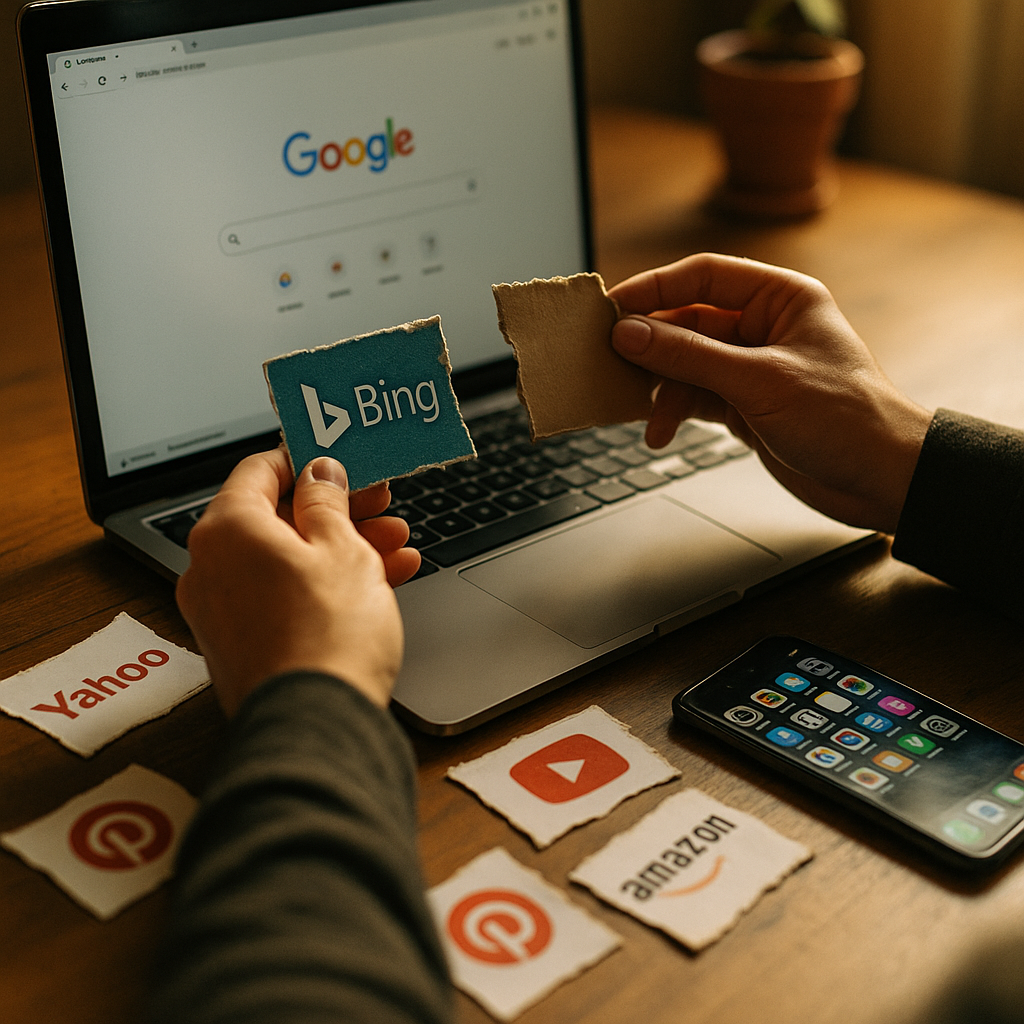
Google’s share of search referral traffic has quietly slipped in category after category, while Reddit threads rank on page one for product research and AI chatbots answer questions that used to send users to a results page. Generative search fragmentation isn’t a future risk anymore. It’s already rewriting how discovery happens, and most media mix models haven’t caught up.
If your planning still treats “search” and “social” as two clean buckets, you’re already behind. Discovery now happens across a scattered mesh of forums, short-video apps, and AI answer engines, each with its own ranking logic and none of them behaving like the Google of five years ago.
Why Discovery Broke Into Pieces
For two decades, discovery had a predictable shape: keyword, SERP, click. Brands built entire budgets around that funnel. That shape is gone.
Three forces are pulling discovery apart simultaneously. First, Reddit’s visibility deal with Google means forum threads now dominate results for anything remotely comparative — “best,” “vs,” “worth it” queries almost always surface a Reddit thread in the top three results. Second, ByteDance alternatives (Lemon8, RedNote’s US expansion, and a wave of regional short-video apps) are absorbing attention that would have gone to a single dominant platform. Third, AI answer engines — ChatGPT, Perplexity, Google’s AI Mode, Claude — are increasingly the first stop for research queries, skipping the click entirely.
The common thread: users are getting answers without visiting a webpage, and they’re trusting peer discussion over brand messaging at a rate that should worry every CMO.
None of this happened in isolation. It’s the direct byproduct of platforms racing to keep users inside their own walls while search engines race to keep users from ever leaving the results page.
Reddit’s Video Push Changes the Math
Reddit added over 100 million weekly active users in roughly two years, and its video features are no longer an afterthought — they’re a deliberate play to capture the same discovery moments TikTok and YouTube Shorts built their businesses on. What makes this different from a typical platform land-grab is Reddit’s search visibility. Threads rank organically in Google and increasingly get pulled directly into AI Overviews and chatbot answers as citations.
That’s a strange new hybrid: a community platform functioning as an SEO asset and a video platform at the same time. For brands, it means the old “should we be on Reddit” debate is over. The real question is whether your product shows up favorably when someone searches a comparison query and lands on a thread you never participated in.
This is where reputation management and influencer seeding start to overlap with technical SEO in ways most org charts don’t reflect. Marketing teams optimizing for generative engine optimization are already finding that unmanaged Reddit sentiment can outrank their own owned content.
What This Means for Budget Allocation
If a Reddit thread is going to outrank your product page for high-intent queries, ignoring the platform is a bigger risk than a mediocre organic strategy on it. Practical moves brands are testing:
- Allocating a slice of always-on influencer budget specifically to Reddit-native creators and AMA-style content, not repurposed TikTok scripts.
- Monitoring branded and category subreddits the same way teams monitor review sites, with alerts for spikes in negative sentiment.
- Testing Reddit’s native ad video formats against short-form social benchmarks rather than assuming they’ll underperform.
None of this replaces existing social spend. It sits alongside it, in a line item most media plans didn’t have twelve months ago.
The ByteDance Alternative Problem: Fragmentation, Not Replacement
TikTok’s US ownership situation has been the industry’s longest-running cliffhanger, and the resolution — a joint venture structure — hasn’t calmed the fragmentation it triggered. Brands spent real budget hedging against a ban that (mostly) didn’t happen, and that hedging money didn’t evaporate. It went to Lemon8, to Instagram Reels, to YouTube Shorts, and to a handful of regional apps gaining traction in specific demographics.
The result isn’t a single TikTok successor. It’s five or six platforms each capturing a fraction of the attention TikTok used to monopolize. That’s operationally painful: more platforms mean more content formats, more compliance checks, and more creator contracts to manage for the same total reach you used to get from one app.
Brands that treated TikTok as a monolith are now discovering their brand safety assumptions need a full reassessment under the new ownership structure, and that the IP and licensing terms buried in the Oracle-run data arrangement carry real audit obligations most legal teams haven’t scoped yet.
Add TikTok Shop’s ownership shift into the mix, and merchants are separately renegotiating commercial terms while marketers renegotiate media terms — often without talking to each other. Anyone running commerce through the platform should read up on what’s changing for merchants before locking in next quarter’s spend.
AI Answer Engines Are Eating the Click
Here’s the uncomfortable stat: multiple industry analyses now show zero-click search results — where the user gets their answer without visiting any website — exceeding 60% of searches in some categories. AI Overviews, Perplexity answers, and ChatGPT’s web-browsing responses are compressing the research phase into a single generated paragraph, often with no visible link at all.
For brands that built entire acquisition funnels on organic search traffic, this is existential. You can rank number one and still get zero visits, because the AI engine summarized your content and answered the query itself. Opting out of AI Overviews is technically possible, but it trades visibility for traffic in a way most brands can’t afford long-term.
Being cited by an AI answer engine is the new equivalent of ranking on page one — except there’s no click to prove it happened, which breaks most attribution models built in the last decade.
This is forcing a shift from SEO-as-traffic-driver to SEO-as-trust-signal. If ChatGPT is going to summarize your category anyway, the goal becomes making sure your brand is the one it cites, quotes, or recommends by name. Google’s own AI Mode spam update made clear that structured data and content clarity now matter more than keyword density ever did.
Rebuilding the Media Mix Model
Traditional media mix modeling assumes discrete, measurable channels with reasonably stable definitions. Fragmentation breaks that assumption in three specific ways.
First, attribution gets murkier. A user might see a creator video on a ByteDance alternative, read a Reddit thread the AI engine cited, get a summarized answer from Perplexity, and then convert via a branded search a week later. Which channel gets credit? Most attribution stacks still can’t answer that honestly, which is exactly why teams are rethinking measurement around identity persistence rather than channel orchestration, and separately confronting the trust gap in AI-driven attribution models.
Second, creative production scales sideways. Every new platform variant demands its own aspect ratio, pacing, and tone. A media plan that used to require one hero video and a handful of cutdowns now needs distinct content for Reddit’s community norms, TikTok-style vertical formats, and AI-answer-friendly written content that’s citable and factual. Teams leaning on multi-creator testing instead of single-bet campaigns are adapting faster, because they’re already structured for platform-by-platform iteration rather than one big launch.
Third, budget models built around a dominant platform’s CPMs stop working. When spend has to spread across six discovery surfaces instead of two, per-platform efficiency benchmarks like the $5.78 creator ROI figure need constant recalibration, not annual review. The number itself matters less than the discipline of verifying it holds up against your actual mix.
A Practical Framework for Fragmented Discovery
- Audit discovery paths quarterly, not annually. Where users start their research journey is shifting fast enough that yearly reviews miss the inflection points.
- Treat AI citation as a KPI. Track whether your brand, product specs, and reviews get surfaced in AI Overviews and chatbot answers, even without click data attached.
- Build platform-native content, not repurposed content. Reddit users can spot a repurposed TikTok script instantly, and it damages credibility more than not posting at all.
- Diversify creator contracts across discovery surfaces. Don’t lock exclusivity clauses to one ByteDance-family app when the audience is actively splitting across three or four.
- Invest in structured, factual content. AI answer engines favor clear, well-sourced pages, which overlaps heavily with good social listening practice and basic content hygiene.
Governance matters here too. As AI tools increasingly touch both content generation and media buying decisions, marketers should track how AI governance rules are converging across regions, since compliance failures in one fragmented channel can bleed reputational risk into all the others. The FTC’s disclosure guidance already applies to AI-generated and creator content alike, and enforcement attention on synthetic content is only increasing.
What Doesn’t Change
Fragmentation sounds like chaos, but the underlying consumer behavior is simple: people trust other people, and increasingly they trust machines that summarize other people. Influencer credibility, third-party validation, and clear factual content matter more, not less, in this environment. The channels multiplied. The psychology didn’t.
Brands that win here won’t be the ones chasing every new app. They’ll be the ones that built flexible content systems, treated AI visibility as seriously as SERP rank, and stopped assuming any single platform owns discovery. That flexibility is worth more than any single-platform bet, no matter how big that platform currently looks.
Frequently Asked Questions
What is generative search fragmentation?
It refers to the splintering of discovery across multiple surfaces — search engines, AI answer engines, forums like Reddit, and short-video platforms — instead of consumers relying on one dominant search or social channel. Users now start research on any of these surfaces interchangeably, which complicates attribution and media planning.
Why is Reddit becoming more important for brand visibility?
Reddit’s content ranks highly in Google search results and is frequently cited by AI Overviews and chatbots as a trusted, peer-driven source. Combined with its growing video features and user base, Reddit now functions as both a community platform and a de facto SEO and reputation asset for brands.
How should brands respond to ByteDance alternative platforms like Lemon8 or RedNote?
Rather than searching for one platform to replace TikTok, brands should expect attention to remain fragmented across several apps. That means diversifying creator partnerships, avoiding long exclusivity clauses tied to a single platform, and budgeting for higher content production volume across formats.
What does it mean for a brand to be “cited” by an AI answer engine?
It means an AI tool like ChatGPT, Perplexity, or Google’s AI Mode references or quotes your brand, product, or content directly in its generated answer, often without the user clicking through to your site. This is becoming a visibility metric of its own, separate from traditional organic traffic.
How does search fragmentation affect media mix modeling?
It breaks the assumption of clean, discrete channels. Attribution becomes harder because consumers move across forums, AI engines, and video apps before converting. Brands need to track discovery paths more frequently and rebuild measurement around identity and citation, not just click-based channel performance.
Should brands opt out of AI Overviews to protect traffic?
It depends on the category. Opting out can preserve click-through traffic but sacrifices visibility in a growing share of searches that never generate a click regardless. Most brands are better served by optimizing for citation and trust signals than by opting out entirely.
Visible FAQ (duplicate for schema accuracy)
See JSON-LD block below for structured data matching the FAQ section above.
Next step: Pull your last quarter’s discovery data and map exactly where research starts for your top three customer segments. If you can’t answer that with confidence, that’s your budget reallocation priority for next quarter, not a nice-to-have audit.
Top Influencer Marketing Agencies
The leading agencies shaping influencer marketing in 2026
Agencies ranked by campaign performance, client diversity, platform expertise, proven ROI, industry recognition, and client satisfaction. Assessed through verified case studies, reviews, and industry consultations.
Moburst

-
2

The Shelf
Boutique Beauty & Lifestyle Influencer AgencyA data-driven boutique agency specializing exclusively in beauty, wellness, and lifestyle influencer campaigns on Instagram and TikTok. Best for brands already focused on the beauty/personal care space that need curated, aesthetic-driven content.Clients: Pepsi, The Honest Company, Hims, Elf Cosmetics, Pure LeafVisit The Shelf → -
3

Audiencly
Niche Gaming & Esports Influencer AgencyA specialized agency focused exclusively on gaming and esports creators on YouTube, Twitch, and TikTok. Ideal if your campaign is 100% gaming-focused — from game launches to hardware and esports events.Clients: Epic Games, NordVPN, Ubisoft, Wargaming, Tencent GamesVisit Audiencly → -
4

Viral Nation
Global Influencer Marketing & Talent AgencyA dual talent management and marketing agency with proprietary brand safety tools and a global creator network spanning nano-influencers to celebrities across all major platforms.Clients: Meta, Activision Blizzard, Energizer, Aston Martin, WalmartVisit Viral Nation → -
5

The Influencer Marketing Factory
TikTok, Instagram & YouTube CampaignsA full-service agency with strong TikTok expertise, offering end-to-end campaign management from influencer discovery through performance reporting with a focus on platform-native content.Clients: Google, Snapchat, Universal Music, Bumble, YelpVisit TIMF → -
6

NeoReach
Enterprise Analytics & Influencer CampaignsAn enterprise-focused agency combining managed campaigns with a powerful self-service data platform for influencer search, audience analytics, and attribution modeling.Clients: Amazon, Airbnb, Netflix, Honda, The New York TimesVisit NeoReach → -
7

Ubiquitous
Creator-First Marketing PlatformA tech-driven platform combining self-service tools with managed campaign options, emphasizing speed and scalability for brands managing multiple influencer relationships.Clients: Lyft, Disney, Target, American Eagle, NetflixVisit Ubiquitous → -
8

Obviously
Scalable Enterprise Influencer CampaignsA tech-enabled agency built for high-volume campaigns, coordinating hundreds of creators simultaneously with end-to-end logistics, content rights management, and product seeding.Clients: Google, Ulta Beauty, Converse, AmazonVisit Obviously →