


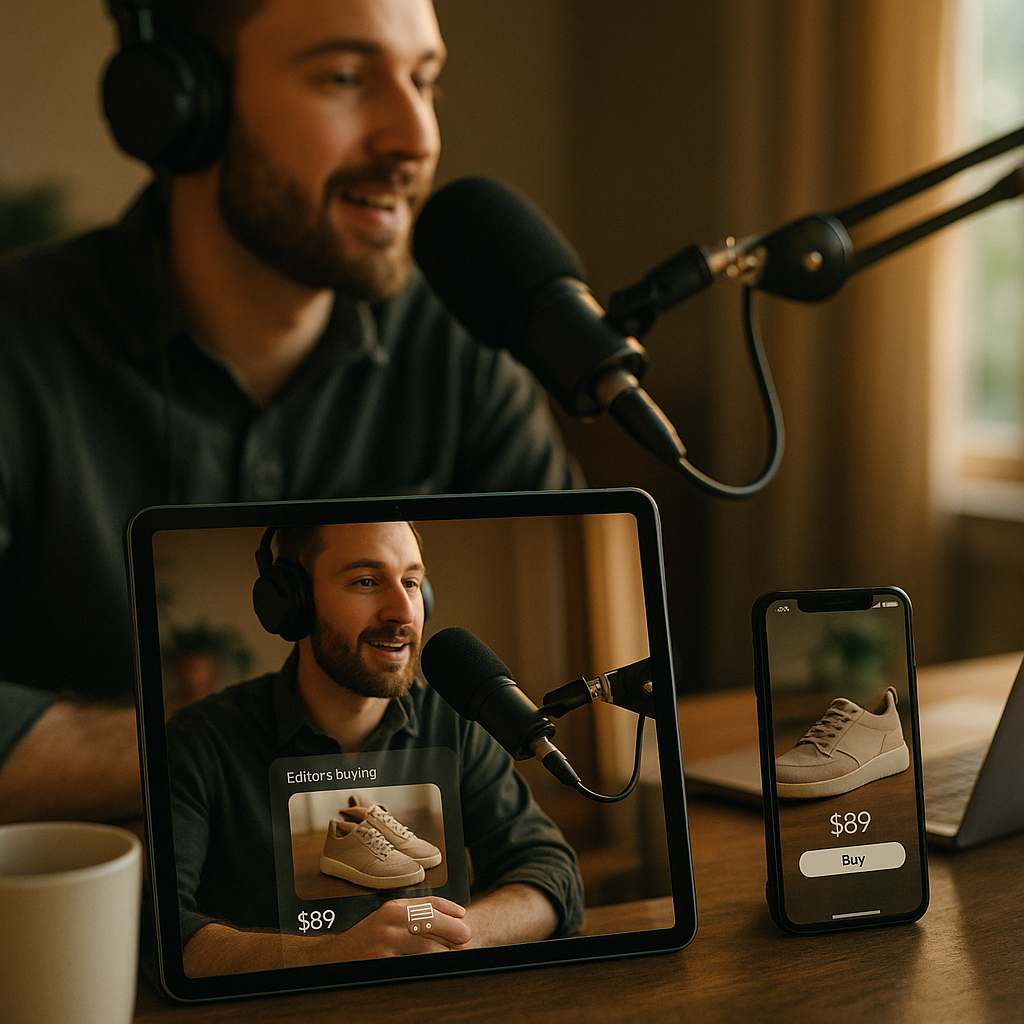
Podcast ad revenue in the U.S. is projected to top $2.5 billion this year, according to eMarketer, yet most brands still treat video podcasts as a passive sponsorship line item instead of a shoppable commerce channel. That’s leaving money on the table. A real shoppable video podcast distribution strategy turns a 45-minute conversation into dozens of purchase-ready clips spread across every platform your customers actually use.
The opportunity is obvious. The execution is where most teams fall apart.
Why Video Podcasts Are the Missing Link in Shoppable Content
Podcasts have something TikTok hauls and Instagram Reels don’t: sustained trust built over dozens of episodes. A host who’s talked skincare for 40 minutes has more credibility endorsing a serum than a 15-second unboxing ever will. That trust converts. Brands running product placements inside long-form video podcasts on YouTube are seeing completion rates and dwell time that outperform typical influencer content, because listeners opt in for the long haul rather than scrolling past in two seconds.
The catch is that podcasts weren’t built for commerce. There’s no native “buy now” button in the middle of a Spotify audio stream. That’s why the distribution layer matters so much: the strategy isn’t the podcast itself, it’s what you do with the video asset after recording ends.
A single long-form podcast episode can generate 15 to 25 shoppable micro-clips, each with its own platform-native CTA, but only if your production workflow is built for chopping, not just recording.
Start With the Episode, Not the Clips
Here’s the mistake nearly every brand makes: they record the podcast first and think about shoppable distribution after the fact. That’s backwards. If you want a video podcast to fuel commerce across TikTok Shop, YouTube Shopping, and Instagram Reels, you need to script product moments into the episode itself.
Practically, that means:
- Flagging product mentions in the pre-interview brief so hosts know when to hold up the item or gesture toward it on camera.
- Shooting with multiple camera angles (a wide two-shot plus a tight product cutaway) so editors have B-roll to work with.
- Recording in landscape and vertical simultaneously, or at minimum in a 4:5 aspect ratio that crops cleanly to 9:16 without losing the product from frame.
- Timestamping product callouts live during recording so post-production doesn’t have to scrub 50 minutes of tape hunting for the “add to cart” moment.
This is the same discipline that’s reshaped short-form strategy elsewhere. If you’ve read our breakdown on snackable video ROI, you already know the principle: plan for the cutdown before you shoot the master file.
Platform by Platform: What “Shoppable” Actually Means
Shoppable doesn’t mean the same thing on every platform, and treating it like a single checkbox is where a lot of distribution budgets get wasted.
YouTube is the natural home for the full episode, and it’s also where shoppable tagging is most mature. Product tags pinned to specific timestamps, affiliate links in the description, and Shorts pulled from the main cut all funnel back to a single, measurable video ID. Brands should also be watching how YouTube treats sponsorship disclosure inside these formats; our branded content labels playbook covers exactly where compliance requirements kick in for paid product integrations.
TikTok wants the punchy 30 to 90 second clip, not the full episode. Pull the single sharpest product moment, add a TikTok Shop tag, and let the algorithm do its job. Category managers on TikTok Shop are increasingly recruiting podcast hosts directly because their audiences convert at a higher rate than pure entertainment creators, a trend we’ve detailed in our TikTok Shop recruiting playbook.
Instagram Reels functions similarly to TikTok but rewards a slightly more polished cut and benefits from Meta’s product tagging inside Reels for brands with a connected catalog. Worth testing both platforms against each other rather than assuming identical creative performs the same; our Instagram vs YouTube Shorts comparison is a useful reference point for where paid reach diverges.
Amazon Live and Whatnot are worth a mention too, even though they’re not native podcast platforms. Some brands are repurposing podcast hosts as live shopping talent, streaming a shorter “highlights” version of the episode alongside a live product demo. The algorithmic signals driving discovery on Amazon Live are surprisingly similar to what fuels podcast recommendation engines, both reward watch time and repeat engagement over raw follower count, a dynamic explored in our Amazon Live algorithm breakdown.
What About Audio-Only Listeners?
Not everyone watches. Spotify and Apple Podcasts still carry a huge audio-only audience, and you can’t tag a product inside an MP3 file. The workaround: use dynamic ad insertion with a trackable promo code or short link read aloud by the host, and treat the audio feed as a top-of-funnel awareness layer rather than a direct shoppable surface. The video cutdowns do the heavy commerce lifting; audio builds the trust that makes those cutdowns convert.
Building the Distribution Calendar
A single episode, distributed well, should generate roughly three weeks of content. Here’s a rough cadence that’s worked for consumer brands running episodic influencer podcast partnerships:
- Day 0: Full episode goes live on YouTube with shoppable timestamps and affiliate links in the description.
- Day 1 to 3: Two to three vertical clips post across TikTok and Reels, each isolating one product moment with a platform-native shopping tag.
- Day 4 to 7: A “best moments” recap posts to YouTube Community tab or Shorts, re-surfacing the episode to subscribers who missed the initial drop. Our piece on the YouTube Community tab covers why this underused surface drives outsized retention.
- Week 2: Remaining clips roll out on a lower-frequency cadence, often paired with a small paid boost behind the top-performing organic clip.
- Week 3: A UGC-style recut, using the podcast clip as a duet or stitch template, invites other creators to riff on the product moment.
This staggered approach avoids the single-drop trap where all your commerce potential expires within 48 hours of the episode airing.
Attribution Is the Hard Part, Not the Content
Everyone gets excited about the creative. Almost nobody plans the tracking properly, and it shows up later as a brand manager unable to answer “did the podcast actually sell anything?”
Set this up before episode one records, not after episode ten airs:
- Unique UTM parameters per platform per clip, not just per episode.
- Platform-native shopping tags wherever available (YouTube Shopping, TikTok Shop, Instagram catalog tags) since these usually carry cleaner first-party attribution than external links.
- A dedicated promo code per host or per episode arc, which also doubles as a simple way to measure creator-level performance if you’re running multiple podcast partnerships simultaneously.
- A shared dashboard that pulls conversion data across platforms weekly, because waiting for a quarterly report means you can’t course-correct creative that’s underperforming.
If you can’t tell which platform, which clip, and which host drove a sale within a week of posting, your shoppable strategy is really just a content calendar with extra steps.
This attribution discipline mirrors what’s already standard in affiliate-heavy programs. The Walmart Creator affiliate model and Fetch’s micro-influencer onboarding approach both lean heavily on per-creator tracking codes precisely because platform-level attribution alone isn’t granular enough to optimize spend.
Compliance Can’t Be an Afterthought
Shoppable content is still paid endorsement, and the FTC hasn’t relaxed its disclosure expectations just because the format is a podcast clip instead of a static post. Every shoppable cutdown needs a clear, platform-appropriate disclosure, whether that’s a spoken “this episode is sponsored by” at the top of the audio or a visible #ad tag on the video overlay. Review the FTC’s endorsement guidance before launching a multi-platform push, since enforcement has increasingly focused on video and short-form content rather than traditional blog posts.
Platform-specific labeling matters too. YouTube’s branded content tools require disclosure to be toggled correctly at upload, and getting this wrong can trigger demonetization or reduced distribution, not just a compliance headache. It’s worth reviewing your process against our branded content compliance playbook before scaling clip output across a full podcast season.
Measuring What Actually Matters
Vanity metrics (views, likes) tell you almost nothing about commerce performance. Track these instead:
- Click-through rate on product tags, segmented by platform and by clip type (product demo versus casual mention).
- Conversion rate per platform, since TikTok Shop and YouTube Shopping audiences behave differently even watching the same source content.
- Watch-through rate on the full episode versus the clips, which tells you whether your audience prefers the long-form trust-build or the quick-hit format.
- Repeat purchase rate from podcast-driven customers, a signal that’s often stronger than first-purchase conversion because podcast audiences skew loyal.
Engagement density, not raw follower count, is increasingly the better predictor of which clips will actually convert. Our piece on engagement density lays out why algorithms now weight this signal so heavily, and it applies just as directly to podcast clip performance as it does to standalone influencer posts.
Next step: audit your last three podcast episodes, count how many shoppable clips you actually extracted from each, and if the number is under ten, you’re leaving distribution value on the editing room floor.
FAQs
What platforms work best for shoppable video podcast clips?
YouTube handles the full episode and long-tail search discovery, while TikTok and Instagram Reels drive the fastest commerce conversions from short cutdowns. Amazon Live and Whatnot are viable secondary channels if you pair clips with live product demos.
How many shoppable clips can one podcast episode realistically produce?
A well-planned 45 to 60 minute episode typically yields 15 to 25 usable clips, provided the recording process flags product moments in advance rather than leaving editors to hunt through raw footage.
Do audio-only podcast listeners count toward shoppable strategy?
Not directly, since audio platforms lack native shopping tags. Treat audio as a trust-building, top-of-funnel layer and rely on dynamic ad insertion with trackable promo codes rather than expecting direct attribution.
What’s the biggest compliance risk in shoppable podcast content?
Missing or improperly toggled sponsorship disclosure on individual clips, especially when a single episode gets cut into dozens of pieces across platforms with different labeling requirements.
How should brands track attribution across platforms?
Use unique UTM parameters per clip, platform-native shopping tags where available, and per-host or per-episode promo codes, then consolidate everything into a weekly dashboard rather than waiting for quarterly reporting.
Top Influencer Marketing Agencies
The leading agencies shaping influencer marketing in 2026
Agencies ranked by campaign performance, client diversity, platform expertise, proven ROI, industry recognition, and client satisfaction. Assessed through verified case studies, reviews, and industry consultations.
Moburst

-
2

The Shelf
Boutique Beauty & Lifestyle Influencer AgencyA data-driven boutique agency specializing exclusively in beauty, wellness, and lifestyle influencer campaigns on Instagram and TikTok. Best for brands already focused on the beauty/personal care space that need curated, aesthetic-driven content.Clients: Pepsi, The Honest Company, Hims, Elf Cosmetics, Pure LeafVisit The Shelf → -
3

Audiencly
Niche Gaming & Esports Influencer AgencyA specialized agency focused exclusively on gaming and esports creators on YouTube, Twitch, and TikTok. Ideal if your campaign is 100% gaming-focused — from game launches to hardware and esports events.Clients: Epic Games, NordVPN, Ubisoft, Wargaming, Tencent GamesVisit Audiencly → -
4

Viral Nation
Global Influencer Marketing & Talent AgencyA dual talent management and marketing agency with proprietary brand safety tools and a global creator network spanning nano-influencers to celebrities across all major platforms.Clients: Meta, Activision Blizzard, Energizer, Aston Martin, WalmartVisit Viral Nation → -
5

The Influencer Marketing Factory
TikTok, Instagram & YouTube CampaignsA full-service agency with strong TikTok expertise, offering end-to-end campaign management from influencer discovery through performance reporting with a focus on platform-native content.Clients: Google, Snapchat, Universal Music, Bumble, YelpVisit TIMF → -
6

NeoReach
Enterprise Analytics & Influencer CampaignsAn enterprise-focused agency combining managed campaigns with a powerful self-service data platform for influencer search, audience analytics, and attribution modeling.Clients: Amazon, Airbnb, Netflix, Honda, The New York TimesVisit NeoReach → -
7

Ubiquitous
Creator-First Marketing PlatformA tech-driven platform combining self-service tools with managed campaign options, emphasizing speed and scalability for brands managing multiple influencer relationships.Clients: Lyft, Disney, Target, American Eagle, NetflixVisit Ubiquitous → -
8

Obviously
Scalable Enterprise Influencer CampaignsA tech-enabled agency built for high-volume campaigns, coordinating hundreds of creators simultaneously with end-to-end logistics, content rights management, and product seeding.Clients: Google, Ulta Beauty, Converse, AmazonVisit Obviously →