


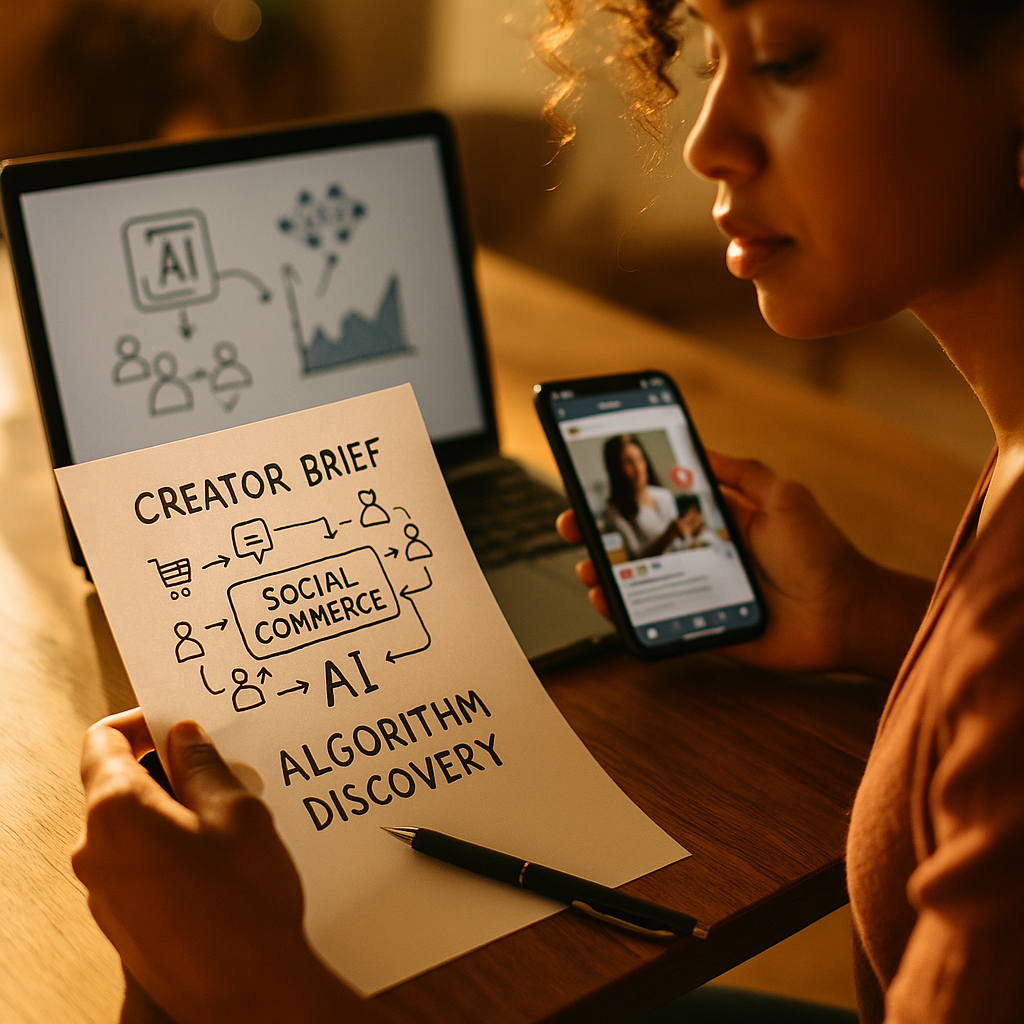
One Brief. Two Discovery Engines. Zero Compromises.
Seventy-two percent of Gen Z and millennial shoppers now discover products through short-form video before any other channel. But here’s the strategic gap most brands are missing: the same video that earns TikTok FYP placement is now being parsed by ChatGPT Shopping, Perplexity, and Google’s AI Overviews to answer buyer queries. The social commerce creator brief that ignores this dual-discovery reality is leaving measurable revenue on the table.
Why Your Current Brief Is Already Obsolete
Most creator briefs were engineered for a single objective: beat the platform algorithm. Hook in three seconds, native audio on, trending sound, clear CTA. That logic still holds. But it’s now table stakes, not a competitive advantage.
Generative engines have become active shopping advisors. When a buyer asks Perplexity “what’s the best moisturizer under $40 for combination skin,” the AI doesn’t just return a list of links. It synthesizes product information from structured data, review signals, and increasingly, from video content it can parse. Brands whose creators speak in clear, entity-rich language are getting cited. Everyone else is invisible.
The operational challenge is that most teams are running two separate workflows: one for social content, one for SEO and GEO (Generative Engine Optimization). That’s redundant, slow, and expensive. A unified brief solves this at the source.
A creator brief that doubles as a GEO content signal doesn’t require two productions. It requires smarter pre-production instructions that serve both audiences simultaneously.
The Architecture of a Dual-Discovery Brief
Think of the brief in three layers: the Hook Layer (human attention), the Signal Layer (algorithmic distribution), and the Entity Layer (AI parsing). Most brands nail the first. Few address the third. None of them integrate all three into a single document the creator can actually execute on set.
Hook Layer. This is unchanged. Your creator needs a pattern interrupt in the first two seconds, a specific problem statement by second five, and a visual or verbal payoff that earns a second watch. Refer to proven hook structures for Reels briefs to populate this section with tested openers. The hook exists purely for human retention. Don’t contaminate it with keyword stuffing.
Signal Layer. Platform algorithms reward watch time, saves, shares, and on-platform shopping behavior. Your brief must specify: minimum video duration (47-60 seconds for TikTok Shop content outperforms 15-second clips by 2.3x on conversion, per TikTok for Business data), on-screen text placement that avoids UI overlay zones, native caption strategy, and product tag timing. If you’re running simultaneous formats, reference your vertical video specs to keep production efficient.
Entity Layer. This is where most briefs fall short. Generative engines identify products, brands, ingredients, use cases, and sentiment through natural language processing of video transcripts, auto-captions, and linked metadata. Your brief must instruct creators to verbally state: the full product name (not just “this”), the primary use case in plain language (“for oily skin” not “for people like me”), specific quantifiable claims (“visibly reduced redness in 48 hours”), and category context (“drugstore skincare under $30”).
These verbal cues become the raw material AI systems use to generate shopping recommendations. A creator who says “I’ve been using the CeraVe Hydrating Facial Cleanser every morning for two weeks and my dry patches are gone” is giving a generative engine everything it needs to surface that product when a user asks for gentle cleansers for dry skin.
The Template: Section by Section
Below is a working structure you can adapt for any social commerce campaign. This isn’t a creative constraints document. It’s a dual-purpose content production spec.
Section 1: Campaign Context (Internal Use Only)
Product name (exact, as it appears in structured data), SKU or product URL, primary product category, price point, platform priority order, and target audience segment. This section never reaches the creator verbatim but informs every decision that follows.
Section 2: The Hook Brief
Provide three pre-approved hook options. Each should be a specific, testable opening line. “POV: You’ve tried 7 eye creams” beats “Let me show you my skincare routine.” Include the problem statement the creator should land within the first five seconds. For interactive formats, see how to brief creators for interactive video ads that extend dwell time.
Section 3: Verbal Entity Requirements (Non-Negotiable)
List the specific phrases the creator must say on camera, verbatim or close paraphrase. Include: full product name, primary benefit claim, secondary use case, price or value signal, and brand name. This section is explicitly labeled for the creator as “words that must appear in your script.” No creative wiggle room here.
Section 4: Visual Specification
Lighting requirements, product visibility windows, on-screen text rules, aspect ratio, safe zones. Cross-reference your shoot-once repurposing strategy so one production serves TikTok, Reels, and Shorts without re-shooting.
Section 5: CTA and Commerce Trigger
Specify the exact CTA, timing (ideally at 35-45 seconds for longer formats), product tag placement, and link-in-bio instruction. For TikTok Shop, include the affiliate disclosure language per FTC guidelines. The CTA must work for a human viewer watching live and for an AI system parsing the transcript for a “how to buy” signal.
Section 6: Caption and Metadata Brief
This is non-negotiable for GEO performance. Provide a caption template that front-loads the product name and primary benefit in the first line, uses natural question phrasing (“Looking for a gentle cleanser that actually works?”), and includes three to five category-relevant hashtags. Captions are indexed. Treat them like meta descriptions. For broader AI search optimization, the brief templates for AI search offer additional caption frameworks worth adapting here.
Section 7: Performance Thresholds
Define what success looks like before the creator publishes. Set minimum watch-through rate targets (platform benchmarks vary: Sprout Social and HubSpot both publish current engagement benchmarks by vertical), click-through rate expectations for shoppable links, and GEO citation tracking method (most teams currently use Semrush’s AI Overview tracking or manual prompt testing).
What Makes This Actually Work in Production
The brief only succeeds if creators understand why Section 3 exists. Most creators push back on rigid verbal requirements because they feel unnatural. The fix: explain that their words become the data source for AI shopping recommendations. Frame it as expanding their reach, not constraining their creativity. When creators understand that saying “Dyson Airwrap, under $600, for thick curly hair” makes them more likely to be featured in a Perplexity shopping answer, compliance becomes collaborative.
Operationally, run the verbal entity requirements through an AI transcript check before approving the final video. Paste the auto-generated caption into ChatGPT or Gemini and ask: “If someone asked you for [product category] recommendations, would this video’s transcript give you enough information to recommend this product?” If the answer is no, send it back for a pickup line.
Treating the auto-caption as a GEO asset, not an accessibility afterthought, is the single highest-leverage change most social commerce teams can make right now.
For teams running volume, this brief integrates cleanly with performance-linked brief frameworks that tie creator deliverables to distribution outcomes. Pair it with AI video testing workflows to identify which hooks and entity phrasings drive the strongest combined algorithm and AI citation performance.
The Measurement Gap You Need to Close
Standard social commerce reporting tracks impressions, click-through, and ROAS. None of those metrics tell you if a video influenced a generative engine recommendation. Add two tracking layers: prompt-based citation audits (manually test 10-15 buyer queries monthly in ChatGPT, Gemini, and Perplexity to see if your products surface) and transcript quality scoring using a checklist tied to your Section 3 entity requirements. Both are manual today. Both will be automatable within 12 months. Build the habit now before every competitor is doing it.
Also worth monitoring: Google’s AI Overviews are increasingly featuring product-specific video content in shopping contexts. The structured data attached to your creator’s published video, including product schema, review aggregation, and merchant feed alignment, determines eligibility. That’s a conversation between your SEO and influencer teams that most organizations still aren’t having.
Start by running one campaign with this unified brief against your existing brief format. The delta in GEO citation rate will make the case for every future brief you write.
Frequently Asked Questions
What is a social commerce creator brief for dual discovery?
It’s a structured content production document that instructs creators to produce short-form video optimized for two simultaneous goals: earning algorithmic distribution on social platforms like TikTok and Instagram, and appearing in generative AI shopping answers from tools like ChatGPT, Perplexity, and Google’s AI Overviews. It includes verbal entity requirements, caption frameworks, and performance benchmarks that serve both human viewers and AI parsing systems.
How do generative AI engines use creator video content to make shopping recommendations?
Generative engines index video transcripts, auto-captions, and linked metadata. When a creator clearly states a full product name, use case, benefit claim, and price context on camera, that natural language becomes a data signal the AI uses when generating shopping recommendations for user queries. Videos with vague language (“this stuff,” “my favorite product”) provide insufficient entity signals and are less likely to be cited.
Do I need to produce separate videos for social algorithms and AI search?
No. A well-constructed unified brief produces one video that serves both purposes. The hook and visual storytelling serve human attention and platform algorithms. The verbal entity requirements and caption structure serve AI parsers. These objectives are compatible, not conflicting, when the brief is designed correctly from the start.
What specific verbal elements must creators include for GEO performance?
Creators should verbally state the full product name (not a pronoun substitute), the primary use case in plain descriptive language, a specific and verifiable benefit claim, a price or value signal, and the brand name. These elements should appear naturally in the script within the first 30-40 seconds of the video to ensure they’re captured in platform auto-captions that AI systems index.
How do I measure whether a creator video appeared in a generative AI shopping answer?
The most reliable current method is manual prompt auditing: regularly test 10-15 buyer queries relevant to your product category in ChatGPT, Perplexity, and Gemini and note which products or brands are cited. Supplement this with Semrush’s AI Overview tracking for Google. Structured GEO measurement tools are still maturing, but building the manual audit habit now gives you baseline data before automation tools scale.
How does FTC compliance work for shoppable creator content that also targets AI search?
FTC disclosure requirements apply regardless of discovery channel. Creators must include clear affiliate or sponsorship disclosures in the video itself and in the caption. For GEO purposes, disclosures should be factual and positioned naturally in the caption rather than buried in hashtags, as AI systems do read caption text and clear disclosure language does not appear to suppress AI citation eligibility based on current testing.
Top Influencer Marketing Agencies
The leading agencies shaping influencer marketing in 2026
Agencies ranked by campaign performance, client diversity, platform expertise, proven ROI, industry recognition, and client satisfaction. Assessed through verified case studies, reviews, and industry consultations.
Moburst

-
2

The Shelf
Boutique Beauty & Lifestyle Influencer AgencyA data-driven boutique agency specializing exclusively in beauty, wellness, and lifestyle influencer campaigns on Instagram and TikTok. Best for brands already focused on the beauty/personal care space that need curated, aesthetic-driven content.Clients: Pepsi, The Honest Company, Hims, Elf Cosmetics, Pure LeafVisit The Shelf → -
3

Audiencly
Niche Gaming & Esports Influencer AgencyA specialized agency focused exclusively on gaming and esports creators on YouTube, Twitch, and TikTok. Ideal if your campaign is 100% gaming-focused — from game launches to hardware and esports events.Clients: Epic Games, NordVPN, Ubisoft, Wargaming, Tencent GamesVisit Audiencly → -
4

Viral Nation
Global Influencer Marketing & Talent AgencyA dual talent management and marketing agency with proprietary brand safety tools and a global creator network spanning nano-influencers to celebrities across all major platforms.Clients: Meta, Activision Blizzard, Energizer, Aston Martin, WalmartVisit Viral Nation → -
5

The Influencer Marketing Factory
TikTok, Instagram & YouTube CampaignsA full-service agency with strong TikTok expertise, offering end-to-end campaign management from influencer discovery through performance reporting with a focus on platform-native content.Clients: Google, Snapchat, Universal Music, Bumble, YelpVisit TIMF → -
6

NeoReach
Enterprise Analytics & Influencer CampaignsAn enterprise-focused agency combining managed campaigns with a powerful self-service data platform for influencer search, audience analytics, and attribution modeling.Clients: Amazon, Airbnb, Netflix, Honda, The New York TimesVisit NeoReach → -
7

Ubiquitous
Creator-First Marketing PlatformA tech-driven platform combining self-service tools with managed campaign options, emphasizing speed and scalability for brands managing multiple influencer relationships.Clients: Lyft, Disney, Target, American Eagle, NetflixVisit Ubiquitous → -
8

Obviously
Scalable Enterprise Influencer CampaignsA tech-enabled agency built for high-volume campaigns, coordinating hundreds of creators simultaneously with end-to-end logistics, content rights management, and product seeding.Clients: Google, Ulta Beauty, Converse, AmazonVisit Obviously →